Why Older Dogs Can Seem Confused at Night

Nighttime pacing, staring, vocalizing, or getting lost at home can be associated with cognitive decline—but pain, vision loss, and other medical problems may look similar.
An older dog who navigates the house normally during the day may begin pacing, staring into corners, or appearing lost after dark. Nighttime confusion is not simply “normal aging.” It can reflect cognitive decline, but it can also signal pain, sensory loss, or another medical problem that deserves attention.
The night itself may not be causing the behavior. Fewer visual cues, a quiet household, and changes in the dog’s sleep-wake cycle can make an underlying problem much more noticeable.
Cognitive decline can disrupt a dog’s internal clock
Canine cognitive dysfunction syndrome, sometimes called canine dementia, is an age-related neurodegenerative condition. It affects how some senior dogs process information, remember familiar routines, and respond to their surroundings.
Changes in sleep are among the signs families may notice first. A dog may sleep for much of the day, then wander, whine, bark, or repeatedly wake family members during the night.
Other possible signs include:
- Getting stuck behind furniture or in corners
- Staring at walls or into space
- Failing to recognize familiar people or pets
- Becoming unusually clingy, withdrawn, or anxious
- Forgetting previously learned commands
- Having indoor accidents after years of reliable house training
- Pacing without an obvious destination
Veterinarians commonly organize these behavioral changes under the acronym DISHAA: disorientation, altered interactions, sleep-wake changes, house-soiling, altered activity, and anxiety.
A dog does not need to show every sign. Cognitive dysfunction may begin with one subtle change and develop gradually.
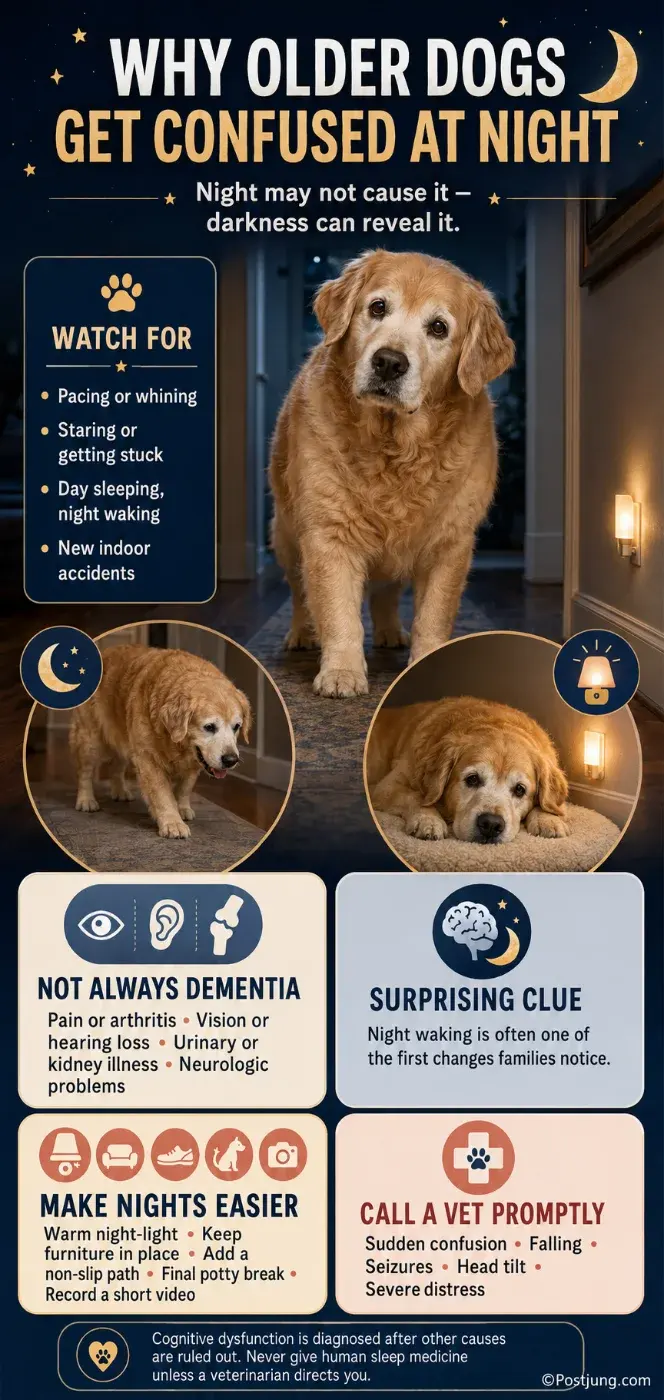
Darkness may expose problems that daytime hides
A familiar room provides many navigational cues during daylight. After dark, an older dog with declining vision may struggle to identify doorways, furniture, stairs, or the path to a water bowl.
Hearing loss can add to the uncertainty. A dog that no longer hears a person approaching may startle easily, while one that relies increasingly on vision may become less confident when the lights go out.
This is why apparent confusion may partly be sensory confusion, rather than memory loss alone. Some dogs experience both sensory decline and cognitive changes, making the distinction difficult without an examination.
A disrupted daily rhythm may contribute as well. If a senior dog sleeps for long stretches during the day because of reduced activity, the dog may be awake and restless when the household is trying to sleep.
The behavior is sometimes informally compared with “sundowning” in people. That comparison may help describe a pattern that worsens later in the day, but it is not a diagnosis. Canine cognitive dysfunction is a veterinary condition that must be evaluated on its own terms.
Dementia is not the only possible explanation
Behavioral changes in an older dog should not automatically be blamed on aging. Arthritis or other chronic pain may make it difficult to settle comfortably. A dog may repeatedly stand up, circle, pant, or change sleeping positions because lying down hurts.
Increased nighttime bathroom trips could be connected to urinary, kidney, hormonal, or other systemic problems. Seizure disorders, neurological disease, medication effects, and changes in vision or hearing can also produce behavior that resembles cognitive decline.
For that reason, canine cognitive dysfunction is usually a diagnosis of exclusion. A veterinarian may recommend a physical and neurological examination, bloodwork, and urine testing. Additional testing may be considered when the dog’s history or examination suggests another condition.
The timing matters. Slowly progressive changes over weeks or months may fit an age-related disorder. Sudden disorientation, especially when accompanied by weakness, falling, a head tilt, seizures, severe distress, or an inability to stand, warrants prompt veterinary attention.
Small changes can make nights safer
Owners can reduce confusion without waiting for a final diagnosis. A dim night-light may help a dog with limited vision find familiar landmarks. Keep beds, water bowls, and furniture in consistent locations, and block access to stairs or other hazards.
Non-slip rugs can help dogs with arthritis or weakness move more confidently. A predictable evening routine—including a bathroom break shortly before bed—may also reduce nighttime disruption.
Appropriate daytime activity can support a more regular sleep pattern. The amount and type should match the dog’s mobility and health rather than forcing strenuous exercise.
When the dog wakes, use a calm voice and gentle guidance. Punishment can increase fear and anxiety, particularly if the dog no longer understands what is expected.
Recording short videos and keeping a daily log can be valuable. Note when the behavior begins, how long it lasts, whether the dog responds to their name, and whether there have been changes in appetite, thirst, movement, bathroom habits, or social behavior.
Earlier evaluation can preserve quality of life
There is no single home test that can determine why a senior dog seems confused. Treatment depends on the cause and may involve pain management, environmental adjustments, dietary strategies, behavioral support, or prescription medication selected by a veterinarian.
Evidence for many supplements marketed for canine brain health remains limited, and products can interact with medications. Discuss supplements and sleep aids with a veterinarian first, including products labeled as natural.
Nighttime wandering can be exhausting for both dogs and their families, but it is also useful information. It may be the first visible clue that an older dog needs more support.
The most helpful response is not to dismiss the behavior as old age. Make the environment safe, document what is happening, and arrange a veterinary assessment. Even when cognitive decline is involved, identifying pain, anxiety, sensory loss, or another treatable condition can make the dog’s remaining years more comfortable.
Cornell University College of Veterinary Medicine, American Animal Hospital Association, Merck Veterinary Manual
REFERENCES:
https://www.vet.cornell.edu/departments-centers-and-institutes/riney-canine-health-center/canine-health-topics/cognitive-dysfunction-syndrome
https://www.vet.cornell.edu/departments-centers-and-institutes/riney-canine-health-center/canine-health-topics/senior-dog-dementia
https://www.aaha.org/resources/2023-aaha-senior-care-guidelines-for-dogs-and-cats/managing-cognitive-dysfunction-and-behavioral-anxiety/
https://www.merckvetmanual.com/behavior/behavior-of-dogs/behavior-problems-of-dogs

เขียนโดย Postjung Insights
 รู้หรือไม่? เปิดรายได้พนักงานส่งพัสดุของแต่ละแอป วันหนึ่งได้เท่าไร
 โรงเรียนที่มีนักเรียนมากที่สุดในไทย
 หนุ่มขับ Porsche ใจหล่อสุดๆ ติดประกาศเด็กหายไว้รอบคัน..หวังช่วยเผยแพร่ข้อมูลให้ตามหาได้เร็วขึ้น
 แปลปกสลาก งวด 1 ต.ค. 69 ส่องตัวเลขจากภาพปกสลากกินแบ่งรัฐบาล
 'สควีชชี่'ของเล่นที่กำลังเป็นไวรัลอาจถูกเจ้าหน้าที่ของสนามบินยึดได้ ตรวจสอบให้ดีก่อนนำขึ้นเครื่อง
 เปิดรายชื่อ 5 โรงเรียนเป้าหมาย เด็กสอบเข้าต้องเตรียมตัวให้พร้อม
 อำเภอที่มีชื่ออำเภอสั้นที่สุด 3 อำเภอเท่านั้นในประเทศไทย
 โรสแมรี่ แฮร์ริส ‘ป้าเมย์’ แห่ง Spider-Man ฉบับโทบีย์ แม็คไกวร์ อายุครบ 99 ปี
 ซาบีดา” เรียกถกด่วน ปมภาพ “ชุดไทย” ถูกนำไปอ้างเป็นชุดกัมพูชา
 ตาราง “เด่นเหนือเด่นใต้” งวด 1 ต.ค. 69 เปิดข้อมูลตามโพย เลขไหนอยู่ตรงไหน
 เรียก “ป๋อง สุพรรณ” เซียนพระดัง แจงปมมูลนิธิฯ วัดพุทไธศวรรย์
 สถิติย้อนหลัง 10 ปี ออกเลขไหนบ้างมาดูกันซาบีดา” เรียกถกด่วน ปมภาพ “ชุดไทย” ถูกนำไปอ้างเป็นชุดกัมพูชาเปิดรายชื่อ 5 โรงเรียนเป้าหมาย เด็กสอบเข้าต้องเตรียมตัวให้พร้อมหนุ่มขับ Porsche ใจหล่อสุดๆ ติดประกาศเด็กหายไว้รอบคัน..หวังช่วยเผยแพร่ข้อมูลให้ตามหาได้เร็วขึ้น
 วาบิ-ซาบิ (Wabi-Sabi) ปรัชญาญี่ปุ่นที่สอนให้เราโอบกอดความไม่สมบูรณ์แบบ
 English Edition