Why Automatic Pet Feeders Can Fail When Pets Need Them Most

Power outages and empty hoppers are only part of the risk. Food jams, frightened pets, incorrect portions, and competition between animals can turn a working feeder into a missed meal.
Automatic pet feeders solve a real problem: they serve measured meals when an owner is sleeping, working late, or temporarily away. But convenience can create false confidence, especially when the machine becomes the only thing standing between a pet and its next meal.
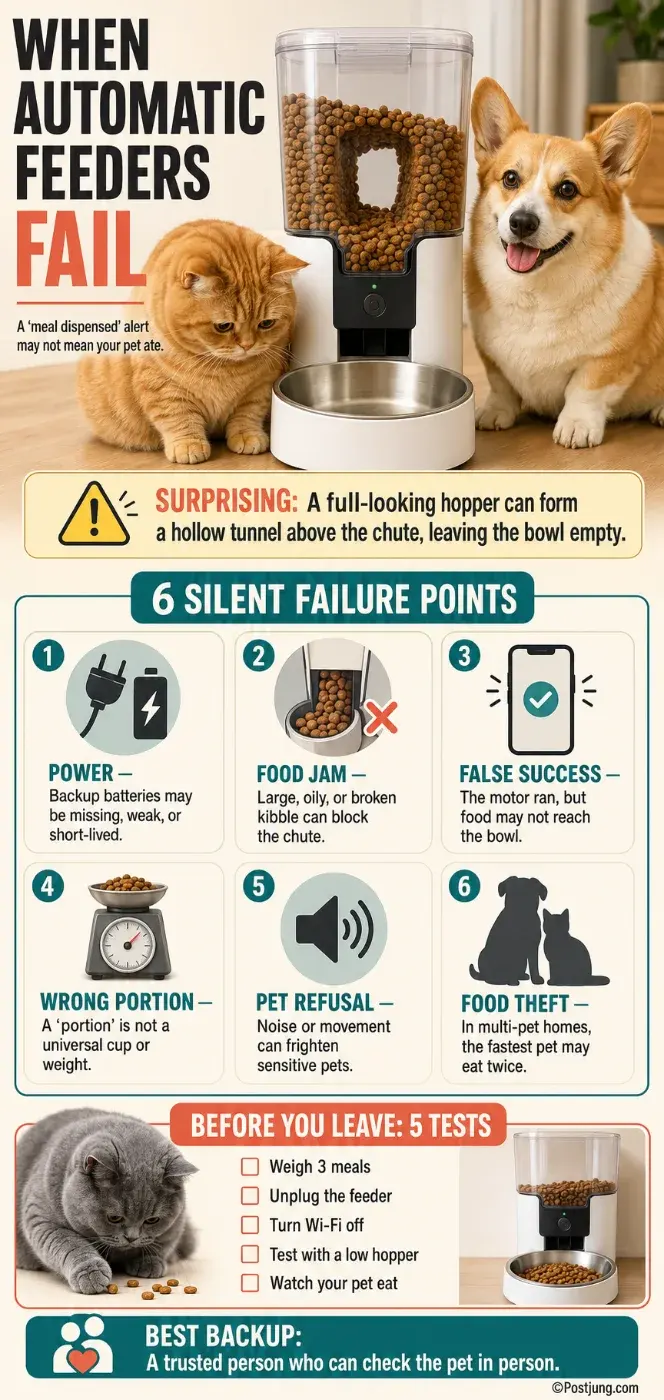
A feeder can remain powered on, follow its schedule, and even send a successful notification while the pet still receives too little food—or none at all. Dispensed does not always mean eaten.
The machine has more than one way to fail
Loss of electrical power is the most obvious concern. Some feeders offer batteries as emergency backup, but not every model includes batteries, and backup capacity varies.
PetSafe, for example, lists an optional four-battery backup for one of its smart feeders. Petlibro recommends using its original power adapter while keeping fresh alkaline batteries installed for emergencies, noting that declining battery voltage may contribute to feeding faults. Owners should check the instructions for their exact model rather than assume “battery compatible” means indefinite operation. (PetSafe, Petlibro)
Food can also bridge, clump, or become wedged inside the dispensing mechanism. Kibble that is too large, unusually shaped, crumbly, or oily may not move through a feeder as reliably as the dry food used during product testing.
The hopper may appear full from the outside while food has stopped falling toward the mechanism. A motor sound proves only that the motor ran—not that the correct portion reached the bowl.
Smart features introduce different weak points
Wi-Fi feeders can make monitoring easier, but an internet connection adds another layer that may fail. A router can restart, an app session can expire, or a notification may arrive late.
Many programmed feeders can continue serving stored schedules without Wi-Fi, but that behavior differs by model. Owners should find out what happens if the feeder loses internet access, electrical power, or both.
There is also a subtle limitation to app alerts. Unless a feeder weighs the bowl, records video, or uses another form of direct meal detection, a “feeding completed” message may indicate that the machine executed a command. It may not confirm that food reached the bowl or that the pet ate it.
Even feeders with cameras have blind spots. The pet might approach outside the recorded window, another animal might eat the food, or the bowl may be partly hidden.
Sometimes the feeder works, but the pet does not cooperate
A mechanically successful meal can still become a missed meal if a pet is frightened by the sound or movement. VCA Animal Hospitals notes that some sensitive animals may be startled by automatic feeders and avoid eating even when hungry. Complicated feeders can also require careful disassembly to clean properly. (VCA Animal Hospitals)
This is why a new feeder should never make its debut after an owner has already left home. A pet needs time to learn that the motor noise predicts food rather than danger.
Multi-pet homes create another challenge. One cat may guard the bowl, a larger dog may steal both portions, or the most confident animal may eat every meal before the intended pet arrives. Two bowls attached to one dispenser do not guarantee equal access.
For homes with food competition, owners may need separated feeding areas, microchip-controlled access, or direct supervision to verify that each animal receives the intended diet.
Programming and portion errors can be surprisingly quiet
Digital feeders often define a “portion” using the machine’s internal measurement rather than a universal cup or weight. A setting of five portions may not equal five tablespoons, five ounces, or the serving printed on the food package.
Different kibble shapes can also produce slightly different amounts. Measure the actual output with your pet’s usual food before relying on the displayed portion number.
Clock settings deserve attention too. Daylight-saving changes, time-zone adjustments, accidental button presses, factory resets, and misunderstood 12-hour versus 24-hour displays can shift a meal without creating an obvious hardware error.
After changing batteries, updating an app, unplugging the feeder, or moving it to another location, confirm that its clock and complete feeding schedule remain correct.
Run a real-world test before depending on it
A safer trial uses the same food, schedule, power source, and location planned for everyday use. Observe the feeder for several days rather than testing a single button press.
During that period:
- Weigh or measure several dispensed meals.
- Confirm the feeder recovers after being unplugged.
- Disconnect Wi-Fi and see whether stored meals continue.
- Check how low the hopper can get before portions become inconsistent.
- Watch the pet approach, eat, and finish.
- Test whether another pet can block access or steal food.
- Confirm that low-food, jam, and battery alerts actually reach your phone.
Clean food-contact parts according to the manufacturer’s instructions. Crumbs, oils, moisture, and saliva can accumulate around chutes and bowls, even when the upper hopper looks clean.
Automation should have a human backup
An automatic feeder is best treated as a scheduling tool, not a substitute for care. The safest setup includes a person who can intervene if a camera shows untouched food, the app goes offline, or a pet behaves unusually.
Before traveling, arrange for a trusted person to check the animal in person. Give that person access instructions, feeding amounts, veterinary contact details, and permission to enter if the technology fails.
This becomes especially important for very young or elderly pets, animals with medical conditions, and pets whose meals are tied to medication. Feeding and medication plans should be confirmed with a veterinarian rather than delegated entirely to a consumer device.
Automatic feeders can improve portion control and maintain a routine. Their real limitation is not that they always fail—it is that some failures look exactly like success from a distance.
VCA Animal Hospitals, PetSafe, Petlibro
REFERENCES:
https://vcahospitals.com/resources/lifestyle-cat/supplies/pros-and-cons-of-automatic-feeders
https://www.petsafe.com/p/smart-feed/PFD00-16828/
https://petlibro.com/pages/can-the-essential-automatic-wifi-feeder-work-solely-on-batteries-plaf001-002-plaf101-102-af001-002-af101-102
https://petlibro.com/products/granary-smart-camera-feeder-for-pet

เขียนโดย Postjung Insights
 โรงเรียนที่มีนักเรียนมากที่สุดในไทย
 ถ้าไม่กลัวเหนื่อย 7 อาชีพที่ตลาดยังต้องการ และค่าทักษะไปถึง 800 บาท/วัน
 เปิด 5 โรงเรียนหญิงล้วนเก่าแก่ของไทย ที่มีประวัติยาวนานกว่าศตวรรษ
 หัวลูกศรหินย้อนเวลา 80,000 ปี ในเอเชียกลาง… หลักฐานใหม่ชี้ โฮโม เซเปียนส์ อาจเคยบุกยุโรปเร็วขึ้นนับหมื่นปี!
 รู้หรือไม่? เปิดรายได้พนักงานส่งพัสดุของแต่ละแอป วันหนึ่งได้เท่าไร
 ตาราง “เด่นเหนือเด่นใต้” งวด 1 ต.ค. 69 เปิดข้อมูลตามโพย เลขไหนอยู่ตรงไหน
 ฝูงลิงญี่ปุ่นนับสิบรุมล้อมและโจมตีชายคนหนึ่งในคานากาวะ
 อำเภอที่มีชื่ออำเภอสั้นที่สุด 3 อำเภอเท่านั้นในประเทศไทย
 ยูเครนขอจัดการประชุมสุดยอดกับญี่ปุ่น
 ส่องเลข 3 สำนักพิมพ์ งวด 1 ต.ค. 69 ตัวไหนมีข้อมูลตรงกัน
 6 จุดหมายดังติดโผ นักท่องเที่ยวเจอ ไม่เป็นมิตร เมืองในฝันก็ไม่รอด เหตุผลคืออะไร
 สถิติย้อนหลัง 10 ปี ออกเลขไหนบ้างมาดูกันเปิด 5 โรงเรียนหญิงล้วนเก่าแก่ของไทย ที่มีประวัติยาวนานกว่าศตวรรษหัวลูกศรหินย้อนเวลา 80,000 ปี ในเอเชียกลาง… หลักฐานใหม่ชี้ โฮโม เซเปียนส์ อาจเคยบุกยุโรปเร็วขึ้นนับหมื่นปี!ถ้าไม่กลัวเหนื่อย 7 อาชีพที่ตลาดยังต้องการ และค่าทักษะไปถึง 800 บาท/วัน
 ทำไมแผนที่ส่วนใหญ่เอาทิศเหนือไว้ด้านบน ทั้งที่โลกไม่มี “ด้านบน” จริง ๆ?
 English Edition