Why Senior Pets Experience Cognitive Changes as They Age

Older dogs and cats may become confused, restless, less social, or forget familiar routines. Some changes reflect brain aging, but pain, sensory loss, and medical conditions can look surprisingly similar.
A senior pet may suddenly seem unsure of a familiar doorway, wake repeatedly at night, or forget a routine followed for years. These changes can be unsettling, but they are not necessarily stubbornness—and they should not automatically be dismissed as “just old age.”
Like the rest of the body, the brain changes over time. Yet cognitive decline is not inevitable in every senior pet, and behavior alone cannot reveal its cause.
What changes inside an aging brain?
The brain depends on a steady supply of oxygen and nutrients, effective communication between nerve cells, and the ability to repair everyday cellular damage. Aging can gradually make each of these processes less efficient.
Researchers studying older dogs and cats have identified several changes that may contribute to declining brain function. These include oxidative damage, altered blood flow, inflammation, changes in chemical signaling, and the accumulation of abnormal proteins.
Some older animals develop deposits of beta-amyloid, a protein also studied in human neurodegenerative disease. That similarity makes companion animals valuable to aging research, but it does not mean canine or feline cognitive dysfunction is identical to Alzheimer’s disease.
Genetics, overall health, environment, and individual resilience may all influence how noticeable these brain changes become.
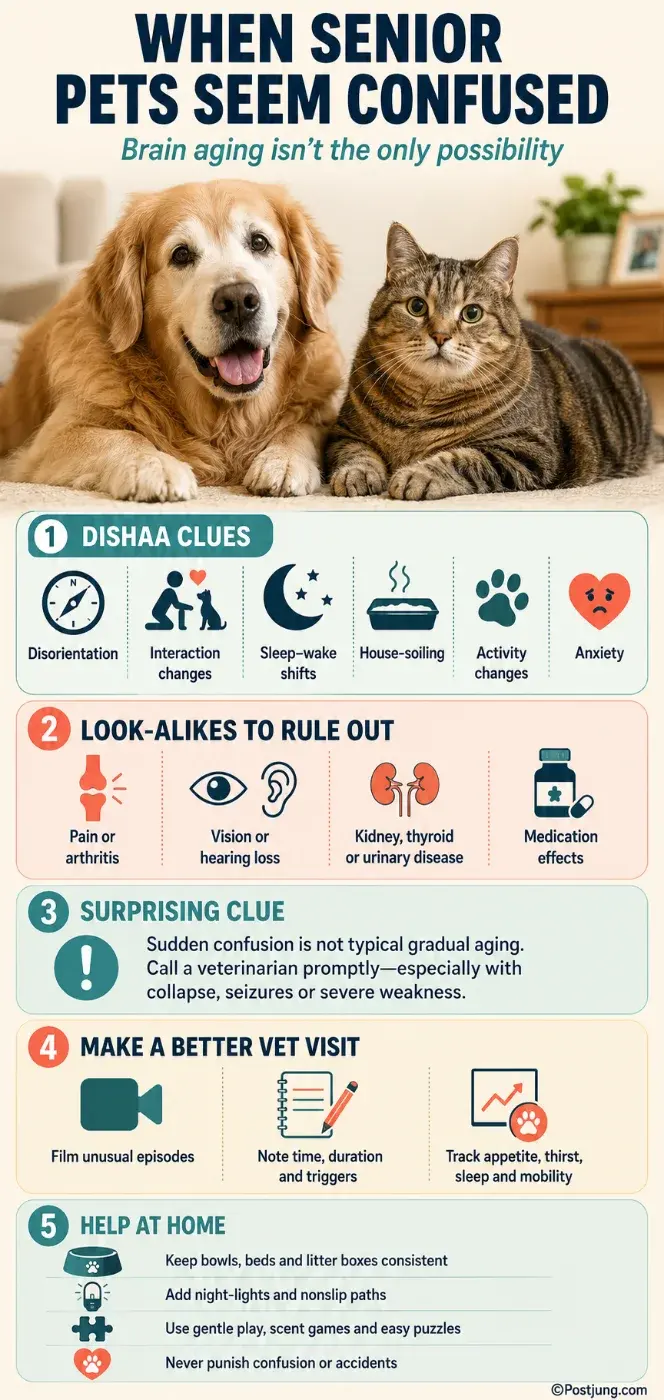
The signs may appear in everyday routines
Veterinarians often assess cognitive changes by looking for patterns involving orientation, social interaction, sleep, house training, activity, and anxiety. In dogs, these categories are sometimes summarized with the acronym DISHAA.
An affected pet might:
- Become trapped behind furniture or stare at walls
- Appear lost in familiar rooms
- Stop greeting family members as before
- Become unusually clingy, distant, or irritable
- Sleep more during the day and pace or vocalize at night
- Forget house-training or litter-box habits
- Lose interest in play or repeat the same movements
- Show new anxiety when left alone
- Struggle to find food, water, or a familiar doorway
Cats can be particularly difficult to assess because they often conceal discomfort and naturally change their activity as they age. Nighttime yowling, missed litter boxes, or reduced interaction may be interpreted as cognitive decline, but several other conditions can produce the same behavior.
It may not be cognitive dysfunction
A dog that hesitates on the stairs may be confused, but it may also have arthritis. A cat that cries at night could be disoriented, in pain, unable to hear normally, or affected by an underlying illness.
Possible look-alike problems include:
- Arthritis and other sources of chronic pain
- Hearing or vision loss
- Dental disease
- Kidney or liver disease
- Thyroid disorders
- Diabetes
- Urinary tract problems
- High blood pressure
- Neurological disease
- Medication side effects
A new behavior is a symptom, not a diagnosis. That is why veterinarians generally use a combination of medical history, physical and neurological examinations, laboratory testing, and observations from the owner before considering cognitive dysfunction.
Sudden confusion deserves particular attention. Cognitive dysfunction usually develops gradually, while an abrupt behavioral change may point to pain, poisoning, seizure activity, a circulation problem, or another condition requiring prompt care.
Small observations can help the veterinarian
Owners see details that may never appear during a short clinic visit. Keeping a simple diary can reveal whether a problem is becoming more frequent or follows a recognizable pattern.
Record what happened, when it occurred, how long it lasted, and anything that might have triggered it. A phone video of pacing, unusual vocalization, getting stuck, or staring episodes can also be useful.
Changes in appetite, drinking, urination, bowel movements, mobility, sleep, and medication should be noted as well. Patterns over several days can be more informative than one isolated incident.
Regular senior wellness examinations matter because pets often compensate for disease until changes become difficult to hide. The age at which a pet is considered senior varies by species, breed, body size, and medical history; large dogs, for example, generally reach this life stage earlier than smaller dogs.
Familiarity can make daily life easier
A predictable environment can reduce stress for an older pet, regardless of whether cognitive dysfunction is eventually diagnosed.
Helpful adjustments may include keeping beds, bowls, and litter boxes in consistent locations; using night-lights in dark hallways; adding nonslip flooring; and placing extra water stations or litter boxes where they are easy to reach.
Gentle activity remains valuable when the pet’s physical condition allows it. Short walks, food puzzles that are not overly difficult, scent games, and calm social interaction can provide stimulation without causing frustration.
Avoid punishing accidents, nighttime vocalization, or apparent forgetfulness. Confused pets need support, not correction. A veterinarian may recommend environmental changes, treatment of contributing diseases, dietary strategies, supplements, medication, or a combination based on the individual animal.
No single product can reverse every age-related change, and supplements marketed for “brain health” vary in evidence and quality. Owners should discuss them with a veterinarian, especially when a pet already takes medication or has kidney, liver, or metabolic disease.
Aging changes the relationship, not its value
Cognitive changes can be difficult for families because the pet may seem different while still having many comfortable and meaningful moments. Monitoring quality of life—including pain, appetite, mobility, sleep, hygiene, social connection, and enjoyment—can help owners make decisions based on the animal’s daily experience.
Early evaluation may uncover a treatable condition or make cognitive symptoms easier to manage. Most importantly, it replaces guessing with a plan tailored to the pet.
This article provides general educational information and cannot diagnose an individual animal. Sudden disorientation, collapse, seizures, breathing difficulty, severe weakness, or other abrupt neurological changes warrant prompt veterinary attention.
American Animal Hospital Association, Cornell University College of Veterinary Medicine
REFERENCES:
https://www.aaha.org/resources/2023-aaha-senior-care-guidelines-for-dogs-and-cats/
https://www.vet.cornell.edu/departments-centers-and-institutes/riney-canine-health-center/canine-health-information/cognitive-dysfunction-syndrome

เขียนโดย Postjung Insights
 รมว.วัฒนธรรมเอาจริง! จ่อส่งหนังสือทักท้วง Miss Universe Cambodia ปมใช้ภาพหญิงกำแพงเพชร หากไม่แก้ เตรียมใช้กฎหมาย
 รู้หรือไม่? เปิดรายได้พนักงานส่งพัสดุของแต่ละแอป วันหนึ่งได้เท่าไร
 โรงเรียนที่มีนักเรียนมากที่สุดในไทย
 5 คณะที่เรียนจบมาแล้ว มีอาชีพรองรับมากกว่าที่คิด
 เปิด 5 โรงเรียนหญิงล้วนเก่าแก่ของไทย ที่มีประวัติยาวนานกว่าศตวรรษ
 ดูหนัง–ซีรีส์ฟรีอาจไม่ฟรีอย่างที่คิด! เปิดโทษละเมิดลิขสิทธิ์ เตือนคนปล่อยคอนเทนต์เถื่อน เสี่ยงทั้งคุกทั้งปรับ
 แมคาเดเมีย (Macadamia): ราชินีแห่งถั่ว กับขุมทรัพย์โภชนาการจากออสเตรเลีย
 อำเภอที่มีชื่ออำเภอสั้นที่สุด 3 อำเภอเท่านั้นในประเทศไทย
 นักวิชาการ ม.อ.ไม่ปลื้ม! "ลิซ่า" ชวนดื่มหมดแก้ว ลั่น! เหยื่อเหล้าในไทยตายเยอะกว่าก่อการร้ายทั่วโลก
 MRT เตาปูนกลับมาเปิดปกติแล้ว รมช.คมนาคมเผยปมไฟไหม้ พบประกายไฟจากชุดสายไฟ 750 โวลต์
 แมงป่อง: แมลงนักล่าสายพันธุ์โบราณของโลก ที่ยังคงอยู่มาจนถึงปัจจุบัน
 มัดรวมจับเลขชน สัตว์นำโชค 1 ตุลาคม 2569
 English Edition