Why Apartment Pets Need More Than Food, Walks, and Toys
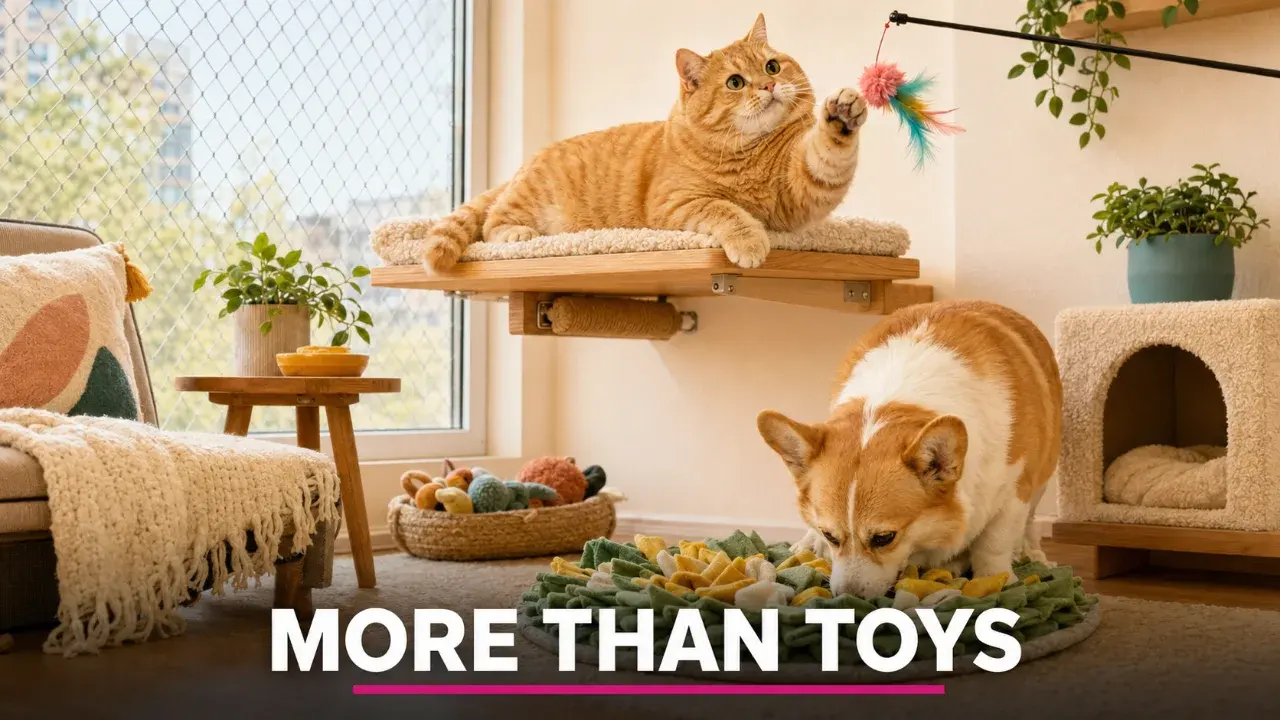
A small home can still support a satisfying life for a cat or dog. The key is creating daily opportunities to explore, search, climb, sniff, play, rest, and make choices.
Living in an apartment does not automatically make a pet unhappy. A cat can thrive without roaming outdoors, and a dog does not need a private yard to live well.
The challenge is that apartment life can make every day look remarkably similar. Food, safety, and affection are essential, but they are not the whole environment. Cats and dogs also need acceptable ways to perform the behaviors their bodies and brains are built to perform.
Environmental enrichment provides those opportunities. It can include food puzzles, scent games, climbing spaces, training, social interaction, and even something as simple as letting a pet choose where to rest.
The real issue is not square footage
A large home can still be dull if an animal has little to do. A small apartment can be engaging when it contains different surfaces, resting spots, scents, activities, and predictable interaction with people.
The Ohio State University’s Indoor Pet Initiative defines enrichment as modifying an animal’s surroundings to encourage physical activity and normal species-typical behavior. Effective enrichment should meet the individual animal’s needs without frightening or forcing it.
That last point matters. Buying a pile of toys and leaving them on the floor is not necessarily enrichment. An activity only works when the pet willingly engages with it.
Apartment living can reduce the variety an animal encounters naturally. Outdoor smells may arrive only through a window. Meals appear in the same bowl. Walking routes may become repetitive. Cats may have few places to climb or hide, while dogs may spend long periods waiting for their owners to return.
Enrichment adds some of that missing variety in safe, manageable ways.
Cats need territory in three dimensions
People usually measure an apartment by floor area. Cats experience space vertically as well.
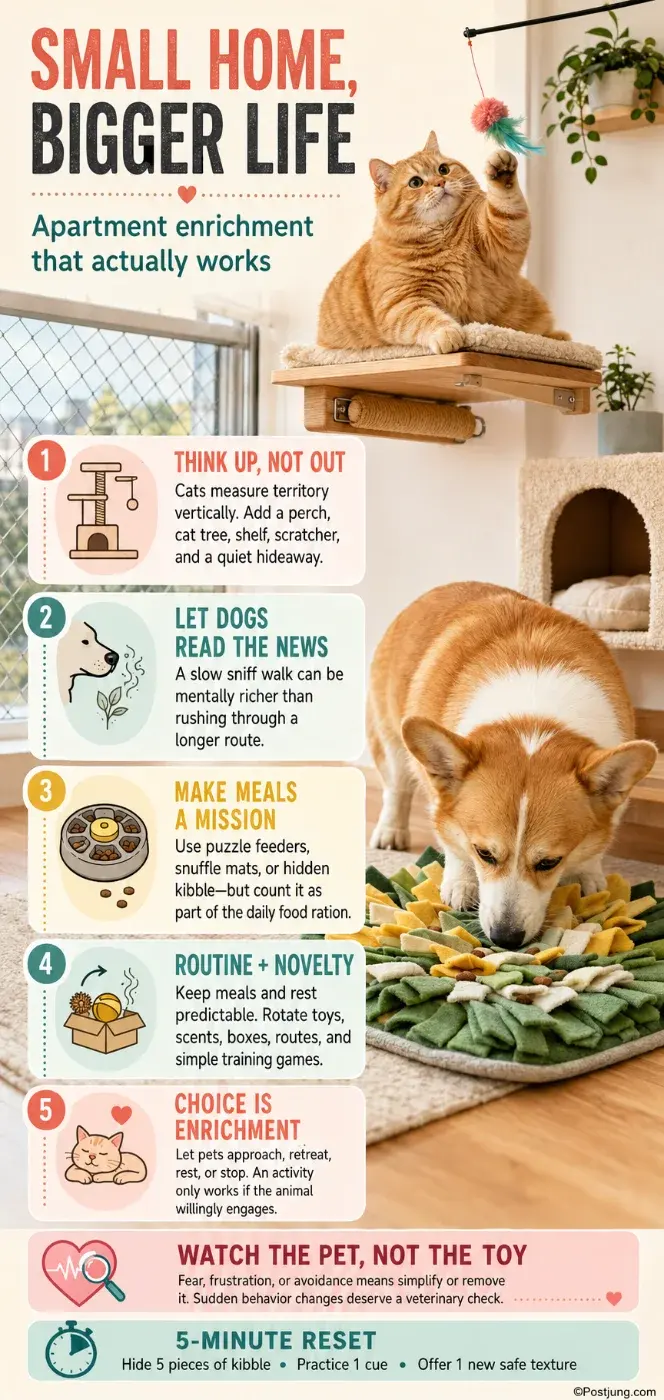
A secure cat tree, sturdy shelf, window perch, or cleared section of furniture can expand a cat’s usable territory without taking over the room. Elevated positions allow cats to observe activity while maintaining distance, an option that can be especially valuable in homes with children or multiple animals.
Cats also need opportunities to scratch, hide, stalk, chase, and capture. A complete indoor setup might include:
- A stable vertical and horizontal scratching surface
- A covered retreat or accessible cardboard box
- Short interactive play sessions with a wand-style toy
- Food puzzles or small portions hidden in safe locations
- Several comfortable resting choices
- A window view, provided the window and screen are secure
Interactive play often works best when it resembles a hunt: the toy moves away from the cat, disappears, reappears, and is eventually caught. Allowing a successful “capture” prevents the game from becoming endless frustration.
Owners can rotate toys rather than leaving everything available. A familiar toy may feel interesting again after spending several days out of sight.
In homes with multiple cats, enrichment also means reducing competition. Food, water, litter boxes, resting places, and hiding spots should be distributed so one cat cannot easily control every resource. Ohio State’s guidance recommends one litter box per cat, plus one additional box, where space permits.
Dogs need more than physical exhaustion
Walking is valuable, but mileage alone does not meet every canine need. A slow walk with time to investigate smells may be mentally richer than a longer walk spent constantly pulling the dog away from everything interesting.
Try varying the experience rather than merely extending it:
- Let the dog sniff on part of the walk
- Occasionally reverse the usual route
- Scatter appropriate food in a snuffle mat
- Hide treats or toys for a supervised search
- Practice short sessions of reward-based training
- Offer safe chewing or licking activities
- Arrange calm interaction with compatible dogs or people
Sniffing, searching, chewing, and problem-solving are activities, not distractions. They give dogs appropriate outlets for behavior that may otherwise appear as destructive chewing, scavenging, excessive attention-seeking, or restlessness.
Food-based activities should use part of the pet’s normal daily ration when possible. Continually adding treats can unintentionally increase calorie intake, particularly for small or less-active apartment pets.
Puzzle difficulty matters too. Begin with an easy task and let the animal learn how it works. A puzzle that is impossible to solve may create frustration instead of enrichment.
Predictability and novelty must work together
Pets benefit from a routine they can understand: reasonably consistent meals, walks, rest periods, and human interaction. Predictability gives them a sense of security.
Within that routine, small changes can prevent monotony. Owners might rotate toys, introduce a cardboard box, teach a new cue, change a food-search location, or offer a different safe texture to explore.
The best enrichment plan combines reliable routines with manageable novelty. New objects should be introduced gradually, especially for shy animals. Pets should be free to approach or retreat.
Television, music, or a window view can provide stimulation for some animals, but they are not universal solutions. A window that exposes a cat to an intimidating outdoor cat, for example, may increase stress. Watch the pet rather than assuming an activity is enjoyable.
Behavior changes deserve a closer look
Reduced stimulation can contribute to unwanted behavior, but boredom should not become a catch-all diagnosis.
Destructive behavior, house-soiling, vocalizing, compulsive grooming, sudden aggression, sleep changes, or withdrawal can also be associated with pain, illness, anxiety, conflict, or separation-related distress.
A sudden or persistent change warrants a veterinary evaluation. Owners should avoid punishing the animal before understanding what is driving the behavior. Punishment can increase fear without meeting the underlying need.
Enrichment is most useful when it is individualized. An older dog with joint discomfort may prefer scent work to strenuous exercise. A cautious cat may value quiet hiding places more than constant novelty. A highly social pet may need additional interaction, while another may need greater control over when interaction occurs.
A satisfying apartment environment does not need to be expensive or elaborate. It needs to offer safe ways to move, investigate, choose, and rest—and an owner willing to notice which opportunities the animal actually uses.
The Ohio State University Indoor Pet Initiative, Compendium: Continuing Education for Veterinarians, Animals
REFERENCES:
https://indoorpet.osu.edu/dogs/environmental_enrichment_dogs
https://indoorpet.osu.edu/cats/basic-indoor-cat-needs
https://pmc.ncbi.nlm.nih.gov/articles/PMC3922041/
https://pmc.ncbi.nlm.nih.gov/articles/PMC10936385/

เขียนโดย Postjung Insights
 รู้หรือไม่? เปิดรายได้พนักงานส่งพัสดุของแต่ละแอป วันหนึ่งได้เท่าไร
 เปิดรายชื่อ 5 โรงเรียนเอกชนขนาดใหญ่ นักเรียนกว่า 5,000 คนทุกแห่ง
 อำเภอที่มีชื่ออำเภอสั้นที่สุด 3 อำเภอเท่านั้นในประเทศไทย
 ตาราง “เด่นเหนือเด่นใต้” งวด 1 ต.ค. 69 เปิดข้อมูลตามโพย เลขไหนอยู่ตรงไหน
 ราคาทองวันนี้ 21 ก.ย. 69 อัปเดตตลาดทองคำ ทองรูปพรรณแตะ 69,750 บาท
 ส่องเลข 3 สำนักพิมพ์ งวด 1 ต.ค. 69 ตัวไหนมีข้อมูลตรงกัน
 เปิดรายชื่อ 5 โรงเรียนเป้าหมาย เด็กสอบเข้าต้องเตรียมตัวให้พร้อม
 โรงเรียนที่มีนักเรียนมากที่สุดในไทย
 หนุ่มขับ Porsche ใจหล่อสุดๆ ติดประกาศเด็กหายไว้รอบคัน..หวังช่วยเผยแพร่ข้อมูลให้ตามหาได้เร็วขึ้น
 เปิด 5 โรงเรียนหญิงล้วนเก่าแก่ของไทย ที่มีประวัติยาวนานกว่าศตวรรษ
 'สควีชชี่'ของเล่นที่กำลังเป็นไวรัลอาจถูกเจ้าหน้าที่ของสนามบินยึดได้ ตรวจสอบให้ดีก่อนนำขึ้นเครื่อง
 แปลปกสลาก งวด 1 ต.ค. 69 ส่องตัวเลขจากภาพปกสลากกินแบ่งรัฐบาล
 เปิด 5 สินค้าส่งออกของลาวที่คนไทยอาจคาดไม่ถึง หนึ่งในนั้นทำเงินเกือบ 1 พันล้านดอลลาร์ราคาทองวันนี้ 21 ก.ย. 69 อัปเดตตลาดทองคำ ทองรูปพรรณแตะ 69,750 บาทเปิดรายชื่อ 5 โรงเรียนเอกชนขนาดใหญ่ นักเรียนกว่า 5,000 คนทุกแห่ง
 ซาบีดา” เรียกถกด่วน ปมภาพ “ชุดไทย” ถูกนำไปอ้างเป็นชุดกัมพูชาเปิดรายชื่อ 5 โรงเรียนเป้าหมาย เด็กสอบเข้าต้องเตรียมตัวให้พร้อมหนุ่มขับ Porsche ใจหล่อสุดๆ ติดประกาศเด็กหายไว้รอบคัน..หวังช่วยเผยแพร่ข้อมูลให้ตามหาได้เร็วขึ้น
 English Edition