Why Punishing Your Pet Can Make Behavior Problems Worse

Yelling, physical corrections, and other frightening consequences may interrupt unwanted behavior, but they can also create fear and damage learning. A better approach addresses the cause and teaches the pet a safe alternative.
A punishment may stop a dog from barking or make a cat jump off the counter, but that immediate silence can be misleading. Stopping a behavior is not the same as changing it, and the fear or confusion created in the process may produce a larger problem later.
Veterinary behavior guidance increasingly favors reward-based training over methods that cause pain, fear, or distress. Evidence involving companion dogs has linked aversive training with more stress-related behavior, poorer welfare, and behavioral concerns such as fear, avoidance, and aggression.
The American Veterinary Society of Animal Behavior recommends reward-based methods for dog training and advises against aversive tools and techniques. Veterinary guidance for cats similarly warns that punishment can increase fear, avoidance, and defensive behavior.
Your pet may learn a lesson you never intended
For punishment to communicate clearly, it would need to occur at exactly the right moment and be consistently connected to one specific action. That is difficult in an ordinary household.
Consider a dog that urinates indoors while alone. Scolding the dog after returning home does not clearly explain what was wrong. The dog may instead learn that the owner’s arrival, the sight of the mess, or being approached near it predicts anger.
The same problem can occur when a cat is sprayed with water for scratching furniture. The cat might stop while the person is present but resume when nobody is watching. It has learned to avoid the person or the spray—not necessarily where scratching is allowed.
This is why the familiar “guilty look” should not be treated as proof that an animal understands a past offense. Lowered posture, flattened ears, avoidance, or appeasing behavior may reflect a response to the owner’s tone and body language.
Pets learn from immediate associations, not from a human-style explanation of right and wrong delivered minutes later.
Fear can hide the behavior without solving it
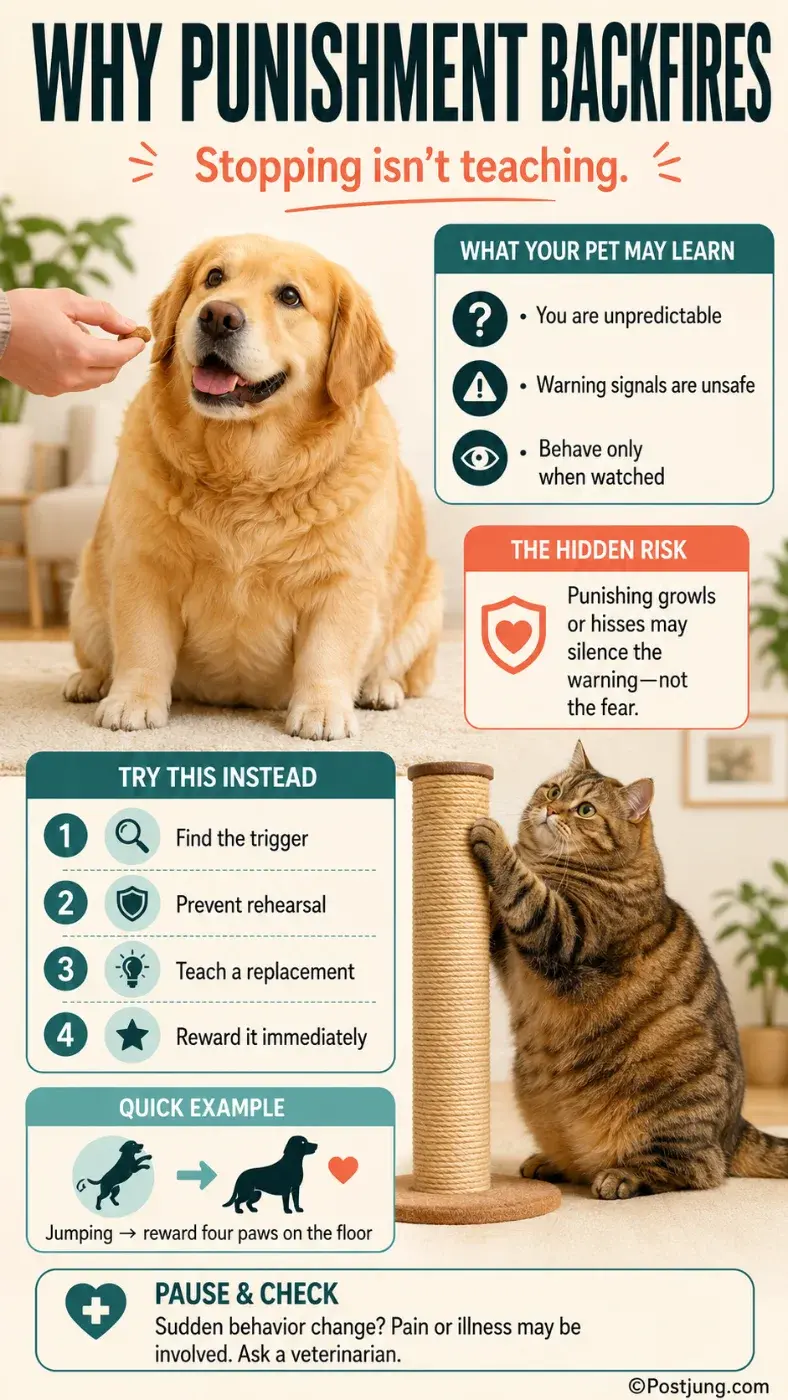
Punishment can suppress warning signals while leaving the emotion beneath them unchanged.
A dog that growls when uncomfortable is communicating distress. If growling leads to a frightening correction, the dog may stop giving that warning. The discomfort may remain, however, and the animal could move more quickly to snapping or biting in a future encounter.
A cat punished for hissing when cornered may become more afraid of hands, visitors, or being picked up. When escape is unavailable, defensive aggression can become more likely.
Research on aversive dog training has documented behaviors associated with stress, including tense posture, panting, lip licking, yawning, and lowered body position. One study also found that dogs trained with more aversive methods displayed poorer welfare indicators than dogs attending reward-based schools.
Not every unwanted behavior is caused by training history. Genetics, early experiences, the environment, unmet needs, fear, and health problems can all play a role. Still, adding fear rarely resolves the original cause.
The behavior may be serving a real need
Before trying to stop a behavior, ask what the animal gains or avoids by doing it.
A dog may bark because it sees people outside, feels isolated, is frightened by noise, or has learned that barking brings attention. A cat may scratch furniture to stretch, maintain its claws, leave scent signals, or use the only stable scratching surface available.
Other behaviors may have medical causes. Sudden house-soiling can be associated with urinary, digestive, mobility, or cognitive problems. Irritability may appear when touching a painful area. Restlessness, destruction, vocalization, or aggression can also accompany fear and anxiety.
A sudden or significant change deserves veterinary attention, especially if it involves appetite, elimination, sleep, movement, sensitivity to touch, aggression, or withdrawal.
Behavior can be information about health or emotion. Punishing the visible symptom may delay recognition of the underlying problem.
Teach the replacement, not just the restriction
Reward-based training does not mean allowing a pet to do anything it wants. It means arranging the environment, preventing repeated mistakes, and reinforcing a behavior that can replace the unwanted one.
A practical plan often looks like this:
- Identify the trigger and the reward maintaining the behavior.
- Prevent access to the trigger while training is underway.
- Choose a realistic alternative behavior.
- Reward that alternative immediately and consistently.
- Practice in easy situations before adding distractions.
- Adjust the environment so the desired choice is convenient.
If a dog jumps on visitors, for example, the alternative might be keeping four paws on the floor or going to a mat. Begin practicing before an exciting visitor arrives, then reward the behavior generously in short sessions.
For a cat scratching a couch, provide a tall, stable scratching post near the targeted area. Match the surface and orientation the cat already prefers, reward investigation of the post, and protect the furniture during the transition.
Food, play, access to favorite activities, praise, and distance from something frightening can all function as rewards, depending on the animal. The best reward is one the pet actually values.
When professional help is the safer choice
Fear, aggression, separation-related distress, compulsive behavior, and severe reactivity usually require more than a few training tips. Begin with a veterinarian to rule out pain or illness.
The veterinarian may recommend a qualified behavior professional. Ask prospective trainers to explain their methods and equipment clearly. Be cautious if someone relies on intimidation, “dominance” confrontations, shock collars, painful equipment, or deliberately frightening the animal.
Behavior change takes time because emotions and learned associations do not disappear on command. Progress is more durable when a pet feels safe enough to learn what works.
The goal is not simply to make behavior stop in front of a person. It is to help the animal make a better choice without fear—even when nobody is standing nearby.
American Veterinary Society of Animal Behavior, Merck Veterinary Manual, PLOS ONE, RSPCA
REFERENCES:
https://avsab.org/wp-content/uploads/2021/08/AVSAB-Humane-Dog-Training-Position-Statement-2021.pdf
https://www.merckvetmanual.com/behavior/behavioral-medicine-introduction/treatment-of-behavior-problems-in-animals
https://pubmed.ncbi.nlm.nih.gov/33326450/
https://www.rspca.org.uk/adviceandwelfare/pets/dogs/training

เขียนโดย Postjung Insights
 เปิดรายชื่อ 5 โรงเรียนเป้าหมาย เด็กสอบเข้าต้องเตรียมตัวให้พร้อม
 รู้หรือไม่? เปิดรายได้พนักงานส่งพัสดุของแต่ละแอป วันหนึ่งได้เท่าไร
 ซาบีดา” เรียกถกด่วน ปมภาพ “ชุดไทย” ถูกนำไปอ้างเป็นชุดกัมพูชา
 โรงเรียนที่มีนักเรียนมากที่สุดในไทย
 แปลปกสลาก งวด 1 ต.ค. 69 ส่องตัวเลขจากภาพปกสลากกินแบ่งรัฐบาล
 อำเภอที่มีชื่ออำเภอสั้นที่สุด 3 อำเภอเท่านั้นในประเทศไทย
 ตาราง “เด่นเหนือเด่นใต้” งวด 1 ต.ค. 69 เปิดข้อมูลตามโพย เลขไหนอยู่ตรงไหน
 เปิด 5 โรงเรียนหญิงล้วนเก่าแก่ของไทย ที่มีประวัติยาวนานกว่าศตวรรษ
 หนุ่มขับ Porsche ใจหล่อสุดๆ ติดประกาศเด็กหายไว้รอบคัน..หวังช่วยเผยแพร่ข้อมูลให้ตามหาได้เร็วขึ้น
 โรสแมรี่ แฮร์ริส ‘ป้าเมย์’ แห่ง Spider-Man ฉบับโทบีย์ แม็คไกวร์ อายุครบ 99 ปี
 ส่องเลข 3 สำนักพิมพ์ งวด 1 ต.ค. 69 ตัวไหนมีข้อมูลตรงกัน
 จากอินเดียสู่เส้นทางสายไหม! เจาะลึก “การเผยแผ่พระพุทธศาสนา” ปรากฏการณ์เปลี่ยนโลกเมื่อกว่า 2,500 ปีก่อนซาบีดา” เรียกถกด่วน ปมภาพ “ชุดไทย” ถูกนำไปอ้างเป็นชุดกัมพูชาเปิดรายชื่อ 5 โรงเรียนเป้าหมาย เด็กสอบเข้าต้องเตรียมตัวให้พร้อมหนุ่มขับ Porsche ใจหล่อสุดๆ ติดประกาศเด็กหายไว้รอบคัน..หวังช่วยเผยแพร่ข้อมูลให้ตามหาได้เร็วขึ้น
 วาบิ-ซาบิ (Wabi-Sabi) ปรัชญาญี่ปุ่นที่สอนให้เราโอบกอดความไม่สมบูรณ์แบบ
 English Edition