Why Small Batteries Can Become a Pet Emergency Within Minutes
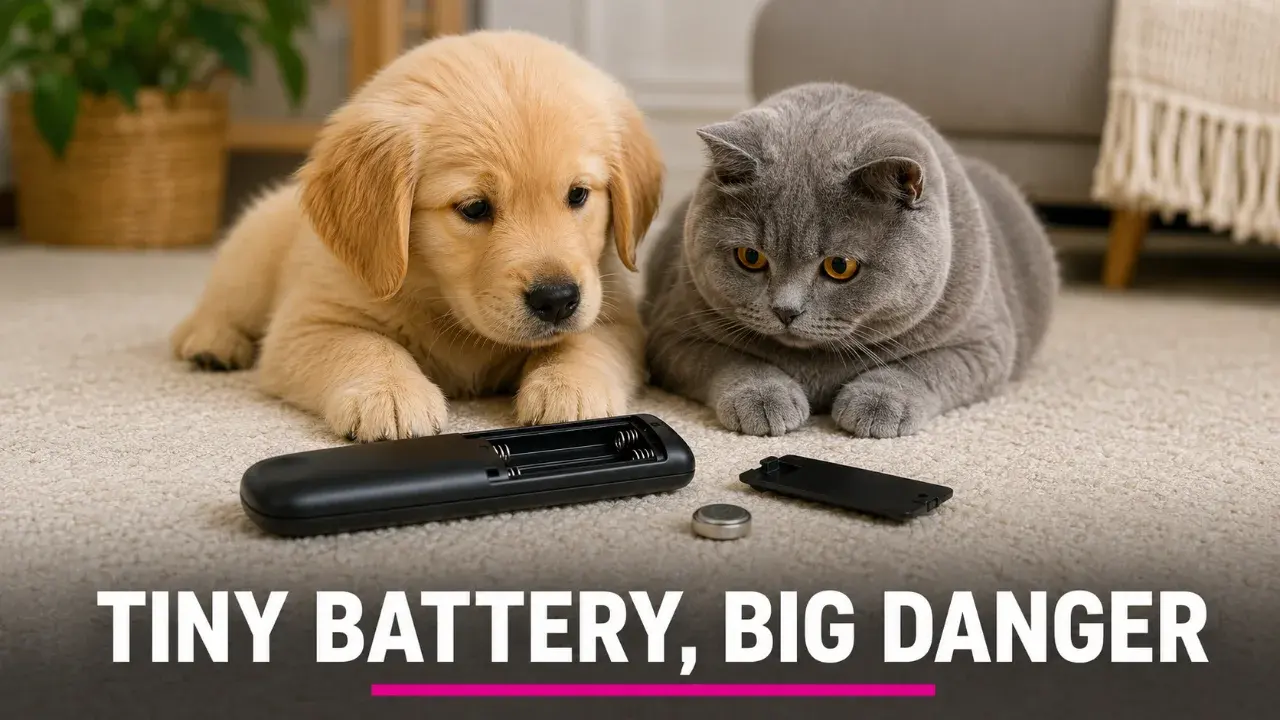
Button and coin batteries can burn tissue, obstruct the digestive tract, or become lodged in a pet’s esophagus. Suspected exposure requires immediate veterinary advice—even when the animal seems fine.
A battery small enough to disappear beneath a couch cushion can cause a life-threatening injury when swallowed or chewed by a pet. Button and coin batteries are especially concerning because they can lodge in the esophagus and begin damaging surrounding tissue before obvious symptoms appear.
Any suspected battery ingestion should be treated as an emergency. Owners should contact a veterinarian or animal poison service immediately rather than waiting to see whether the battery passes naturally.
The danger is not limited to “battery acid”
Dogs are the pets most commonly involved in battery accidents because they often chew remote controls, electronic toys, hearing aids, key fobs, watches, calculators, and other household devices.
The phrase “battery acid” can also be misleading. Many familiar household batteries contain alkaline compounds such as potassium hydroxide or sodium hydroxide. If chewing punctures the casing, this material can leak onto the mouth, tongue, esophagus, or stomach and cause deep chemical burns.
Button and coin batteries introduce another danger. When one becomes lodged against moist tissue, its electrical current can trigger a chemical reaction at the battery’s surface. The resulting highly alkaline environment can rapidly injure tissue even if the battery does not appear to be leaking.
This means an intact-looking battery is not necessarily harmless.
Why button batteries are particularly dangerous
Their smooth, compact shape makes button batteries easy to swallow and difficult for an owner to notice when one goes missing.
A swallowed battery may become trapped in the esophagus, the tube connecting the mouth to the stomach. Prolonged contact can produce circular ulcers and, in severe cases, perforate the esophageal wall.
Serious damage can begin before visible symptoms develop. Pet Poison Helpline notes that contact with a 3-volt lithium button battery may cause significant tissue injury very quickly. The exact risk depends on the battery, its location, the size of the animal, and whether the casing was damaged.
Small batteries can also be inhaled into the airway, creating a choking emergency. If they reach the stomach or intestines, they may cause obstruction or additional tissue damage.
Metal toxicity is another possible complication when battery fragments remain inside the digestive tract, although corrosive burns and obstruction are usually the more immediate concerns.
Warning signs may be subtle or delayed
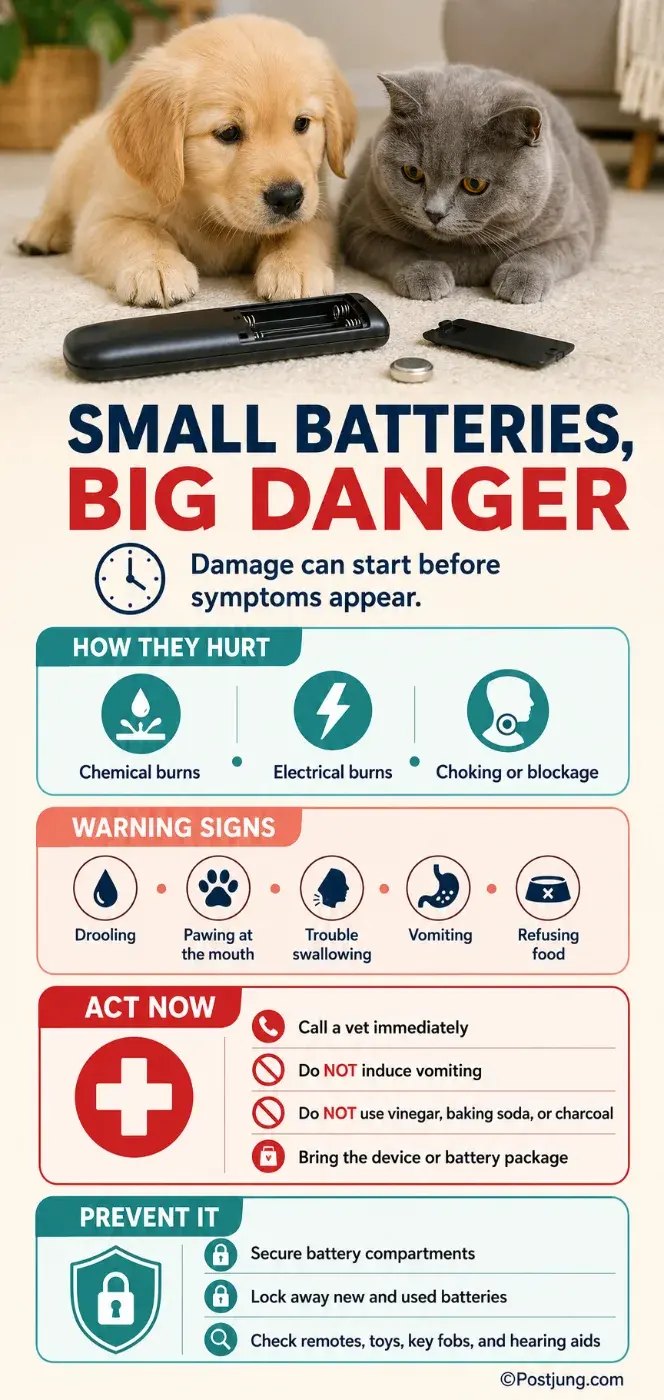
A pet that has chewed or swallowed a battery may develop:
- Drooling or repeated swallowing
- Pawing at the mouth
- Pain or redness inside the mouth
- Difficulty eating or swallowing
- Vomiting
- Loss of appetite
- Abdominal discomfort
- Coughing or breathing difficulty
- Unusual quietness or distress
- Dark residue around the mouth after a battery has been punctured
The absence of these signs does not rule out an emergency. Burns inside the mouth or esophagus may not become visible for several hours.
Do not wait for pain, vomiting, or burns to appear. If a battery is missing and a pet had access to the device, veterinary assessment is the safer course.
What to do after suspected exposure
Call a veterinarian or emergency animal hospital immediately. Tell them what kind of battery may be involved, whether it was chewed or swallowed, when the incident may have happened, and the pet’s approximate weight.
If possible, bring the damaged device, battery packaging, or an identical battery. This may help the veterinary team identify its size and chemistry. Do not delay leaving for the clinic while searching for these items.
If battery residue is visibly present in the mouth, ask the veterinarian or animal poison service how to rinse it safely. Guidance may include gently flushing the mouth with lukewarm water when this can be done without causing choking or delaying treatment.
Several common home responses can make the injury worse:
- Do not induce vomiting. Corrosive material can burn the esophagus again on the way back up.
- Do not try to neutralize the chemical with vinegar, baking soda, or another household substance. The reaction may produce heat and worsen the burn.
- Do not give activated charcoal unless specifically instructed. It is ineffective for corrosive battery chemicals and can interfere with examination of damaged tissue.
- Do not pull at an object lodged deep in the throat.
- Do not offer food, medication, or large amounts of water unless a veterinary professional directs you to do so.
A veterinarian may examine the mouth and use X-rays to determine whether a battery or battery fragments remain inside the animal. Depending on their location and condition, removal may require endoscopy or surgery. Further care can include pain relief, gastrointestinal protection, monitoring, and treatment of burns or infection.
Prevention starts with the devices pets already notice
Store spare and used batteries in closed containers inside secure cabinets. Used batteries remain dangerous and should not be left loose on counters or collected in open bowls before recycling.
Check electronic devices for battery compartments that slide open or have broken covers. Remotes, key fobs, greeting cards, flameless candles, small toys, digital scales, hearing aids, and fitness devices can all contain batteries that attract a curious pet.
Children’s toys deserve special attention because they are often left on floors. Devices with screw-secured battery compartments provide an additional layer of protection.
Discard damaged batteries according to local recycling or hazardous-waste guidance. Before throwing away a broken electronic item, remove its battery and store it somewhere inaccessible to both pets and children.
A battery’s size can make it look insignificant. For a pet, however, a missing button battery is never a wait-and-see situation.
Merck Veterinary Manual, Pet Poison Helpline
REFERENCES:
https://www.merckvetmanual.com/toxicology/toxicoses-from-household-hazards/toxicoses-from-corrosive-agents-in-animals
https://www.petpoisonhelpline.com/uncategorized/household-batteries/
https://www.petpoisonhelpline.com/poison/batteries/

เขียนโดย Postjung Insights
 หนุ่มขับ Porsche ใจหล่อสุดๆ ติดประกาศเด็กหายไว้รอบคัน..หวังช่วยเผยแพร่ข้อมูลให้ตามหาได้เร็วขึ้น
 รู้หรือไม่? เปิดรายได้พนักงานส่งพัสดุของแต่ละแอป วันหนึ่งได้เท่าไร
 โรงเรียนที่มีนักเรียนมากที่สุดในไทย
 ซาบีดา” เรียกถกด่วน ปมภาพ “ชุดไทย” ถูกนำไปอ้างเป็นชุดกัมพูชา
 เปิดรายชื่อ 5 โรงเรียนเป้าหมาย เด็กสอบเข้าต้องเตรียมตัวให้พร้อม
 เปิด 5 โรงเรียนหญิงล้วนเก่าแก่ของไทย ที่มีประวัติยาวนานกว่าศตวรรษ
 ตาราง “เด่นเหนือเด่นใต้” งวด 1 ต.ค. 69 เปิดข้อมูลตามโพย เลขไหนอยู่ตรงไหน
 Ctrip แพลตฟอร์มการท่องเที่ยวของจีน เปิดขายตั๋วสำหรับทริปท่องเที่ยวอวกาศ ของ Virgin Galactic 6 วัน ในราคาประมาณ 24 ล้านบาท
 อำเภอที่มีชื่ออำเภอสั้นที่สุด 3 อำเภอเท่านั้นในประเทศไทย
 'สควีชชี่'ของเล่นที่กำลังเป็นไวรัลอาจถูกเจ้าหน้าที่ของสนามบินยึดได้ ตรวจสอบให้ดีก่อนนำขึ้นเครื่อง
 แปลปกสลาก งวด 1 ต.ค. 69 ส่องตัวเลขจากภาพปกสลากกินแบ่งรัฐบาล
 6 วิธีรักษาชีวิตของคนโบราณ! ก่อนมียา โรงพยาบาล และเทคโนโลยี พวกเขาเอาตัวรอดกันแบบนี้ซาบีดา” เรียกถกด่วน ปมภาพ “ชุดไทย” ถูกนำไปอ้างเป็นชุดกัมพูชาเปิดรายชื่อ 5 โรงเรียนเป้าหมาย เด็กสอบเข้าต้องเตรียมตัวให้พร้อมหนุ่มขับ Porsche ใจหล่อสุดๆ ติดประกาศเด็กหายไว้รอบคัน..หวังช่วยเผยแพร่ข้อมูลให้ตามหาได้เร็วขึ้น
 วาบิ-ซาบิ (Wabi-Sabi) ปรัชญาญี่ปุ่นที่สอนให้เราโอบกอดความไม่สมบูรณ์แบบ
 English Edition