Why Pet Portion Sizes Are So Easy to Misjudge
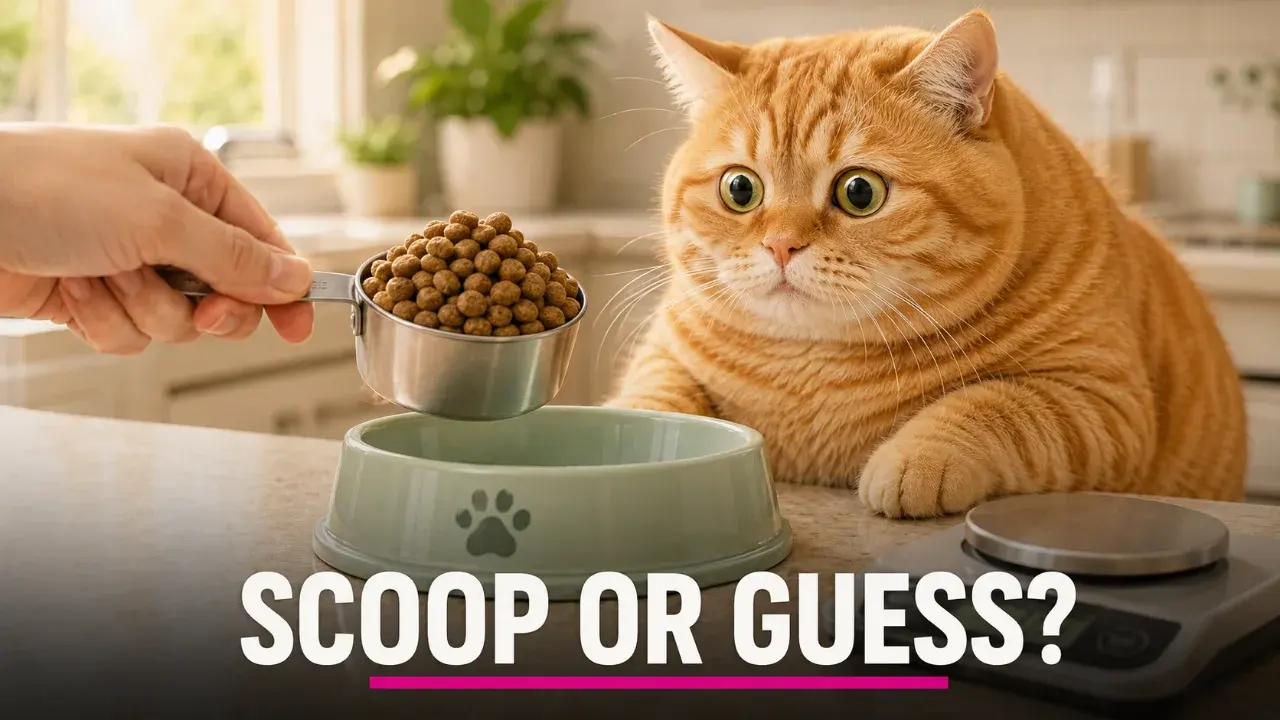
A scoop that looks reasonable may not match your pet’s actual calorie needs. Package estimates, calorie-dense foods, treats, and small measuring errors can all change the daily total.
Feeding a pet seems straightforward: check the package, fill a cup, and serve. Yet that familiar routine contains several opportunities for error.
The problem is rarely a lack of care. It is that people naturally judge food by volume and appearance, while an animal’s needs are determined by calories, body condition, life stage, health, and activity.
A full bowl is not a nutritional measurement.
The feeding guide is only a starting point
Pet food packages commonly provide suggested daily amounts based on weight. Those recommendations can be useful, but they cannot account perfectly for every dog or cat.
Two pets of the same weight may have different energy needs because of age, reproductive status, activity, body composition, environment, or medical conditions. Even individual animals that appear similar can require noticeably different portions to maintain a healthy weight.
The American Animal Hospital Association advises owners to review portions as a pet’s weight and activity change. The World Small Animal Veterinary Association likewise recommends nutrition plans tailored to the individual animal.
In other words, the number on the package should begin the conversation—not end it.
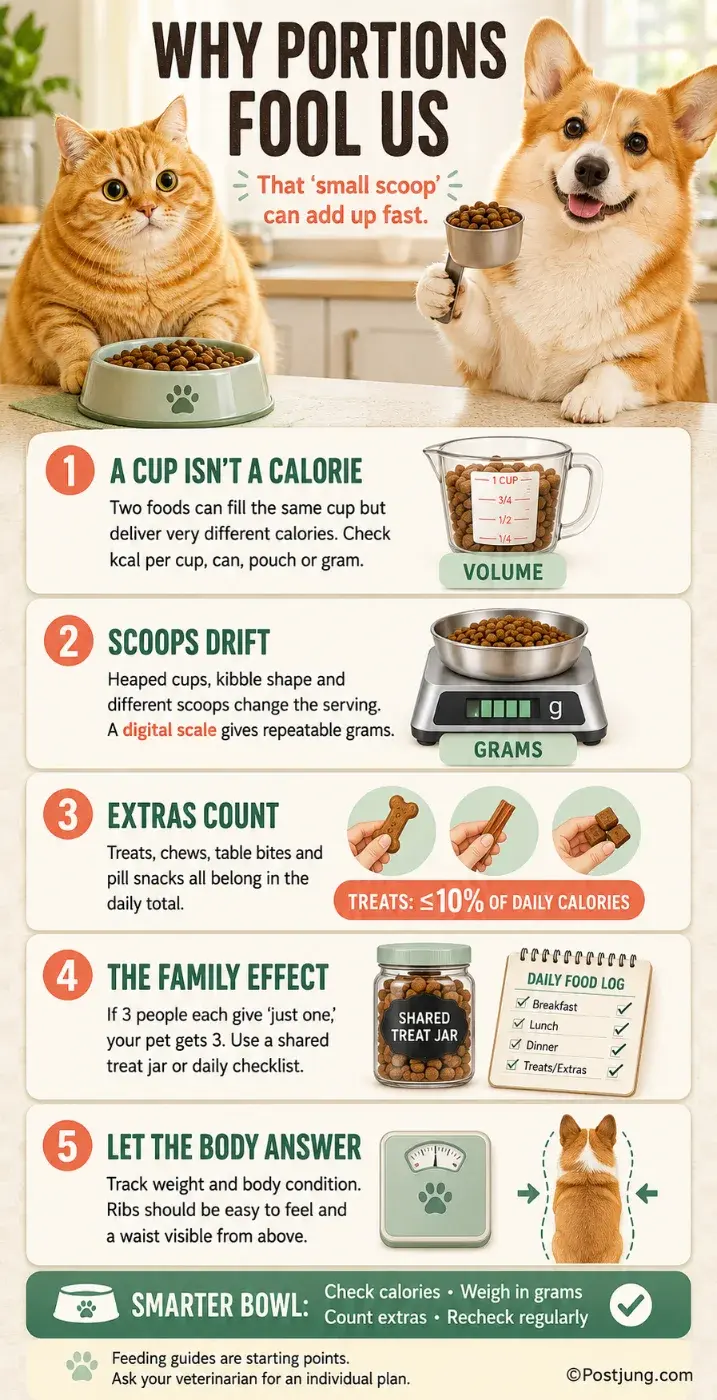
The same-sized scoop can hold different calories
A cup describes volume, not calories.
One dry food may contain substantially more energy per cup than another. Switching foods while continuing to serve the same volume can therefore change a pet’s calorie intake, even if the bowl looks exactly the same.
Wet food creates another complication. Similar-looking cans, trays, or pouches may differ in net weight and calorie density. Dividing a container into “about half” is also less precise than it sounds.
Before setting a portion, check the label for calories per cup, can, pouch, or kilogram. If calorie information is unavailable, the manufacturer should be able to provide it.
Compare calories, not just scoop size.
Household cups are surprisingly imprecise
Scooping dry food can produce inconsistent portions. Kibble shape, cup size, whether the food is level or heaped, and how firmly the cup is filled can all affect the amount served.
Small errors matter most for cats and small dogs because their total daily allowance may already be modest. A little extra at breakfast and dinner can become a meaningful calorie surplus over time.
For greater consistency, weigh dry food in grams with a digital kitchen scale. Place the bowl on the scale, reset it to zero, and add food until it reaches the veterinarian-recommended weight.
If a scale is not practical, use one standardized measuring cup and level it the same way every time. Avoid coffee mugs, drinking glasses, or unmarked scoops.
Treats and “tiny bites” still count
Meals are only part of the daily total.
Training rewards, dental chews, table scraps, food used to hide medication, and bites offered by different family members can quietly add calories. A snack that seems trivial to a person may be significant for a small animal.
AAHA recommends keeping treats to no more than 10% of daily calories. This helps prevent extras from displacing the balanced nutrition supplied by a complete pet food.
One useful approach is to reserve part of the pet’s measured daily kibble allowance for training. Everyone in the household should also know what has already been given.
Count every extra, not only meals.
Free-feeding hides the real intake
Keeping a bowl full all day makes it difficult to know how much one pet consumes. The problem becomes greater in multi-pet homes, where one animal may visit another’s bowl.
Measured meals create a clearer record. For pets that prefer several small meals, divide the calculated daily allowance across multiple feedings or use a timed feeder.
Owners of multiple pets may need separate feeding areas, supervised meals, or microchip-controlled feeders to prevent food sharing.
Changes in appetite can also be medically important. Knowing what was offered and what remained makes those changes easier to notice and report to a veterinarian.
The pet’s body provides the final feedback
Even a carefully calculated portion may need adjustment. That is why feeding decisions should be checked against weight trends and body condition rather than treated as permanent.
Veterinary teams commonly use a body condition score to evaluate fat coverage. At an ideal condition, a pet’s ribs should generally be easy to feel without a thick layer of fat, and a waist should be visible when viewed from above. Breed and body shape can affect appearance, so a veterinarian can demonstrate what is normal for an individual pet.
Muscle condition matters too. Weight alone cannot distinguish fat gain from changes in muscle, growth, pregnancy, or fluid retention.
The correct portion is the amount that maintains an appropriate condition, not necessarily the amount printed for a particular weight range.
A simple portion check
Pet owners can make feeding more reliable with a short routine:
- Record the exact food and its calories per cup, can, pouch, or gram.
- Ask a veterinarian to assess the pet’s ideal weight and body condition.
- Establish a daily calorie target appropriate for that individual pet.
- Convert that target into grams or container fractions.
- Include treats, chews, table food, and medication snacks.
- Measure every serving consistently.
- Track weight and body condition, then adjust with veterinary guidance.
Do not make a sudden, severe reduction because a pet appears overweight. Cats in particular should not be placed on an aggressive unsupervised diet, and pets with medical conditions, pregnancy, growth needs, or unexplained weight changes require individualized veterinary advice.
Portion control is less about serving visibly smaller meals than about knowing what the bowl actually contains. Once calories, extras, and body condition are considered together, feeding becomes far less dependent on guesswork.
American Animal Hospital Association, World Small Animal Veterinary Association
REFERENCES:
https://www.aaha.org/resources/5-ways-to-know-how-much-to-feed-your-pet/
https://www.aaha.org/wp-content/uploads/globalassets/02-guidelines/2021-nutrition-and-weight-management/resourcepdfs/new-2021-aaha-nutrition-and-weight-management-guidelines-with-ref.pdf
https://wsava.org/global-guidelines/global-nutrition-guidelines/
https://wsava.org/wp-content/uploads/2021/04/Selecting-a-pet-food-for-your-pet-updated-2021_WSAVA-Global-Nutrition-Toolkit.pdf

เขียนโดย Postjung Insights
 Google ยอมรับแล้ว! Gemini AI เข้าถึงระบบบริษัทจริง 3 แห่ง ระหว่างการทดสอบความปลอดภัย
 อำเภอที่มีชื่ออำเภอสั้นที่สุด 3 อำเภอเท่านั้นในประเทศไทย
 เปิดรายชื่อโรงเรียนในไทยที่ “ว่ายน้ำ” อยู่ในหลักสูตร เรียนจริงตั้งแต่อนุบาลถึงมัธยม
 ตาราง “เด่นเหนือเด่นใต้” งวด 1 ต.ค. 69 เปิดข้อมูลตามโพย เลขไหนอยู่ตรงไหน
 เลขเด็ดปฏิทิน "หลวงปู่โต๊ะ" งวดวันที่ 1 ตุลาคม 69..ส่องเลย เลขไหนให้โชค!
 5 คณะที่เรียนจบมาแล้ว มีอาชีพรองรับมากกว่าที่คิด
 รู้หรือไม่? เปิดรายได้พนักงานส่งพัสดุของแต่ละแอป วันหนึ่งได้เท่าไร
 โรงเรียนที่มีนักเรียนมากที่สุดในไทย
 เปิด 5 โรงเรียนหญิงล้วนเก่าแก่ของไทย ที่มีประวัติยาวนานกว่าศตวรรษ
 โรงเรียนเพียงแห่งเดียวของประเทศไทย ที่อยู่มาตั้งแต่ยุครัชกาลที่ 4
 อุทยานเขาใหญ่เรียกตัว “ตีนผี” หลังขับจี้ช้างป่าพ่อลูก ลั่นระยะ 50 เมตรต้องจำให้ขึ้นใจ
 สถิติย้อนหลัง 10 ปี ออกเลขไหนบ้างมาดูกัน5 คณะที่เรียนจบมาแล้ว มีอาชีพรองรับมากกว่าที่คิดเปิดรายชื่อโรงเรียนในไทยที่ “ว่ายน้ำ” อยู่ในหลักสูตร เรียนจริงตั้งแต่อนุบาลถึงมัธยมGoogle ยอมรับแล้ว! Gemini AI เข้าถึงระบบบริษัทจริง 3 แห่ง ระหว่างการทดสอบความปลอดภัยเลขเด็ดปฏิทิน "หลวงปู่โต๊ะ" งวดวันที่ 1 ตุลาคม 69..ส่องเลย เลขไหนให้โชค!
 ทำไมของพลาสติกเก่าบางชิ้นถึง “เหนียว” ขึ้นมาเอง ทั้งที่ไม่ได้เปื้อนอะไร?อุทยานเขาใหญ่เรียกตัว “ตีนผี” หลังขับจี้ช้างป่าพ่อลูก ลั่นระยะ 50 เมตรต้องจำให้ขึ้นใจ
 English Edition