Why Cats Still Scratch the Sofa When They Have a Scratching Post

A scratching post may look suitable to a person but fail the cat’s test for texture, height, stability, or location. Understanding those preferences can help protect the furniture without punishing a natural behavior.
Your cat is not scratching the sofa out of spite. If a perfectly good scratching post sits untouched nearby, the problem is usually not that the cat refuses to cooperate—it is that the sofa offers a better place to perform an important natural behavior.
Cats scratch to maintain their claws, stretch their bodies, and leave visible and scent-based signals. A post can provide all of those benefits, but only if its design and location match what the individual cat wants.
The sofa may simply be the better scratcher
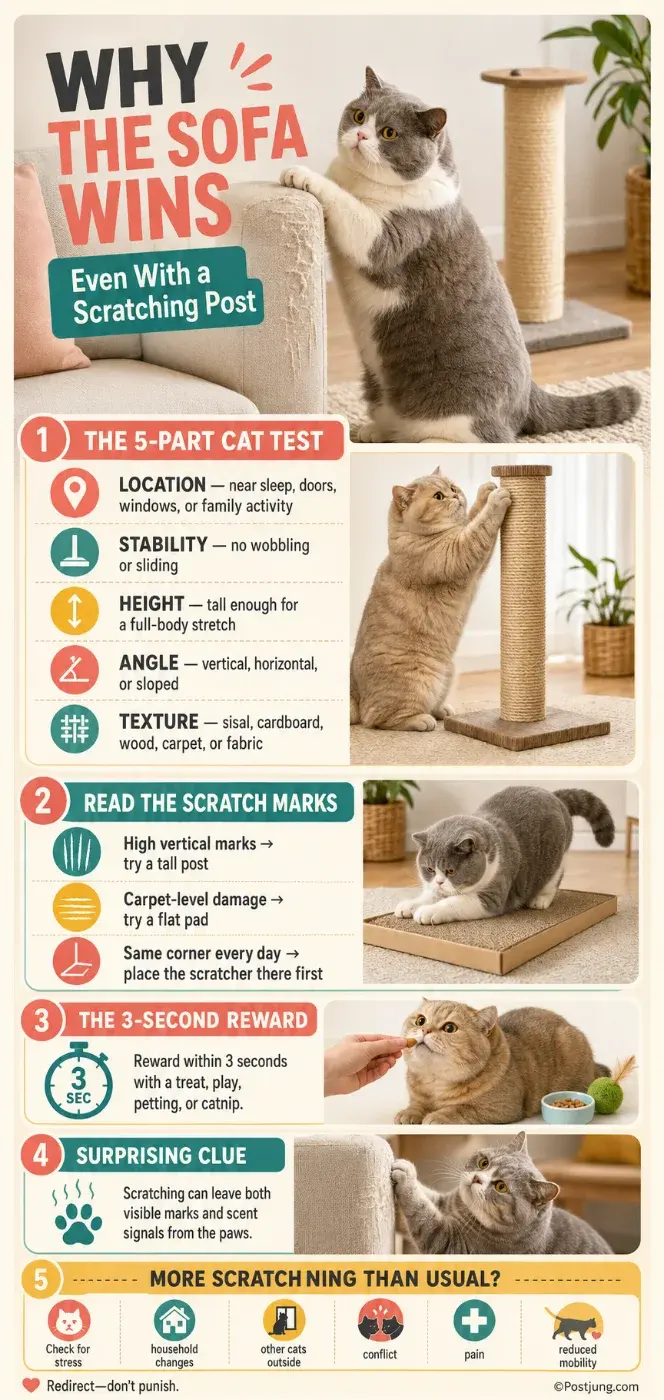
Consider the experience from the cat’s perspective. A sofa is heavy, stable, and tall enough to support a full-body stretch. Its corners provide a convenient vertical edge, while textured upholstery gives the claws resistance.
A small post may wobble, tip, or slide when the cat pulls against it. It may also be too short for the cat to extend its front legs and spine comfortably.
Stability matters as much as appearance. A post that moves under pressure can feel unreliable, even if it looks sturdy to its owner.
Some cats favor vertical scratching, while others prefer a horizontal or angled surface. Texture matters too: one cat may enjoy sisal, another may choose corrugated cardboard, carpet, rough fabric, or wood.
This means there is no single scratching post that appeals to every cat.
Scratching is also a location-based message
Cats do not necessarily scratch wherever a convenient object happens to be. Scratching helps create both visual marks and chemical signals left through glands around the paws.
That makes location important. Prominent household areas, doorways, windows, sleeping spaces, and frequently used pathways can be more meaningful than an isolated corner chosen for human convenience.
A sofa often occupies exactly the kind of socially important location a cat might select. It may sit in the room where the family gathers, beside a favorite sleeping place, or near a window where another cat can be seen or smelled.
The post must be where the behavior happens, not simply where it fits best with the décor.
Cats also commonly stretch and scratch after waking. A post across the room may lose to a sofa arm positioned just one step from the cat’s favorite nap spot.
Old scratch marks invite another visit
Once a cat has scratched a particular sofa corner, that location gains a history. The visible marks and accumulated scent can encourage the cat to return and refresh the signal.
Placing a new post elsewhere does not erase that attraction. A more effective first move is to position an appropriate scratcher directly beside—or temporarily in front of—the targeted area.
Furniture protectors or a securely placed throw can help interrupt access while the new habit develops. The alternative surface should be immediately available, stable, and similar in orientation to the furniture being scratched.
If the cat targets a vertical sofa arm, try a tall vertical post. If the cat pulls at carpet or the lower edge of the couch, test a horizontal or angled scratching board.
After the cat uses the new surface reliably, it can be moved gradually if necessary. Moving it too far or too quickly may send the cat back to the original spot.
Make the approved option rewarding
Cats can be encouraged to investigate a scratcher with treats, toys, catnip when appropriate, play, petting, or another reward they enjoy. Positive reinforcement works best when the reward follows the desired behavior immediately.
A dangling toy can be moved around the post to encourage the cat to reach and make contact with it. Owners can also reward spontaneous use whenever they notice it.
Avoid grabbing the cat’s paws and dragging them down the post. That may make the object unpleasant. Yelling, spraying water, or frightening the cat can also increase stress without teaching it which surface to use.
Punishment does not solve the cat’s underlying need to scratch. Veterinary behavior guidance favors offering attractive alternatives and rewarding their use.
Claw trimming may reduce the damage caused by scratching, but it does not eliminate the behavior itself. Anyone unfamiliar with trimming should ask a veterinarian or veterinary technician for a demonstration.
Declawing is not a simple nail trim; it involves surgical amputation of part of each toe and is opposed by major feline veterinary organizations as a routine response to furniture scratching.
A sudden increase can be meaningful
Occasional scratching is normal. A noticeable increase, especially in new or highly visible places, can be associated with tension or changes in the cat’s environment.
Possible triggers include a new pet, conflict between cats, unfamiliar visitors, moved furniture, changes in household routines, or outdoor cats appearing near windows and doors.
In a multi-cat home, one scratching station may not be enough. Providing multiple resources in separate locations can reduce competition and allow each cat to choose a preferred surface.
Older cats may also change how they scratch. A horizontal surface can be easier for a cat with reduced mobility than a tall vertical post requiring a long stretch.
If scratching changes abruptly or appears alongside hiding, aggression, appetite changes, mobility problems, overgrooming, or other unusual behavior, a veterinary examination is appropriate. Pain and stress should not be dismissed as disobedience.
Let the damaged furniture reveal the solution
The sofa can provide useful clues. Look at the exact location, direction, height, and material the cat repeatedly chooses.
Then reproduce those features in an acceptable form:
- Match a vertical target with a tall, firm vertical scratcher.
- Match carpet or floor scratching with a horizontal pad.
- Try different materials rather than repeatedly buying the same type.
- Place scratchers near existing targets and favorite sleeping areas.
- Offer more than one option in homes with multiple cats.
- Reward use promptly and consistently.
The best scratching post is the one the cat chooses. When its height, texture, orientation, stability, and placement compete successfully with the sofa, redirecting the behavior becomes far more realistic.
The goal is not to stop scratching. It is to give that normal behavior a place where both the cat and the furniture can live with it.
KEY TAKEAWAYS:
Cats scratch to maintain their claws, stretch, and communicate through visible and scent-based marks.
A post may be ignored because it is unstable, too short, the wrong texture, or positioned in an unimportant location.
Place a matching scratcher directly beside the targeted furniture and reward its use.
Punishment can increase stress and does not teach the cat where to scratch.
A sudden increase in scratching may justify checking for environmental stress, conflict, mobility issues, or pain.
REFERENCES:
https://icatcare.org/articles/scratching-on-furniture-and-carpets
https://catvets.com/resource/training-techniques-for-addressing-undesirable-behaviors/
https://www.avma.org/resources-tools/animal-health-and-welfare/animal-welfare/alternatives-declawing
https://pubmed.ncbi.nlm.nih.gov/29082814/

เขียนโดย Postjung Insights
 รู้หรือไม่? เปิดรายได้พนักงานส่งพัสดุของแต่ละแอป วันหนึ่งได้เท่าไร
 เปิดรายชื่อโรงเรียนในไทยที่ “ว่ายน้ำ” อยู่ในหลักสูตร เรียนจริงตั้งแต่อนุบาลถึงมัธยม
 Google ยอมรับแล้ว! Gemini AI เข้าถึงระบบบริษัทจริง 3 แห่ง ระหว่างการทดสอบความปลอดภัย
 อำเภอที่มีชื่ออำเภอสั้นที่สุด 3 อำเภอเท่านั้นในประเทศไทย
 โรงเรียนที่มีนักเรียนมากที่สุดในไทย
 ตาราง “เด่นเหนือเด่นใต้” งวด 1 ต.ค. 69 เปิดข้อมูลตามโพย เลขไหนอยู่ตรงไหน
 เลขเด็ดปฏิทิน "หลวงปู่โต๊ะ" งวดวันที่ 1 ตุลาคม 69..ส่องเลย เลขไหนให้โชค!
 5 คณะที่เรียนจบมาแล้ว มีอาชีพรองรับมากกว่าที่คิด
 เปิด 5 โรงเรียนหญิงล้วนเก่าแก่ของไทย ที่มีประวัติยาวนานกว่าศตวรรษ
 โรงเรียนเพียงแห่งเดียวของประเทศไทย ที่อยู่มาตั้งแต่ยุครัชกาลที่ 4
 ทำไมของพลาสติกเก่าบางชิ้นถึง “เหนียว” ขึ้นมาเอง ทั้งที่ไม่ได้เปื้อนอะไร?
 ดอลลาร์จะล่มสลายจริงไหม?5 คณะที่เรียนจบมาแล้ว มีอาชีพรองรับมากกว่าที่คิดเปิดรายชื่อโรงเรียนในไทยที่ “ว่ายน้ำ” อยู่ในหลักสูตร เรียนจริงตั้งแต่อนุบาลถึงมัธยมGoogle ยอมรับแล้ว! Gemini AI เข้าถึงระบบบริษัทจริง 3 แห่ง ระหว่างการทดสอบความปลอดภัยเลขเด็ดปฏิทิน "หลวงปู่โต๊ะ" งวดวันที่ 1 ตุลาคม 69..ส่องเลย เลขไหนให้โชค!ทำไมของพลาสติกเก่าบางชิ้นถึง “เหนียว” ขึ้นมาเอง ทั้งที่ไม่ได้เปื้อนอะไร?
 อุทยานเขาใหญ่เรียกตัว “ตีนผี” หลังขับจี้ช้างป่าพ่อลูก ลั่นระยะ 50 เมตรต้องจำให้ขึ้นใจ
 English Edition