Why Clicker Training Works for Many Pets—and When It Doesn’t

A clicker can tell a pet exactly which action earned a reward, making complicated skills easier to teach. The method is useful for many animals, but the sound itself is only one part of the process.
A small plastic clicker cannot reward a pet by itself. Its usefulness comes from what happens immediately afterward: the animal receives something it values, such as food, play, or access to a favorite activity.
Through repetition, the neutral clicking sound becomes a clear message: that exact action earned a reward. This precision can make training easier for dogs, cats, and other animals, especially when the desired behavior lasts only a moment.
The click works like a snapshot
Imagine teaching a cat to touch a target with its nose. By the time you reach forward with a treat, the cat may have turned its head, stepped backward, or looked at your hand. Which action earned the food?
A well-timed click marks the instant the cat’s nose touches the target. The treat can arrive a second or two later, but the animal has already been given information about the successful action.
Veterinary guidance from VCA Animal Hospitals describes clicker training as a form of positive-reinforcement training in which an audible signal precisely marks a desired behavior.
That makes the click less like a command and more like a camera shutter. It captures one small piece of behavior before the moment disappears.
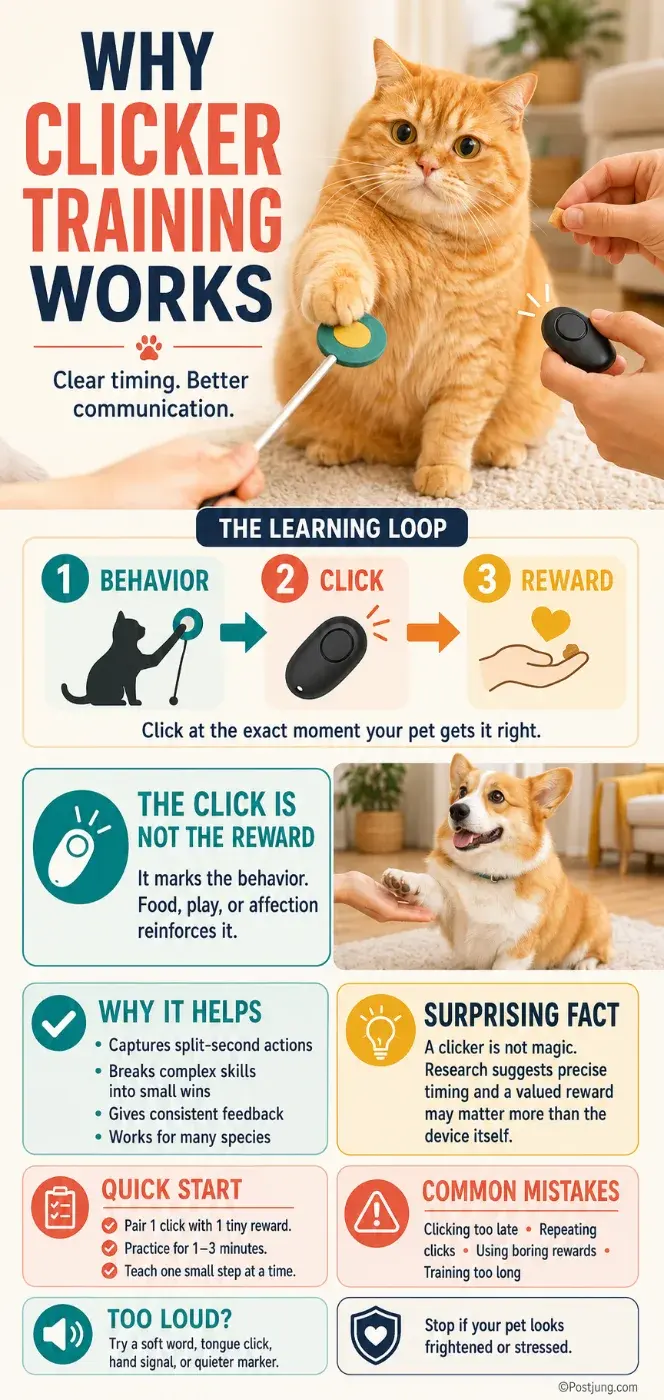
First, the sound has to acquire meaning
A pet is not born knowing what a clicker means. At first, the sound may be irrelevant, confusing, or even startling.
Owners commonly begin by pressing the clicker once and immediately delivering a small reward. After several pairings, many animals start looking for the reward when they hear the sound. Trainers often call this “charging” the clicker.
Once that association is established, the owner can click when the pet performs a desired action. The basic sequence is:
Desired behavior → click → reward
The order matters. Clicking after handing over the treat, or clicking while the animal is doing something else, weakens the message. The click identifies the behavior; the reward reinforces it.
One click should normally be followed by one reward, particularly while a new skill is being taught. If clicks sometimes lead to nothing, the marker may become less reliable.
Precision helps with more than tricks
Clicker training is often associated with shaking paws or rolling over, but its practical uses can be broader.
A cat might learn to enter a carrier, touch a target, or stand on a mat. A dog might learn to make eye contact, wait at a doorway, settle on a bed, or hold still briefly for grooming.
The method can also help owners shape a complicated action in small stages. Rather than waiting for the complete behavior, the trainer rewards gradual progress. A dog learning to lie on a mat, for example, might first be clicked for looking at it, then approaching it, placing a paw on it, and eventually lying down.
This process gives the animal frequent opportunities to succeed. Small, achievable steps reduce confusion and allow the trainer to adjust the lesson to the individual pet.
Reward-based training also aligns with guidance from the American Veterinary Society of Animal Behavior, which recommends reward-based methods for dog training and behavior modification.
The clicker may not be the special ingredient
Clickers are useful, but research does not show that the device is universally faster or better than every alternative.
A 2016 study published in Applied Animal Behaviour Science compared dogs trained with a clicker, a spoken marker, or food alone. It did not find a clear learning advantage unique to the clicker for the tasks studied. A later review of clickers and other conditioned reinforcers similarly found that the evidence for a special clicker effect remained limited.
That does not mean clicker training is pointless. It suggests that clear timing and consistent rewards may matter more than the particular sound being used.
A short word such as “yes,” a tongue click, a whistle, a hand signal, or another consistent marker can serve a similar purpose. Visual or tactile markers may be preferable for an animal that cannot hear, while a quieter verbal marker may suit a pet frightened by sharp noises.
The clicker’s practical advantage is consistency. Unlike a human voice, its sound does not change with mood, volume, or tone. It is also brief enough to mark a tiny movement accurately.
Common mistakes can blur the message
Clicker training becomes less effective when the marker is used like a remote control. Pressing repeatedly does not make a pet obey, and clicking before the desired behavior occurs does not explain what the animal should repeat.
Other common problems include sessions that run too long, rewards the pet does not value, and advancing before the animal understands the current step.
Keep initial sessions brief and finish while the pet is still interested. Use tiny food portions when appropriate so repeated rewards do not add unnecessary calories. Toys, play, affection, or access to something enjoyable may work better for some individuals.
Never click close to a pet’s ears. If the animal startles, flinches, retreats, freezes, or refuses to reengage, switch to a softer marker and give the pet space. Training should not depend on fear or discomfort.
Serious aggression, intense fear, separation-related distress, or sudden behavioral changes should not be treated as simple obedience problems. A veterinarian can check for pain or illness and, when needed, recommend a qualified reward-based behavior professional.
A shared language built one moment at a time
The clicker does not force an animal to cooperate. It helps the trainer communicate more accurately and makes the consequences of a successful choice easier to understand.
For many pets, that clarity turns training into an engaging problem-solving activity. For owners, it encourages close observation: instead of focusing only on mistakes, they learn to notice and reward the small moments when their pet gets something right.
The tool is optional. Clear communication is the essential part.
VCA Animal Hospitals, American Veterinary Society of Animal Behavior, Applied Animal Behaviour Science, Animals
REFERENCES:
https://vcahospitals.com/know-your-pet/behavior-modification---clicker-and-target-training
https://avsab.org/resources/position-statements/
https://www.sciencedirect.com/science/article/abs/pii/S0168159116302386
https://pmc.ncbi.nlm.nih.gov/articles/PMC7906040/

เขียนโดย Postjung Insights
 รู้หรือไม่? เปิดรายได้พนักงานส่งพัสดุของแต่ละแอป วันหนึ่งได้เท่าไร
 เปิดรายชื่อโรงเรียนในไทยที่ “ว่ายน้ำ” อยู่ในหลักสูตร เรียนจริงตั้งแต่อนุบาลถึงมัธยม
 Google ยอมรับแล้ว! Gemini AI เข้าถึงระบบบริษัทจริง 3 แห่ง ระหว่างการทดสอบความปลอดภัย
 ตาราง “เด่นเหนือเด่นใต้” งวด 1 ต.ค. 69 เปิดข้อมูลตามโพย เลขไหนอยู่ตรงไหน
 สถิติย้อนหลัง 10 ปี ออกเลขไหนบ้างมาดูกัน
 5 คณะที่เรียนจบมาแล้ว มีอาชีพรองรับมากกว่าที่คิด
 อำเภอที่มีชื่ออำเภอสั้นที่สุด 3 อำเภอเท่านั้นในประเทศไทย
 เลขเด็ดปฏิทิน "หลวงปู่โต๊ะ" งวดวันที่ 1 ตุลาคม 69..ส่องเลย เลขไหนให้โชค!
 โรงเรียนที่มีนักเรียนมากที่สุดในไทย
 อุทยานเขาใหญ่เรียกตัว “ตีนผี” หลังขับจี้ช้างป่าพ่อลูก ลั่นระยะ 50 เมตรต้องจำให้ขึ้นใจ
 ดอลลาร์จะล่มสลายจริงไหม?
 เปิด 5 โรงเรียนหญิงล้วนเก่าแก่ของไทย ที่มีประวัติยาวนานกว่าศตวรรษ5 คณะที่เรียนจบมาแล้ว มีอาชีพรองรับมากกว่าที่คิดเปิดรายชื่อโรงเรียนในไทยที่ “ว่ายน้ำ” อยู่ในหลักสูตร เรียนจริงตั้งแต่อนุบาลถึงมัธยมGoogle ยอมรับแล้ว! Gemini AI เข้าถึงระบบบริษัทจริง 3 แห่ง ระหว่างการทดสอบความปลอดภัยเลขเด็ดปฏิทิน "หลวงปู่โต๊ะ" งวดวันที่ 1 ตุลาคม 69..ส่องเลย เลขไหนให้โชค!
 ทำไมของพลาสติกเก่าบางชิ้นถึง “เหนียว” ขึ้นมาเอง ทั้งที่ไม่ได้เปื้อนอะไร?อุทยานเขาใหญ่เรียกตัว “ตีนผี” หลังขับจี้ช้างป่าพ่อลูก ลั่นระยะ 50 เมตรต้องจำให้ขึ้นใจ
 English Edition