Why Tiny Training Treats Work Better for Dogs
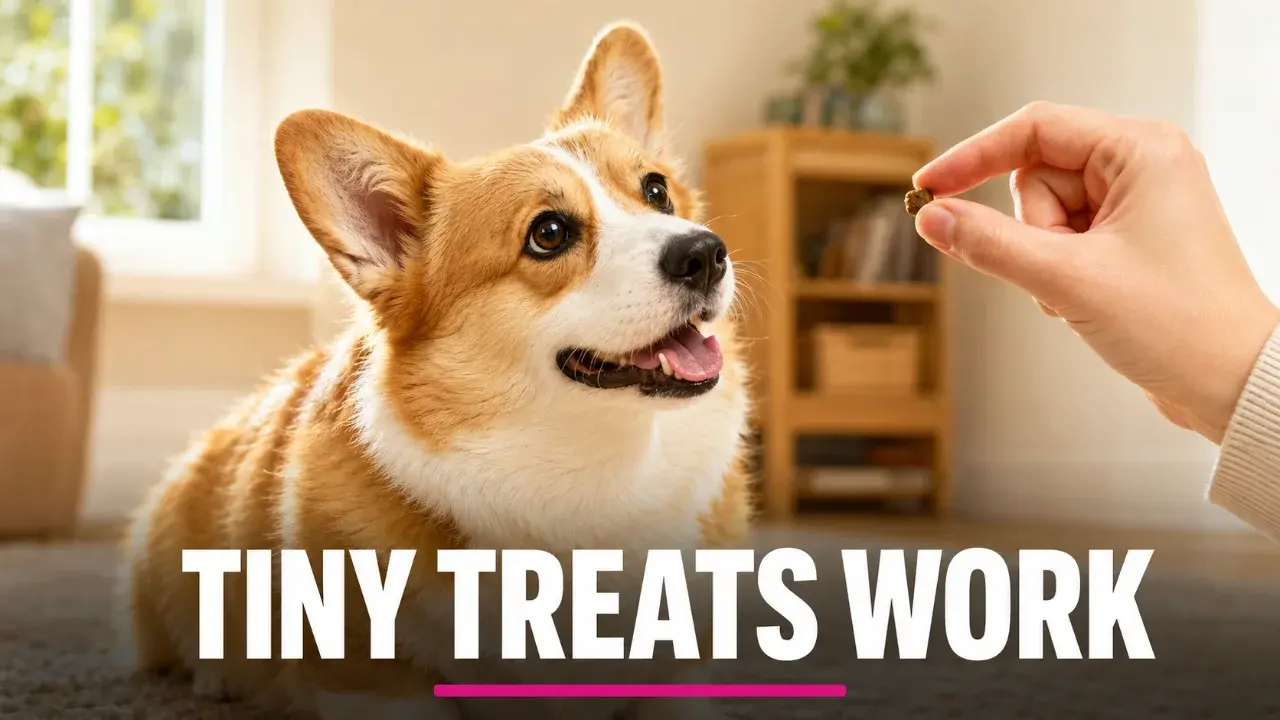
A training reward does not need to be large to feel valuable. Tiny pieces let dogs earn more repetitions without consuming an excessive share of their daily calories.
A dog may perform the same exercise dozens of times during one training session. If every correct response earns a full-size biscuit, the calories—and interruptions—can add up surprisingly fast.
That is why effective training rewards are usually tiny. The reward should mark success, not become a meal.
Dogs count rewards differently than people do
People often judge a treat by its size. A large cookie feels more generous than a crumb, so giving a dog a bigger piece can seem like the better reward.
Training works differently. The important event is the connection between the dog’s behavior and the consequence that immediately follows it. When a dog sits and quickly receives something it enjoys, that consequence makes the behavior more likely to be repeated.
The reward still needs to be appealing, but it does not always need to be large. A pea-sized or similarly small piece may be enough for many dogs, depending on the animal and the food being used.
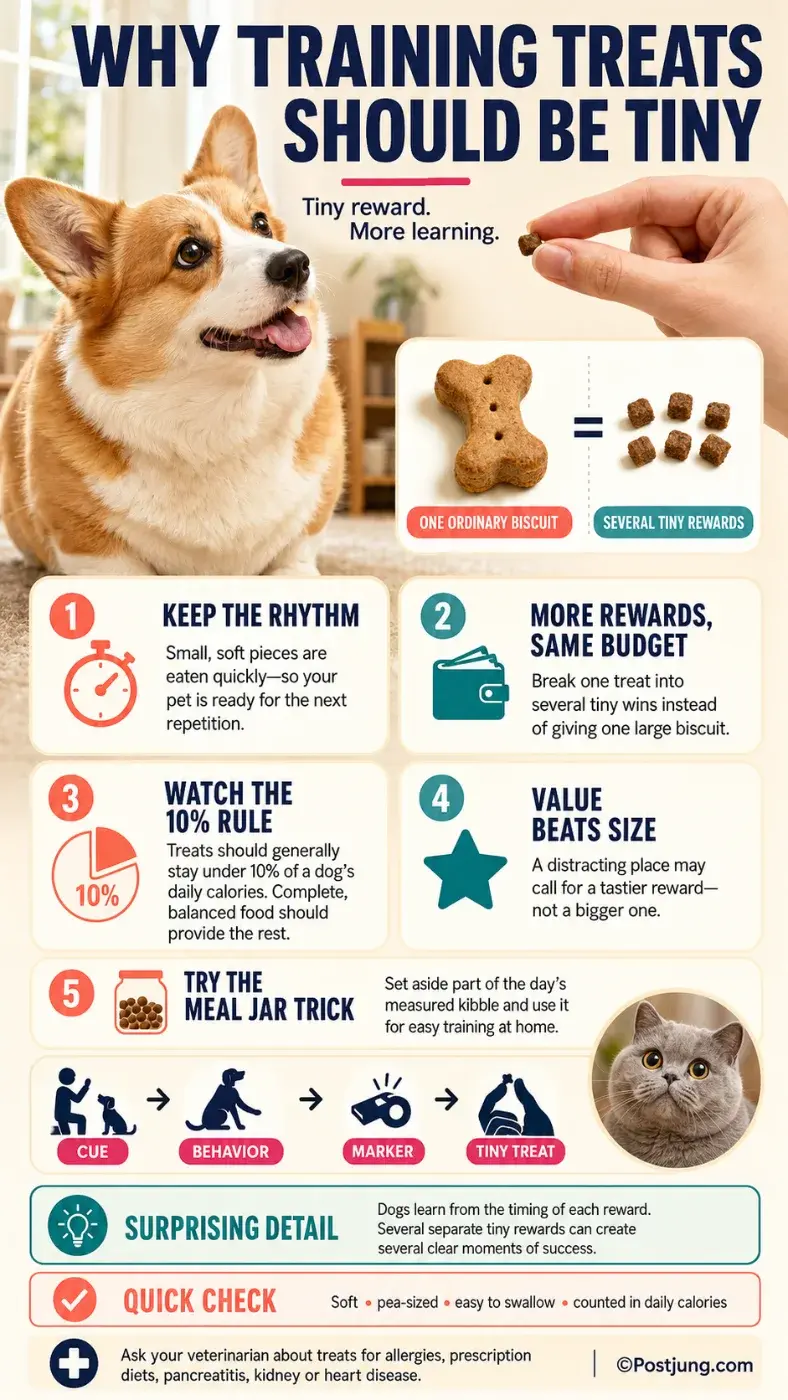
Several tiny pieces delivered separately may also create more training opportunities than one large piece containing the same amount of food. The dog experiences several distinct successes instead of one extended snack break.
Smaller pieces keep the lesson moving
Timing matters in reward-based training. Owners generally want to mark the correct response and deliver the reward promptly, before the dog becomes distracted or offers a different behavior.
A large, hard biscuit takes time to chew. Crumbs may scatter across the floor, shifting the dog’s attention from the person to a prolonged search for leftovers. Rich treats can also leave the dog thirsty or slow down a fast-moving practice session.
Tiny, soft pieces are usually eaten quickly. This creates a useful rhythm:
The dog performs the behavior, hears a marker such as “yes” or a click, receives the reward, and becomes ready for the next repetition.
That smooth sequence is especially helpful when teaching precise skills or practicing several short repetitions. More successful repetitions can mean clearer learning, provided the session remains enjoyable and the dog is not becoming tired, frustrated, or overexcited.
Treat calories accumulate during training
Training may involve far more rewards than owners realize. Ten rewards for “sit,” another ten for leash practice, and several more for coming when called can turn into a substantial amount of food by the end of the day.
VCA Animal Hospitals advises that treats should generally remain within 10% of a dog’s total daily calorie intake. The remaining calories should come from complete and balanced food appropriate for the dog.
This limit matters because many treats are supplemental rather than nutritionally complete. Regularly replacing too much of a balanced diet with treats can add excess calories and disturb the diet’s nutritional balance.
Breaking rewards into tiny pieces helps stretch that treat allowance across more repetitions. Owners can also set aside the entire day’s training portion in advance rather than repeatedly reaching into the package without tracking how much has been given.
Think in daily calories, not treat counts. Products vary widely in size and calorie density, so ten pieces of one treat may be very different from ten pieces of another.
Ordinary food may be enough at home
A reward does not always need to come from a special treat bag. Some dogs will happily work for pieces of their regular kibble, particularly in a quiet room where distractions are limited.
Using part of the dog’s measured meal for training can make calorie management easier. It also allows more of the day’s food to come from a complete and balanced diet.
The environment changes what a dog considers rewarding, however. Kibble that works in the kitchen may lose its appeal outside, where other dogs, unfamiliar smells, traffic, or wildlife compete for attention.
In a distracting setting, a dog may need a more desirable reward such as a tiny piece of soft commercial treat or another veterinarian-approved food. The answer is usually to increase the reward’s value—not necessarily its size.
Owners can reserve especially appealing treats for difficult behaviors, unfamiliar environments, recall practice, or situations in which the dog must disengage from a powerful distraction.
Tiny does not mean invisible
A treat still has to function as a reward. Making pieces so small that they are difficult to handle, repeatedly dropped, or barely noticed can disrupt training rather than improve it.
The practical size depends on the dog. A piece suitable for a large Labrador may overwhelm a toy breed, while a speck intended for a small dog may be awkward to deliver to a much larger animal. Texture matters too: soft food is often easier to divide and consume quickly than a large crunchy biscuit.
Owners should also consider chewing ability, age, allergies, digestive sensitivity, and medical conditions. Dogs on prescription diets or those with pancreatitis, kidney disease, heart disease, food allergies, or weight-management plans may need carefully selected rewards.
A veterinarian can help define an appropriate treat budget for dogs with special dietary or medical needs.
Food is useful, but it is not the only reward
The American Veterinary Society of Animal Behavior supports reward-based training and notes that rewards can include food, toys, play, attention, or access to something the dog wants.
Food is convenient because it is easy to deliver precisely, but owners can broaden the reward menu. A dog might earn permission to sniff a tree, chase a toy, greet a familiar person, or continue walking after checking in.
Once a behavior is well established, rewards may become more varied or less predictable. That does not mean abruptly removing reinforcement. It means recognizing that the best reward depends on the dog and the moment.
Tiny treats are therefore not about being stingy. They are a practical training tool: quick to deliver, easy to repeat, and simpler to fit into a healthy daily diet. To the dog, each small piece still carries a meaningful message—“That was the behavior I wanted.”
American Veterinary Society of Animal Behavior, VCA Animal Hospitals
REFERENCES:
https://avsab.org/wp-content/uploads/2021/08/AVSAB-Humane-Dog-Training-Position-Statement-2021.pdf
https://avsab.org/what-are-reward-based-training-methods-for-dogs-and-cats/
https://vcahospitals.com/know-your-pet/using-food-and-treats-for-training-dogs
https://vcahospitals.com/know-your-pet/dog-treats

เขียนโดย Postjung Insights
 ตาราง “เด่นเหนือเด่นใต้” งวด 1 ต.ค. 69 เปิดข้อมูลตามโพย เลขไหนอยู่ตรงไหน
 เปิดรายชื่อโรงเรียนในไทยที่ “ว่ายน้ำ” อยู่ในหลักสูตร เรียนจริงตั้งแต่อนุบาลถึงมัธยม
 โรงเรียนที่มีนักเรียนมากที่สุดในไทย
 Google ยอมรับแล้ว! Gemini AI เข้าถึงระบบบริษัทจริง 3 แห่ง ระหว่างการทดสอบความปลอดภัย
 5 คณะที่เรียนจบมาแล้ว มีอาชีพรองรับมากกว่าที่คิด
 รู้หรือไม่? เปิดรายได้พนักงานส่งพัสดุของแต่ละแอป วันหนึ่งได้เท่าไร
 จุฬาฯ มหาวิทยาลัยแห่งแรกของไทย มีจุดเริ่มต้นในสมัยรัชกาลที่ 5
 อำเภอที่มีชื่ออำเภอสั้นที่สุด 3 อำเภอเท่านั้นในประเทศไทย
 ทำไมของพลาสติกเก่าบางชิ้นถึง “เหนียว” ขึ้นมาเอง ทั้งที่ไม่ได้เปื้อนอะไร?
 เปิด 5 โรงเรียนหญิงล้วนเก่าแก่ของไทย ที่มีประวัติยาวนานกว่าศตวรรษ
 อุทยานเขาใหญ่เรียกตัว “ตีนผี” หลังขับจี้ช้างป่าพ่อลูก ลั่นระยะ 50 เมตรต้องจำให้ขึ้นใจ
 เลขเด็ดปฏิทิน "หลวงปู่โต๊ะ" งวดวันที่ 1 ตุลาคม 69..ส่องเลย เลขไหนให้โชค!5 คณะที่เรียนจบมาแล้ว มีอาชีพรองรับมากกว่าที่คิดเปิดรายชื่อโรงเรียนในไทยที่ “ว่ายน้ำ” อยู่ในหลักสูตร เรียนจริงตั้งแต่อนุบาลถึงมัธยมGoogle ยอมรับแล้ว! Gemini AI เข้าถึงระบบบริษัทจริง 3 แห่ง ระหว่างการทดสอบความปลอดภัยเลขเด็ดปฏิทิน "หลวงปู่โต๊ะ" งวดวันที่ 1 ตุลาคม 69..ส่องเลย เลขไหนให้โชค!ทำไมของพลาสติกเก่าบางชิ้นถึง “เหนียว” ขึ้นมาเอง ทั้งที่ไม่ได้เปื้อนอะไร?อุทยานเขาใหญ่เรียกตัว “ตีนผี” หลังขับจี้ช้างป่าพ่อลูก ลั่นระยะ 50 เมตรต้องจำให้ขึ้นใจ
 English Edition