What to Check Before Buying a Pet Water Fountain
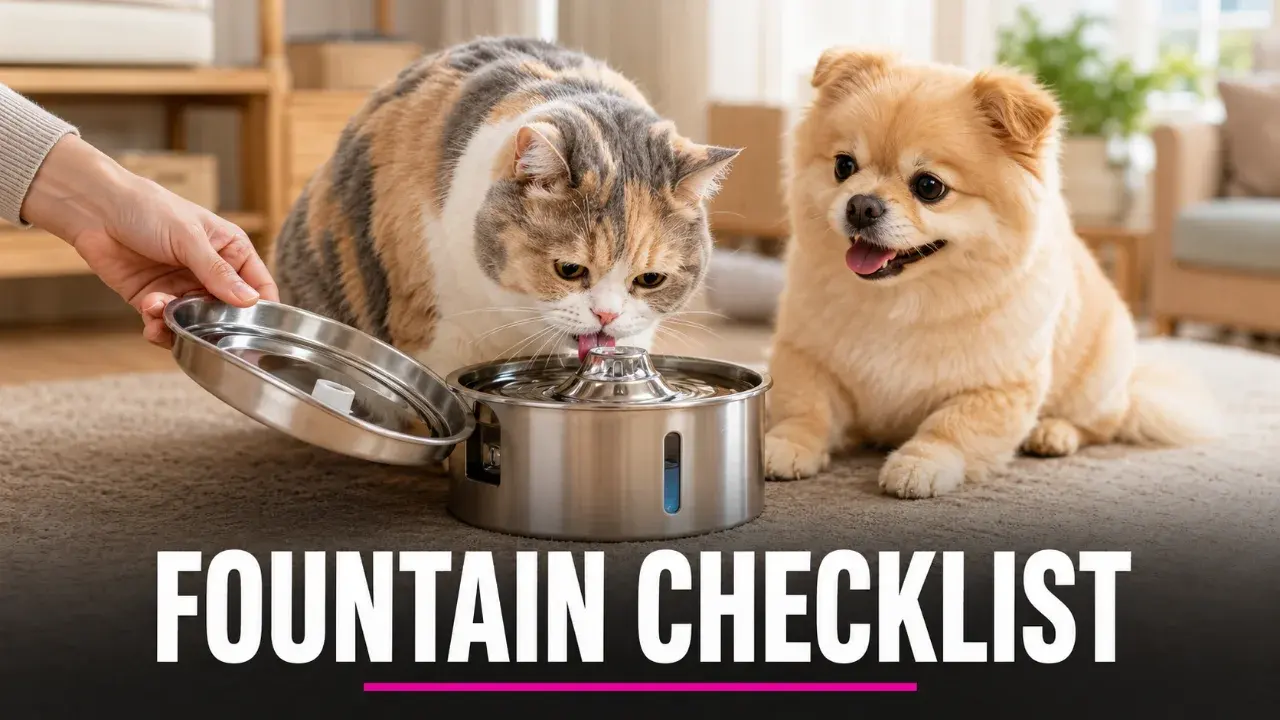
A quiet pump and attractive design are not enough. The best fountain for your pet should also be easy to clean, appropriately sized, electrically safe, and supported by readily available replacement parts.
A pet water fountain can make moving water more appealing to some cats and dogs. But the feature that matters most may not be the stream, filter, or smart sensor—it is whether you can keep the entire fountain clean.
Before buying one, look beyond the product photos. Check the drinking surface, pump design, replacement filters, noise level, capacity, power system, and how easily the unit comes apart.
Start with your pet, not the fountain
Some cats are drawn to running water, while others prefer a motionless bowl. Dogs also vary: a small, cautious dog may accept a gentle flow, while a large dog can empty or splash around a compact cat fountain quickly.
Fountains are therefore an option, not a universal upgrade. VCA Animal Hospitals recommends trying different bowl types and notes that some cats enjoy fountains, but individual preferences differ.
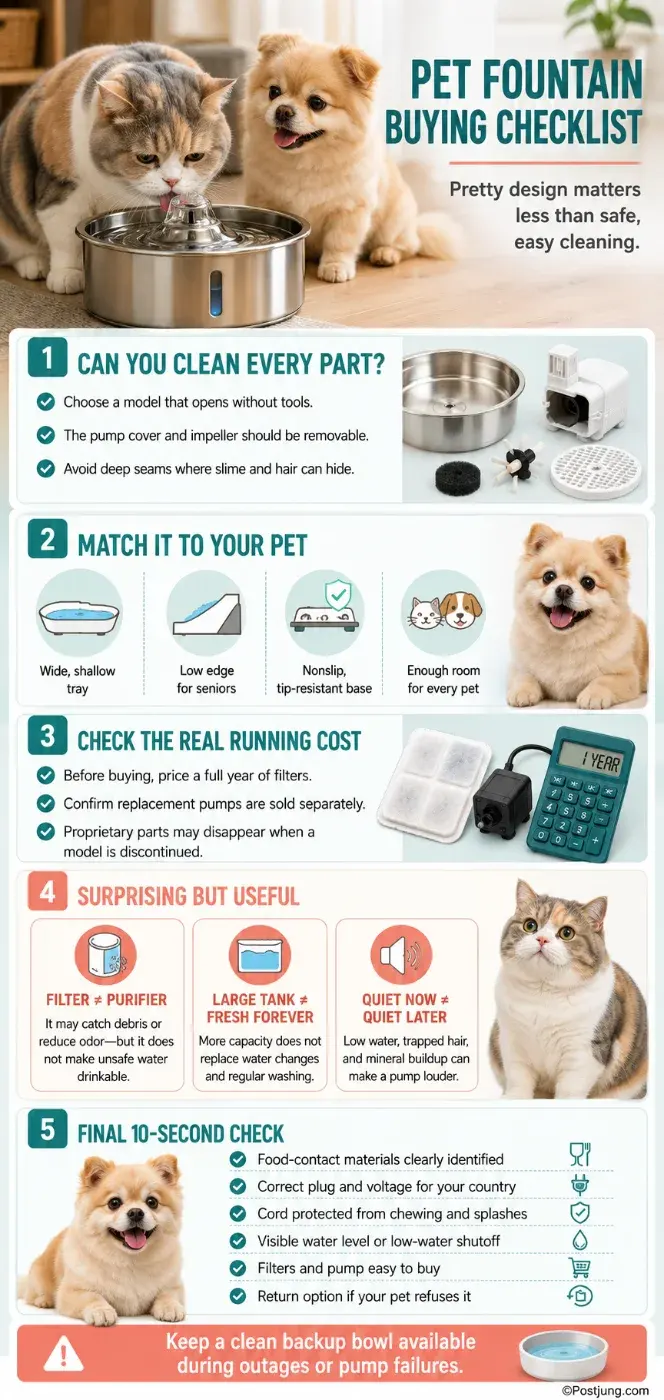
Consider your pet’s size, age, mobility, and habits. A senior animal may need a low drinking edge. A flat-faced breed may be more comfortable with a broad, shallow surface. A fountain for a multi-pet household needs enough open space to prevent one animal from blocking the others.
The unit should also be difficult to tip over. Check its filled weight, base width, and whether it has nonslip feet—especially if you have an enthusiastic dog or a cat that likes to paw at water.
The easiest fountain to clean usually wins
Every surface touched by water eventually needs attention. Pet hair, food particles, saliva, dust, and mineral deposits can collect in the basin, narrow channels, seams, pump housing, and filter compartment.
Look for a fountain that separates into a few simple pieces without special tools. Check whether you can reach the inside corners with a sponge or small brush. A beautiful sculpted design can become frustrating if it contains deep grooves that trap residue.
The pump deserves particular attention. Ask whether its cover and impeller can be removed for cleaning and whether the manufacturer provides clear instructions. Simply rinsing the basin may leave buildup hidden inside the pump.
Dishwasher-safe parts can save time, but verify exactly which components are safe for the dishwasher. Pumps, cords, adapters, and some coated parts usually require separate care.
Veterinary guidance consistently emphasizes access to fresh, clean water. VCA advises cleaning fountain filters weekly or according to the manufacturer’s directions. The full cleaning schedule may need to be more frequent in warm rooms, dusty environments, or homes with several pets.
A useful rule is simple: if cleaning looks inconvenient before purchase, it will not become easier later.
Compare materials carefully
Stainless steel, glazed ceramic, and pet-safe plastic can all be used successfully, but each has trade-offs.
Stainless steel is durable, relatively light, and easy to inspect for residue. Check the grade claimed by the manufacturer, the finish around seams, and whether the water-contact area is truly stainless steel rather than a thin removable plate over a plastic reservoir.
Ceramic fountains are heavier and can be difficult to tip. They may also be quieter because their weight helps reduce vibration. Inspect ceramic parts regularly for cracks or chipped glaze, which can create difficult-to-clean areas.
Plastic is lightweight and often less expensive. It can also scratch over time, particularly when cleaned with abrasive tools. Those scratches may become harder to wash thoroughly. If choosing plastic, look for clearly identified materials intended for food or drinking-water contact rather than relying only on an unexplained “premium” label.
“BPA-free” is common marketing language, but it does not describe the fountain’s entire construction or durability. The U.S. Food and Drug Administration evaluates food-contact materials based on their intended uses. Buyers should still assess the complete product, its instructions, and the credibility of its manufacturer.
Check the filter—and the cost of keeping it
Many fountains combine a physical screen with activated carbon or another filter medium. These components may catch debris or improve taste and odor, depending on their design, but a fountain filter is not a substitute for washing.
It should not be assumed to purify unsafe tap water, remove every contaminant, or make questionable water suitable for drinking. Fill the fountain with water that is already considered safe for your household and follow any local water guidance.
Before purchasing, find out:
- How often the filter must be replaced
- How much replacements cost over a year
- Whether filters are sold locally
- Whether generic replacements fit correctly
- What happens if the original model is discontinued
Check pump availability too. A replaceable pump can extend the useful life of the fountain; a proprietary pump that cannot be purchased separately may turn a minor failure into a full replacement.
Capacity, noise, and power matter every day
Choose capacity according to the number and size of pets, but do not treat a large tank as permission to leave the same water indefinitely. Water still needs to be refreshed, and the reservoir must be washed.
Look for a visible water-level indicator or a basin that is easy to inspect. A low-water shutoff can protect some pumps, but confirm how the feature works rather than assuming every fountain has one.
Noise is another common deal-breaker. Pumps may become louder when the water level drops or when hair and mineral deposits restrict circulation. Reviews can help identify recurring complaints, but also inspect the physical design: vibration isolation and stable assembly are more meaningful than broad claims such as “silent.”
For powered models, confirm that the plug, voltage, and frequency suit your country. Examine the cord routing, adapter, and distance between electrical connections and possible spills. VCA specifically advises owners to consider cord safety when introducing a fountain to a kitten.
In the United States, a recognized third-party electrical safety certification can provide more confidence than a vague “safety tested” claim. In Thailand and elsewhere in Southeast Asia, buyers should confirm compatibility with local voltage and plugs rather than depending on an adapter of uncertain quality.
Cord-chewing pets require extra precautions. Keep connections dry, route the cable where the animal cannot pull or bite it, and stop using any unit with damaged wiring, cracks, leakage, overheating, or an unusual odor.
Keep another water source available
A fountain depends on electricity and a working pump. Power outages, blocked pumps, damaged cords, or an accidentally unplugged adapter can stop circulation.
Keeping a clean bowl elsewhere gives your pet another option. Multiple water stations can also help in multi-level homes or when one pet guards a shared fountain.
A fountain should never be used to dismiss a meaningful change in drinking behavior. Sudden increases or decreases in thirst can be associated with diet, weather, stress, or illness. Persistent changes deserve veterinary attention, particularly when accompanied by lethargy, vomiting, appetite changes, weight loss, or unusual urination.
The best fountain is not necessarily the smartest or most expensive one. It is the model your pet willingly uses, you can clean completely, and you can maintain without hunting for discontinued filters every month.
Cornell University College of Veterinary Medicine, VCA Animal Hospitals, U.S. Food and Drug Administration, UL Solutions
REFERENCES:
https://www.vet.cornell.edu/departments-centers-and-institutes/cornell-feline-health-center/health-information/feline-health-topics/hydration
https://vcahospitals.com/resources/preventive-cat/nutrition/tips-to-encourage-cats-to-drink-more-water
https://vcahospitals.com/pediatric/kitten/health-wellness/how-to-keep-your-kitten-hydrated
https://www.fda.gov/food/food-ingredients-packaging/food-packaging-other-substances-come-contact-food-information-consumers

เขียนโดย Postjung Insights
 รู้หรือไม่? เปิดรายได้พนักงานส่งพัสดุของแต่ละแอป วันหนึ่งได้เท่าไร
 อำเภอที่มีชื่ออำเภอสั้นที่สุด 3 อำเภอเท่านั้นในประเทศไทย
 โรงเรียนที่มีนักเรียนมากที่สุดในไทย
 5 คณะที่เรียนจบมาแล้ว มีอาชีพรองรับมากกว่าที่คิด
 Google ยอมรับแล้ว! Gemini AI เข้าถึงระบบบริษัทจริง 3 แห่ง ระหว่างการทดสอบความปลอดภัย
 สถิติย้อนหลัง 10 ปี ออกเลขไหนบ้างมาดูกัน
 เปิดรายชื่อโรงเรียนในไทยที่ “ว่ายน้ำ” อยู่ในหลักสูตร เรียนจริงตั้งแต่อนุบาลถึงมัธยม
 เลขเด็ดปฏิทิน "หลวงปู่โต๊ะ" งวดวันที่ 1 ตุลาคม 69..ส่องเลย เลขไหนให้โชค!
 อุทยานเขาใหญ่เรียกตัว “ตีนผี” หลังขับจี้ช้างป่าพ่อลูก ลั่นระยะ 50 เมตรต้องจำให้ขึ้นใจ
 ตาราง “เด่นเหนือเด่นใต้” งวด 1 ต.ค. 69 เปิดข้อมูลตามโพย เลขไหนอยู่ตรงไหน
 จุฬาฯ มหาวิทยาลัยแห่งแรกของไทย มีจุดเริ่มต้นในสมัยรัชกาลที่ 5
 โรงเรียนเพียงแห่งเดียวของประเทศไทย ที่อยู่มาตั้งแต่ยุครัชกาลที่ 45 คณะที่เรียนจบมาแล้ว มีอาชีพรองรับมากกว่าที่คิดเปิดรายชื่อโรงเรียนในไทยที่ “ว่ายน้ำ” อยู่ในหลักสูตร เรียนจริงตั้งแต่อนุบาลถึงมัธยมGoogle ยอมรับแล้ว! Gemini AI เข้าถึงระบบบริษัทจริง 3 แห่ง ระหว่างการทดสอบความปลอดภัยเลขเด็ดปฏิทิน "หลวงปู่โต๊ะ" งวดวันที่ 1 ตุลาคม 69..ส่องเลย เลขไหนให้โชค!
 ทำไมของพลาสติกเก่าบางชิ้นถึง “เหนียว” ขึ้นมาเอง ทั้งที่ไม่ได้เปื้อนอะไร?อุทยานเขาใหญ่เรียกตัว “ตีนผี” หลังขับจี้ช้างป่าพ่อลูก ลั่นระยะ 50 เมตรต้องจำให้ขึ้นใจ
 English Edition