Why Moving House Is So Stressful for Cats and Dogs

A new address may feel exciting to people, but pets experience unfamiliar rooms, scents, sounds, and routines all at once. Careful preparation can reduce anxiety and help them settle safely.
Moving house does not simply give a pet a new place to sleep. It removes many of the scents, landmarks, sounds, and routines that told the animal it was safe.
That disruption may begin weeks before the move, when boxes appear and furniture starts disappearing. It can continue after arrival, even when the new home appears peaceful to everyone else.
Home is a map made of scent and routine
People understand that their belongings are being packed for a temporary journey. Pets cannot be given the same explanation.
Cats rely heavily on familiar territory and scent. Their beds, scratching areas, doorways, hiding places, and even furniture all contribute to an invisible map of home. Moving replaces that map with unfamiliar smells and spaces that have not yet been identified as safe.
Dogs may be more socially focused, but they also depend on predictable patterns. Walks, meals, periods alone, household activity, and familiar neighborhood sounds help them anticipate what will happen next.
A move can change all of those signals at once. The problem is not just the new building; it is the sudden loss of predictability.
Packing may also reduce the attention pets receive. Doors remain open, strangers enter the property, and owners become busy or tense. A pet that normally copes well with small changes can become unsettled when several happen together.
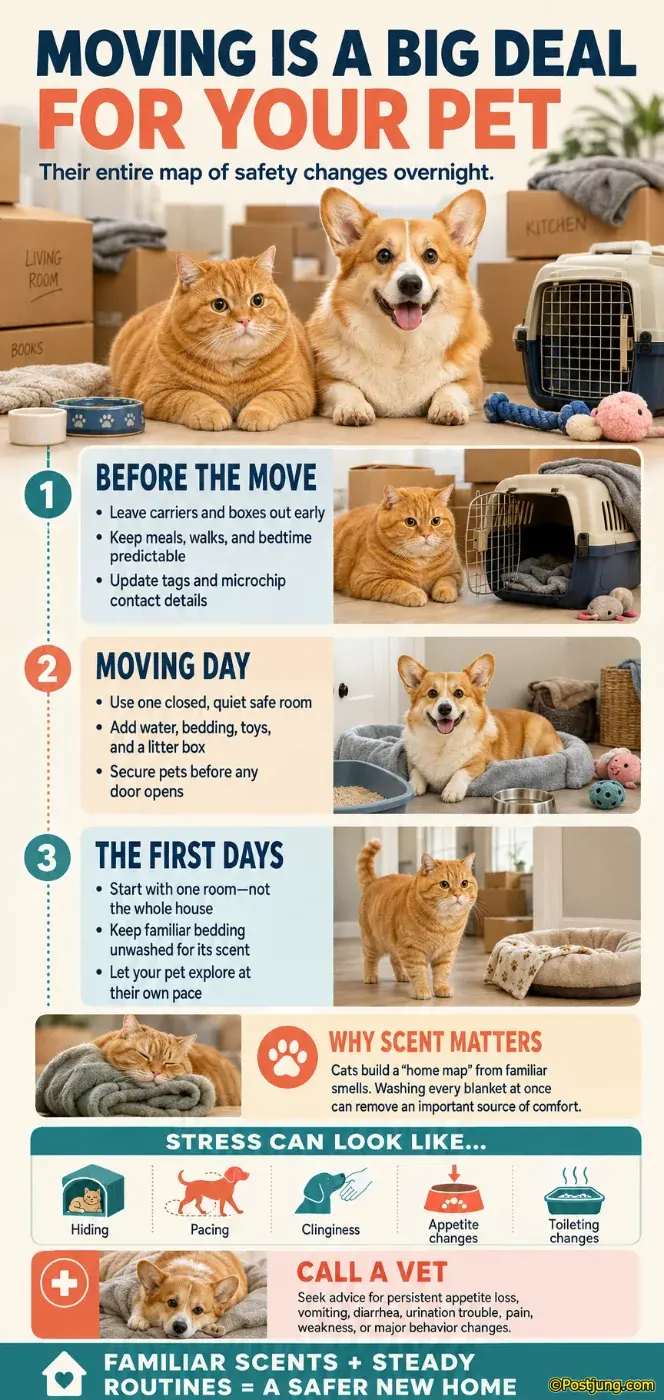
Stress does not always look dramatic
Some animals hide or become unusually quiet. Others pace, vocalize, follow their owners constantly, scratch, chew, or appear unable to relax.
Possible signs of stress can include:
- Avoiding people or hiding more than usual
- Pacing, panting, trembling, or increased vocalization
- Changes in appetite, sleep, or toileting
- Clinginess or difficulty being left alone
- Increased scratching, chewing, or scent marking
- Irritability toward people or other animals
These behaviors should not automatically be treated as disobedience. Punishment can add another source of fear to an animal that is already struggling.
At the same time, owners should not assume every change is emotional. Appetite loss, vomiting, diarrhea, urination problems, pain, weakness, or a major behavioral change may have a medical cause. Stress and illness can look similar, so concerning or persistent symptoms deserve veterinary advice.
The riskiest moment may be moving day
Open doors, unfamiliar workers, loud noises, and displaced furniture make moving day particularly hazardous. A frightened cat or dog may bolt, hide inside packing materials, or slip outside unnoticed.
The ASPCA recommends keeping pets in a quiet, familiar room with the door closed—or arranging for them to stay with someone trusted—while belongings are being moved.
Prepare that secure area with water, bedding, familiar toys, and any species-appropriate necessities, such as a litter box. Tell everyone involved in the move that the room must remain closed.
Transport animals in a secure carrier or appropriate vehicle restraint. Make sure identification and microchip contact information are current before the move rather than waiting until after arrival.
Escape prevention matters as much as emotional comfort.
Give the new home a smaller starting point
It can be tempting to let a pet explore every room immediately. For a nervous animal, however, a large unfamiliar space may feel less like freedom and more like exposure.
Start with one quiet room containing familiar bedding, food, water, toys, and other essentials. Items carrying the pet’s own scent can help make the room feel recognizable. Unless something is dirty or unsafe, avoid washing every blanket and bed immediately before the move.
Cats may benefit from hiding places, elevated resting areas, scratching surfaces, and gradual access to additional rooms. Keep food, water, and litter facilities in appropriate separate locations rather than crowding everything together.
Dogs can be introduced to the property calmly, with access expanding as they become comfortable. Supervised walks around the new neighborhood can help them learn its sounds and smells without overwhelming them.
Let the pet set the pace. One animal may investigate within hours, while another may need days or longer before behaving normally.
Outdoor access requires particular care. A newly moved cat may not yet recognize the property as home and could try to return to its former territory. Follow veterinary or reputable animal-welfare guidance before allowing outdoor exploration, especially if the old home is nearby.
Familiar schedules rebuild predictability
Owners may be surrounded by boxes for weeks, but basic routines can still remain stable.
Try to preserve regular meal times, walks, play sessions, bedtime habits, and periods of companionship. Dogs that will eventually spend time alone should be introduced to that routine gradually, rather than going from constant company during the move to a full day alone.
Cats should have dependable access to quiet resting places and essential resources. In multi-pet homes, provide enough separate resources to reduce competition when every animal is already adapting.
Pheromone products may help some pets, but they are not substitutes for a secure environment, gradual adjustment, or professional care. Owners should consult a veterinarian before giving calming supplements or medication. Never use human sedatives without veterinary direction.
A successful move is not measured by how quickly every room is unpacked. For a pet, success means gradually discovering that meals still arrive, favorite people remain nearby, resting places are protected, and this unfamiliar territory is becoming home.
American Society for the Prevention of Cruelty to Animals, Cats Protection, Blue Cross
REFERENCES:
https://www.aspca.org/pet-care/general-pet-care/moving-your-pet
https://www.cats.org.uk/help-and-advice/home-and-environment/moving-home-with-your-cat
https://www.bluecross.org.uk/advice/cat/moving-house-and-travelling-with-cats
https://www.bluecross.org.uk/advice/dog/moving-house-and-travelling-with-dogs

เขียนโดย Postjung Insights
 เจาะลึกรายได้พนักงานส่งอาหารแต่ละวันได้เท่าไร/หักค่าใช้จ่ายอะไรบ้าง
 รู้หรือไม่? เปิดรายได้พนักงานส่งพัสดุของแต่ละแอป วันหนึ่งได้เท่าไร
 เกษียณแล้วทำอะไรดี เปิด 4 กลุ่มอาชีพที่ผู้สูงวัยไทยทำกันน้อย จากข้อมูล 5.26 ล้านคน
 อำเภอที่มีชื่ออำเภอสั้นที่สุด 3 อำเภอเท่านั้นในประเทศไทย
 เลขเด็ดไพ่ยิปซี งวด 1 ตุลาคม 2569 รวมเลขเด่นและเลขท้าย 2 ตัว
 เปิดศึกเลขเด็ดงวดนี้! เจ้าพ่อปากแดง ปะทะ เจ้าแม่ตะเคียนทอง งวด 1 ต.ค. 59 คัดมาให้เน้นๆ พร้อมลุ้นรวย
 ความลับ 30 ล้านปีของ “แม่น้ำไนล์”: ทำไมสายน้ำสายนี้ถึงไม่เคยเหือดแห้งกลางทะเลทรายซาฮารา
 ส่องเลข 3 สำนักพิมพ์ งวด 1 ต.ค. 69 ตัวไหนมีข้อมูลตรงกัน
 โรงเรียนที่มีนักเรียนมากที่สุดในไทย
 เปิด 5 โรงเรียนหญิงล้วนเก่าแก่ของไทย ที่มีประวัติยาวนานกว่าศตวรรษ
 สุดระทึก! ไฟไหม้รางรถไฟฟ้า MRT สถานีเตาปูน-บางโพ..หยุดให้บริการชั่วคราวทุกสถานี
 ตาราง “เด่นเหนือเด่นใต้” งวด 1 ต.ค. 69 เปิดข้อมูลตามโพย เลขไหนอยู่ตรงไหนสุดระทึก! ไฟไหม้รางรถไฟฟ้า MRT สถานีเตาปูน-บางโพ..หยุดให้บริการชั่วคราวทุกสถานีเจาะลึกรายได้พนักงานส่งอาหารแต่ละวันได้เท่าไร/หักค่าใช้จ่ายอะไรบ้างเปิด 5 โรงเรียนหญิงล้วนเก่าแก่ของไทย ที่มีประวัติยาวนานกว่าศตวรรษ
 เปิด 5 สินค้าส่งออกของลาวที่คนไทยอาจคาดไม่ถึง หนึ่งในนั้นทำเงินเกือบ 1 พันล้านดอลลาร์เกษียณแล้วทำอะไรดี เปิด 4 กลุ่มอาชีพที่ผู้สูงวัยไทยทำกันน้อย จากข้อมูล 5.26 ล้านคน
 โรงเรียนเพียงแห่งเดียวของประเทศไทย ที่อยู่มาตั้งแต่ยุครัชกาลที่ 4
 English Edition