Why Senior Pet Food Is More Than Marketing—But the Label Is Not Enough

Aging can change a dog’s or cat’s nutritional needs, making the right food genuinely useful. But “senior” is not a standardized nutritional life stage, so owners still need to examine the formula—and the pet eating it.
The gray muzzle may appear first. Then come shorter walks, longer naps, a changing appetite, or a body that no longer holds muscle as easily as it once did.
This is when many owners encounter shelves of food marked “senior,” often packaged with silver lettering and images of calm, older pets. It is reasonable to wonder whether the product is meaningfully different or whether manufacturers are simply selling aging back to us in a new bag.
The most accurate answer is more nuanced: senior pet nutrition is not merely a marketing invention, but the word “senior” does not guarantee that a food meets one universal standard.
Aging can change what a pet needs from food
Older dogs and cats do not all age in the same way. Some become less active and gain excess weight. Others lose muscle, struggle to maintain weight, develop dental discomfort, or live with diseases that affect their nutritional needs.
The American Animal Hospital Association notes that senior pets can experience changes in energy requirements as well as muscle or overall weight loss. These changes may be associated with aging itself or an underlying disease.
That creates a real reason for age-conscious nutrition. Depending on the individual animal, an appropriate diet may help deliver:
- A calorie level suited to lower activity or changing metabolism
- Enough high-quality protein to support lean body mass
- A texture that is easier to chew
- More moisture for pets that do not drink enough
- Nutrients selected to support mobility, skin, digestion, or cognitive health
- A balance designed for a diagnosed medical condition
The crucial phrase is “depending on the individual animal.” An overweight older dog and a thin older dog with muscle loss should not automatically receive the same nutritional treatment simply because both qualify as seniors.
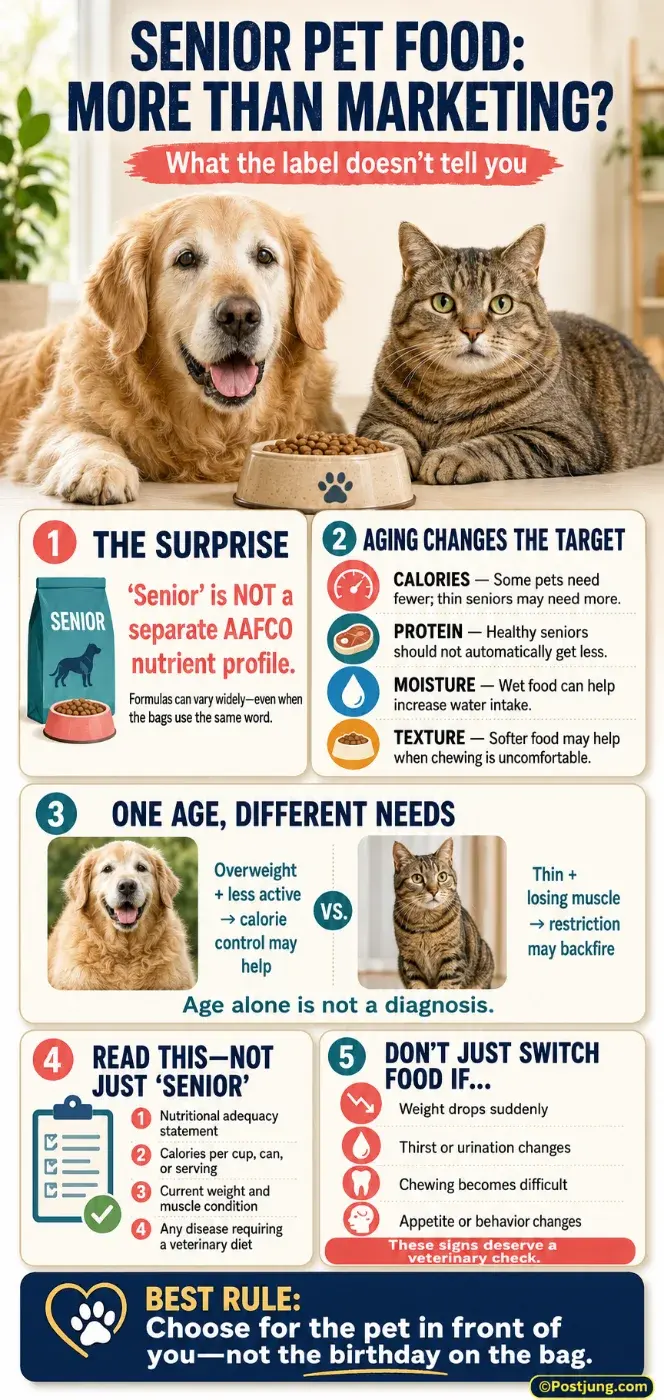
“Senior” is not a universal nutrition standard
This is the detail many shoppers miss.
The Association of American Feed Control Officials, whose model regulations influence pet food labeling in the United States, recognizes nutritional profiles associated with growth, reproduction, adult maintenance, and all life stages. It does not list “senior” as a distinct nutrient profile for dogs or cats.
That means manufacturers can formulate senior products differently. One may contain fewer calories than the company’s regular adult food. Another may emphasize protein, fiber, fatty acids, antioxidants, or ingredients marketed for joint support. A third may differ only modestly from an adult-maintenance formula.
So the term can identify a product intended for older animals, but it cannot tell owners exactly what is inside or whether those differences suit their pet.
This does not make every senior formula empty marketing. It means the useful information is found beyond the large word on the front of the package.
Less protein is not automatically better
One persistent assumption is that all older pets should eat less protein. That can be an unhelpful oversimplification.
Aging animals may lose lean muscle, and adequate dietary protein can be important for maintaining it. Arbitrarily restricting protein in a healthy senior pet could work against that goal.
A diagnosed illness may change the recommendation. Chronic kidney disease, for example, can require a carefully designed therapeutic diet with controlled levels of certain nutrients. But a veterinary kidney diet is not interchangeable with an ordinary bag labeled “senior,” and age by itself is not a diagnosis.
This distinction matters especially for cats. Older cats can become overweight, but some become too thin. Cornell University’s Feline Health Center advises owners to involve a veterinarian when an aging cat gains or loses weight because medical problems may be responsible.
Calories matter, but they should not be judged alone
Some senior foods are less calorie-dense, which may help an inactive pet avoid weight gain. That feature is not appropriate for every older animal.
A dog that is already thin, losing muscle, or eating poorly may need a more calorie-dense approach. A cat that suddenly loses weight should not simply be offered a “better senior food” while the change goes unexplained.
Weight changes in an older pet can be an early sign of illness. Dental pain, kidney disease, thyroid disorders, diabetes, cancer, digestive problems, and other conditions may affect appetite or body weight. Food can support treatment, but it should not delay an examination.
Moisture and texture may become more important
The value of senior food is not limited to its nutrient percentages.
Dental disease may make hard pieces uncomfortable to chew. Reduced appetite can make aroma, flavor, and texture increasingly important. Wet food can also increase water intake, which may be useful for some pets—although it is not a substitute for veterinary treatment when a disease is present.
Cornell emphasizes that older cats need easy access to clean water, particularly because kidney function commonly deteriorates with age. Owners can also place water in several convenient locations and observe whether drinking habits change.
An unexplained increase or decrease in thirst deserves veterinary attention.
How to evaluate a senior food
Begin with the nutritional adequacy statement rather than the illustration on the front. For many healthy older pets, the product should be complete and balanced for adult maintenance or another life stage appropriate to that animal.
Then consider questions that connect the food to the pet:
- Is the pet maintaining an appropriate body condition?
- Is muscle becoming less prominent over the spine, hips, or limbs?
- Has appetite, thirst, stool quality, or activity changed?
- Is chewing difficult?
- How many calories does the food provide per cup, can, or serving?
- Does the pet have a medical condition that requires a therapeutic diet?
- Can the manufacturer provide clear nutrient and quality-control information?
Ingredient lists alone do not reveal a food’s overall nutritional quality. Nutrient balance, digestibility, calorie density, manufacturing controls, and how the animal responds all matter.
There is no automatic birthday for switching
“Senior” is not one fixed age across every dog and cat. A large dog may show age-related changes earlier than a small dog, while cats also vary widely in health and longevity.
Rather than switching food on a birthday, owners can use life stage as a signal to begin more careful monitoring. Body weight, muscle condition, dental health, mobility, appetite, laboratory findings, and diagnosed illnesses provide better guidance than age alone.
Cornell’s guidance for senior dogs similarly stresses that there is no single diet for every older animal. Obesity, arthritis, and loss of lean tissue are different problems and may require different nutritional strategies.
Change food gradually—and watch the pet
Unless a veterinarian recommends another method, transition to a new food gradually. Mixing increasing amounts of the new formula with decreasing amounts of the old one over several days can reduce digestive upset and reveal whether the pet accepts it.
After the transition, monitor more than whether the bowl becomes empty. Watch body weight, muscle condition, stool, energy, skin and coat, thirst, urination, and willingness to eat.
For a senior pet, refusal to eat, unexplained weight loss, repeated vomiting, marked thirst, difficulty chewing, or a major behavior change should prompt veterinary advice rather than another round of food experimentation.
Senior nutrition is real because aging produces real changes. Yet the best diet is not necessarily the one with the largest “senior” label. It is the one that is complete, appropriate for the animal’s current health, eaten willingly, and reassessed as those needs change.
American Animal Hospital Association, Association of American Feed Control Officials, Cornell University College of Veterinary Medicine
REFERENCES:
https://www.aaha.org/resources/2023-aaha-senior-care-guidelines-for-dogs-and-cats/nutrition/
https://www.aafco.org/consumers/understanding-pet-food/selecting-the-right-pet-food/
https://www.vet.cornell.edu/departments-centers-and-institutes/riney-canine-health-center/canine-health-topics/choosing-food-your-senior-dog
https://www.vet.cornell.edu/departments-centers-and-institutes/cornell-feline-health-center/health-information/feline-health-topics/loving-care-older-cats

เขียนโดย Postjung Insights
 รู้หรือไม่? เปิดรายได้พนักงานส่งพัสดุของแต่ละแอป วันหนึ่งได้เท่าไร
 ซาบีดา” เรียกถกด่วน ปมภาพ “ชุดไทย” ถูกนำไปอ้างเป็นชุดกัมพูชา
 แปลปกสลาก งวด 1 ต.ค. 69 ส่องตัวเลขจากภาพปกสลากกินแบ่งรัฐบาล
 Ctrip แพลตฟอร์มการท่องเที่ยวของจีน เปิดขายตั๋วสำหรับทริปท่องเที่ยวอวกาศ ของ Virgin Galactic 6 วัน ในราคาประมาณ 24 ล้านบาท
 โรงเรียนที่มีนักเรียนมากที่สุดในไทย
 เปิด 5 โรงเรียนหญิงล้วนเก่าแก่ของไทย ที่มีประวัติยาวนานกว่าศตวรรษ
 เปิดรายชื่อ 5 โรงเรียนเป้าหมาย เด็กสอบเข้าต้องเตรียมตัวให้พร้อม
 ตาราง “เด่นเหนือเด่นใต้” งวด 1 ต.ค. 69 เปิดข้อมูลตามโพย เลขไหนอยู่ตรงไหน
 อำเภอที่มีชื่ออำเภอสั้นที่สุด 3 อำเภอเท่านั้นในประเทศไทย
 หนุ่มขับ Porsche ใจหล่อสุดๆ ติดประกาศเด็กหายไว้รอบคัน..หวังช่วยเผยแพร่ข้อมูลให้ตามหาได้เร็วขึ้น
 'สควีชชี่'ของเล่นที่กำลังเป็นไวรัลอาจถูกเจ้าหน้าที่ของสนามบินยึดได้ ตรวจสอบให้ดีก่อนนำขึ้นเครื่อง
 โรสแมรี่ แฮร์ริส ‘ป้าเมย์’ แห่ง Spider-Man ฉบับโทบีย์ แม็คไกวร์ อายุครบ 99 ปีซาบีดา” เรียกถกด่วน ปมภาพ “ชุดไทย” ถูกนำไปอ้างเป็นชุดกัมพูชาเปิดรายชื่อ 5 โรงเรียนเป้าหมาย เด็กสอบเข้าต้องเตรียมตัวให้พร้อมหนุ่มขับ Porsche ใจหล่อสุดๆ ติดประกาศเด็กหายไว้รอบคัน..หวังช่วยเผยแพร่ข้อมูลให้ตามหาได้เร็วขึ้น
 วาบิ-ซาบิ (Wabi-Sabi) ปรัชญาญี่ปุ่นที่สอนให้เราโอบกอดความไม่สมบูรณ์แบบ
 English Edition