Why Dogs Can Seem Fine When They’re Actually in Pain

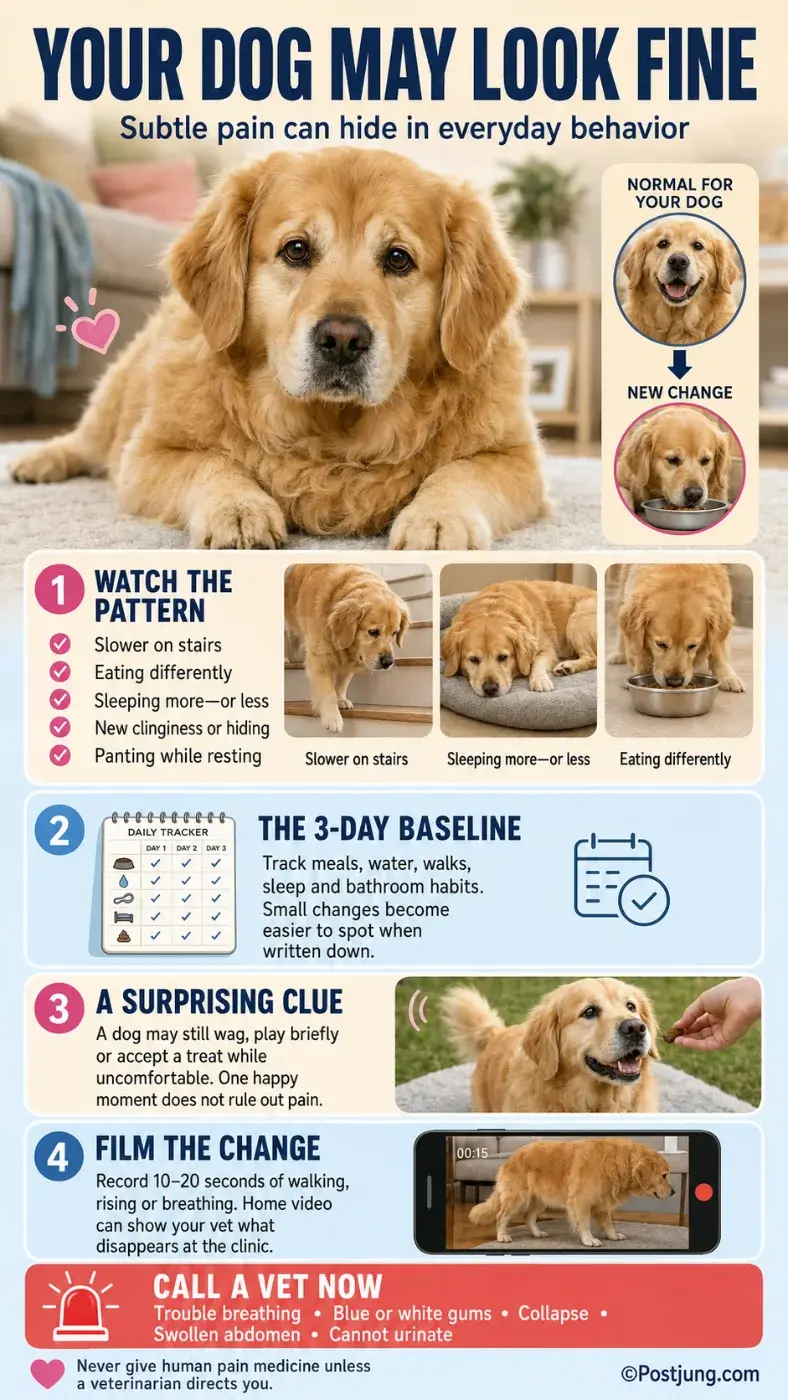
A wagging tail, an eager greeting, or a finished meal does not always mean a dog feels well. The earliest clues may be quiet changes in movement, sleep, appetite, posture, or personality.
A dog can greet you at the door, eat dinner, and still be uncomfortable. Pain and illness do not always produce dramatic symptoms, especially in their early stages.
Dogs are not consciously pretending that nothing is wrong. Instead, their warning signs may be remarkably subtle—a slower trip upstairs, an unfinished breakfast, or a new reluctance to be touched.
That is why knowing what is normal for your own dog can be more useful than waiting for an unmistakable sign.
“Fine” is not the same as symptom-free
People often picture a sick dog as one that refuses food, cries, vomits, or cannot get up. Those signs deserve attention, but discomfort can appear long before a dog reaches that point.
Veterinary pain assessments consider more than vocalization. Appetite, demeanor, posture, movement, sleep, and reactions to touch can all provide information. Some dogs become restless; others grow unusually quiet. Some withdraw from the family, while others suddenly want constant reassurance.
Even familiar happy behaviors can be misleading when viewed alone. A dog may still wag its tail because its owner has come home. It may accept a favorite treat despite dental pain or nausea. A brief burst of play does not tell you how the dog feels during the rest of the day.
One normal-looking moment cannot rule out a problem. The broader pattern matters.
Look for changes, not a universal “sick dog” look
Every dog has an individual baseline. One naturally sleeps for much of the afternoon, while another follows family members from room to room. A behavior that is normal for one could be meaningful in another.
Useful changes to notice include:
- Eating more slowly, dropping food, chewing on one side, or leaving part of a meal
- Drinking or urinating noticeably more or less than usual
- Sleeping longer, repeatedly changing positions, or struggling to settle
- Hesitating before jumping, climbing stairs, entering a car, or standing up
- Walking with a shorter stride, stiffness, or an altered posture
- Avoiding touch, hiding, becoming clingy, or reacting irritably
- Licking or chewing one area of the body repeatedly
- Panting while resting without an obvious reason
- Losing interest in walks, toys, or social interaction
- Having unexpected accidents indoors
None of these changes identifies a specific disease on its own. Pain, anxiety, infection, dental problems, digestive illness, joint disease, and other conditions can produce overlapping signs.
The important question is not simply, “Does my dog look sick?” It is: “What has changed from my dog’s usual pattern?”
Quiet pain may show up as a workaround
Dogs often adjust how they move or behave around discomfort. A dog with soreness may still climb the stairs but do it slowly. One with mouth pain may continue eating while choosing softer pieces or swallowing with less chewing. A dog with joint discomfort may stop jumping onto the couch without ever developing an obvious limp.
Posture can offer clues as well. A hunched back, tucked tail, unusual sitting position, lowered head, or difficulty transitioning between standing and lying down may reflect discomfort.
Personality changes deserve equal attention. Uncharacteristic growling or snapping is sometimes treated as a training problem, but pain or illness should be considered—especially when the change is sudden. Punishing the behavior without investigating its cause can miss the medical issue and make the dog more fearful.
A phone can help document what the clinic cannot see
Dogs do not always behave at a veterinary clinic as they do at home. Excitement, fear, adrenaline, and an unfamiliar floor can temporarily change how they move or respond.
A short phone video can capture hesitation on stairs, difficulty rising after sleep, unusual breathing, coughing, or a change in gait. Recording when the behavior occurs—after exercise, before meals, overnight, or after resting—can also help the veterinarian see the pattern.
A simple daily note is often enough:
- How much the dog ate and drank
- Urination and bowel movements
- Activity and willingness to exercise
- Sleep and restlessness
- Vomiting, diarrhea, coughing, or sneezing
- Any change in movement, posture, or behavior
This does not replace an examination. It gives the veterinary team a clearer picture of what has changed and how quickly it is progressing.
When waiting is not appropriate
A mild, isolated change may sometimes be monitored briefly, but persistent or repeated symptoms warrant a veterinary call. Merck Veterinary Manual advises arranging an appointment when signs such as reduced appetite, lower activity, vomiting, diarrhea, abnormal urination, coughing, discharge, skin problems, or limping continue for more than a day or two.
Some symptoms should not be watched at home. Difficulty breathing requires immediate veterinary attention. Other emergency signs include blue or white gums, heavy bleeding, collapse, seizures, suspected poisoning, severe injury, inability to urinate, repeated unproductive attempts to vomit, or a suddenly swollen abdomen.
Call a veterinary clinic or emergency hospital if you are unsure how urgently your dog needs care. Describe the symptoms, when they began, and whether they are worsening.
Do not give a dog human pain medication unless a veterinarian specifically directs you to do so. The safe drug and dose depend on the animal and its medical history.
Your familiarity is an important health tool
Veterinarians have the training and diagnostic tools to determine what is wrong, but owners see the small daily details: how quickly the dog rises, which side it sleeps on, how eagerly it eats, and whether it still pauses at the same step.
Those observations can reveal a problem before the symptoms become dramatic.
A wagging tail still means something—but it is only one part of the picture. When a dog seems “fine” yet feels subtly different, trust the change you are noticing and ask a veterinarian whether it needs investigation.
American Animal Hospital Association, Cornell University College of Veterinary Medicine, Merck Veterinary Manual
REFERENCES:
https://www.aaha.org/resources/2022-aaha-pain-management-guidelines-for-dogs-and-cats/acute-and-perioperative-canine-pain-assessment/
https://www.aaha.org/resources/whats-wrong-common-pet-pain-signs/
https://www.vet.cornell.edu/departments-centers-and-institutes/riney-canine-health-center/canine-health-topics/recognizing-pain-dogs
https://www.merckvetmanual.com/multimedia/table/when-to-see-a-veterinarian

เขียนโดย Postjung Insights
 รู้หรือไม่? เปิดรายได้พนักงานส่งพัสดุของแต่ละแอป วันหนึ่งได้เท่าไร
 เปิดรายชื่อโรงเรียนในไทยที่ “ว่ายน้ำ” อยู่ในหลักสูตร เรียนจริงตั้งแต่อนุบาลถึงมัธยม
 โรงเรียนที่มีนักเรียนมากที่สุดในไทย
 5 คณะที่เรียนจบมาแล้ว มีอาชีพรองรับมากกว่าที่คิด
 อำเภอที่มีชื่ออำเภอสั้นที่สุด 3 อำเภอเท่านั้นในประเทศไทย
 Google ยอมรับแล้ว! Gemini AI เข้าถึงระบบบริษัทจริง 3 แห่ง ระหว่างการทดสอบความปลอดภัย
 เลขเด็ดปฏิทิน "หลวงปู่โต๊ะ" งวดวันที่ 1 ตุลาคม 69..ส่องเลย เลขไหนให้โชค!
 จุฬาฯ มหาวิทยาลัยแห่งแรกของไทย มีจุดเริ่มต้นในสมัยรัชกาลที่ 5
 ส่องเลข 3 สำนักพิมพ์ งวด 1 ต.ค. 69 ตัวไหนมีข้อมูลตรงกัน
 เปิด 5 โรงเรียนหญิงล้วนเก่าแก่ของไทย ที่มีประวัติยาวนานกว่าศตวรรษ
 อุทยานเขาใหญ่เรียกตัว “ตีนผี” หลังขับจี้ช้างป่าพ่อลูก ลั่นระยะ 50 เมตรต้องจำให้ขึ้นใจ
 โรงเรียนเพียงแห่งเดียวของประเทศไทย ที่อยู่มาตั้งแต่ยุครัชกาลที่ 4
 😃 ชวนเข้ามาดูกันอีกกับคนที่มีร่างกายพิเศษจนเหมือนมีกล่องสมบัติที่หายาก 😯5 คณะที่เรียนจบมาแล้ว มีอาชีพรองรับมากกว่าที่คิดเปิดรายชื่อโรงเรียนในไทยที่ “ว่ายน้ำ” อยู่ในหลักสูตร เรียนจริงตั้งแต่อนุบาลถึงมัธยมGoogle ยอมรับแล้ว! Gemini AI เข้าถึงระบบบริษัทจริง 3 แห่ง ระหว่างการทดสอบความปลอดภัยเลขเด็ดปฏิทิน "หลวงปู่โต๊ะ" งวดวันที่ 1 ตุลาคม 69..ส่องเลย เลขไหนให้โชค!
 ทำไมของพลาสติกเก่าบางชิ้นถึง “เหนียว” ขึ้นมาเอง ทั้งที่ไม่ได้เปื้อนอะไร?
 English Edition