Why Your Cat May Hide After You Return From a Trip
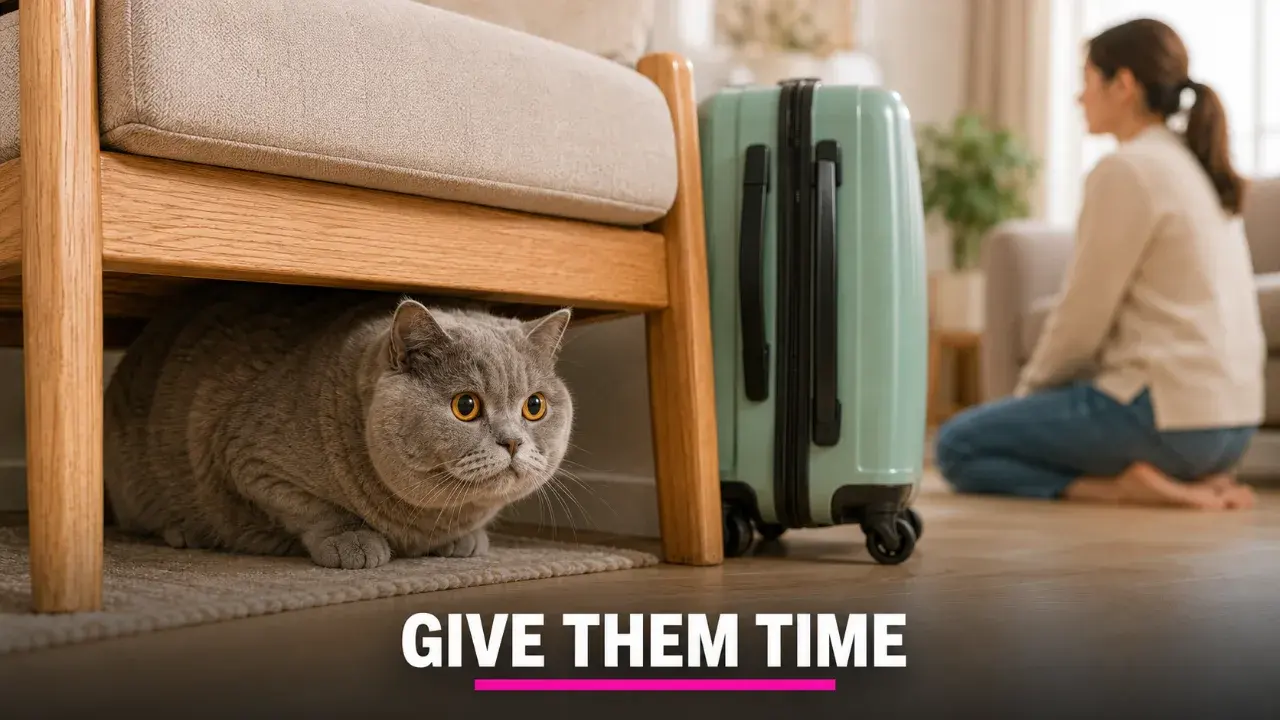
A disrupted routine, unfamiliar smells, and a suddenly busy home can make some cats retreat after their owner returns. The behavior usually calls for patience, but certain accompanying symptoms deserve veterinary attention.
You have been looking forward to seeing your cat for days. You open the door, call their name—and watch a tail disappear beneath the bed.
The reaction can feel personal, especially if your cat is normally affectionate. In most cases, though, hiding is not feline revenge. It is a way for a cat to create distance while assessing changes in their surroundings.
Your absence changed more than you realized
Cats often organize their lives around predictable events: when breakfast arrives, which rooms are quiet, when someone sits on the couch, and where household members usually sleep.
A trip can temporarily rearrange that pattern. Meals may come from a pet sitter at different times. New people may enter the home. The litter box, lights, doors, or curtains may be handled differently. If the cat stayed at a boarding facility, nearly everything around them may have changed.
Then the owner returns, sometimes with rolling luggage, excited voices, unfamiliar objects, and a sudden burst of activity.
International Cat Care notes that environmental stress can be connected to changes in routine and limited access to secure hiding places. The Feline Veterinary Medical Association likewise advises that unfamiliar smells, sounds, and sights may be perceived as threatening by some cats. International Cat Care, Feline Veterinary Medical Association
The result may be a cat who needs time to observe before resuming normal social contact.
Your suitcase may smell more interesting than you do
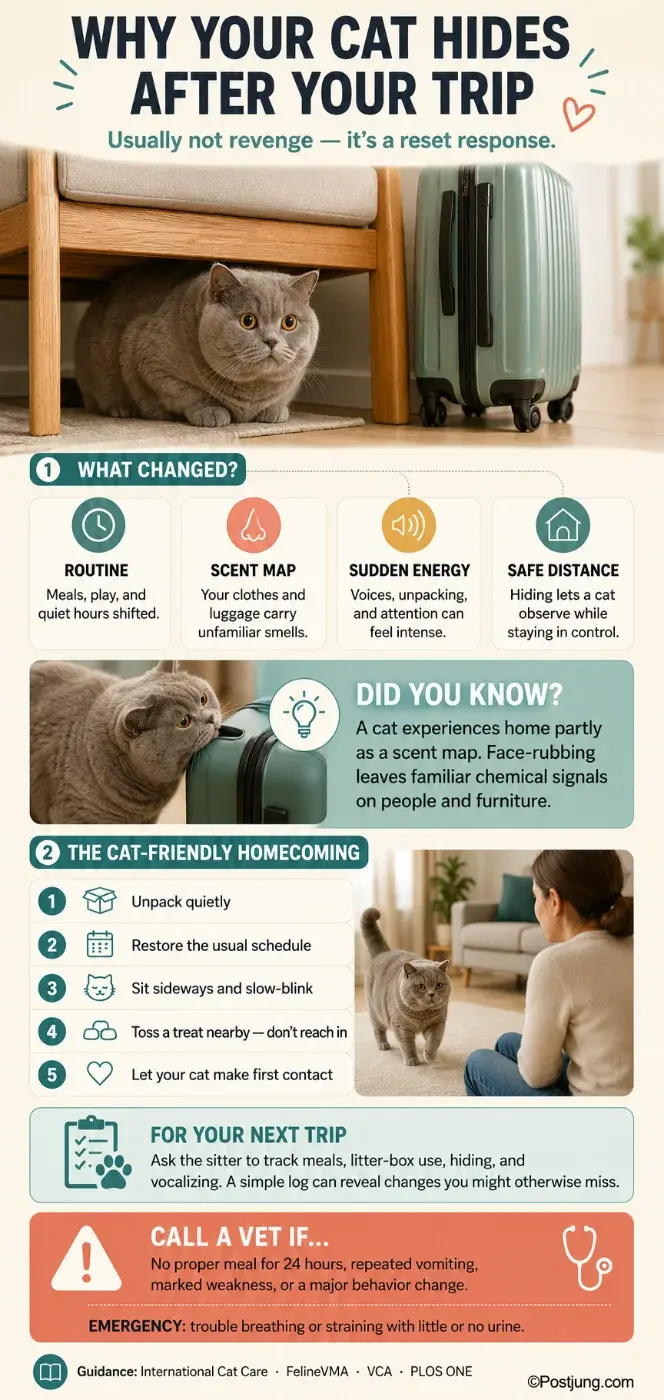
Scent plays a major role in how cats understand familiar territory. They leave scent signals by rubbing their faces and bodies against furniture, doorways, people, and other animals.
After traveling, your clothes and bags may carry traces of hotels, airports, other homes, unfamiliar animals, cleaning products, or outdoor environments. That does not necessarily mean your cat has forgotten you. It may simply mean the familiar person now carries unfamiliar information.
International Cat Care explains that cats use scent to identify what belongs in their environment and that familiar household scents can contribute to a sense of security. International Cat Care
Other sensory changes may matter too. A loud suitcase, strong perfume, freshly washed travel clothing, or enthusiastic attempts to pick the cat up can make the reunion more intense than the cat wants.
Hiding gives a cat control
A hiding place is not automatically a sign that something is seriously wrong. It can be a normal strategy for dealing with uncertainty.
From beneath a bed or behind a chair, a cat can listen, smell, and watch without being approached from every direction. That distance allows the animal to decide when it feels safe enough to emerge.
The best response is usually quiet and undemanding:
- Put the suitcase away and reduce household noise.
- Return meals, play sessions, and bedtime activities to their normal schedule.
- Make sure food, water, litter boxes, scratching surfaces, and resting areas remain easily accessible.
- Sit nearby without reaching into the hiding place.
- Speak softly or offer a familiar treat, then allow the cat to choose whether to approach.
- Avoid pulling the cat out, cornering them, or insisting on physical affection.
Let the cat control the reunion. A slow blink, a relaxed posture, or simply remaining quietly in the same room may be more reassuring than repeated calling and touching.
If the cat comes out, keep the first interaction calm. A brief sniff or cheek rub may be all they want before walking away again.
It is not always separation anxiety
Cats can form meaningful social bonds, and research suggests that some experience separation-related problems. A 2020 questionnaire study involving 223 cats identified potential separation-related behaviors in a subset of the animals, including destructive behavior, excessive vocalization, inappropriate elimination, agitation, and depression-like inactivity.
The researchers also emphasized that feline separation-related problems remain difficult to identify and require further study. A cat hiding briefly after a trip is therefore not enough to diagnose separation anxiety. PLOS ONE
Look at the full pattern instead. Did the behavior begin only after this particular absence? Were there signs of distress while you were gone? Did the sitter notice reduced eating, constant vocalization, overgrooming, house soiling, or destructive behavior? Does the same pattern occur every time you leave?
A veterinarian or qualified veterinary behaviorist can help distinguish separation-related distress from fear, household conflict, boredom, pain, or another medical issue.
When hiding may signal a health problem
Hiding can also accompany pain or illness. This matters because cats are often subtle when they feel unwell, and the timing of a behavior change can be coincidental. Your return may simply be the moment you notice a problem that developed while you were away.
Monitor whether your cat is eating, drinking, urinating, defecating, grooming, and moving normally. Watch for vomiting, diarrhea, unusual breathing, weakness, limping, repeated litter-box visits, straining, or a major change in personality.
VCA Animal Hospitals advises seeking prompt veterinary attention if a cat has not eaten properly for 24 hours. Difficulty breathing or an inability to pass urine requires immediate care. VCA Animal Hospitals
Contact your veterinarian sooner if your cat has an existing medical condition, is elderly, appears painful, or seems markedly different from normal. A behavioral change should be judged against that individual cat’s usual habits, not against a universal timetable.
For a healthy cat who continues eating and using the litter box normally, a quiet decompression period may be all that is needed. Keep the home predictable, make yourself available, and resist turning the reunion into a test of affection.
Your cat’s eventual appearance—perhaps casual, perhaps demanding dinner as if nothing happened—is often their way of saying that the home feels familiar again.
International Cat Care, Feline Veterinary Medical Association, VCA Animal Hospitals, PLOS ONE
REFERENCES:
https://icatcare.org/articles/stress-in-cats
https://catvets.com/resource/setting-up-for-success/
https://vcahospitals.com/know-your-pet/recognizing-signs-of-illness-in-cats
https://journals.plos.org/plosone/article?id=10.1371/journal.pone.0230999

เขียนโดย Postjung Insights
 รู้หรือไม่? เปิดรายได้พนักงานส่งพัสดุของแต่ละแอป วันหนึ่งได้เท่าไร
 อำเภอที่มีชื่ออำเภอสั้นที่สุด 3 อำเภอเท่านั้นในประเทศไทย
 Google ยอมรับแล้ว! Gemini AI เข้าถึงระบบบริษัทจริง 3 แห่ง ระหว่างการทดสอบความปลอดภัย
 โรงเรียนที่มีนักเรียนมากที่สุดในไทย
 เปิดรายชื่อโรงเรียนในไทยที่ “ว่ายน้ำ” อยู่ในหลักสูตร เรียนจริงตั้งแต่อนุบาลถึงมัธยม
 เปิด 5 โรงเรียนหญิงล้วนเก่าแก่ของไทย ที่มีประวัติยาวนานกว่าศตวรรษ
 ทำไมของพลาสติกเก่าบางชิ้นถึง “เหนียว” ขึ้นมาเอง ทั้งที่ไม่ได้เปื้อนอะไร?
 5 คณะที่เรียนจบมาแล้ว มีอาชีพรองรับมากกว่าที่คิด
 ตาราง “เด่นเหนือเด่นใต้” งวด 1 ต.ค. 69 เปิดข้อมูลตามโพย เลขไหนอยู่ตรงไหน
 เลขเด็ดปฏิทิน "หลวงปู่โต๊ะ" งวดวันที่ 1 ตุลาคม 69..ส่องเลย เลขไหนให้โชค!
 โรงเรียนเพียงแห่งเดียวของประเทศไทย ที่อยู่มาตั้งแต่ยุครัชกาลที่ 4
 จุฬาฯ มหาวิทยาลัยแห่งแรกของไทย มีจุดเริ่มต้นในสมัยรัชกาลที่ 55 คณะที่เรียนจบมาแล้ว มีอาชีพรองรับมากกว่าที่คิดเปิดรายชื่อโรงเรียนในไทยที่ “ว่ายน้ำ” อยู่ในหลักสูตร เรียนจริงตั้งแต่อนุบาลถึงมัธยมGoogle ยอมรับแล้ว! Gemini AI เข้าถึงระบบบริษัทจริง 3 แห่ง ระหว่างการทดสอบความปลอดภัยเลขเด็ดปฏิทิน "หลวงปู่โต๊ะ" งวดวันที่ 1 ตุลาคม 69..ส่องเลย เลขไหนให้โชค!ทำไมของพลาสติกเก่าบางชิ้นถึง “เหนียว” ขึ้นมาเอง ทั้งที่ไม่ได้เปื้อนอะไร?
 อุทยานเขาใหญ่เรียกตัว “ตีนผี” หลังขับจี้ช้างป่าพ่อลูก ลั่นระยะ 50 เมตรต้องจำให้ขึ้นใจ
 English Edition