Why Stainless Steel Bowls Remain a Popular Choice for Pets

Stainless steel bowls are durable, widely available, and usually easy to clean. But the material alone cannot keep a pet’s food and water free from germs.
Stainless steel pet bowls are popular for a refreshingly simple reason: they handle daily life well. They can survive drops, repeated washing, wet food, and enthusiastic eaters without demanding much attention from their owners.
Their familiar silver appearance may not be especially decorative, but practicality is the real selling point. A well-made stainless steel bowl can serve a dog or cat for years—provided it is cleaned regularly and replaced if it becomes damaged.
A smooth surface makes everyday cleaning easier
Stainless steel has a hard, smooth surface that does not normally absorb water, food odors, or grease. That makes leftover food and the slippery film that develops in water bowls easier to see and scrub away.
Many stainless steel bowls are also dishwasher-safe, although owners should still follow the manufacturer’s instructions. The U.S. Centers for Disease Control and Prevention says dishwasher-safe pet bowls can be cleaned in a dishwasher, with a high-temperature or sanitizing setting used when disinfection is needed. CDC cleaning guidance
This washability is especially useful for wet pet food, which can leave oils and residue along the bowl’s sides. It also matters in warm climates, including much of Southeast Asia, where uneaten moist food should not be allowed to sit at room temperature for long periods.
Plastic bowls can also be washed, but repeated use may leave scratches. Those small damaged areas can become harder to clean thoroughly. Ceramic bowls have their own advantages, including weight and quieter use, but they should be checked regularly for chips, cracks, and worn glaze.
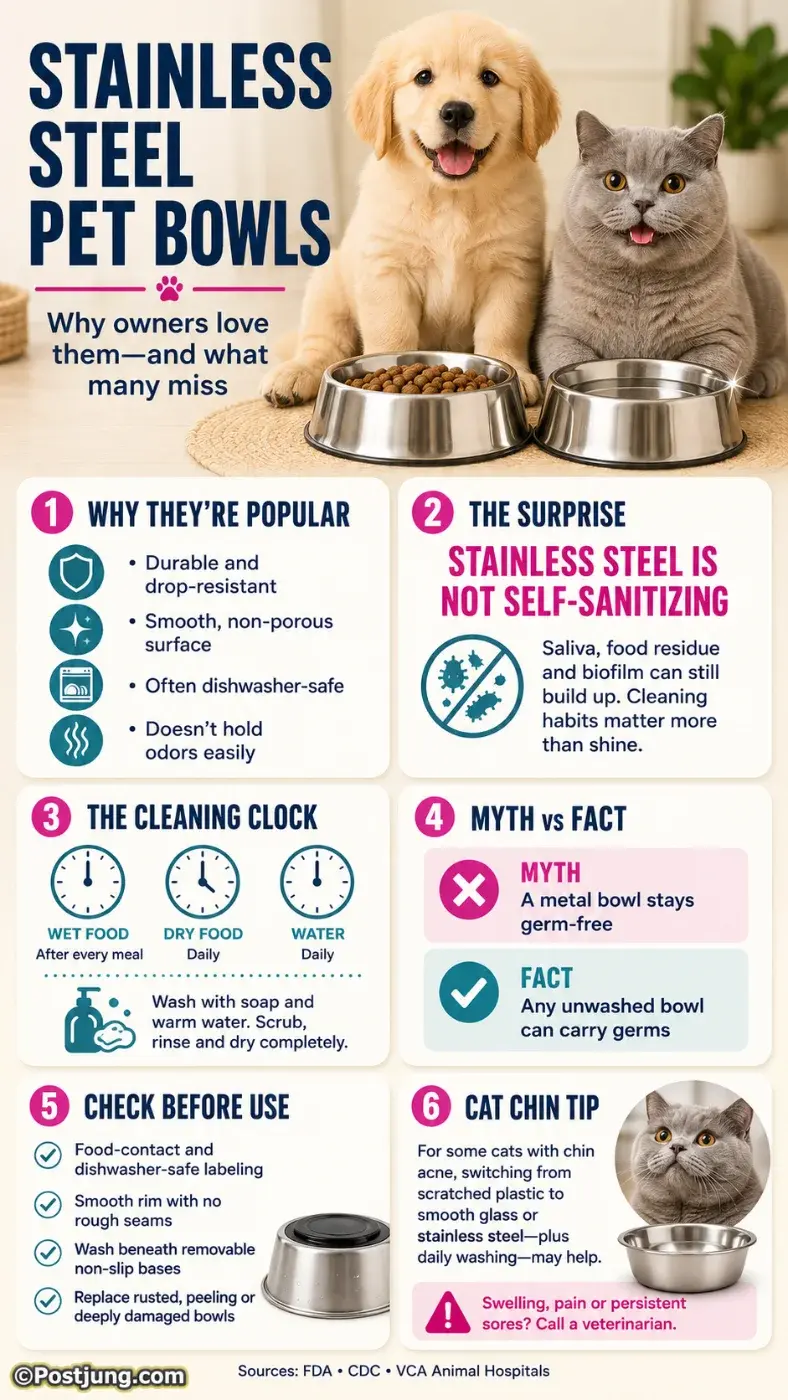
Stainless steel is durable—but not self-cleaning
A metal bowl may look clean long after it has collected saliva, food residue, and a barely visible biofilm. Stainless steel does not automatically kill microorganisms, and choosing it should never replace a cleaning routine.
Research into household feeding practices has found that contamination can be influenced by several interacting factors, including the food served, how the bowl is cleaned, and its material. That means sweeping claims that one material is always the “most hygienic” deserve caution. Published study on pet-bowl contamination
The CDC recommends cleaning bowls after every serving of wet food and daily when they hold dry food or water. The U.S. Food and Drug Administration offers even stricter general advice: wash pet-food bowls and feeding utensils with soap and hot water after each use. FDA safe-handling guidance
In other words, the cleanest bowl is usually the bowl that gets cleaned.
For most routine cleaning, soap or detergent and warm water are sufficient. Scrub the bowl, rinse away the soap, and let it dry completely or use a clean towel. Disinfection may be appropriate when a pet is sick or when someone in the household is particularly vulnerable to infection, but disinfectants must be used exactly as directed and rinsed when the label requires it.
Durability can make stainless steel economical
Pet bowls are knocked over, pushed across floors, carried outdoors, and occasionally mistaken for toys. Stainless steel tolerates this treatment better than breakable ceramic and often outlasts lightweight plastic.
That longevity can make a good bowl economical even if its initial price is higher than the cheapest alternative. It also reduces the need to discard bowls because of deep scratches, absorbed odors, or accidental breakage.
A removable rubber or silicone base can prevent sliding and soften the metallic clatter that bothers some pets. Owners should inspect that base as carefully as the bowl itself because moisture and food can collect underneath it.
The bowl should also have a smooth rim and stable construction. Rough edges, peeling coatings, rust spots, deep dents, or seams that trap residue are reasons to stop using it. Buying from a manufacturer that clearly identifies the product as intended for food contact offers more reassurance than choosing an unlabeled metal bowl based only on appearance.
It may help some cats with chin acne
Cats that develop blackheads, crusts, or inflammation around the chin are sometimes switched from plastic dishes to smooth glass or stainless steel bowls.
Veterinary guidance from VCA Animal Hospitals notes a possible association between plastic dishes and feline chin acne, although the disorder has several potential contributing factors and its precise cause is not fully understood. Switching to a smooth, nonporous bowl and washing it daily may help some cats. VCA guidance on feline chin acne
A different bowl is not a substitute for veterinary care. Chin swelling, painful sores, discharge, persistent crusting, or difficulty eating should be evaluated because infections and other conditions can resemble or complicate feline acne.
The right shape still depends on the pet
Material is only part of a useful feeding setup. A bowl can be durable and easy to sanitize yet remain uncomfortable for the animal using it.
Cats may prefer a wide, shallow dish that lets them eat without pushing their face deeply into the bowl. Flat-faced dogs and cats may also need a shape suited to their shorter muzzle. Older animals or pets with mobility problems may benefit from a stable setup recommended for their individual condition.
Large dogs that shove their bowls may need a heavier nonslip base. Fast eaters may require a properly designed slow-feeding bowl rather than a standard open dish. Pets that seem startled by reflections or the sound of tags hitting metal may respond better to ceramic or glass.
The best bowl fits both the animal and the cleaning routine. Stainless steel remains popular because it provides a strong starting point: durable, simple, and easy to maintain. Its real advantage appears when owners pair those qualities with frequent washing, careful inspection, and a shape their pet can use comfortably.
U.S. Food and Drug Administration, Centers for Disease Control and Prevention, BMC Veterinary Research, VCA Animal Hospitals
REFERENCES:
https://www.fda.gov/animal-veterinary/animal-health-literacy/tips-safe-handling-pet-food-and-treats
https://www.cdc.gov/healthy-pets/about/cleaning-and-disinfecting-pet-supplies.html
https://pmc.ncbi.nlm.nih.gov/articles/PMC10701922/
https://vcahospitals.com/know-your-pet/chin-acne-in-cats

เขียนโดย Postjung Insights
 รู้หรือไม่? เปิดรายได้พนักงานส่งพัสดุของแต่ละแอป วันหนึ่งได้เท่าไร
 อำเภอที่มีชื่ออำเภอสั้นที่สุด 3 อำเภอเท่านั้นในประเทศไทย
 หนุ่มขับ Porsche ใจหล่อสุดๆ ติดประกาศเด็กหายไว้รอบคัน..หวังช่วยเผยแพร่ข้อมูลให้ตามหาได้เร็วขึ้น
 ซาบีดา” เรียกถกด่วน ปมภาพ “ชุดไทย” ถูกนำไปอ้างเป็นชุดกัมพูชา
 แปลปกสลาก งวด 1 ต.ค. 69 ส่องตัวเลขจากภาพปกสลากกินแบ่งรัฐบาล
 เปิดรายชื่อ 5 โรงเรียนเป้าหมาย เด็กสอบเข้าต้องเตรียมตัวให้พร้อม
 โรงเรียนที่มีนักเรียนมากที่สุดในไทย
 ส่องเลข 3 สำนักพิมพ์ งวด 1 ต.ค. 69 ตัวไหนมีข้อมูลตรงกัน
 'สควีชชี่'ของเล่นที่กำลังเป็นไวรัลอาจถูกเจ้าหน้าที่ของสนามบินยึดได้ ตรวจสอบให้ดีก่อนนำขึ้นเครื่อง
 Ctrip แพลตฟอร์มการท่องเที่ยวของจีน เปิดขายตั๋วสำหรับทริปท่องเที่ยวอวกาศ ของ Virgin Galactic 6 วัน ในราคาประมาณ 24 ล้านบาท
 โรสแมรี่ แฮร์ริส ‘ป้าเมย์’ แห่ง Spider-Man ฉบับโทบีย์ แม็คไกวร์ อายุครบ 99 ปี
 ตาราง “เด่นเหนือเด่นใต้” งวด 1 ต.ค. 69 เปิดข้อมูลตามโพย เลขไหนอยู่ตรงไหนซาบีดา” เรียกถกด่วน ปมภาพ “ชุดไทย” ถูกนำไปอ้างเป็นชุดกัมพูชาเปิดรายชื่อ 5 โรงเรียนเป้าหมาย เด็กสอบเข้าต้องเตรียมตัวให้พร้อมหนุ่มขับ Porsche ใจหล่อสุดๆ ติดประกาศเด็กหายไว้รอบคัน..หวังช่วยเผยแพร่ข้อมูลให้ตามหาได้เร็วขึ้น
 วาบิ-ซาบิ (Wabi-Sabi) ปรัชญาญี่ปุ่นที่สอนให้เราโอบกอดความไม่สมบูรณ์แบบ
 English Edition