Why the Right Harness Fit Can Change Your Dog’s Walk
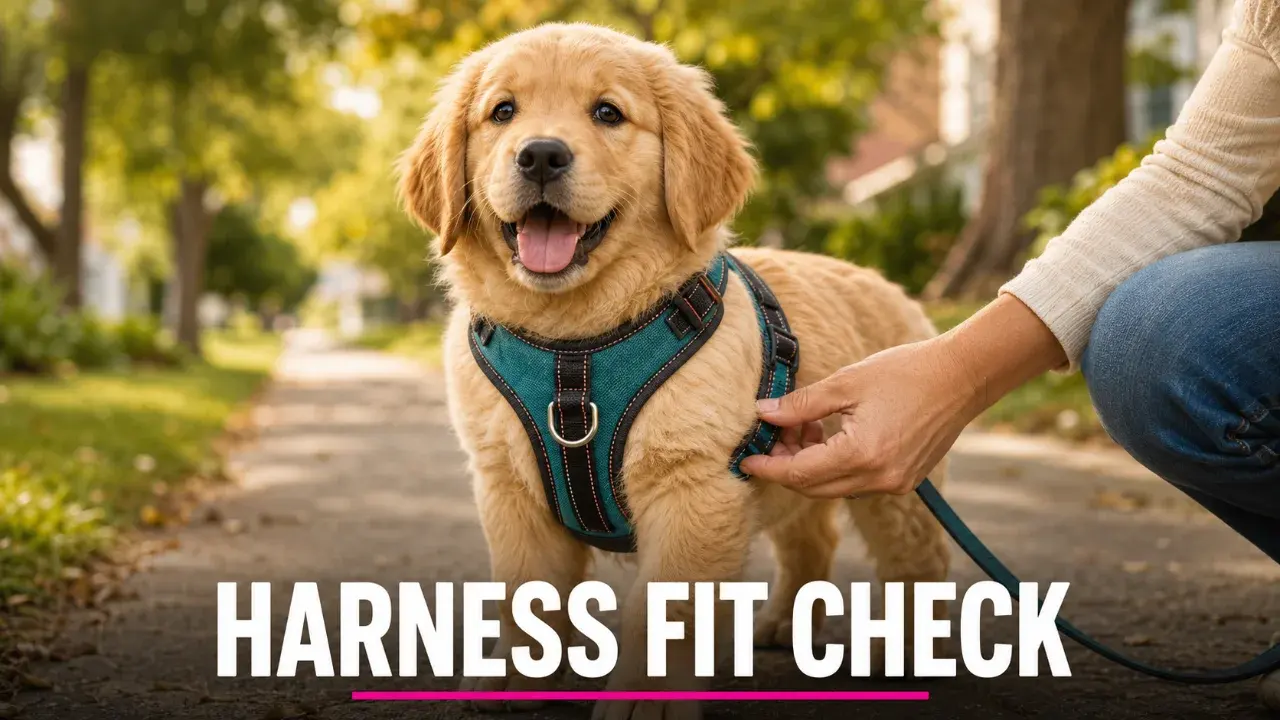
A harness can look secure while still rubbing, shifting, or limiting a dog’s natural stride. A quick fit check can make walks safer and more comfortable.
Why the Right Harness Fit Can Change Your Dog’s Walk
A harness is supposed to make walking safer and more comfortable—not create a new source of irritation. Yet even a good harness can cause trouble when it is too tight, too loose, positioned poorly, or simply wrong for a dog’s body shape.
The issue is easy to miss. A dog cannot point to a strap and explain that it pinches with every step, so owners have to watch the harness and the dog together.
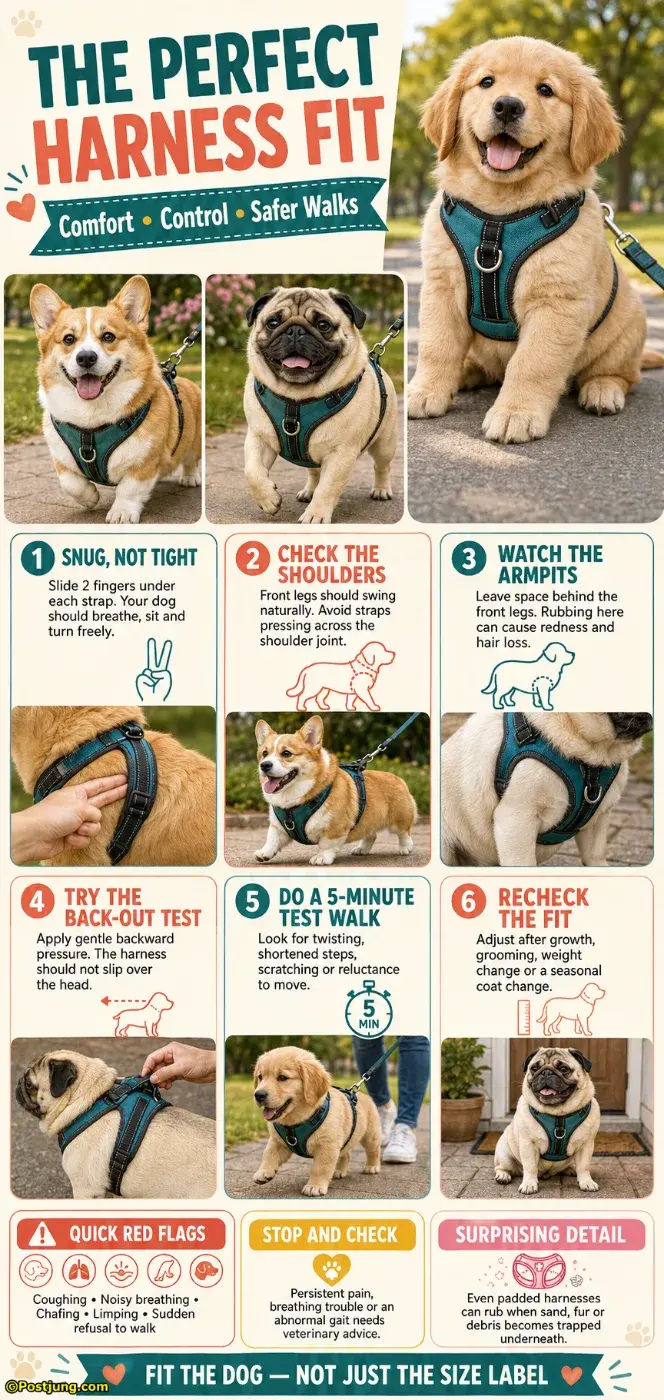
A secure harness should still allow natural movement
Harnesses spread leash pressure across a broader part of the body instead of concentrating it around the neck. That can be helpful for dogs that pull, flat-faced dogs with breathing concerns, and dogs that cough or strain against a collar.
But covering more of the body also creates more opportunities for a strap or panel to interfere with movement. Blue Cross advises choosing a harness that lets a dog walk and run naturally, noting that some designs can rub or affect movement if they do not fit correctly. Blue Cross
The goal is not to make every strap as tight as possible. A harness should remain stable without pinching the dog, sliding into the armpits, pressing against the throat, or rotating around the torso.
Watch the dog from the front and side while walking. The front legs should move freely, the harness should remain centered, and the chest piece should not be pulled sharply to one side whenever the leash becomes tense.
Too loose can be as risky as too tight
An oversized harness may look comfortable, but looseness creates its own problems. Straps can shift and rub repeatedly, while a frightened or determined dog may reverse out of the harness.
After fastening it, gently move each strap and examine the buckles. The harness should not rotate freely around the body or slide over the dog’s head when light backward pressure is applied.
At the same time, you should be able to place your fingers beneath the straps without forcing them. Treat finger spacing as a starting check rather than a universal sizing formula: coat thickness, body shape, strap width, and harness design all affect how the fit feels.
The dog must be able to breathe, sit, turn, and extend its legs normally. Check those movements before relying on a new harness outdoors.
Dogs with narrow heads, deep chests, broad shoulders, or slim waists may escape standard designs even when the labeled size appears correct. An additional body strap or escape-resistant model may provide greater security for these dogs, but it still needs to be individually adjusted.
Look beyond the “restrictive” label
Harnesses are often divided into designs that cross the front of the shoulders and Y-shaped styles intended to leave the shoulder area more open. It may seem obvious that one category must always be better, but current research is more complicated.
A 2026 review of dog-worn equipment found that the harnesses studied could alter gait to varying degrees. Design, attachment position, fit, leash tension, the handler’s position, and the individual dog may all influence what happens during movement. The review also noted that chafing can result from poor fit, seams, wrinkles, or debris trapped between the harness and skin. Frontiers in Veterinary Science
That means the shape printed on the package does not replace watching the dog move. A model marketed as unrestricted may still sit badly on a particular dog, while another design may remain stable and comfortable after careful adjustment.
Back-clip harnesses are commonly used for everyday walking. Front-clip designs can offer additional steering when a dog pulls, but the front section may twist if the fit is loose or leash pressure is constantly applied from one side.
A harness can help manage pulling, but it does not teach loose-leash walking by itself. VCA Animal Hospitals recommends pairing suitable walking equipment with reward-based training and paying attention to whether a dog coughs, breathes noisily, or physically overpowers the handler. VCA Animal Hospitals
Give every new harness a short test walk
Before taking a newly fitted harness on a long outing, let the dog wear it briefly at home. Reward calm behavior, then walk for a few minutes in a quiet area.
During and after the test, check for:
- Straps creeping into the armpits
- A chest piece pressing against the throat
- Buckles sitting directly over joints or bony areas
- Shortened steps, stiffness, or reluctance to move
- Repeated scratching, biting, or turning toward the harness
- Redness, flattened fur, dampness, or tender skin
- Gaping sections that could catch on an object
- The harness rotating when the dog pulls
Inspect more carefully beneath thick or long fur, where irritation can remain hidden. Sand, small twigs, and dirt can also become trapped under padded material and turn an otherwise comfortable harness into an abrasive surface.
Puppies need frequent adjustments because their bodies change quickly. Adult dogs may also require refitting after weight changes, grooming, seasonal coat changes, or a period of reduced activity.
Your dog’s behavior is part of the fit test
Some dogs initially freeze or walk awkwardly simply because wearing a harness is unfamiliar. Gradual introduction with treats can help distinguish uncertainty from physical discomfort.
Persistent reluctance deserves closer attention. A sudden change in stride or willingness to walk should not be ignored, especially if it continues after the harness is removed.
Stop using equipment that causes visible skin damage, coughing, breathing difficulty, pain, or an abnormal gait. A veterinarian can check for an underlying problem, while a qualified reward-based trainer can help when pulling or harness avoidance is primarily behavioral.
A well-fitted harness should fade into the background of the walk. The dog should be free to sniff, turn, and move naturally, while the person holding the leash retains secure control. That quiet balance—not the brand name or the appearance—is the clearest sign that the fit is doing its job.
VCA Animal Hospitals, Blue Cross, Frontiers in Veterinary Science
REFERENCES:
https://vcahospitals.com/know-your-pet/controlling-pulling-on-walks
https://www.bluecross.org.uk/advice/dog/wellbeing-and-care/first-time-dog-owner-guide
https://www.frontiersin.org/journals/veterinary-science/articles/10.3389/fvets.2026.1711781/full

เขียนโดย Postjung Insights
 อำเภอที่มีชื่ออำเภอสั้นที่สุด 3 อำเภอเท่านั้นในประเทศไทย
 รู้หรือไม่? เปิดรายได้พนักงานส่งพัสดุของแต่ละแอป วันหนึ่งได้เท่าไร
 ตาราง “เด่นเหนือเด่นใต้” งวด 1 ต.ค. 69 เปิดข้อมูลตามโพย เลขไหนอยู่ตรงไหน
 Ctrip แพลตฟอร์มการท่องเที่ยวของจีน เปิดขายตั๋วสำหรับทริปท่องเที่ยวอวกาศ ของ Virgin Galactic 6 วัน ในราคาประมาณ 24 ล้านบาท
 เปิดรายชื่อ 5 โรงเรียนเป้าหมาย เด็กสอบเข้าต้องเตรียมตัวให้พร้อม
 ซาบีดา” เรียกถกด่วน ปมภาพ “ชุดไทย” ถูกนำไปอ้างเป็นชุดกัมพูชา
 โรงเรียนที่มีนักเรียนมากที่สุดในไทย
 โรสแมรี่ แฮร์ริส ‘ป้าเมย์’ แห่ง Spider-Man ฉบับโทบีย์ แม็คไกวร์ อายุครบ 99 ปี
 'สควีชชี่'ของเล่นที่กำลังเป็นไวรัลอาจถูกเจ้าหน้าที่ของสนามบินยึดได้ ตรวจสอบให้ดีก่อนนำขึ้นเครื่อง
 หนุ่มขับ Porsche ใจหล่อสุดๆ ติดประกาศเด็กหายไว้รอบคัน..หวังช่วยเผยแพร่ข้อมูลให้ตามหาได้เร็วขึ้น
 แปลปกสลาก งวด 1 ต.ค. 69 ส่องตัวเลขจากภาพปกสลากกินแบ่งรัฐบาล
 บุ๋ม ปนัดดา” เล่าเบื้องหลังหญิงตีเนียน หลังเจออยู่กลางวงสัมภาษณ์ “หนุ่ม กรรชัย”ซาบีดา” เรียกถกด่วน ปมภาพ “ชุดไทย” ถูกนำไปอ้างเป็นชุดกัมพูชาเปิดรายชื่อ 5 โรงเรียนเป้าหมาย เด็กสอบเข้าต้องเตรียมตัวให้พร้อมหนุ่มขับ Porsche ใจหล่อสุดๆ ติดประกาศเด็กหายไว้รอบคัน..หวังช่วยเผยแพร่ข้อมูลให้ตามหาได้เร็วขึ้น
 วาบิ-ซาบิ (Wabi-Sabi) ปรัชญาญี่ปุ่นที่สอนให้เราโอบกอดความไม่สมบูรณ์แบบ
 English Edition