Why a Safe-Looking Toy Can Become a Choking Hazard
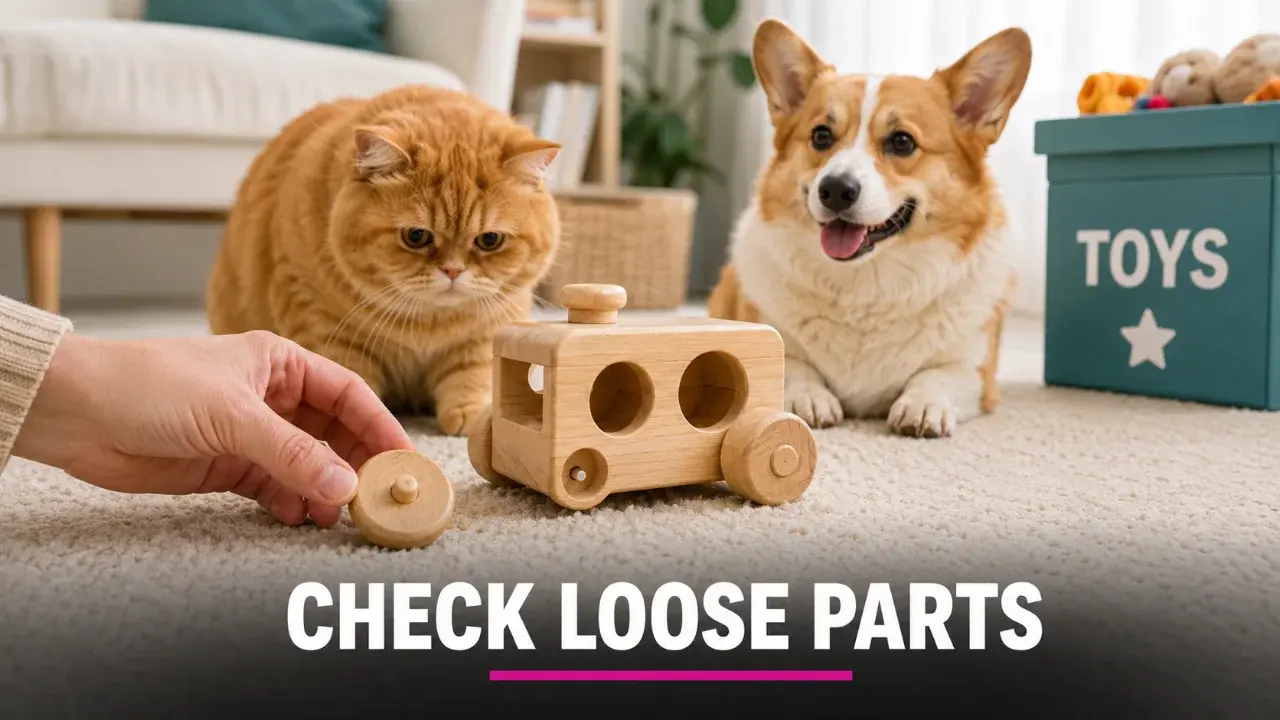
A toy does not need to begin as a tiny object to pose a risk. Damage, detachable pieces, age mismatches, and access by younger siblings can turn ordinary playthings into choking hazards.
A toy may look sturdy, familiar, and perfectly safe—until a wheel loosens, a plastic seam cracks, or a younger sibling finds a piece meant for an older child. The hazard is often a change in the toy, not something immediately obvious when it comes out of the package.
That is why choosing an age-appropriate toy is only the first step. Toys also need to remain intact, stay with the intended child, and be checked as they wear.
Small enough to block a young child’s airway
Young children explore objects with their mouths and do not yet have the judgment or physical skills of older children. A loose bead, miniature wheel, game piece, doll accessory, or broken plastic component can therefore become dangerous quickly.
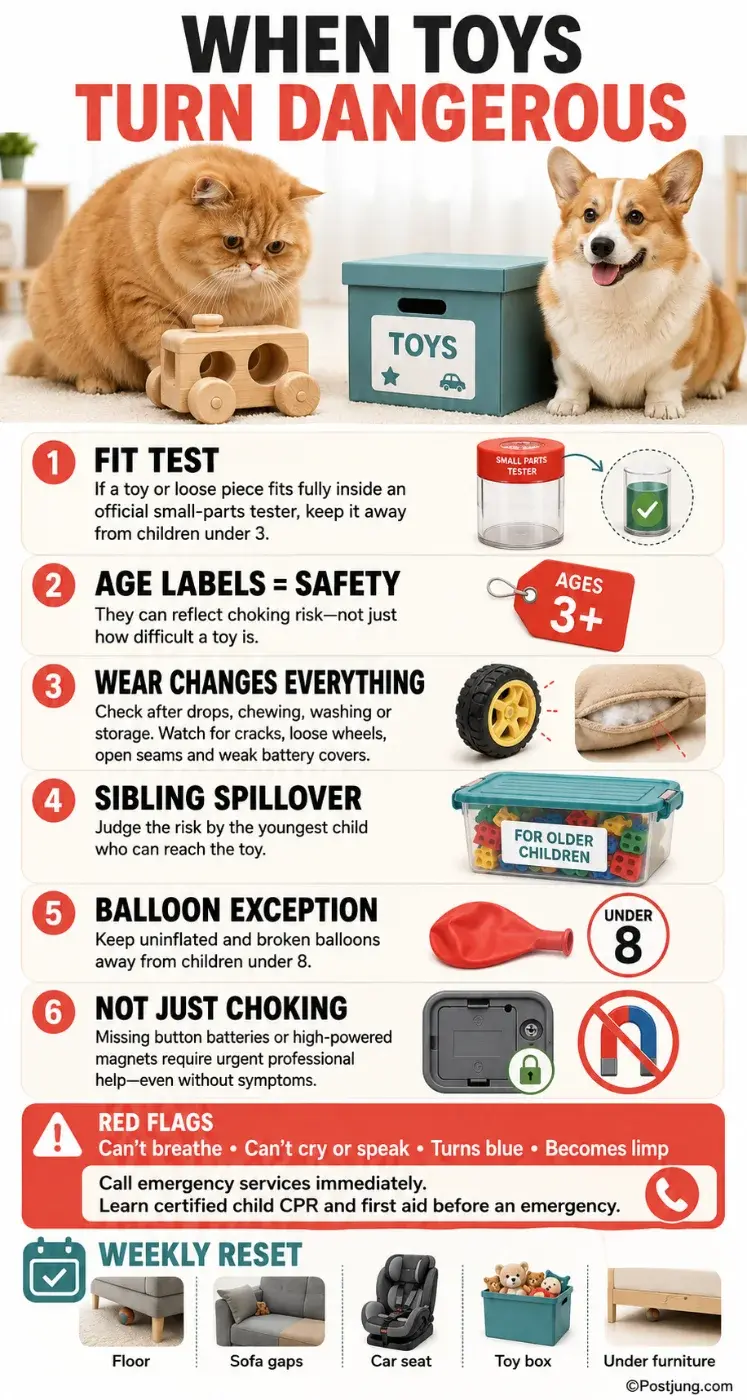
Under U.S. rules, a “small part” is an object that fits completely, without compression and in any orientation, inside a standardized small-parts cylinder. The fixture approximates the size of the fully expanded throat of a child younger than 3, according to the U.S. Consumer Product Safety Commission.
A small part can be an entire object, a detachable component, or a fragment produced when a toy breaks. This last category matters because a large toy can release a dangerously small piece even when its original shape appears harmless.
Manufacturers do not evaluate only a new toy’s visible dimensions. Regulatory use-and-abuse testing can include impact, flexing, twisting, pulling, and compression to simulate stresses that toys for children under 3 may encounter.
A toy’s condition can change the risk
Normal play is rarely gentle. Toys are dropped, thrown, stepped on, chewed, washed, left in sunlight, and pushed into storage bins. Plastic can become brittle, adhesives can weaken, stitching can open, and fasteners can work loose.
Warning signs include:
- Cracks around wheels, eyes, buttons, or decorative pieces
- Loose beads, bells, squeakers, or internal filling
- Peeling stickers or foam components
- Stretched seams on plush toys
- Battery covers that no longer close securely
- Pieces that detach with light pulling or twisting
- Parts missing without a clear explanation
Repairs also require caution. Tape, glue, replacement buttons, and improvised fasteners may not withstand renewed play. If a repair creates a detachable piece or the toy cannot be restored securely, retiring it is safer than repeatedly patching it.
The age label is a safety instruction
Adults sometimes interpret an age recommendation as a measure of whether a child is clever enough to use a toy. That is only part of its purpose.
Age guidance can also reflect choking hazards and the physical or developmental abilities required for safer play. The American Academy of Pediatrics advises families to follow package recommendations and avoid toys with small or detachable parts for infants and young children.
This becomes especially important in homes with children of different ages. A building set, craft kit, miniature figure, or board game may be appropriate for a school-age child but unsafe when its pieces migrate into a toddler’s play area.
Evaluate the youngest child who can reach the toy, not only the child whose name is on the gift.
Storage can reduce that crossover. Older children’s toys with small pieces should be used in a separate area and returned to a closed container after play. Floors, couch cushions, car seats, and the spaces beneath furniture deserve regular checks because dropped pieces often remain hidden until a crawling child discovers them.
Balloons require longer precautions
Balloons are a particularly important exception to the familiar “under 3” rule. The CPSC advises keeping deflated balloons away from children younger than 8. Broken fragments should also be discarded promptly.
Latex can conform to and obstruct an airway, so an uninflated balloon or torn fragment does not behave like a rigid toy part. Balloons remain a choking concern well beyond toddlerhood.
Packaging can introduce separate dangers. Thin plastic wrapping should be discarded immediately after a toy is opened rather than left within a child’s reach.
Choking is not the only small-object emergency
Button or coin batteries and high-powered magnets may be found in toys, but swallowing them creates dangers beyond airway blockage. Batteries can cause serious internal injury, while multiple magnets—or a magnet and another metal object—can attract through tissue.
Battery compartments should close securely and remain inaccessible without a tool when required. If a battery or magnet is missing, stop play and account for it immediately. Suspected ingestion requires urgent professional guidance even when the child appears comfortable.
A quick safety routine that grows with the toy
Parents and caregivers can make inspection part of ordinary cleanup:
- Read the age label and warnings before opening the toy.
- Remove packaging and check that every compartment closes securely.
- Look for loose or damaged components before each play session.
- Recheck toys after hard falls, rough play, washing, or long storage.
- Separate older children’s small-piece toys from younger children’s spaces.
- Search the CPSC recall database when buying or receiving used toys.
- Stop using a toy immediately if it breaks or appears unsafe.
The CPSC’s toy-safety guidance also recommends checking products for recalls and reporting dangerous malfunctions.
Caregivers should know the signs of a complete airway obstruction. A child who cannot breathe, talk, cry, or make noise—or who becomes blue, limp, or unconscious—needs immediate emergency assistance. The American Academy of Pediatrics recommends certified first-aid and CPR training so caregivers can learn age-appropriate techniques before an emergency occurs.
Toy safety is not a one-time judgment made in a store. It is an ongoing question: Is this toy still intact, still appropriate, and still out of reach of any child too young to use it safely?
U.S. Consumer Product Safety Commission, Electronic Code of Federal Regulations, American Academy of Pediatrics
REFERENCES:
https://www.cpsc.gov/Business--Manufacturing/Business-Education/Business-Guidance/Small-Parts-for-Toys-and-Childrens-Products
https://www.cpsc.gov/Safety-Education/Safety-Education-Centers/Toys
https://www.healthychildren.org/English/health-issues/injuries-emergencies/Pages/Choking-Prevention.aspx
https://www.ecfr.gov/current/title-16/chapter-II/subchapter-C/part-1501/section-1501.4

เขียนโดย Postjung Insights
 รวมเลขปฏิทินจีน งวด 16 พ.ย 69
 มังกรหยก วางเลขเด่นคนละหลัก! ชูหลักสิบ 1 หลักหน่วย 8 จัดคู่สองตัว 10 ชุด งวด 16 พ.ย. 69
 ลาภเด็ด...เช็คให้รวย เปิดเลขเด่นวงกลม 2-9 จัดคู่เลข 6 ชุด งวด 16 พ.ย. 69
 4 โรงงานใหญ่ในไทย ที่มีพนักงานหลักพันคน
 พลังเต่าหับ ชูเลขเด่นวงกลม 5-1 จัด 8 คู่สองตัว แบ่งชัดสองกลุ่ม งวด 16 พ.ย. 69
 10 นามสกุลที่มีผู้ใช้มากที่สุดในประเทศไทย
 5 มหาวิทยาลัยไทย ที่เรียนจบยากมากที่สุด ต้องผ่านกี่ด่านกว่าจะได้ปริญญา?
 เปิดพิกัดทางหลวง 117 ถนนสายยาวผ่านพิจิตร กับปริศนาทางตรงเกือบ 100 กิโลเมตร
 เปิด 10 อำเภอที่ดินถูกที่สุดในไทย บางพื้นที่ราคาประเมินเริ่มเพียง 10,000 บาทต่อไร่
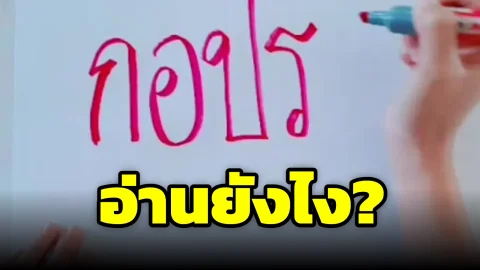 เปิดความหมาย "กอปร" อ่านอย่างไร แปลว่าอะไร? รู้จักคำไทยทรงคุณค่าที่พบบ่อยในงานเขียน
 มหาวิทยาลัยไหนมีบัณฑิตตกงานน้อยที่สุดในไทย
 รู้หรือไม่ว่า "กระเป๋า 4 มิติของ "โดราเอมอน" ใส่สิ่งมีชีวิตได้นะ!!"
 รถไฟสายแรกของไทยเปิดตั้งแต่ พ.ศ. 2436 แต่ทำไมคนส่วนใหญ่จึงจำปี 2439
 มนุษย์เป็นสัตว์ชนิดเดียวที่มีคางจริงหรือ
 คนเราฟังเพลงกี่เพลงตลอดชีวิต
 คนเรากินอาหารกี่มื้อตลอดชีวิต
 ร่างกายสร้างเม็ดเลือดแดงใหม่ได้เร็วแค่ไหนลาภเด็ด...เช็คให้รวย เปิดเลขเด่นวงกลม 2-9 จัดคู่เลข 6 ชุด งวด 16 พ.ย. 69
 English Edition
 Examining the Structure of Thailand’s Amulet Market: When Certification Power, Pricing, and Belief Become a Self-Perpetuating Cycle By C.T. Suwan
 EP1 — What Does It Take to Turn a Book into a Real Product? Behind the Creation of Cosmic Mind: From Manuscript to Four Published Formats
 Why Cats Quiver Their Tails When They Greet You
 Is It Jealousy or Resource Competition Between Pets?