Why Some Cats Throw Up After Eating—and When to Worry
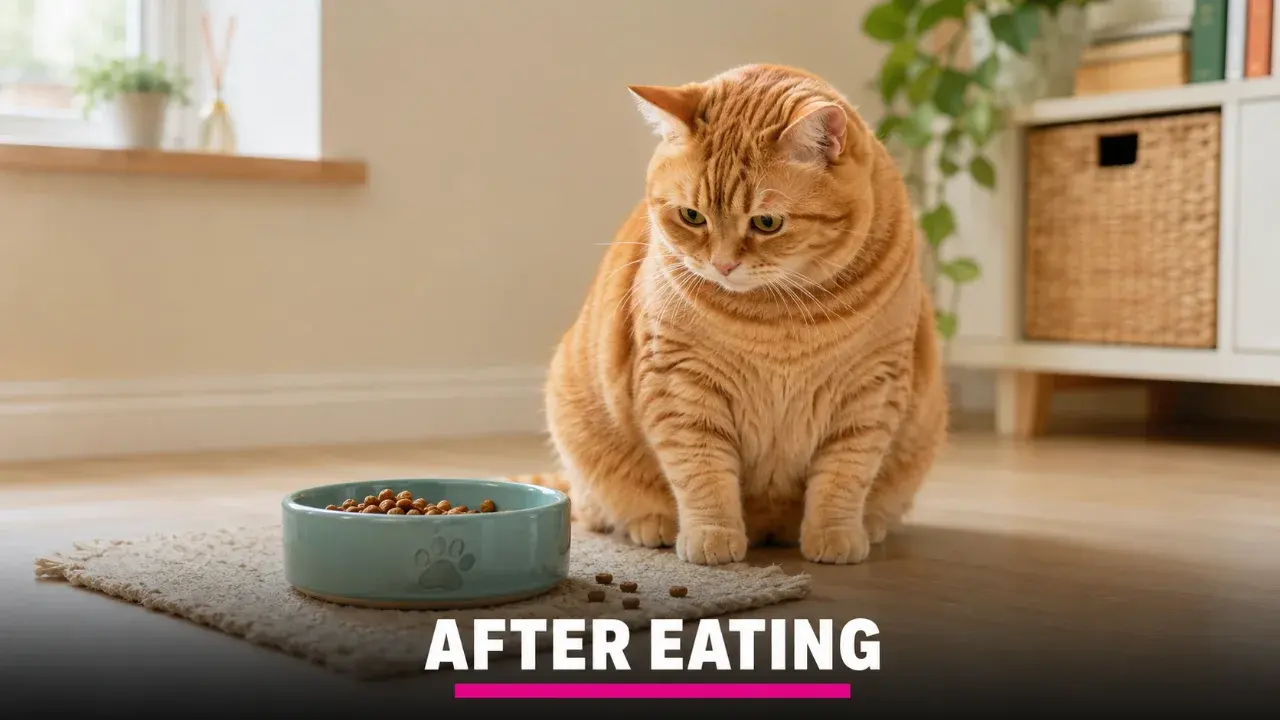
Eating too quickly can make a cat bring food back up, but repeated episodes may point to something more serious. The way it happens—and how your cat behaves afterward—offers important clues.
A cat finishes dinner, walks away from the bowl, and suddenly deposits a tube-shaped pile of nearly untouched food on the floor. It looks alarming, but what happened may not technically be vomiting.
The first useful question is not simply why the cat threw up. It is whether the episode was vomiting or regurgitation, two events that can look similar but involve different parts of the digestive system.
The timing and body movements tell you a lot
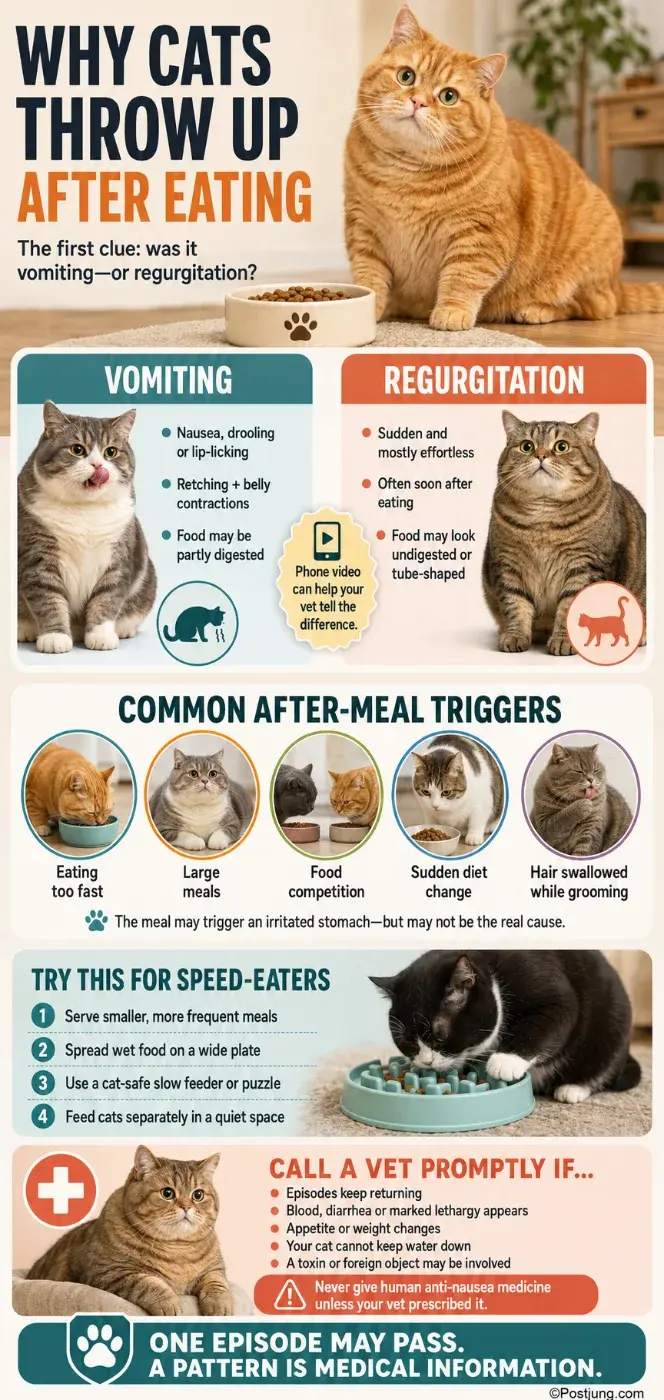
Vomiting is an active process. A cat may become restless, lick its lips, drool, repeatedly swallow, crouch, retch, and visibly contract its abdomen before bringing up material from the stomach or upper intestine.
Regurgitation is more passive. Food or water may come back up suddenly, often shortly after eating, without nausea, heaving, or strong abdominal movement. The material is frequently undigested and may retain a tubular shape after sitting in the esophagus.
These differences matter because regurgitation can be associated with eating behavior or an esophageal problem, while vomiting has a much broader range of possible causes. The MSD Veterinary Manual describes vomiting as forceful ejection that is commonly preceded by salivation, repeated swallowing, retching, and abdominal contractions.
If the distinction is hard to make, record a video for your veterinarian. An episode captured on a phone can reveal movements and timing that are difficult to describe afterward.
Some cats simply eat too fast
A hungry or food-motivated cat may swallow large mouthfuls with little chewing. In a multi-cat home, competition around the bowls can make this behavior worse—even when there is plenty of food available.
Fast eating is particularly associated with regurgitation. Food may collect in the esophagus or be swallowed faster than the digestive tract can comfortably handle it. Minutes later, it comes back up looking almost unchanged.
Owners can try several low-risk adjustments:
- Divide the daily food allowance into smaller, more frequent meals.
- Spread wet food across a wide, shallow plate.
- Use a cat-appropriate slow feeder or food puzzle.
- Feed competing cats in separate, quiet locations.
- Avoid allowing an extremely hungry cat to consume one large meal at once.
The goal is to slow the meal without reducing needed nutrition. Interactive feeders can prolong mealtime and provide mental stimulation, although the feeder must suit the cat’s age, mobility, and eating style.
Food can be involved—but not always in the obvious way
A sudden diet change may upset a cat’s digestive system. Spoiled food, table scraps, plants, foreign material, and certain medications can also trigger vomiting.
Some cats have adverse reactions to dietary ingredients, but vomiting alone cannot confirm a food allergy or intolerance. Similar symptoms can occur with parasites, inflammation, infections, or diseases unrelated to food.
Repeatedly switching brands in search of the “right” diet can make the pattern harder to interpret. A veterinarian may instead recommend a structured feeding trial using a specific diet for a defined period.
Hair can also contribute. Cats naturally swallow loose fur while grooming, and some of it may be brought up. Still, frequent vomiting should not automatically be dismissed as “just hairballs.” A mass of hair can occasionally contribute to an intestinal obstruction, according to the Cornell Feline Health Center.
Repeated vomiting may have little to do with the meal
Because the episode happens after eating, it is easy to blame the food. Sometimes the meal merely triggers an already irritated digestive tract.
Possible underlying causes include gastrointestinal inflammation, parasites, swallowed objects, pancreatitis, liver or kidney disease, hyperthyroidism, and other metabolic disorders. Regurgitation can also occur with inflammation, narrowing, poor movement, or enlargement of the esophagus.
This list does not mean that every isolated episode signals disease. It does mean that recurrent vomiting deserves investigation, especially when a cat’s appetite, weight, energy, thirst, urination, or stool has also changed.
The Cornell Feline Health Center advises prompt veterinary evaluation when a cat vomits more often than once per week or has accompanying signs such as lethargy, weakness, decreased appetite, blood in the vomit, abnormal thirst or urination, or diarrhea. Its feline vomiting guidance also emphasizes that vomiting is a symptom with many possible causes—not a diagnosis by itself.
What to observe before calling the veterinarian
A short record can make the veterinary visit more productive. Note:
- How soon the episode occurs after eating
- Whether there is drooling, retching, or abdominal heaving
- Whether the food is undigested, partially digested, foamy, or mixed with bile
- How often it happens
- What and how much the cat ate
- Any recent diet, medication, or household changes
- Appetite, water intake, bowel movements, urination, weight, and energy level
Photographs of the expelled material may also help. Do not deliberately expose the cat to suspected foods again to “test” the reaction.
When not to wait
Contact a veterinarian promptly if episodes keep recurring or the cat is losing weight, eating less, acting painful, hiding unusually, or developing diarrhea.
More urgent care may be needed when vomiting is repeated over a short period, the cat cannot keep water down, blood is present, a toxin or foreign object may have been swallowed, or the cat becomes weak, collapsed, or markedly lethargic.
Kittens, older cats, and cats with existing medical conditions may become unwell more quickly. Never give human anti-nausea medicine unless a veterinarian has specifically prescribed it for that cat.
A single episode in an otherwise bright, comfortable cat may pass without further trouble. But a pattern—especially one that keeps returning after meals—is useful medical information, not merely an unpleasant cleaning job.
Cornell University College of Veterinary Medicine, MSD Veterinary Manual, Texas A&M College of Veterinary Medicine & Biomedical Sciences, VCA Animal Hospitals
REFERENCES:
https://www.vet.cornell.edu/departments-centers-and-institutes/cornell-feline-health-center/health-information/feline-health-topics/vomiting
https://www.msdvetmanual.com/cat-owners/digestive-disorders-of-cats/vomiting-in-cats
https://vetmed.tamu.edu/news/pet-talk/when-to-be-concerned-about-feline-vomiting/
https://vcahospitals.com/know-your-pet/vomiting-in-cats

เขียนโดย Postjung Insights
 โรงเรียนที่มีนักเรียนมากที่สุดในไทย
 เปิดรายชื่อ 5 โรงเรียนเป้าหมาย เด็กสอบเข้าต้องเตรียมตัวให้พร้อม
 รู้หรือไม่? เปิดรายได้พนักงานส่งพัสดุของแต่ละแอป วันหนึ่งได้เท่าไร
 แปลปกสลาก งวด 1 ต.ค. 69 ส่องตัวเลขจากภาพปกสลากกินแบ่งรัฐบาล
 ซาบีดา” เรียกถกด่วน ปมภาพ “ชุดไทย” ถูกนำไปอ้างเป็นชุดกัมพูชา
 หนุ่มขับ Porsche ใจหล่อสุดๆ ติดประกาศเด็กหายไว้รอบคัน..หวังช่วยเผยแพร่ข้อมูลให้ตามหาได้เร็วขึ้น
 'สควีชชี่'ของเล่นที่กำลังเป็นไวรัลอาจถูกเจ้าหน้าที่ของสนามบินยึดได้ ตรวจสอบให้ดีก่อนนำขึ้นเครื่อง
 อำเภอที่มีชื่ออำเภอสั้นที่สุด 3 อำเภอเท่านั้นในประเทศไทย
 โรสแมรี่ แฮร์ริส ‘ป้าเมย์’ แห่ง Spider-Man ฉบับโทบีย์ แม็คไกวร์ อายุครบ 99 ปี
 ส่องเลข 3 สำนักพิมพ์ งวด 1 ต.ค. 69 ตัวไหนมีข้อมูลตรงกัน
 เรียก “ป๋อง สุพรรณ” เซียนพระดัง แจงปมมูลนิธิฯ วัดพุทไธศวรรย์
 บุ๋ม ปนัดดา” เล่าเบื้องหลังหญิงตีเนียน หลังเจออยู่กลางวงสัมภาษณ์ “หนุ่ม กรรชัย”ซาบีดา” เรียกถกด่วน ปมภาพ “ชุดไทย” ถูกนำไปอ้างเป็นชุดกัมพูชาเปิดรายชื่อ 5 โรงเรียนเป้าหมาย เด็กสอบเข้าต้องเตรียมตัวให้พร้อมหนุ่มขับ Porsche ใจหล่อสุดๆ ติดประกาศเด็กหายไว้รอบคัน..หวังช่วยเผยแพร่ข้อมูลให้ตามหาได้เร็วขึ้น
 วาบิ-ซาบิ (Wabi-Sabi) ปรัชญาญี่ปุ่นที่สอนให้เราโอบกอดความไม่สมบูรณ์แบบ
 English Edition