What Your Dog’s Different Tail Wags May Be Telling You
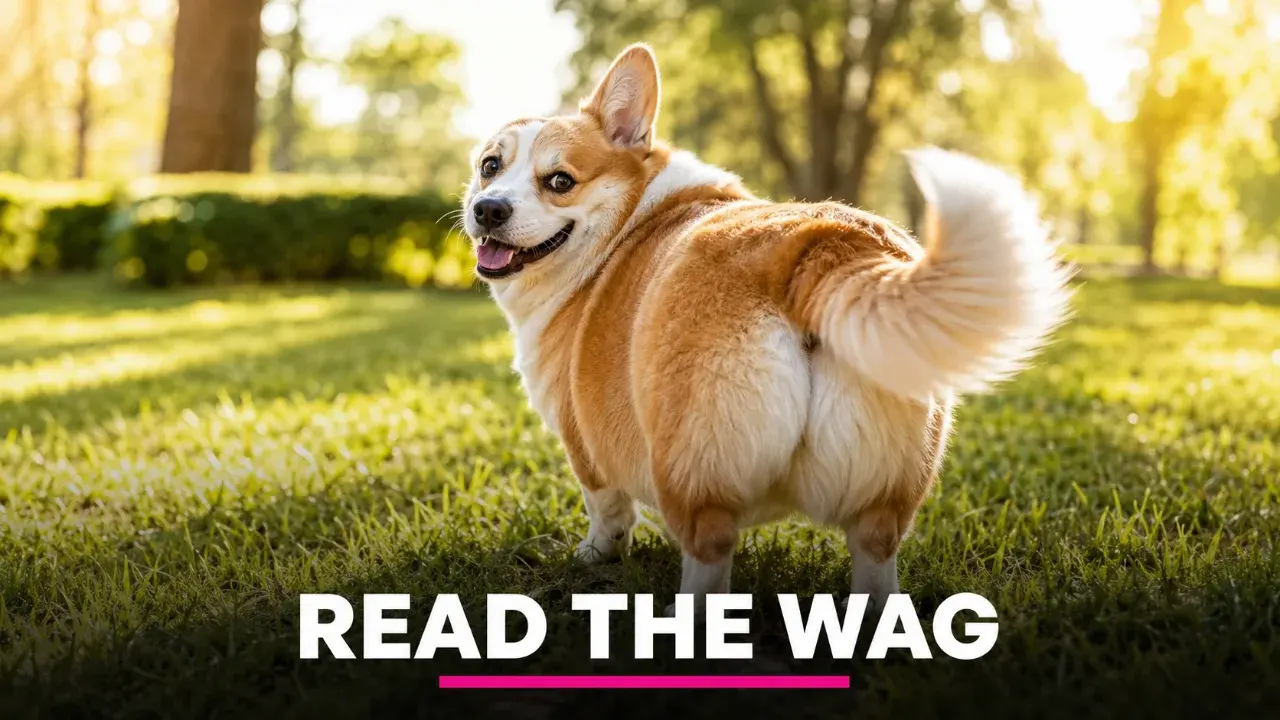
A loose, sweeping wag can look friendly, while a fast, rigid wag may signal tension. Understanding the difference means watching the whole dog—not just the tail.
A wagging tail is often treated as a universal sign of happiness. In reality, dogs also wag when they are excited, uncertain, anxious, alert, or emotionally conflicted.
The useful question is not simply, “Is the tail moving?” It is: How is the tail moving, and what is the rest of the dog doing?
Dogs communicate through combinations of movement, posture, facial expression, and sound. The height, speed, range, stiffness, and even direction of a tail wag can add information—but no single wag works like a word with one fixed definition.
Start with your dog’s neutral tail position
Before interpreting a wag, learn what your dog’s tail looks like when they are genuinely relaxed.
A neutral tail hangs relatively low in many dogs, but body structure makes a major difference. Beagles commonly carry their tails higher, sighthounds such as greyhounds tend to hold them lower, and breeds including Siberian huskies naturally curl their tails over their backs.
This means a high tail is not automatically assertive, and a low tail is not automatically fearful. Compare the movement with that dog’s normal posture, not with an imaginary standard that applies to every breed.
Dogs with short, tightly curled, naturally bobbed, or docked tails may be harder to read from a distance. In those cases, watch the tail base, hips, back, ears, mouth, eyes, and distribution of body weight.
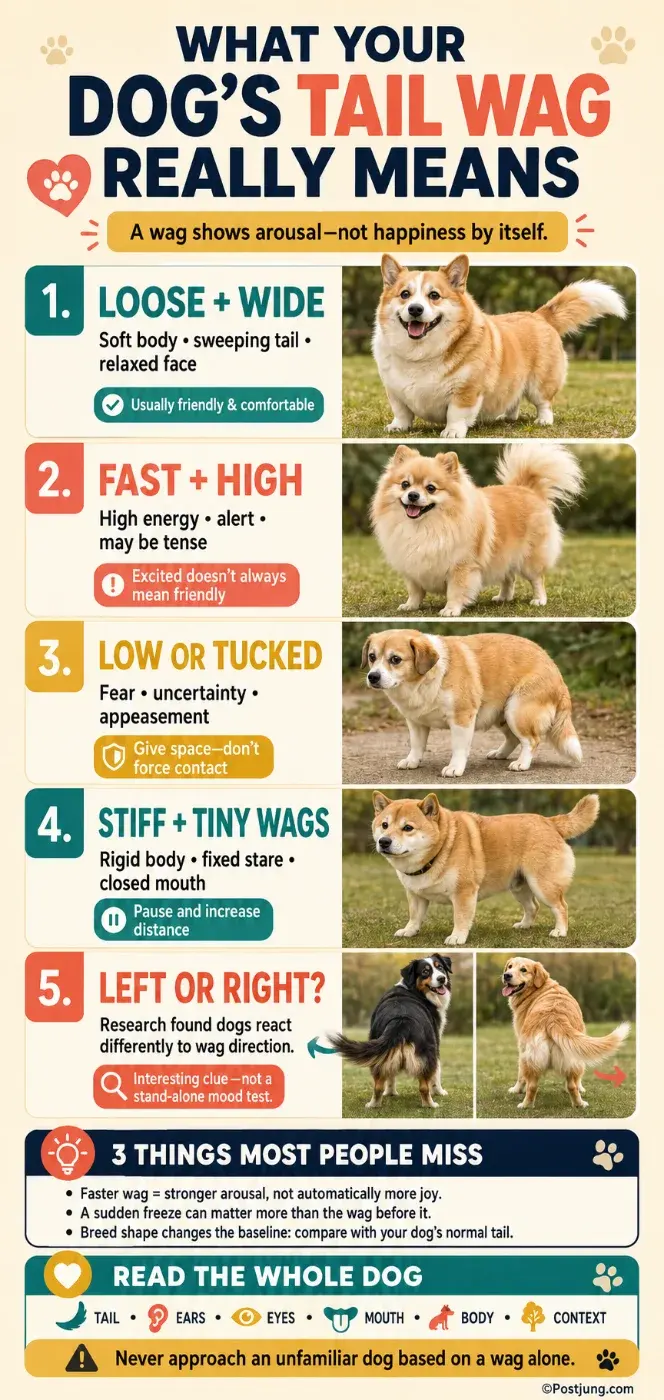
A loose, sweeping wag often accompanies friendly interest
The familiar broad wag that appears to move the dog’s entire rear end is commonly seen during relaxed greetings and positive social interaction.
The body usually looks soft rather than braced. The dog may have relaxed facial muscles, naturally positioned ears, gentle eyes, and an open mouth. Some dogs curve their bodies or wiggle from the shoulders to the hips.
A circular “helicopter” motion is also frequently associated with enthusiastic greetings, especially when a dog sees someone they know well.
These patterns can suggest friendly excitement, but context still matters. A dog bouncing toward its owner at home is in a very different situation from an unfamiliar dog straining toward someone in a crowded park.
Faster does not necessarily mean happier
Speed is more closely connected to emotional intensity—or arousal—than to happiness alone.
A rapidly moving tail may appear when a dog is thrilled to greet someone. It may also appear when the dog is overstimulated, frustrated, nervous, or unsure how an interaction will unfold.
Position helps refine the picture:
- A fast wag near the dog’s neutral height, combined with a loose body, often accompanies eager social engagement.
- A rapid low wag may appear when a dog feels worried or conflicted.
- A fast, high wag with a rigid body can signal intense arousal and should not be assumed to be friendly.
VCA Animal Hospitals cautions that some dogs wag while attempting to pause or end an uncomfortable interaction. Misreading that signal can lead a person to keep touching or approaching a dog that wants more distance. VCA Animal Hospitals
A stiff tail deserves more caution than a soft one
A small, tight wag near the tip of a rigid, elevated tail can look subtle, but it may carry more tension than a large, relaxed sweep.
Look for accompanying signs such as a frozen posture, forward-shifted weight, a closed mouth, hard stare, raised hair, tense facial muscles, or ears held sharply forward or backward. Together, these signals can indicate that the dog is highly alert or uncomfortable.
A tucked tail usually suggests fear, anxiety, or an effort to appear less threatening—particularly when paired with crouching, flattened ears, lip licking, yawning, trembling, or avoidance of eye contact.
The RSPCA similarly emphasizes reading the tail alongside the dog’s posture, face, ears, and weight distribution. RSPCA
A wagging dog can still need space. Do not reach toward an unfamiliar dog solely because its tail is moving. Let the dog’s handler guide the interaction, and allow the dog to approach voluntarily.
The direction of the wag may contain another clue
Laboratory research suggests that tail wagging can be asymmetrical.
In a 2007 study, dogs showed different left-right wagging biases when presented with stimuli including their owners, unfamiliar people, cats, and unfamiliar dominant dogs. Current Biology
A later experiment found that dogs watching another dog wag predominantly toward the left showed higher cardiac activity and more anxious behavior than dogs watching a right-biased wag. The researchers concluded that dogs can detect information contained in this asymmetry. PubMed
These findings are fascinating, but owners should not try to diagnose a dog’s mood from a quick glance at wag direction. The movement can be difficult to judge in real time, and the research does not turn every left or right wag into a simple emotional label.
A 2024 review also noted that major questions remain about how tail wagging developed during domestication and why domestic dogs display it so often. Several explanations have been proposed, but the evolutionary story is not settled. Biology Letters
Read the situation, then read the whole dog
The most reliable approach is to notice clusters of signals:
- Is the body loose or stiff?
- Is the dog leaning closer or shifting away?
- Are the eyes soft or fixed in a hard stare?
- Is the mouth relaxed or tightly closed?
- Are the ears natural, pinned back, or intensely forward?
- Did the wag change when a person, dog, sound, or object appeared?
Also watch for sudden changes. A dog that stops wagging and becomes motionless may be communicating something important. Freezing can be a request for distance and should not be ignored.
Over time, owners can learn an individual dog’s baseline by observing them during calm rest, play, greetings, unfamiliar encounters, and moments of uncertainty. The change from normal is often more informative than the wag itself.
If a dog’s tail carriage changes suddenly without an obvious emotional trigger—especially if movement appears painful, weak, or impossible—a veterinarian should evaluate the dog. That may be a physical problem rather than a behavioral message.
A tail is expressive, but it is only one part of the conversation. The safest readers of canine body language resist the tempting shortcut that every wag means “happy” and pay attention to what the entire dog is saying.
Current Biology, Biology Letters, PubMed, RSPCA, VCA Animal Hospitals
REFERENCES:
https://www.cell.com/current-biology/fulltext/S0960-9822(07)00949-9
https://pubmed.ncbi.nlm.nih.gov/24184108/
https://royalsocietypublishing.org/rsbl/article/20/1/20230407/63446/Why-do-dogs-wag-their-tails-Why-do-dogs-wag-their
https://www.rspca.org.uk/adviceandwelfare/pets/dogs/behaviour/understanding

เขียนโดย Postjung Insights
 รู้หรือไม่? เปิดรายได้พนักงานส่งพัสดุของแต่ละแอป วันหนึ่งได้เท่าไร
 โรงเรียนที่มีนักเรียนมากที่สุดในไทย
 เปิดรายชื่อ 5 โรงเรียนเป้าหมาย เด็กสอบเข้าต้องเตรียมตัวให้พร้อม
 ซาบีดา” เรียกถกด่วน ปมภาพ “ชุดไทย” ถูกนำไปอ้างเป็นชุดกัมพูชา
 ตาราง “เด่นเหนือเด่นใต้” งวด 1 ต.ค. 69 เปิดข้อมูลตามโพย เลขไหนอยู่ตรงไหน
 อำเภอที่มีชื่ออำเภอสั้นที่สุด 3 อำเภอเท่านั้นในประเทศไทย
 แปลปกสลาก งวด 1 ต.ค. 69 ส่องตัวเลขจากภาพปกสลากกินแบ่งรัฐบาล
 หนุ่มขับ Porsche ใจหล่อสุดๆ ติดประกาศเด็กหายไว้รอบคัน..หวังช่วยเผยแพร่ข้อมูลให้ตามหาได้เร็วขึ้น
 'สควีชชี่'ของเล่นที่กำลังเป็นไวรัลอาจถูกเจ้าหน้าที่ของสนามบินยึดได้ ตรวจสอบให้ดีก่อนนำขึ้นเครื่อง
 ส่องเลข 3 สำนักพิมพ์ งวด 1 ต.ค. 69 ตัวไหนมีข้อมูลตรงกัน
 สถิติย้อนหลัง 10 ปี ออกเลขไหนบ้างมาดูกัน
 โรสแมรี่ แฮร์ริส ‘ป้าเมย์’ แห่ง Spider-Man ฉบับโทบีย์ แม็คไกวร์ อายุครบ 99 ปีซาบีดา” เรียกถกด่วน ปมภาพ “ชุดไทย” ถูกนำไปอ้างเป็นชุดกัมพูชาเปิดรายชื่อ 5 โรงเรียนเป้าหมาย เด็กสอบเข้าต้องเตรียมตัวให้พร้อมหนุ่มขับ Porsche ใจหล่อสุดๆ ติดประกาศเด็กหายไว้รอบคัน..หวังช่วยเผยแพร่ข้อมูลให้ตามหาได้เร็วขึ้น
 วาบิ-ซาบิ (Wabi-Sabi) ปรัชญาญี่ปุ่นที่สอนให้เราโอบกอดความไม่สมบูรณ์แบบ
 English Edition