Why Some Cats Hate Closed Doors—and What They Really Want
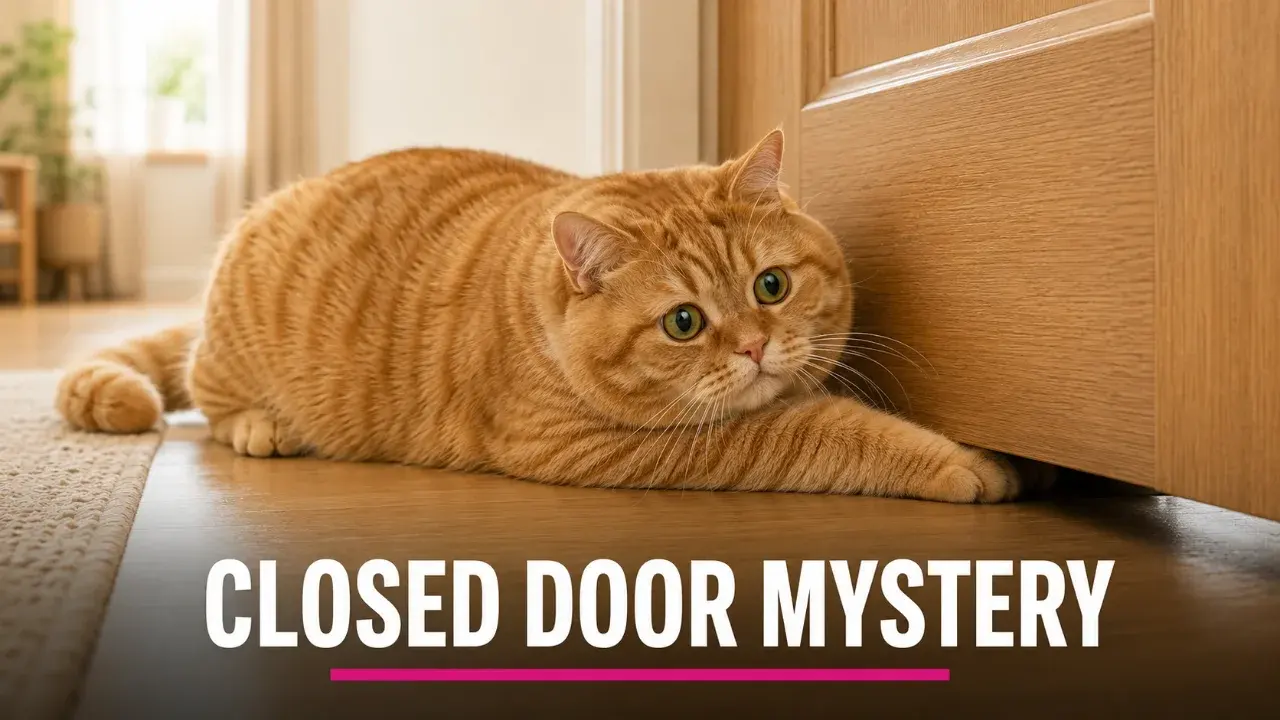
A closed door can block more than a room. For some cats, it disrupts their territory, routine, access to people, or ability to investigate what is happening nearby.
A cat demands that you open a door, walks through it—and immediately wants to leave again. The behavior can look ridiculous, but the cat may not be asking for the room itself. It may be asking for access, information, or choice.
Closed doors affect cats differently. Some barely notice them, while others meow, paw at the gap, scratch the frame, or wait outside for hours. Personality matters, but so do the cat’s environment, habits, relationships, and past experiences.
The door suddenly divides their territory
Cats do not understand household boundaries in the same way people do. If a bedroom, bathroom, or office has normally been available, a closed door abruptly removes part of the space the cat considers familiar.
Veterinary environmental guidelines describe cats as territorial animals that rely heavily on familiarity, scent, and predictable access to important resources. They also benefit from having some control over where they rest, hide, explore, and interact.
A closed door may therefore create a small but meaningful disruption. The cat can hear movement and detect scents on the other side but cannot inspect their source.
The mystery behind the door can matter more than the room. Once the door opens and the cat confirms that nothing unusual is happening, its interest may disappear.
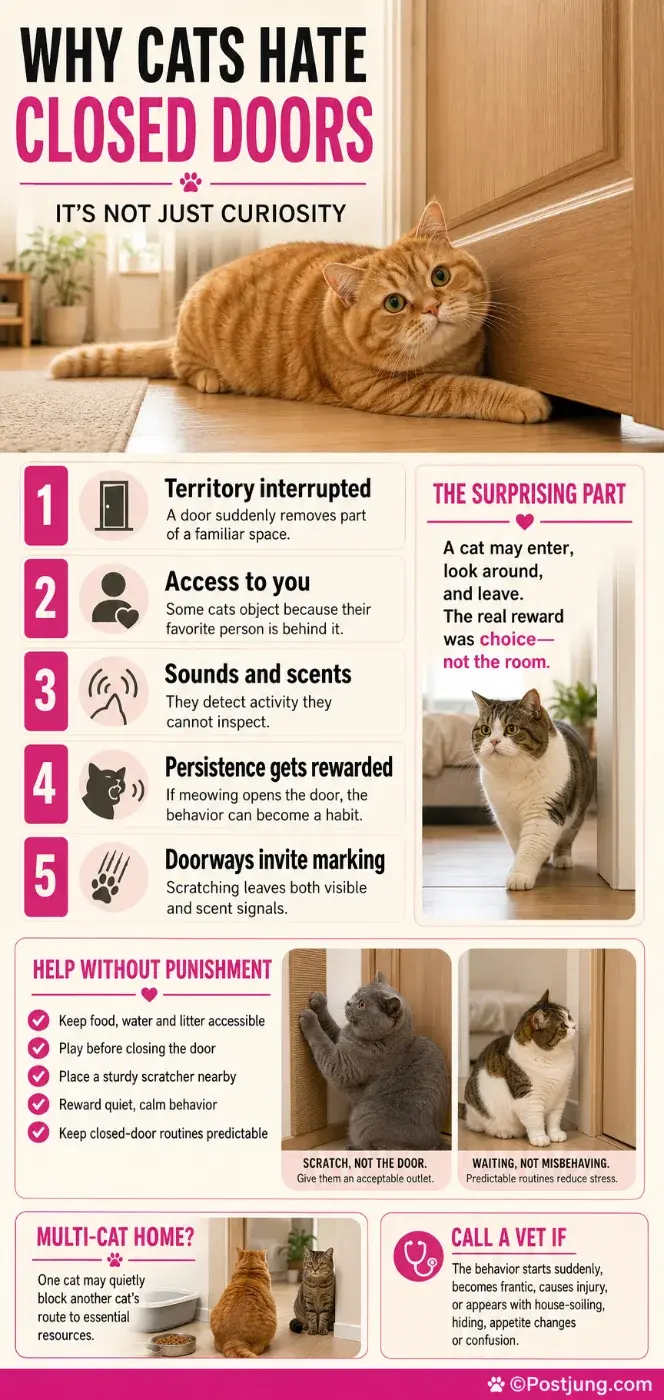
Your cat may be looking for you
Cats form social relationships with people, even though they do not always display attachment in obvious ways. A cat that follows one particular person through the home may protest when a door suddenly separates them.
That does not automatically mean the cat has separation anxiety. It may simply want attention, companionship, warmth, play, or access to a favored sleeping place.
Research into separation-related behavior in cats has identified possible signs such as excessive vocalization, destructive behavior, agitation, and inappropriate elimination when an attachment figure is absent. These problems are more significant than an occasional complaint outside the bathroom.
Watch the context. A cat that cries briefly and then settles is behaving differently from one that remains distressed, scratches frantically, stops eating, or urinates outside the litter box whenever access to a person is blocked.
Sometimes the cat has learned that persistence works
Cats are good at noticing cause and effect. If pawing, scratching, or meowing repeatedly causes a person to open the door, the behavior has achieved its goal.
The lesson can become surprisingly specific: quiet waiting does nothing, while a loud complaint produces an immediate response.
Opening the door occasionally but refusing at other times can make the behavior especially persistent because the cat never knows which attempt will work. It may keep trying longer.
That does not mean you should ignore possible distress or deny access to food, water, litter boxes, or safe resting areas. But when the cat’s needs are already met, consistency is often more helpful than scolding.
Scratching may serve more than one purpose
Scratching is a normal feline behavior. It maintains the claws, stretches the body, leaves visible marks, and deposits scent from glands in the paws.
A doorway is a socially and geographically important location in a home, making it an appealing place to scratch. A cat may be trying to gain access, mark the boundary, relieve frustration, or combine all three behaviors at once.
Cornell University’s Feline Health Center notes that scratching is largely a marking behavior rather than a deliberate attempt to destroy property. Punishment can increase fear or stress without addressing the reason the cat chose that location.
A sturdy vertical or horizontal scratcher placed near the problem door can provide a better outlet. Rewarding the cat for using it helps make the alternative more worthwhile.
How to make a closed door less upsetting
First, make sure the restricted room does not contain the cat’s only litter box, water source, bed, scratching surface, hiding spot, or route away from another pet. In multi-cat homes, one cat may quietly block another from reaching essential resources.
If the door must remain closed, try to make that boundary predictable. Provide play or attention before closing it, especially if the cat tends to protest when you begin working or sleeping.
Offer enrichment elsewhere: a window perch, food puzzle, climbing space, hiding box, or short interactive play session can redirect the cat’s attention. A scratching post near the doorway may protect the frame while meeting a natural behavioral need.
Reward calm behavior away from the door. Avoid yelling, spraying water, or physically punishing the cat. Guidance from the Feline Veterinary Medical Association recommends positive reinforcement because punishment can increase fear, damage trust, and contribute to further unwanted behavior.
The goal is not to win an argument with the cat. It is to identify what the closed door removed—access, company, stimulation, safety, or routine—and provide a workable alternative.
When the behavior deserves a veterinary check
Door-related complaints are usually behavioral, but a sudden change should not be dismissed. Increased vocalization can accompany pain, anxiety, cognitive changes in older cats, or other medical problems.
Contact a veterinarian if the behavior appears abruptly, becomes intense, causes injury, disrupts eating or sleep, or occurs alongside house-soiling, aggression, hiding, confusion, or other unusual behavior.
For most cats, though, the message is simpler: the door has changed something in their environment, and they would prefer to know what is happening on the other side.
Feline Veterinary Medical Association, Cornell Feline Health Center, PLOS ONE
REFERENCES:
FelineVMA Environmental Needs Guidelines
Cornell Feline Health Center: Destructive Behavior
PLOS ONE: Separation-Related Problems in Domestic Cats
FelineVMA: Training Techniques for Undesirable Behaviors

เขียนโดย Postjung Insights
 รู้หรือไม่? เปิดรายได้พนักงานส่งพัสดุของแต่ละแอป วันหนึ่งได้เท่าไร
 ซาบีดา” เรียกถกด่วน ปมภาพ “ชุดไทย” ถูกนำไปอ้างเป็นชุดกัมพูชา
 เปิดรายชื่อ 5 โรงเรียนเป้าหมาย เด็กสอบเข้าต้องเตรียมตัวให้พร้อม
 แปลปกสลาก งวด 1 ต.ค. 69 ส่องตัวเลขจากภาพปกสลากกินแบ่งรัฐบาล
 ส่องเลข 3 สำนักพิมพ์ งวด 1 ต.ค. 69 ตัวไหนมีข้อมูลตรงกัน
 โรงเรียนที่มีนักเรียนมากที่สุดในไทย
 หนุ่มขับ Porsche ใจหล่อสุดๆ ติดประกาศเด็กหายไว้รอบคัน..หวังช่วยเผยแพร่ข้อมูลให้ตามหาได้เร็วขึ้น
 Ctrip แพลตฟอร์มการท่องเที่ยวของจีน เปิดขายตั๋วสำหรับทริปท่องเที่ยวอวกาศ ของ Virgin Galactic 6 วัน ในราคาประมาณ 24 ล้านบาท
 อำเภอที่มีชื่ออำเภอสั้นที่สุด 3 อำเภอเท่านั้นในประเทศไทย
 'สควีชชี่'ของเล่นที่กำลังเป็นไวรัลอาจถูกเจ้าหน้าที่ของสนามบินยึดได้ ตรวจสอบให้ดีก่อนนำขึ้นเครื่อง
 สถิติย้อนหลัง 10 ปี ออกเลขไหนบ้างมาดูกัน
 โรสแมรี่ แฮร์ริส ‘ป้าเมย์’ แห่ง Spider-Man ฉบับโทบีย์ แม็คไกวร์ อายุครบ 99 ปีซาบีดา” เรียกถกด่วน ปมภาพ “ชุดไทย” ถูกนำไปอ้างเป็นชุดกัมพูชาเปิดรายชื่อ 5 โรงเรียนเป้าหมาย เด็กสอบเข้าต้องเตรียมตัวให้พร้อมหนุ่มขับ Porsche ใจหล่อสุดๆ ติดประกาศเด็กหายไว้รอบคัน..หวังช่วยเผยแพร่ข้อมูลให้ตามหาได้เร็วขึ้น
 วาบิ-ซาบิ (Wabi-Sabi) ปรัชญาญี่ปุ่นที่สอนให้เราโอบกอดความไม่สมบูรณ์แบบ
 English Edition