Why Some Dogs Do Better on Sensitive-Stomach Food

Some dogs react badly to rich, sudden, or unsuitable diets, but stomach trouble is not always “just food.” Here’s what sensitive-stomach formulas are meant to do — and when symptoms deserve a vet visit.
Some dogs can eat almost anything and seem fine. Others develop loose stool, gas, vomiting, or discomfort after a food change, a rich treat, or a diet that simply does not agree with them.
That is where sensitive-stomach dog food comes in. It is not a magic cure, and it is not automatically better for every dog. But for some pets, a gentler, more consistent diet can make everyday digestion easier.
The important part is knowing what the label really means — and when stomach symptoms may point to something more serious than food.
“Sensitive stomach” is a description, not a diagnosis
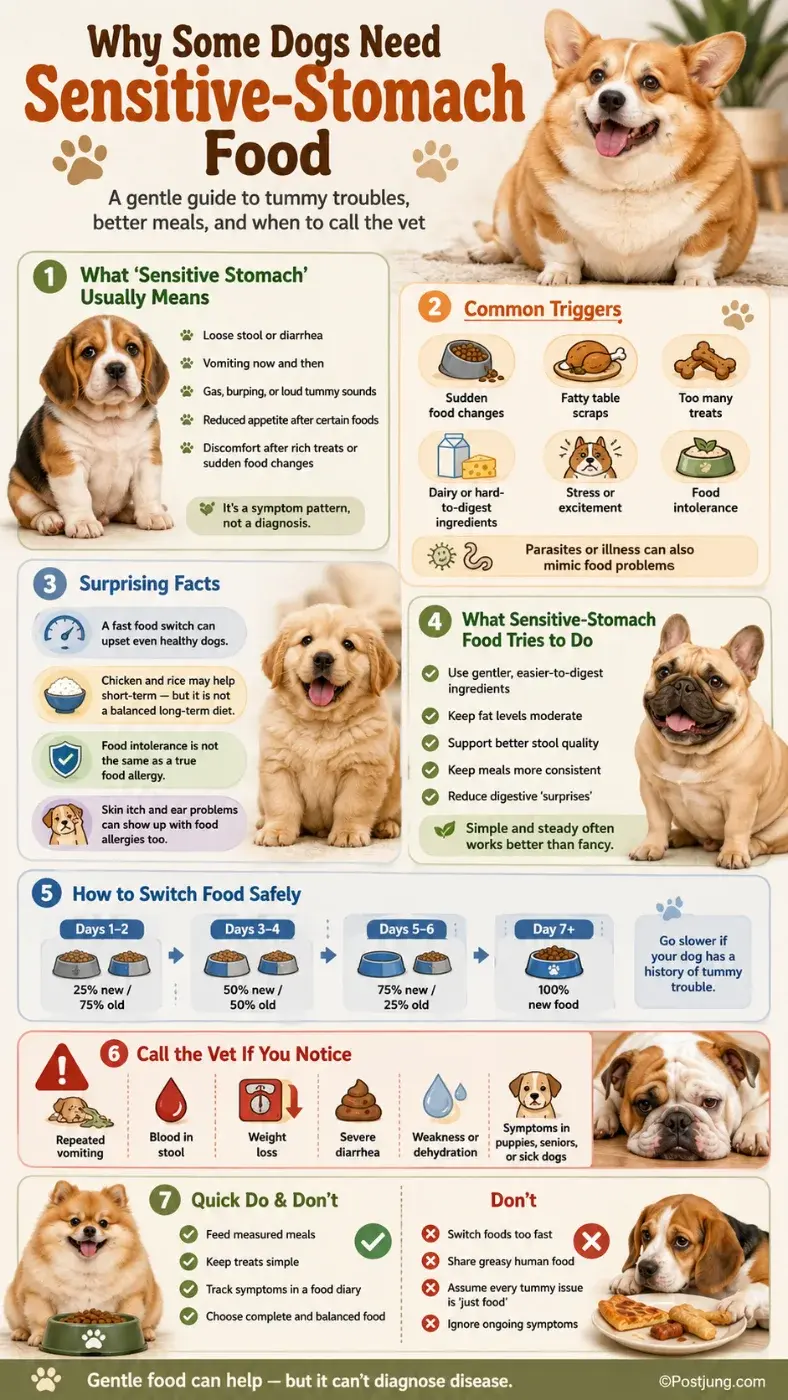
When owners say a dog has a sensitive stomach, they usually mean the dog has recurring digestive upset. That may include soft stool, diarrhea, vomiting, gas, loud stomach sounds, or appetite changes.
But those signs can have many causes. A dog may react to a sudden diet change, spoiled food, table scraps, stress, parasites, infection, food intolerance, allergies, or an underlying gastrointestinal condition. Veterinary references such as Merck Veterinary Manual note that vomiting and diarrhea can have multiple causes, which is why repeated or severe symptoms should not be treated as a simple food issue.
That is the first thing owners should understand: sensitive stomach is not one single condition. It is a pattern of symptoms that needs context.
A dog that has one loose stool after stealing greasy food from the trash is different from a dog that vomits weekly, loses weight, refuses food, or has blood in the stool.
Why regular food may be too much for some dogs
Some dogs do better with food that is easier to digest, lower in fat, more consistent in ingredients, or built around a protein and carbohydrate source they tolerate well.
For example, rich or fatty foods can upset some dogs. So can frequent changes between brands, flavors, treats, and human leftovers. Even a nutritionally complete food can cause problems if the transition happens too quickly.
A 2023 study on puppies found that gradual diet transition was associated with a lower diarrhea rate compared with abrupt change, supporting what many veterinarians already advise: dogs often need time to adjust when food changes.
That matters because many “sensitive stomach” cases begin not with a bad food, but with too many changes at once.
A dog may be eating kibble, wet food, dental chews, training treats, leftovers, flavored supplements, and occasional human snacks. If digestion becomes messy, it can be hard to identify the trigger.
Sensitive-stomach diets often try to reduce that confusion by keeping the formula simpler, gentler, and more predictable.
Food intolerance is not the same as food allergy
One common misunderstanding is that every dog with stomach trouble must be “allergic” to an ingredient.
Food intolerance and food allergy are not the same thing. VCA Animal Hospitals explains that adverse food reactions can include intolerance, while true food allergies involve the immune system and may also show up as skin problems such as itching or ear issues.
A dog with lactose intolerance, for instance, may develop diarrhea, bloating, or discomfort after milk or dairy. That does not necessarily mean the dog has a full immune allergy to all foods.
This difference matters because the solution may differ. Some dogs need a limited-ingredient diet. Some need a veterinary elimination diet. Some simply need owners to stop giving rich treats, dairy, or sudden food changes.
For dogs with suspected allergy or chronic digestive disease, guessing at the pet store is usually not enough. A veterinarian may recommend a structured food trial or a prescription diet designed for a specific medical purpose.
What sensitive-stomach food usually tries to do
Sensitive-stomach formulas vary by brand, so the label should be read carefully. In general, these foods may focus on digestible ingredients, moderate fat levels, selected protein sources, added fiber, or ingredients intended to support stool quality.
The goal is not to make the food “fancier.” The goal is to make digestion more stable.
For many dogs, consistency is the real advantage. Feeding the same appropriate food, in measured portions, with fewer random extras can reduce the daily surprises that irritate the gut.
Owners should also look for a nutritional adequacy statement. The U.S. Food and Drug Administration says pet owners can check whether a food meets a pet’s nutritional needs by looking at the nutritional adequacy statement on the label. AAFCO also explains that pet food labels should identify the species the food is for and provide required label information.
That is especially important if the food will be the dog’s main diet. Gentle food still needs to be complete and balanced for the dog’s life stage, unless a veterinarian gives different instructions.
When a bland diet is only a short-term tool
Some owners turn to boiled chicken and rice when a dog has diarrhea. That can be useful in certain mild cases, but it should not become a long-term diet without veterinary guidance.
Cornell’s Riney Canine Health Center notes that mild diarrhea may sometimes be managed at home with a bland diet, while also emphasizing that more serious signs require veterinary attention.
The key word is temporary. Plain chicken and rice may be easy on the stomach for a short period, but it is not a complete everyday diet for most dogs.
If a dog improves on bland food but relapses whenever regular food returns, that is useful information. It may mean the dog needs a different long-term diet — or that there is an underlying issue still waiting to be diagnosed.
Red flags owners should not ignore
Sensitive-stomach food may help some dogs, but it should not be used to delay medical care.
A vet visit is especially important if symptoms are severe, frequent, or come with warning signs such as blood in stool, repeated vomiting, dehydration, weight loss, weakness, fever, painful belly, loss of appetite, or symptoms in a young puppy, senior dog, or dog with another medical condition.
A sudden digestive episode can also be linked to things that food alone will not fix, including infections, parasites, toxin exposure, pancreatitis, foreign objects, or other disease.
The safest approach is simple: food can support digestion, but it cannot diagnose disease.
How to switch food more safely
If a dog is otherwise well and the owner wants to try a sensitive-stomach formula, a gradual transition is usually best.
A common approach is to mix a small amount of the new food into the old food, then slowly increase the new portion over several days. Some dogs need longer, especially if they have a history of digestive upset.
During the switch, owners should avoid adding new treats, table scraps, chews, or supplements unless a veterinarian recommends them. Otherwise, it becomes difficult to tell whether the new food is helping.
Keeping a short food and symptom diary can also help. Write down what the dog ate, when symptoms appeared, stool quality, vomiting episodes, appetite, and any treats or human foods. That record can be surprisingly useful at the vet clinic.
The real point is comfort, not trendiness
Sensitive-stomach dog food is easy to market because many owners want a simple answer. But the best diet is not the one with the prettiest bag or the longest list of claims.
The best diet is the one that fits the dog’s age, health, digestion, body condition, and veterinary needs.
For some dogs, that may be a sensitive-stomach formula from a reputable brand. For others, it may be a prescription gastrointestinal diet, a limited-ingredient trial, a lower-fat food, or simply a slower transition away from rich snacks.
The quiet truth is that digestive health often improves through boring consistency: measured meals, fewer extras, careful transitions, and attention to early warning signs.
A dog’s stomach does not need a trend. It needs food that works.
Merck Veterinary Manual, VCA Animal Hospitals, Cornell University College of Veterinary Medicine, U.S. Food and Drug Administration, AAFCO, WSAVA
REFERENCES:
https://www.merckvetmanual.com/dog-owners/digestive-disorders-of-dogs/vomiting-in-dogs
https://vcahospitals.com/know-your-pet/adverse-reactions-to-food-in-dogs
https://www.vet.cornell.edu/departments-centers-and-institutes/riney-canine-health-center/canine-health-topics/diarrhea
https://www.fda.gov/animal-veterinary/animal-health-literacy/complete-and-balanced-pet-food

เขียนโดย Postjung Insights
 รู้หรือไม่? เปิดรายได้พนักงานส่งพัสดุของแต่ละแอป วันหนึ่งได้เท่าไร
 5 คณะที่เรียนจบมาแล้ว มีอาชีพรองรับมากกว่าที่คิด
 Google ยอมรับแล้ว! Gemini AI เข้าถึงระบบบริษัทจริง 3 แห่ง ระหว่างการทดสอบความปลอดภัย
 โรงเรียนที่มีนักเรียนมากที่สุดในไทย
 เลขเด็ดปฏิทิน "หลวงปู่โต๊ะ" งวดวันที่ 1 ตุลาคม 69..ส่องเลย เลขไหนให้โชค!
 ตาราง “เด่นเหนือเด่นใต้” งวด 1 ต.ค. 69 เปิดข้อมูลตามโพย เลขไหนอยู่ตรงไหน
 อำเภอที่มีชื่ออำเภอสั้นที่สุด 3 อำเภอเท่านั้นในประเทศไทย
 ส่องเลข 3 สำนักพิมพ์ งวด 1 ต.ค. 69 ตัวไหนมีข้อมูลตรงกัน
 เปิดรายชื่อโรงเรียนในไทยที่ “ว่ายน้ำ” อยู่ในหลักสูตร เรียนจริงตั้งแต่อนุบาลถึงมัธยม
 เปิด 5 โรงเรียนหญิงล้วนเก่าแก่ของไทย ที่มีประวัติยาวนานกว่าศตวรรษ
 ดอลลาร์จะล่มสลายจริงไหม?
 จุฬาฯ มหาวิทยาลัยแห่งแรกของไทย มีจุดเริ่มต้นในสมัยรัชกาลที่ 55 คณะที่เรียนจบมาแล้ว มีอาชีพรองรับมากกว่าที่คิดเปิดรายชื่อโรงเรียนในไทยที่ “ว่ายน้ำ” อยู่ในหลักสูตร เรียนจริงตั้งแต่อนุบาลถึงมัธยมGoogle ยอมรับแล้ว! Gemini AI เข้าถึงระบบบริษัทจริง 3 แห่ง ระหว่างการทดสอบความปลอดภัยเลขเด็ดปฏิทิน "หลวงปู่โต๊ะ" งวดวันที่ 1 ตุลาคม 69..ส่องเลย เลขไหนให้โชค!
 ทำไมของพลาสติกเก่าบางชิ้นถึง “เหนียว” ขึ้นมาเอง ทั้งที่ไม่ได้เปื้อนอะไร?
 อุทยานเขาใหญ่เรียกตัว “ตีนผี” หลังขับจี้ช้างป่าพ่อลูก ลั่นระยะ 50 เมตรต้องจำให้ขึ้นใจ
 English Edition