Why Senior Cats Need Water That Is Easier to Reach
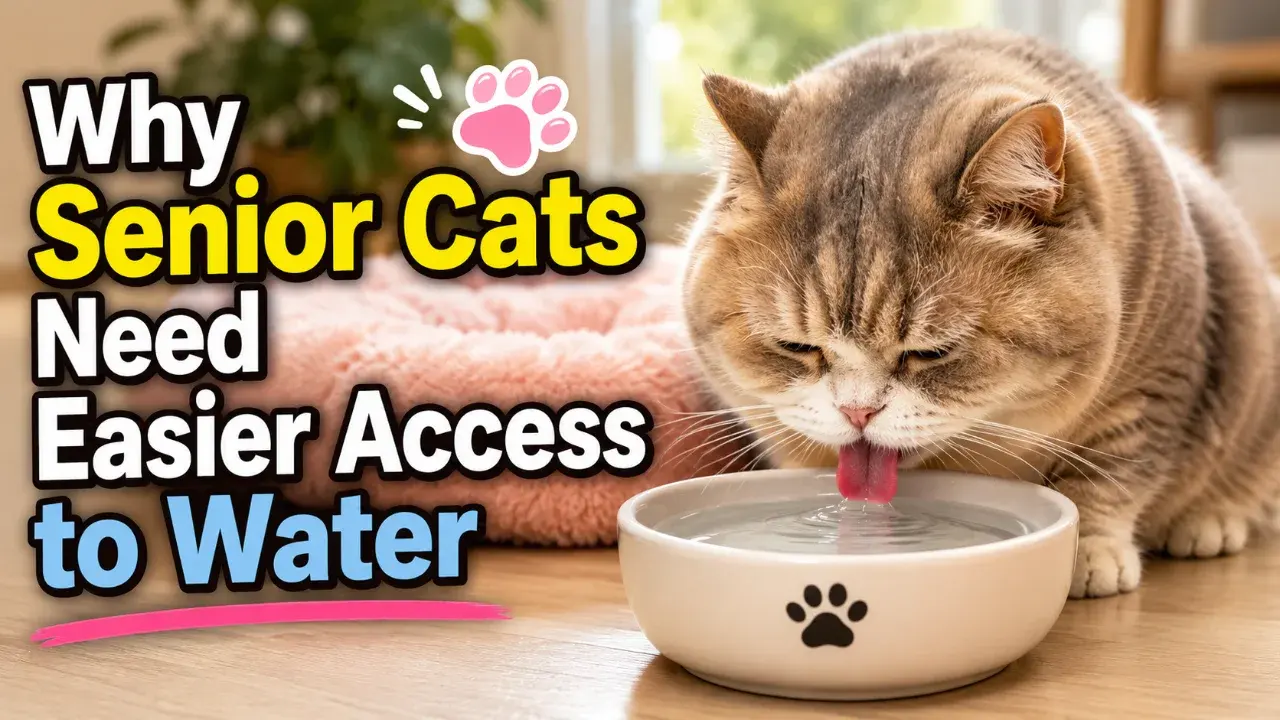
Older cats may drink less when bowls are too far away, too hard to reach, or placed in stressful spots. Small changes at home can make hydration easier, especially for cats with age-related health issues.
Senior cats do not always need more complicated care. Sometimes, they need the basics made easier — and water is one of the most important basics of all.
As cats age, reaching a water bowl can become less simple than it looks. Stiff joints, dental discomfort, vision changes, kidney problems, diabetes, constipation risk, or plain old fatigue can all make drinking less convenient. For an older cat, easy water access is health support, not just a household detail.
Veterinary guidance consistently treats hydration as especially important in senior cats. The 2021 AAFP Feline Senior Care Guidelines note that hydration status matters because common conditions in older cats, including chronic kidney disease and diabetes mellitus, can contribute to gradual body fluid loss. Cornell Feline Health Center also advises multiple clean water sources and wet food as ways to encourage hydration, especially for cats with chronic kidney disease.
That does not mean every older cat is sick. It means water should be easier to find, easier to reach, and easier to enjoy before a problem becomes obvious.
Why older cats may drink less than they should
Cats are already unusual drinkers. Their ancestors evolved in dry environments, and many domestic cats still do not have a strong habit of drinking large amounts from a bowl. Some cats get much of their moisture from food, especially wet food.
A commonly cited guideline is that cats may need around 50 milliliters of water per kilogram of body weight per day, though total intake includes moisture from both food and drinking water. Cornell’s hydration guidance gives a similar owner-friendly estimate: about 4 ounces of water per 5 pounds of lean body weight per day.
The tricky part is that owners rarely measure a cat’s exact daily water intake. A bowl may look “used,” but that does not always mean the cat is drinking comfortably or consistently.
For senior cats, small barriers matter more. A bowl placed upstairs may be easy for a young cat but tiring for one with arthritis. A deep bowl may bother a cat with sensitive whiskers. A bowl beside a noisy appliance may feel unpleasant. A shared bowl near another pet’s territory may make a cautious older cat avoid it.
To humans, the water is available. To the cat, it may not feel accessible.
Aging changes the meaning of “nearby”
A senior cat’s world often gets smaller.
The favorite sunny spot, litter box, food dish, and sleeping area may still be familiar, but moving between them can require more effort. Cats are skilled at hiding discomfort, so owners may not notice pain until the cat is already avoiding stairs, jumping less, or sleeping closer to one area of the home.
That is why one bowl in one room may not be enough for an aging cat.
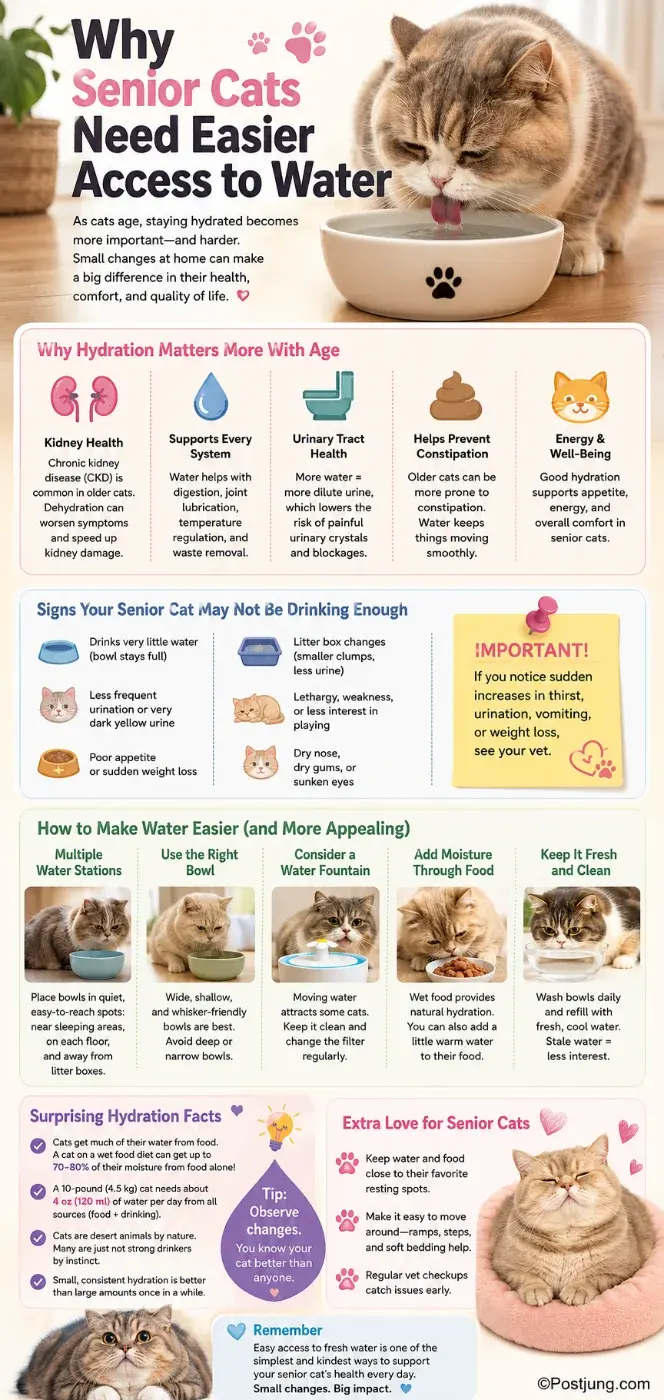
A better setup is usually simple: place clean water in several quiet, easy-to-reach locations. One bowl near the cat’s main sleeping area, one near the feeding area, and one on each level of the home can reduce the effort required to drink.
The bowl should be stable, shallow enough to drink from comfortably, and placed where the cat does not feel cornered. Some cats prefer ceramic, stainless steel, or glass bowls because they can hold fewer odors than old plastic bowls.
The goal is not to force a cat to drink. It is to remove tiny obstacles that may be reducing the cat’s natural willingness to drink.
Kidney health is one reason hydration gets more attention
Chronic kidney disease is commonly diagnosed in older cats, according to international feline medicine guidance. Cats with kidney disease can become more vulnerable to dehydration, and Cornell Feline Health Center notes that dehydration can worsen clinical signs in cats with CKD.
This is one reason many veterinarians ask owners about drinking habits, urination, appetite, weight, and litter box changes during senior cat checkups.
More drinking is not always a good sign. If an older cat suddenly drinks much more water than usual, urinates more, loses weight, vomits, seems weak, or has a poor appetite, that deserves veterinary attention. Increased thirst can be linked with medical conditions, including kidney disease and diabetes.
So the message is balanced: make water easier to access, but do not ignore dramatic changes in thirst.
Wet food can quietly help
Water does not only come from a bowl.
Wet food can contribute significant moisture to a cat’s daily intake, which is why veterinarians often discuss canned or wet diets for cats that need hydration support. Older AAFP senior care guidance also notes that increased water intake can be supported by canned food and multiple water dishes.
This does not mean every senior cat must switch diets overnight. Cats can be particular, and older cats may have medical needs that affect diet choices. But for many households, adding some wet food, warming it slightly, or mixing in a small amount of water under veterinary guidance can be a practical conversation to have with a vet.
Food changes should be gentle, especially for cats with kidney disease, diabetes, digestive issues, dental disease, or prescribed diets.
Water fountains can help some cats, but not all
Many cats are curious about moving water. A fountain may encourage some cats to drink more because the sound and motion attract attention. Cornell mentions fountains as one possible way to encourage drinking in cats with CKD.
But fountains are not magic. Research on water source and intake has found that a fountain did not substantially increase water intake or dilute urine in the cats studied.
That does not make fountains useless. It means owners should watch the individual cat.
Some cats love a fountain. Others ignore it. Some are bothered by motor noise. Some prefer a wide, still bowl. The best water source is the one the cat actually uses.
The most practical approach is variety: offer a clean bowl and, if useful, a fountain in a separate spot. Clean both regularly. Refill with fresh water often. Watch what the cat chooses.
The home setup matters more than owners think
A senior-friendly water plan does not need to be expensive.
Start by looking at the home from the cat’s point of view. Is the water close to where the cat sleeps? Does the cat need to climb stairs? Is the bowl near a dog, a busy hallway, a litter box, or a loud washing machine? Is the bowl narrow, slippery, dirty, or hard to reach?
Then make water easier.
Use multiple stations. Keep bowls away from litter boxes. Choose quiet corners with an easy escape route. Try shallow, wide bowls if the cat seems to dislike deep ones. Put water on the floor rather than a high counter if jumping has become harder. Consider a raised bowl only if it seems more comfortable for the cat’s posture.
For multi-cat homes, more water stations can also reduce social pressure. A shy senior cat may avoid a bowl if a younger cat tends to guard the area.
A small change can reveal a lot. If a senior cat starts drinking more comfortably after water is moved closer, that may mean the old setup was harder than it looked.
The quiet takeaway
Senior cat care often focuses on big concerns: bloodwork, dental disease, weight loss, kidney health, arthritis, and medication. Those things matter. But daily comfort matters too.
Water access sits at the center of both.
A cat that can reach fresh water easily has one less barrier between aging and comfort. A cat owner who notices changes in drinking habits may also catch health concerns earlier.
The best setup is simple: fresh water, several easy locations, low stress, and close observation. For an older cat, that small kindness can make the whole house feel easier to live in.
Cornell Feline Health Center, American Association of Feline Practitioners, International Society of Feline Medicine, Royal Canin Academy, Journal of Feline Medicine and Surgery
REFERENCES:
https://www.vet.cornell.edu/departments-centers-and-institutes/cornell-feline-health-center/health-information/feline-health-topics/hydration
https://www.vet.cornell.edu/departments-centers-and-institutes/cornell-feline-health-center/health-information/feline-health-topics/chronic-kidney-disease
https://pmc.ncbi.nlm.nih.gov/articles/PMC10812122/
https://pmc.ncbi.nlm.nih.gov/articles/PMC11148907/

เขียนโดย Postjung Insights
 รู้หรือไม่? เปิดรายได้พนักงานส่งพัสดุของแต่ละแอป วันหนึ่งได้เท่าไร
 5 คณะที่เรียนจบมาแล้ว มีอาชีพรองรับมากกว่าที่คิด
 อำเภอที่มีชื่ออำเภอสั้นที่สุด 3 อำเภอเท่านั้นในประเทศไทย
 เลขเด็ดปฏิทิน "หลวงปู่โต๊ะ" งวดวันที่ 1 ตุลาคม 69..ส่องเลย เลขไหนให้โชค!
 จุฬาฯ มหาวิทยาลัยแห่งแรกของไทย มีจุดเริ่มต้นในสมัยรัชกาลที่ 5
 แปลปกสลาก งวด 1 ต.ค. 69 ส่องตัวเลขจากภาพปกสลากกินแบ่งรัฐบาล
 เปิดรายชื่อโรงเรียนในไทยที่ “ว่ายน้ำ” อยู่ในหลักสูตร เรียนจริงตั้งแต่อนุบาลถึงมัธยม
 โรงเรียนที่มีนักเรียนมากที่สุดในไทย
 เปิด 5 โรงเรียนหญิงล้วนเก่าแก่ของไทย ที่มีประวัติยาวนานกว่าศตวรรษ
 ทำไมของพลาสติกเก่าบางชิ้นถึง “เหนียว” ขึ้นมาเอง ทั้งที่ไม่ได้เปื้อนอะไร?
 ตาราง “เด่นเหนือเด่นใต้” งวด 1 ต.ค. 69 เปิดข้อมูลตามโพย เลขไหนอยู่ตรงไหน
 Google ยอมรับแล้ว! Gemini AI เข้าถึงระบบบริษัทจริง 3 แห่ง ระหว่างการทดสอบความปลอดภัย5 คณะที่เรียนจบมาแล้ว มีอาชีพรองรับมากกว่าที่คิดเปิดรายชื่อโรงเรียนในไทยที่ “ว่ายน้ำ” อยู่ในหลักสูตร เรียนจริงตั้งแต่อนุบาลถึงมัธยมGoogle ยอมรับแล้ว! Gemini AI เข้าถึงระบบบริษัทจริง 3 แห่ง ระหว่างการทดสอบความปลอดภัยเลขเด็ดปฏิทิน "หลวงปู่โต๊ะ" งวดวันที่ 1 ตุลาคม 69..ส่องเลย เลขไหนให้โชค!ทำไมของพลาสติกเก่าบางชิ้นถึง “เหนียว” ขึ้นมาเอง ทั้งที่ไม่ได้เปื้อนอะไร?
 อุทยานเขาใหญ่เรียกตัว “ตีนผี” หลังขับจี้ช้างป่าพ่อลูก ลั่นระยะ 50 เมตรต้องจำให้ขึ้นใจ
 English Edition