Why Your Dog Needs Sniff Walks, Not Just Fast Walks
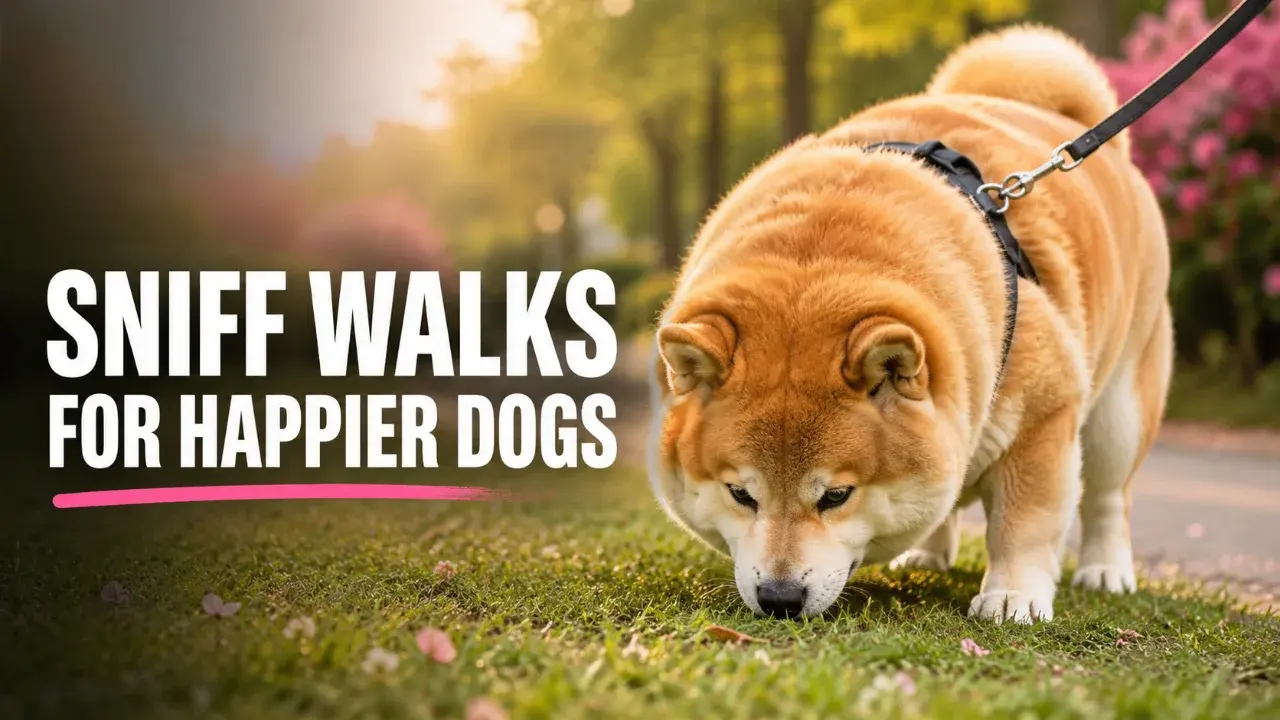
A walk is not just exercise for a dog. Slowing down and letting them sniff gives them mental stimulation, choice, and a richer way to understand the world around them.
For many dog owners, a “good walk” means a brisk pace, a tired body, and a route finished on schedule. But for dogs, the best part of a walk often happens when nothing seems to be happening at all.
That pause at a tree, curb, fence post, patch of grass, or mailbox is not random delay. It is how dogs read the world. A sniff walk gives a dog time to gather information, make small choices, and use one of the strongest senses they have.
Fast walks still matter. Dogs need movement, healthy routines, and chances to burn energy. But if every walk is treated like a workout, many dogs miss the part that feels most natural to them: following their nose.
Why sniffing matters so much to dogs
Humans are visual. We look at street signs, faces, traffic lights, storefronts, and body language. Dogs experience the same route in a very different way.
A sidewalk that looks boring to a person may be packed with scent information for a dog. Other dogs have passed by. People have walked there. Rain, food, plants, soil, wildlife, trash bins, and changing weather all leave traces.
Veterinary and canine behavior resources commonly describe sniffing as a form of mental enrichment, not just a quirky habit. VCA Hospitals notes that sniffing helps dogs learn about their environment and gives them a way to use their powerful sense of smell.
That matters because enrichment is not extra luxury for dogs. It is part of welfare. A dog who only gets physical exercise may still be bored, frustrated, or overstimulated if they rarely get to explore in ways that feel natural.
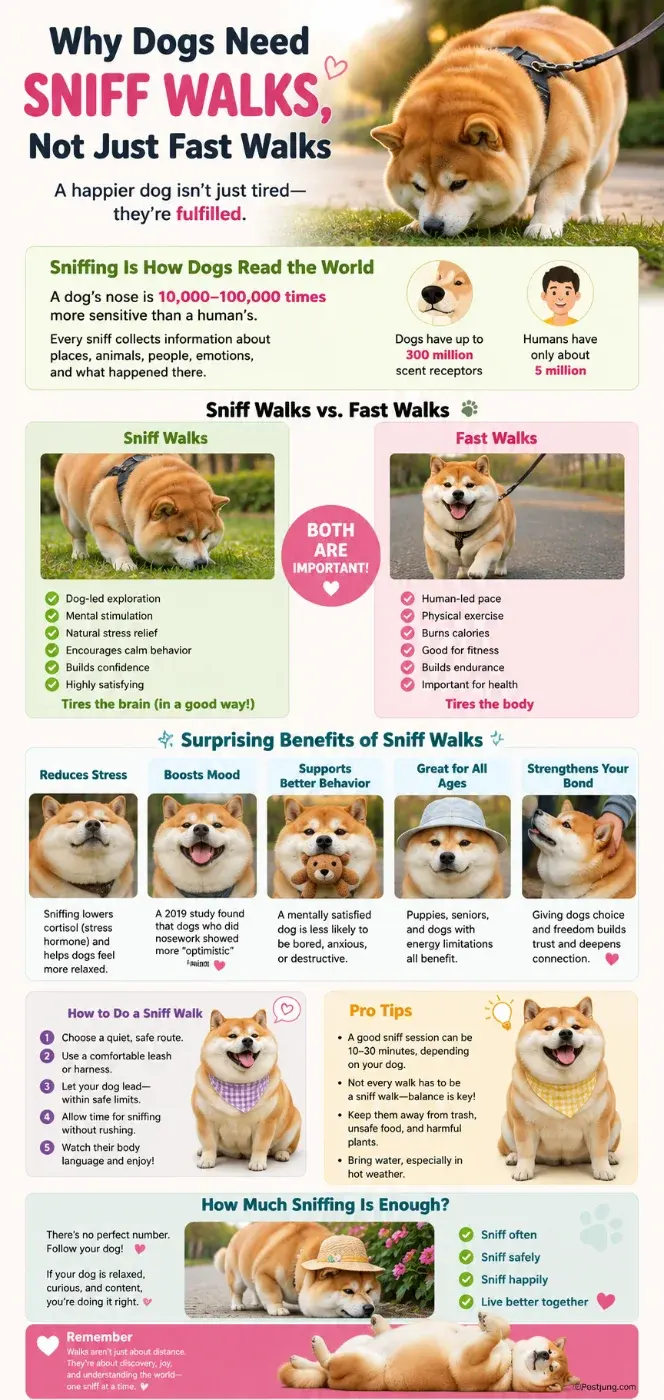
A fast walk is exercise. A sniff walk is information.
The difference between a fast walk and a sniff walk is not simply speed. It is purpose.
A fast walk is usually owner-led. The person sets the pace, direction, and stopping points. The goal may be fitness, bathroom breaks, or getting the dog tired before work.
A sniff walk is more dog-led. The dog is allowed to slow down, choose safe things to investigate, and spend longer with smells that interest them. It does not mean letting the dog drag the person across the street or eat unsafe objects. It means building in time for calm, controlled exploration.
That kind of choice can be surprisingly important. A 2019 study in Applied Animal Behaviour Science found that nosework was linked with a more positive judgment bias in pet dogs, often described as a sign of increased optimism. The study focused on structured nosework, not ordinary sidewalk sniffing, so it should not be stretched too far. Still, it supports a broader point: scent-based activity can contribute to canine welfare.
In simpler terms, dogs may not just enjoy sniffing. Using their nose may help them feel more engaged and settled.
Why “tiring out” a dog is not only about speed
A common mistake is assuming that the faster the walk, the better the result. That can be true for some energetic dogs, especially young, healthy dogs that need aerobic exercise. But speed is not the only kind of work.
Mental effort can be tiring too.
A dog who spends 20 minutes calmly sniffing through a quiet park may come home more satisfied than a dog who power-walks the same block without being allowed to stop. The reason is not magic. Sniffing asks the brain to sort, compare, and process information.
The American Kennel Club describes sniffing as a chance for dogs to make choices and engage in naturally enriching behavior. It also notes that dogs have far more scent receptors than humans, which helps explain why scent plays such a central role in their daily experience.
For owners, this can change the goal of a walk. The question is not always, “How far did we go?” Sometimes the better question is, “Did my dog get to be a dog?”
Sniff walks can help different dogs in different ways
Sniff walks can be especially useful for dogs who are anxious, older, recovering from injury, easily overstimulated, or not suited to intense exercise.
For a senior dog, a slow sniff walk can offer stimulation without requiring a long distance. For a nervous dog, sniffing may provide a calmer alternative to crowded dog parks or high-energy play. For an apartment dog, sniff walks can turn a short outing into a richer daily experience.
They can also help owners notice their dog more closely. A dog that suddenly stops sniffing, avoids familiar places, pulls harder than usual, or seems unusually distracted may be responding to stress, discomfort, fear, or environmental changes.
That does not mean every behavior needs a diagnosis. But walks become more informative when owners stop treating the dog as a fitness accessory and start watching what the dog is actually doing.
How to add sniff walks without losing structure
A sniff walk does not have to replace every regular walk. Most dogs benefit from a mix.
One walk can be more active and fitness-focused. Another can be slower and more exploratory. Owners with limited time can also divide a single walk into sections: five minutes of brisk movement, ten minutes of sniffing, then another short stretch of walking.
A few simple habits help:
Use a safe leash length that gives some freedom without losing control.
Choose quieter routes when possible, such as grassy edges, low-traffic streets, or calm park paths.
Let the dog sniff safe surfaces, but prevent eating trash, unknown food, or dangerous objects.
Avoid yanking the leash every time the dog pauses.
Set a cue, such as “go sniff,” so the dog learns when exploration is allowed.
For dogs who pull hard, a harness and reward-based training can make sniff walks easier. The goal is not chaos. The goal is freedom within safe limits.
When sniffing should be interrupted
Letting dogs sniff does not mean letting them do anything.
Owners should interrupt sniffing near broken glass, toxic plants, pesticides, spoiled food, aggressive dogs, traffic, or places where dogs are not allowed. In hot climates, pavement heat and dehydration also matter. A slow walk is still a walk, and safety comes first.
Dogs with medical conditions, breathing problems, mobility issues, or heat sensitivity may need shorter outings and veterinary guidance. A sniff walk should fit the individual dog, not become another rule owners feel pressured to perform perfectly.
The better walk is not always the faster one
The most useful shift is simple: stop seeing sniffing as the enemy of a good walk.
To a person, sniffing can look like stopping. To a dog, it is participation. It is reading, choosing, searching, learning, and relaxing all at once.
Fast walks help the body. Sniff walks feed the mind. A well-rounded dog often needs both.
The next time a dog pauses at the same patch of grass for what feels like forever, it may help to remember that the walk is not only transportation. For the dog, that patch of grass may be the most interesting page in the neighborhood.
VCA Hospitals, American Kennel Club, Applied Animal Behaviour Science, Animal Humane Society
REFERENCES:
https://vcahospitals.com/resources/preventive-dog/weight-exercise/sniffing-walks-for-dogs
https://www.akc.org/expert-advice/health/is-sniffing-a-dog-s-version-of-social-media/
https://www.sciencedirect.com/science/article/abs/pii/S0168159118304325
https://www.animalhumanesociety.org/resource/four-reasons-take-your-dog-sniff-walks

เขียนโดย Postjung Insights
 รู้หรือไม่? เปิดรายได้พนักงานส่งพัสดุของแต่ละแอป วันหนึ่งได้เท่าไร
 เปิดรายชื่อโรงเรียนในไทยที่ “ว่ายน้ำ” อยู่ในหลักสูตร เรียนจริงตั้งแต่อนุบาลถึงมัธยม
 5 คณะที่เรียนจบมาแล้ว มีอาชีพรองรับมากกว่าที่คิด
 อำเภอที่มีชื่ออำเภอสั้นที่สุด 3 อำเภอเท่านั้นในประเทศไทย
 เลขเด็ดปฏิทิน "หลวงปู่โต๊ะ" งวดวันที่ 1 ตุลาคม 69..ส่องเลย เลขไหนให้โชค!
 โรงเรียนที่มีนักเรียนมากที่สุดในไทย
 Google ยอมรับแล้ว! Gemini AI เข้าถึงระบบบริษัทจริง 3 แห่ง ระหว่างการทดสอบความปลอดภัย
 เปิด 5 โรงเรียนหญิงล้วนเก่าแก่ของไทย ที่มีประวัติยาวนานกว่าศตวรรษ
 ตาราง “เด่นเหนือเด่นใต้” งวด 1 ต.ค. 69 เปิดข้อมูลตามโพย เลขไหนอยู่ตรงไหน
 สถิติย้อนหลัง 10 ปี ออกเลขไหนบ้างมาดูกัน
 โรงเรียนเพียงแห่งเดียวของประเทศไทย ที่อยู่มาตั้งแต่ยุครัชกาลที่ 4
 แปลปกสลาก งวด 1 ต.ค. 69 ส่องตัวเลขจากภาพปกสลากกินแบ่งรัฐบาล
 😃 ชวนเข้ามาดูกันอีกกับคนที่มีร่างกายพิเศษจนเหมือนมีกล่องสมบัติที่หายาก 😯5 คณะที่เรียนจบมาแล้ว มีอาชีพรองรับมากกว่าที่คิดเปิดรายชื่อโรงเรียนในไทยที่ “ว่ายน้ำ” อยู่ในหลักสูตร เรียนจริงตั้งแต่อนุบาลถึงมัธยมGoogle ยอมรับแล้ว! Gemini AI เข้าถึงระบบบริษัทจริง 3 แห่ง ระหว่างการทดสอบความปลอดภัยเลขเด็ดปฏิทิน "หลวงปู่โต๊ะ" งวดวันที่ 1 ตุลาคม 69..ส่องเลย เลขไหนให้โชค!
 ทำไมของพลาสติกเก่าบางชิ้นถึง “เหนียว” ขึ้นมาเอง ทั้งที่ไม่ได้เปื้อนอะไร?
 English Edition