Why Dogs Bring You Their Favorite Toy
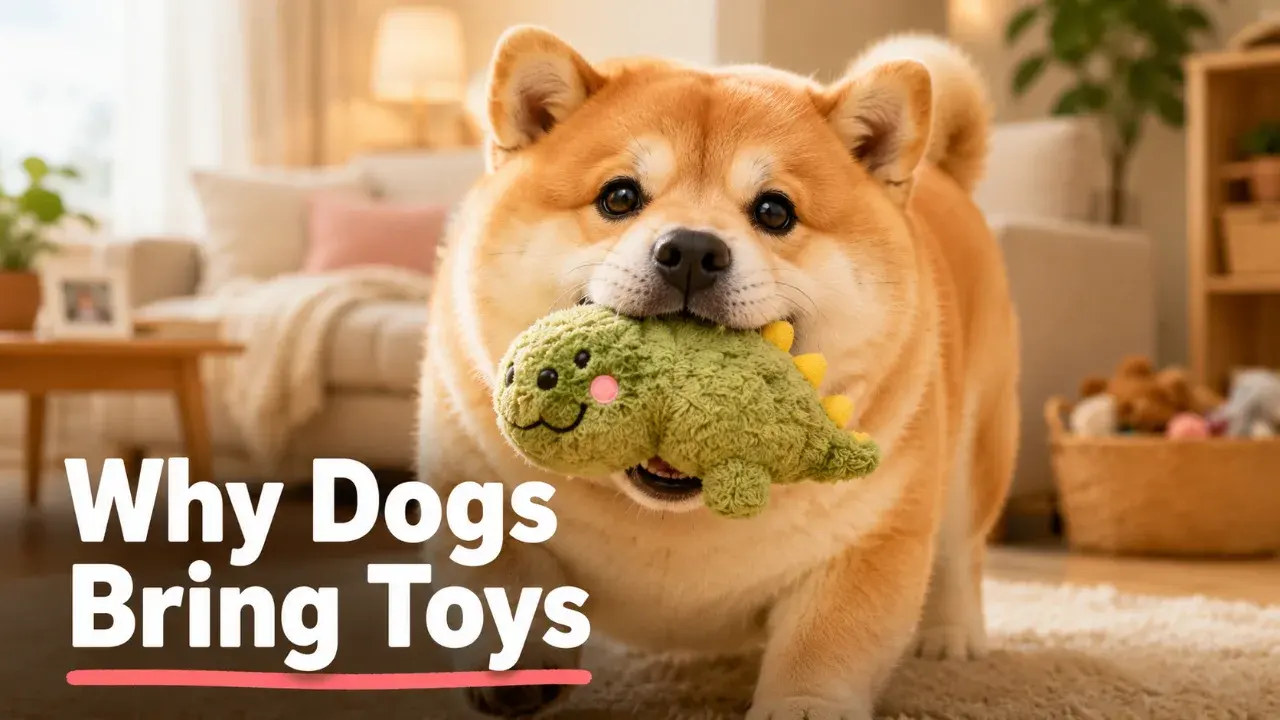
That toy in your dog’s mouth may look like a gift, but the behavior can mean several different things — from excitement and play to comfort, habit, or a simple request for your attention.
A dog trotting over with a favorite toy can feel like one of the purest compliments in pet ownership. The toy may be slobbery, squeaky, or half-destroyed, but the message usually comes wrapped in excitement: your dog wants to connect with you.
That does not always mean your dog is “giving” you the toy in the human sense. Dogs bring toys for several reasons, and the meaning depends on the moment, the dog’s personality, and what usually happens after the toy appears.
Some dogs are asking to play. Some are showing off. Some are managing big feelings by holding something in their mouth. And some have learned a very practical lesson: when they bring a toy, people smile, talk, laugh, reach down, or start a game.
It is often less about the object and more about the interaction that follows.
The toy can be an invitation
For many dogs, bringing a toy is a clear social move: “Do something with me.”
Dogs are social animals, and play is one of the ways they communicate, bond, and release energy. Veterinary behavior references describe play and communication as important parts of dog social life, especially in relationships that are maintained through repeated interaction.
That is why the toy often appears at predictable times: when you come home, when you sit down after work, when you stop looking at your phone, or when your dog knows the evening routine is about to begin.
A retriever may push a ball into your hand. A terrier may shake a stuffed toy dramatically. A herding breed may drop a rope at your feet and stare with laser focus.
Different styles, same basic idea: your dog is trying to start a shared moment.
This is also why the behavior can be so persistent. If the toy has successfully led to fetch, tug, praise, or laughter in the past, the dog has every reason to try it again.
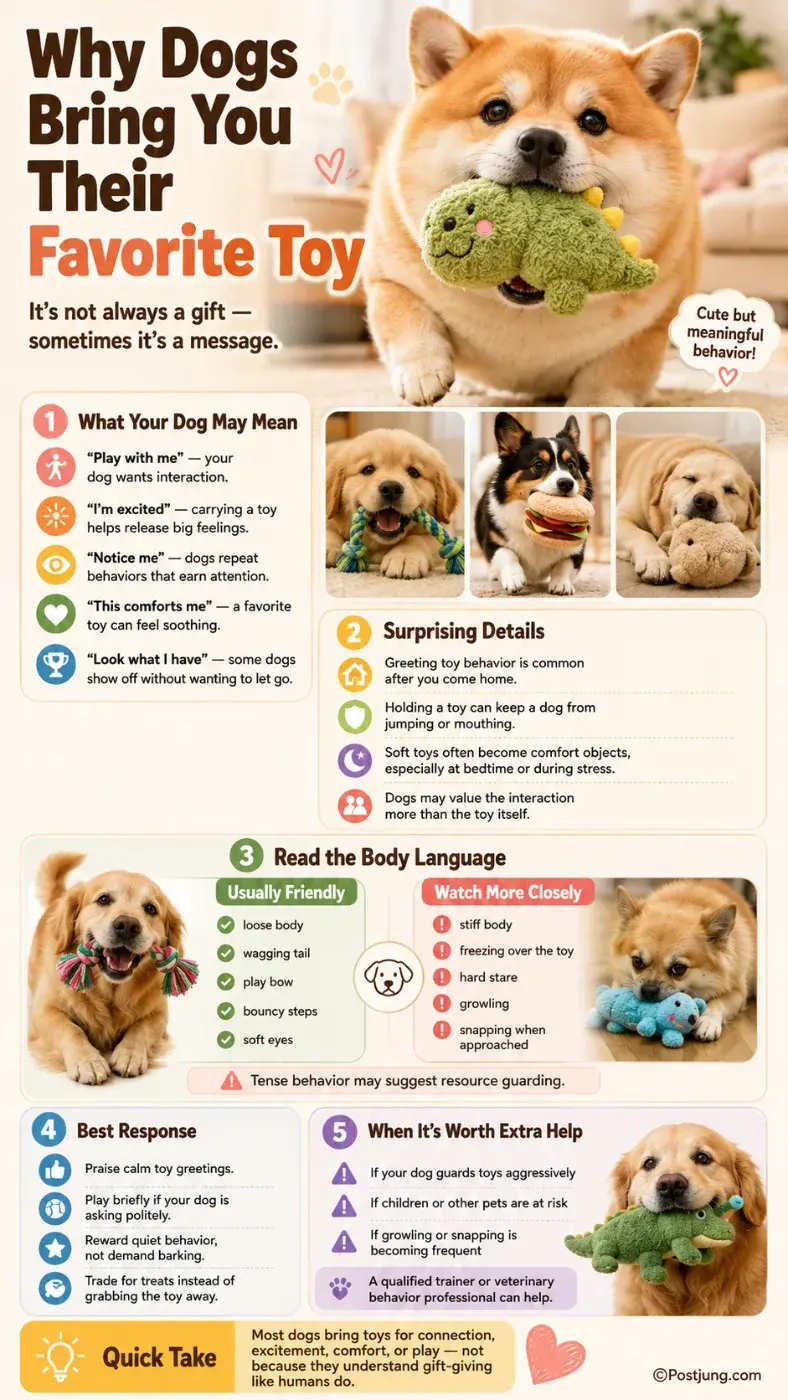
Sometimes it is excitement, not generosity
One of the most common times dogs bring toys is when their person comes home. PetMD notes that many dogs carry toys to the door because they are excited, want to play, want to show off, or need something positive to do with their mouth during a high-energy greeting.
That last point matters.
Some dogs get so excited during greetings that they jump, bark, mouth hands, or spin in circles. Carrying a toy gives that excitement a job. It keeps the mouth busy and can turn a chaotic greeting into a safer, cuter ritual.
In that sense, the toy is not always a “present.” It may be your dog’s emotional outlet.
Instead of saying, “Here, I bought this for you,” your dog may be saying something closer to, “You’re home! I need to hold something!”
That difference helps owners respond more clearly. If your dog brings a toy and wiggles happily, you can praise the calm greeting. If your dog shoves the toy into your body or barks nonstop, you may want to reward the quieter version of the behavior instead.
Dogs learn what gets attention
Dogs are excellent readers of patterns. If bringing a toy makes you look up, laugh, speak in a sweet voice, or start a game, that behavior becomes more valuable.
This does not make it fake. It makes it learned.
A dog can genuinely enjoy carrying the toy and also understand that the toy gets a reaction. Those two things can exist together.
Research on dog-human play has found that play can influence aspects of the dog-owner relationship, including attention and interaction, without supporting old assumptions that winning or losing tug games automatically changes “dominance” in a simple way.
That is useful for everyday owners because it takes some pressure off play. You do not need to treat every toy interaction as a power struggle. Most of the time, a toy is just a toy — and a dog looking for connection is just a dog looking for connection.
The response you give teaches the next habit. If you want your dog to bring toys instead of jumping on guests, reward that. If you do not want a barking demand for fetch every time you sit down, wait for quiet before engaging.
It may be showing off, not handing over
Some dogs bring a toy close but refuse to release it.
This can confuse people. The dog runs over with the toy, tail wagging, then dodges away when someone reaches for it. Is that teasing? Is it possessiveness? Is it a failed game of fetch?
Often, it is simply display behavior. The dog wants you to notice the toy, admire the toy, chase the toy, or join the game — but not necessarily take it.
Think of it less like a formal gift and more like a child running into the room to show a favorite action figure.
The dog may want attention around the object, not the loss of the object.
That is why body language matters. A loose body, wagging tail, play bow, soft face, and bouncy movement usually point toward playful interaction. A stiff body, hard stare, growling, freezing, or turning away with tension can suggest guarding or discomfort.
When the toy is comfort
For some dogs, a toy is a security object.
Soft toys, in particular, can become part of a dog’s calming routine. A dog may carry one when visitors arrive, during thunderstorms, before bedtime, or after being left alone. The toy gives the dog something familiar to hold, smell, and control.
This is especially common in dogs that are mouth-oriented, easily excited, or strongly attached to certain objects.
Owners sometimes describe these toys as “babies,” though it is better not to assume the dog experiences the toy exactly the way a human would. What we can say more safely is that the object may be emotionally meaningful, familiar, and soothing.
If the behavior is calm and harmless, there is usually no reason to stop it. In fact, allowing a dog to choose a safe comfort object can be a gentle way to support emotional regulation.
When to be careful
Most toy-bringing is sweet and normal. Still, there are moments when owners should pay closer attention.
If your dog brings a toy but becomes tense when anyone approaches it, growls when touched, snaps when someone reaches down, or hides with the object, the issue may be resource guarding rather than friendly sharing.
Resource guarding does not mean a dog is “bad.” It means the dog is worried about losing something valuable.
The safest response is not to grab the toy away. Forced removal can make a dog more defensive. A better approach is to teach trading: offer a high-value treat, ask the dog to drop the toy, reward generously, then return the toy when appropriate.
This teaches the dog that human hands near valued objects predict good things, not loss.
If guarding includes biting, repeated growling, or risk to children or other pets, it is wise to work with a qualified trainer or veterinary behavior professional. Safety matters more than proving a point.
How to respond when your dog brings a toy
The best response depends on what you want to encourage.
If your dog calmly brings a toy when you come home, praise it. That behavior is usually much better than jumping, mouthing, or barking.
If your dog drops a toy and waits politely, play for a minute if you can. Even short play sessions can give the dog a satisfying sense of connection.
If your dog demands attention by barking, pushing, or pawing, pause. Wait for a quieter behavior, then reward that version instead.
If your dog only wants to show the toy, admire it without forcing a game. A warm voice, gentle attention, and a little space may be exactly what the dog wanted.
And if your dog brings you something unsafe — a shoe, sock, stick, remote, or stolen kitchen item — avoid turning it into a chase game. Calmly trade for something better.
The simple meaning behind the habit
A dog bringing you a toy is rarely one single message. It can be play, excitement, comfort, habit, attention-seeking, or a mix of all of those at once.
But the larger meaning is usually easy to understand: your dog is including you in something valuable.
The toy matters because your dog likes it. You matter because your dog brings it to you.
That small, ordinary moment says a lot about life with dogs. They do not speak in sentences, but they are constantly communicating — with their eyes, their bodies, their routines, and sometimes with a soggy stuffed duck held proudly in their mouth.
PetMD, American Kennel Club, MSD Veterinary Manual, Applied Animal Behaviour Science
REFERENCES:
https://www.petmd.com/dog/behavior/why-do-dogs-bring-you-toys-when-you-get-home
https://www.akc.org/expert-advice/lifestyle/why-does-my-dog-bring-a-shoe-while-greeting-me/
https://www.msdvetmanual.com/behavior/behavior-of-dogs/social-behavior-of-dogs
https://www.sciencedirect.com/science/article/abs/pii/S0168159101001927

เขียนโดย Postjung Insights
 ดูหนัง–ซีรีส์ฟรีอาจไม่ฟรีอย่างที่คิด! เปิดโทษละเมิดลิขสิทธิ์ เตือนคนปล่อยคอนเทนต์เถื่อน เสี่ยงทั้งคุกทั้งปรับ
 แมคาเดเมีย (Macadamia): ราชินีแห่งถั่ว กับขุมทรัพย์โภชนาการจากออสเตรเลีย
 5 คณะที่เรียนจบมาแล้ว มีอาชีพรองรับมากกว่าที่คิด
 ตาราง “เด่นเหนือเด่นใต้” งวด 1 ต.ค. 69 เปิดข้อมูลตามโพย เลขไหนอยู่ตรงไหน
 รู้หรือไม่? เปิดรายได้พนักงานส่งพัสดุของแต่ละแอป วันหนึ่งได้เท่าไร
 รมว.วัฒนธรรมเอาจริง! จ่อส่งหนังสือทักท้วง Miss Universe Cambodia ปมใช้ภาพหญิงกำแพงเพชร หากไม่แก้ เตรียมใช้กฎหมาย
 โรงเรียนที่มีนักเรียนมากที่สุดในไทย
 อำเภอที่มีชื่ออำเภอสั้นที่สุด 3 อำเภอเท่านั้นในประเทศไทย
 MRT เตาปูนกลับมาเปิดปกติแล้ว รมช.คมนาคมเผยปมไฟไหม้ พบประกายไฟจากชุดสายไฟ 750 โวลต์
 งูมัลกา (Mulga Snake): นักล่าแห่งผืนดินแห้งแล้ง ของทวีปออสเตรเลีย กับฉายา King Brown กัดคนได้ถึงตาย
 เปิดหลักฐานเก่า 120 ปี ปมภาพหญิงเมืองกำแพงเพชร โผล่เวที Miss Universe Cambodia 2026
 แมงป่อง: แมลงนักล่าสายพันธุ์โบราณของโลก ที่ยังคงอยู่มาจนถึงปัจจุบัน
 English Edition