Why Premium Pet Food Costs So Much — and What You’re Really Paying For

Premium pet food can cost more for real reasons, but a higher price does not automatically mean a better diet. The smartest comparison starts with the label, the company behind it, and your pet’s actual needs.
Pet food prices can feel surprisingly high, especially when a small bag of “premium” kibble costs as much as a week of groceries. For many owners, the question is simple: are they paying for better nutrition, better marketing, or both?
The honest answer is that premium pet food can be expensive for several reasons. Some are meaningful. Some are mostly branding. And some depend entirely on the dog or cat eating it.
In the United States, pet food and treats are a massive consumer category. The American Pet Products Association lists pet food and treats among the largest parts of the pet industry, with sales measured in the tens of billions of dollars. That scale helps explain why supermarket shelves, pet stores, and online retailers now carry everything from basic kibble to refrigerated meals, breed-specific formulas, limited-ingredient diets, and subscription-style fresh food.
But price alone does not tell you whether a food is right for your pet.
“Premium” can mean many things
One of the biggest misunderstandings is the word “premium” itself.
The World Small Animal Veterinary Association notes that pet food labels can include marketing images and phrases designed to sell the product, and that terms such as “holistic” or “premium” may have little practical value for nutritional assessment.
That does not mean all expensive pet food is bad or deceptive. It means the word “premium” is not enough.
A premium-looking package may highlight real meat, ancient grains, probiotics, freeze-dried pieces, or special sourcing. Those features may raise production costs. But they do not automatically prove that the food is better balanced, safer, or more appropriate for a particular animal.
For owners, the smarter question is not “Is this premium?” It is: “Does this food meet my pet’s nutritional needs, and can the company support its claims?”
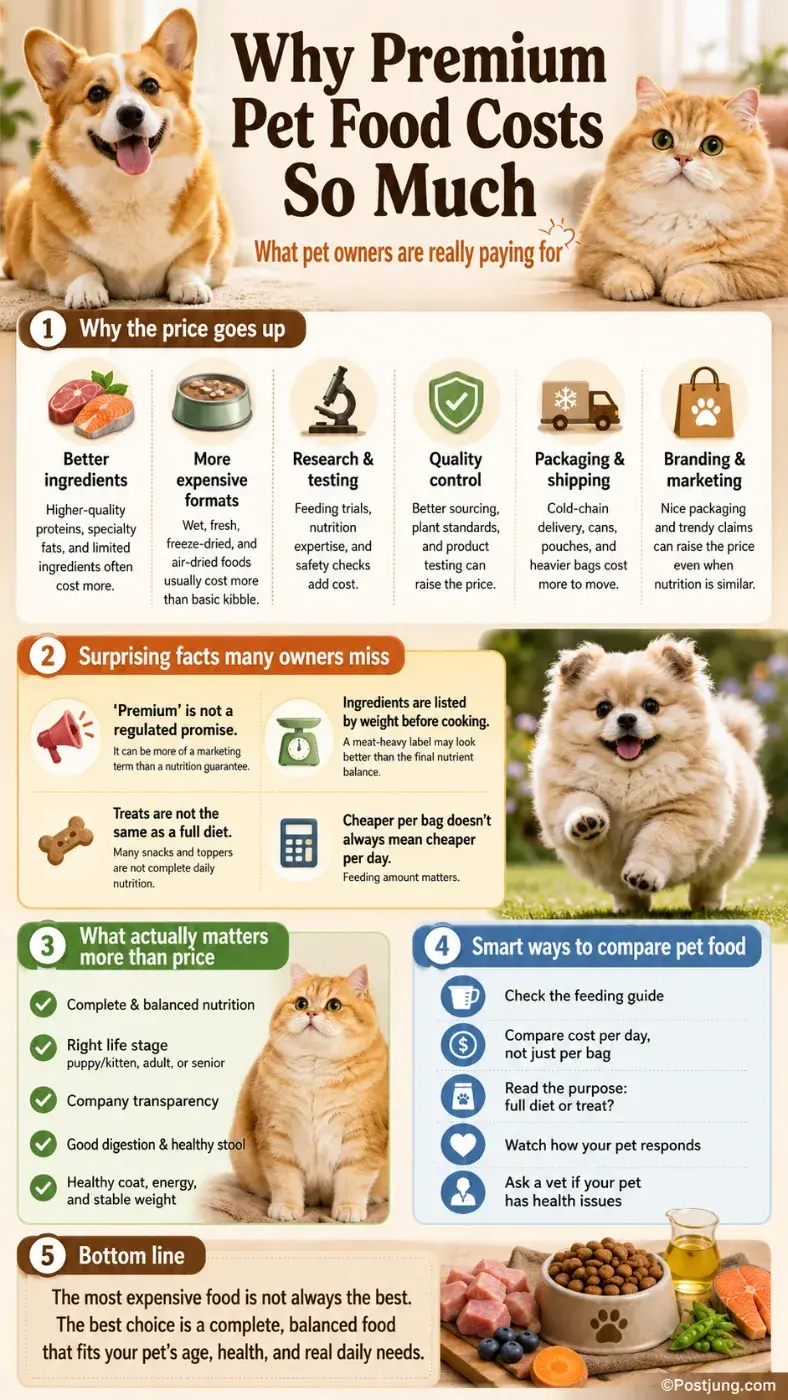
What actually drives the cost up
Several things can make pet food more expensive.
Higher-cost ingredients are one reason. Animal proteins, specialty fats, certain fiber sources, novel proteins, and some functional ingredients can cost more than basic commodity ingredients. Foods marketed for sensitive stomachs, skin support, weight control, or limited ingredients may also require tighter formulation.
Processing matters too. Canned food, freeze-dried food, air-dried food, refrigerated meals, and fresh-style diets often cost more to make, store, and ship than shelf-stable dry kibble. Cold-chain delivery, smaller batch production, and heavier packaging can all push prices higher.
Then there is research, testing, and quality control. WSAVA recommends looking at whether a pet food company employs qualified nutrition professionals, who formulates the diet, and what quality-control processes are used for ingredients and finished products. Those systems cost money, but they can also be more meaningful than attractive packaging.
Marketing and retail margins also play a role. A brand may spend heavily on packaging, influencer campaigns, subscription systems, store placement, and lifestyle messaging. Owners may be paying for convenience and brand trust as much as the food itself.
In other words, some costs are nutritional, some are logistical, and some are emotional.
The label matters more than the front of the bag
The front of a pet food package is designed to catch attention. The back and side panels usually tell you more.
The U.S. Food and Drug Administration says animal food labeling should include information needed for safe and effective use, including proper product identification, net quantity, manufacturer or distributor information, and a listing of ingredients. Ingredients must generally be listed by common or usual name in descending order by weight.
AAFCO, the Association of American Feed Control Officials, says the nutritional adequacy statement is one of the most important parts of a pet food label because it helps match a product to a pet’s needs. “Complete” means the product contains all required nutrients; “balanced” means those nutrients are present in the right ratios.
That matters because a beautiful bag of treats is not the same as a complete daily diet. AAFCO notes that treats are usually not intended to provide complete and balanced nutrition. Some chews, bones, and toys may not need the same nutritional adequacy labeling unless the manufacturer claims they provide nutrition.
For pet owners, this is where price comparisons become clearer. A $60 bag that is complete and balanced for the correct life stage is very different from a $60 collection of treats, toppers, or supplements.
Expensive does not always mean better for your pet
A healthy adult dog may do well on a mid-priced complete and balanced food. A cat with a medical issue may need a veterinary diet that costs more because it is formulated for a specific condition. A growing puppy, pregnant dog, senior cat, or highly active working dog may have different nutritional needs.
That is why the best food is not always the most expensive one.
Owners should be careful with claims that sound scientific but are hard to evaluate. Phrases like “human-grade,” “natural,” “ancestral,” or “clean” may appeal to human food preferences, but pets need diets formulated for their species and life stage.
Ingredient lists can also be misleading if read like a human grocery list. The first ingredient is listed by weight before processing, so moisture-heavy ingredients can appear high on the list. A long list of attractive ingredients does not automatically mean the final nutrient profile is better.
The more useful question is whether the food is complete and balanced, appropriate for the animal’s life stage, made by a company that can answer nutrition and safety questions, and tolerated well by the pet.
How to compare without overspending
A practical way to shop is to start with your pet, not the brand.
Look for the nutritional adequacy statement. Check whether the food is for growth, adult maintenance, all life stages, or another stated purpose. Confirm whether it is meant as a full diet, a treat, or supplemental feeding.
Then look at the company. WSAVA suggests asking whether the brand employs qualified nutrition professionals, who formulates the food, what research or feeding studies have been done, and what quality-control processes are in place.
Also compare cost per day, not just price per bag. A dense food may require smaller portions. A cheaper food may require more cups per meal. Feeding directions are not perfect for every animal, but they help estimate the real cost.
And watch your pet’s actual response: appetite, stool quality, skin, coat, weight, energy, and veterinary feedback all matter. A food that looks impressive online is not a success if it causes digestive trouble or unwanted weight gain.
For pets with allergies, kidney disease, diabetes, urinary issues, obesity, chronic vomiting, or other health concerns, owners should talk with a veterinarian before changing diets. Food can affect real medical decisions, and online claims cannot replace individual veterinary guidance.
The real value is confidence, not luxury
Premium pet food costs so much because it often combines higher-cost ingredients, specialized processing, research, quality control, packaging, shipping, and marketing. Some of that can be worth paying for. Some of it may not matter to your pet at all.
The most useful mindset is calm skepticism.
Do not assume the cheapest food is automatically poor. Do not assume the most expensive one is automatically superior. A good pet food earns trust through nutrition, transparency, safety, and suitability — not just a polished bag.
For owners, the real premium is confidence: knowing what the food is, what it claims to do, who made it, and whether it fits the animal in front of you.
U.S. Food and Drug Administration, AAFCO, World Small Animal Veterinary Association, American Pet Products Association
REFERENCES:
https://www.fda.gov/animal-veterinary/animal-foods-feeds/animal-food-labeling-and-pet-food-claims
https://www.aafco.org/consumers/understanding-pet-food/reading-labels/
https://wsava.org/wp-content/uploads/2021/04/Selecting-a-pet-food-for-your-pet-updated-2021_WSAVA-Global-Nutrition-Toolkit.pdf
https://americanpetproducts.org/industry-trends-and-stats

เขียนโดย Postjung Insights
 อำเภอที่มีชื่ออำเภอสั้นที่สุด 3 อำเภอเท่านั้นในประเทศไทย
 แมคาเดเมีย (Macadamia): ราชินีแห่งถั่ว กับขุมทรัพย์โภชนาการจากออสเตรเลีย
 ดูหนัง–ซีรีส์ฟรีอาจไม่ฟรีอย่างที่คิด! เปิดโทษละเมิดลิขสิทธิ์ เตือนคนปล่อยคอนเทนต์เถื่อน เสี่ยงทั้งคุกทั้งปรับ
 เปิด 5 โรงเรียนหญิงล้วนเก่าแก่ของไทย ที่มีประวัติยาวนานกว่าศตวรรษ
 รู้หรือไม่? เปิดรายได้พนักงานส่งพัสดุของแต่ละแอป วันหนึ่งได้เท่าไร
 รมว.วัฒนธรรมเอาจริง! จ่อส่งหนังสือทักท้วง Miss Universe Cambodia ปมใช้ภาพหญิงกำแพงเพชร หากไม่แก้ เตรียมใช้กฎหมาย
 โรงเรียนที่มีนักเรียนมากที่สุดในไทย
 MRT เตาปูนกลับมาเปิดปกติแล้ว รมช.คมนาคมเผยปมไฟไหม้ พบประกายไฟจากชุดสายไฟ 750 โวลต์
 ตาราง “เด่นเหนือเด่นใต้” งวด 1 ต.ค. 69 เปิดข้อมูลตามโพย เลขไหนอยู่ตรงไหน
 แมงป่อง: แมลงนักล่าสายพันธุ์โบราณของโลก ที่ยังคงอยู่มาจนถึงปัจจุบัน
 5 คณะที่เรียนจบมาแล้ว มีอาชีพรองรับมากกว่าที่คิด
 สถิติย้อนหลัง 10 ปี ออกเลขไหนบ้างมาดูกัน
 English Edition