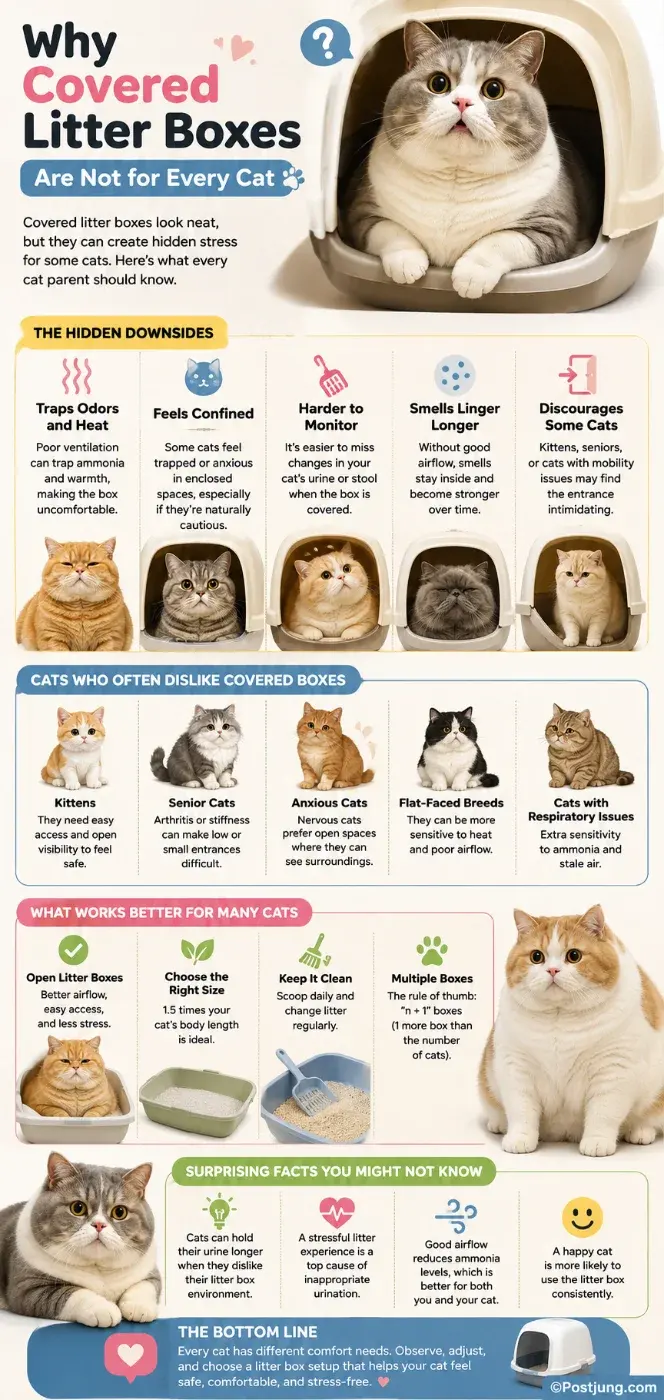
Why Covered Litter Boxes Do Not Work for Every Cat

A covered litter box can look like the perfect solution: less visible mess, less scattered litter, and fewer odors drifting through the room. For some cats, it works just fine. For others, the cover is exactly what makes the box uncomfortable.
That is the detail many cat owners miss. A litter box is not just a household object. To a cat, it is a place where space, smell, safety, access, and routine all matter.
Covered boxes are popular because they solve problems for humans. They hide waste from view, keep litter from spreading as easily, and can make a small apartment feel tidier. But cats do not judge a litter box by how well it blends into the furniture. They judge it by whether it feels safe and easy to use.
The cover may trap what cats want to avoid
One of the biggest problems with a covered litter box is odor. A lid may keep smells away from people in the room, but it can also hold those smells inside the box. Cornell Feline Health Center notes that while people may like covered boxes because they reduce odor and stray litter, covers can hold odors in from the cat’s point of view.
That matters because cats have a strong sense of smell. A box that seems acceptable from across the room may feel intense when a cat steps inside it.
This is why a cleaner-looking box is not always a cleaner-feeling box. If the covered box is not scooped often, the trapped odor can become one more reason for a cat to avoid it.
International Cat Care makes a similar point: many owners choose covered trays for privacy and odor control, but the benefit may be more obvious to humans than to cats.
Privacy is not the same as feeling safe
People often assume cats want a covered box because it gives them privacy. Some cats do like that enclosed feeling. Others may dislike being inside a small space with only one way out.
Cats are vulnerable while toileting. In a multi-cat home, a covered box can make it harder for a cat to see another pet approaching. It can also make escape more awkward if another cat, dog, child, or loud noise startles them.
The ASPCA advises that cats generally like litter boxes in quiet but not “cornered” locations, where they can see people or animals approaching and have multiple escape routes. The same guidance notes that most cats do not like lids on their boxes.
That does not mean every covered box is bad. It means the cat’s sense of control matters. A confident cat in a quiet home may use one happily. A nervous cat, senior cat, or cat living with other animals may prefer an open view and easier exit.
The research is more nuanced than “covered is bad”
A study published in the Journal of Feline Medicine and Surgery compared covered and uncovered litter boxes in 28 cats. The study found no significant overall preference between the two styles when the boxes were otherwise similar and cleaned daily. Some individual cats did show a preference, but many used both.
That finding is useful because it pushes back against a simple rule. Covered boxes are not automatically wrong. Open boxes are not automatically perfect.
The real lesson is more practical: cats are individuals, and litter box design is personal.
A covered box may work well if it is large, easy to enter, well ventilated, cleaned often, and placed somewhere calm. It may fail if it is cramped, dark, smelly, hard to access, or positioned in a busy corner.
Size and access can matter more than style
A common problem with covered boxes is that many are too small. Cats need room to step in, turn around, dig, squat, and cover waste without pressing against the walls or roof. Large cats may find some covered boxes especially uncomfortable.
Kittens and older cats may face a different issue: the entrance. A high doorway or narrow opening can be difficult for a small kitten, an elderly cat, or a cat with arthritis or mobility problems. If using the box takes effort, the cat may start looking for an easier place.
The AAFP/ISFM house-soiling guidelines emphasize optimizing the litter box and meeting cats’ environmental needs. They also recommend that a single-cat household provide two litter boxes in separate locations, while multi-cat homes may need more boxes depending on the number of cats and social groups.
That guidance is especially important for homes with covered boxes. If the only litter box is covered and the cat dislikes it, there is no good backup option.
Signs a covered box may not be working
Cats rarely announce that a litter box design is the problem. Instead, owners may notice changes in behavior.
A cat may hesitate before entering, step in and quickly leave, scratch around the outside of the box, avoid burying waste, or begin urinating or defecating nearby. Some cats may use the box for one purpose but not the other, such as urinating inside but defecating elsewhere.
Any sudden change should be taken seriously. Litter box avoidance can be linked to stress, box conditions, household conflict, or medical issues. Painful urination, constipation, arthritis, and other health problems can also change litter box behavior, so a veterinarian should be involved if the change is sudden, repeated, or paired with signs of discomfort.
The safest approach is not to force a cat to “get used to” a box they clearly avoid. Try offering a second, uncovered box in a different quiet location and observe which one the cat chooses. That gives the cat a vote without creating a battle.
A better litter box test
For many households, the best answer is simple: offer options. Put out one covered and one uncovered box, keep both clean, and watch what your cat actually uses.
Daily scooping matters. So does location. A box hidden beside a noisy appliance, trapped behind a door, or placed where another pet can ambush the cat may fail no matter what shape it is.
A covered litter box can be a useful tool. It is not a universal upgrade. The best litter box is the one your cat uses comfortably, consistently, and without stress.
The practical takeaway is gentle but important: choose the box for the cat, not the room. A prettier setup is not worth much if the cat decides the couch, bath mat, or laundry basket feels safer.
Journal of Feline Medicine and Surgery, AAFP/ISFM, ASPCA, Cornell Feline Health Center, International Cat Care
REFERENCES:
https://pubmed.ncbi.nlm.nih.gov/23103684/
https://pmc.ncbi.nlm.nih.gov/articles/PMC11148882/
https://www.aspca.org/pet-care/cat-care/common-cat-behavior-issues/litter-box-problems
https://www.vet.cornell.edu/departments-centers-and-institutes/cornell-feline-health-center/health-information/feline-health-topics/feline-behavior-problems-house-soiling

เขียนโดย Postjung Insights
 รู้หรือไม่? เปิดรายได้พนักงานส่งพัสดุของแต่ละแอป วันหนึ่งได้เท่าไร
 เปิดรายชื่อ 5 โรงเรียนเอกชนขนาดใหญ่ นักเรียนกว่า 5,000 คนทุกแห่ง
 อำเภอที่มีชื่ออำเภอสั้นที่สุด 3 อำเภอเท่านั้นในประเทศไทย
 โรงเรียนที่มีนักเรียนมากที่สุดในไทย
 เปิดรายชื่อ 5 โรงเรียนเป้าหมาย เด็กสอบเข้าต้องเตรียมตัวให้พร้อม
 ซาบีดา” เรียกถกด่วน ปมภาพ “ชุดไทย” ถูกนำไปอ้างเป็นชุดกัมพูชา
 ตาราง “เด่นเหนือเด่นใต้” งวด 1 ต.ค. 69 เปิดข้อมูลตามโพย เลขไหนอยู่ตรงไหน
 'สควีชชี่'ของเล่นที่กำลังเป็นไวรัลอาจถูกเจ้าหน้าที่ของสนามบินยึดได้ ตรวจสอบให้ดีก่อนนำขึ้นเครื่อง
 ราคาทองวันนี้ 21 ก.ย. 69 อัปเดตตลาดทองคำ ทองรูปพรรณแตะ 69,750 บาท
 Ctrip แพลตฟอร์มการท่องเที่ยวของจีน เปิดขายตั๋วสำหรับทริปท่องเที่ยวอวกาศ ของ Virgin Galactic 6 วัน ในราคาประมาณ 24 ล้านบาท
 หนุ่มขับ Porsche ใจหล่อสุดๆ ติดประกาศเด็กหายไว้รอบคัน..หวังช่วยเผยแพร่ข้อมูลให้ตามหาได้เร็วขึ้น
 ส่องเลข 3 สำนักพิมพ์ งวด 1 ต.ค. 69 ตัวไหนมีข้อมูลตรงกัน
 เปิด 5 สินค้าส่งออกของลาวที่คนไทยอาจคาดไม่ถึง หนึ่งในนั้นทำเงินเกือบ 1 พันล้านดอลลาร์ราคาทองวันนี้ 21 ก.ย. 69 อัปเดตตลาดทองคำ ทองรูปพรรณแตะ 69,750 บาทเปิดรายชื่อ 5 โรงเรียนเอกชนขนาดใหญ่ นักเรียนกว่า 5,000 คนทุกแห่งซาบีดา” เรียกถกด่วน ปมภาพ “ชุดไทย” ถูกนำไปอ้างเป็นชุดกัมพูชาเปิดรายชื่อ 5 โรงเรียนเป้าหมาย เด็กสอบเข้าต้องเตรียมตัวให้พร้อมหนุ่มขับ Porsche ใจหล่อสุดๆ ติดประกาศเด็กหายไว้รอบคัน..หวังช่วยเผยแพร่ข้อมูลให้ตามหาได้เร็วขึ้น
 English Edition