Why Dogs Lean Against Their Owners — and What It Usually Means

A dog’s gentle lean can feel like a hug, but it is also a form of communication. The meaning depends on the moment, the dog’s body language, and what usually happens next.
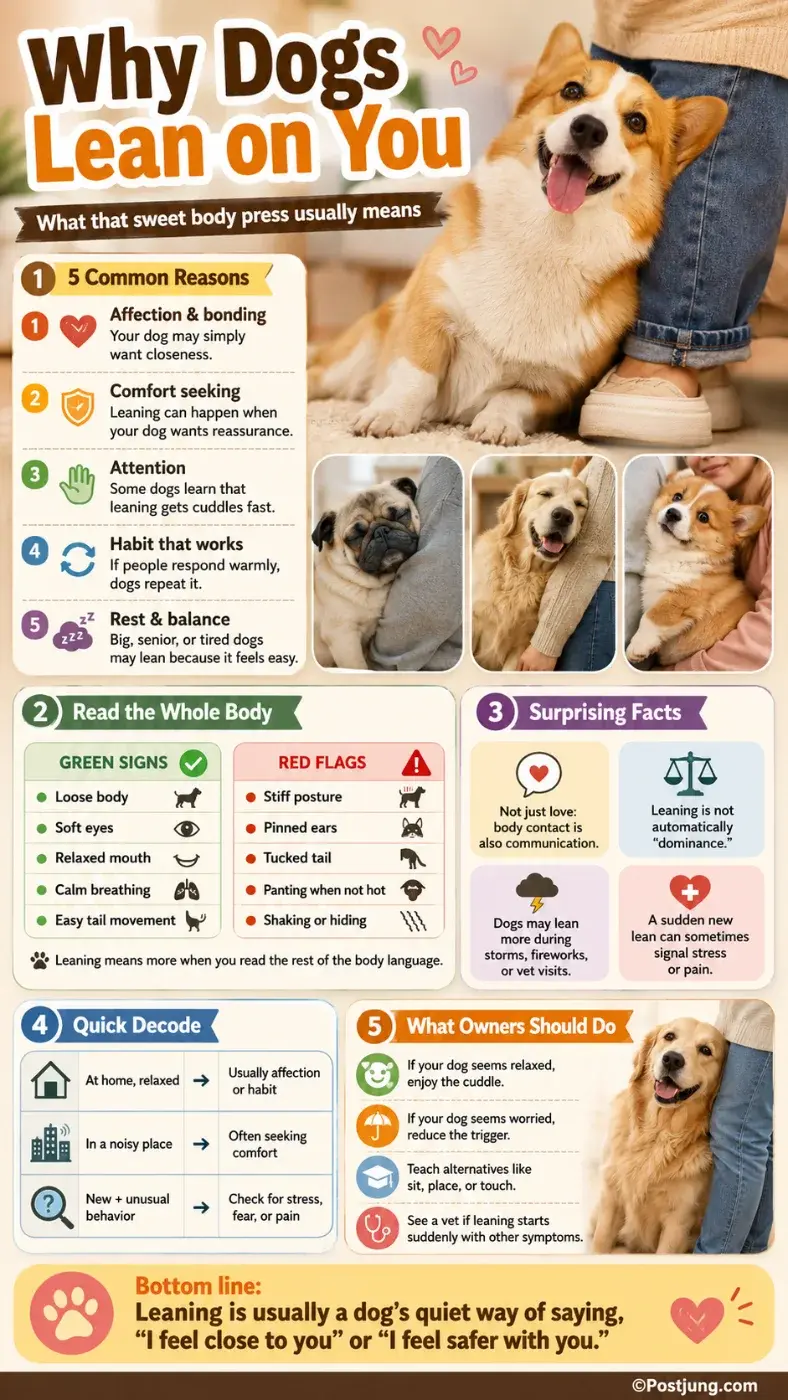
A dog leaning against you is rarely random. That warm weight on your leg may be affection, comfort-seeking, attention, insecurity, or simply a habit that has always worked.
For many owners, it feels sweet and familiar: the dog walks over, presses its shoulder or side into your body, and stays there as if you are the most solid thing in the room. In many cases, that reading is not far off. Dogs often lean on people because they want closeness, reassurance, or connection.
But like most dog behavior, leaning does not mean just one thing. The better question is not “Does my dog love me?” It is: what else is happening in that moment?
Leaning is often about closeness
For many dogs, leaning is a quiet way to stay physically connected. The American Kennel Club notes that dogs may sit on their owners’ feet or lean on their legs for several reasons, including affection, anxiety, security, guarding, or physical comfort.
That range matters. A relaxed dog leaning into you during a calm evening at home is different from a tense dog pressing into your legs at a noisy park, a vet clinic, or a crowded sidewalk.
In the calm version, the message may be simple: your dog wants to be near you. Dogs are social animals, and many learn that body contact brings good things — petting, a familiar voice, warmth, and a little attention.
Some dogs are especially physical. Large breeds may lean because their size makes it easy. Smaller dogs may climb onto feet or squeeze beside a person on the couch. Older dogs may also choose positions that feel easier on sore joints, especially if getting all the way down to the floor is uncomfortable.
It can be affection, but not a human-style hug
People often describe a dog’s lean as a “hug.” That is a useful comparison, but it should not be taken too literally.
Dogs do not communicate exactly like humans. They rely heavily on posture, movement, scent, eye contact, distance, and touch. A lean may be affectionate, but it is still dog language — not a direct translation of a human embrace.
That distinction helps prevent a common mistake. If a dog leans on you, it does not always mean the dog wants a tight squeeze back. Some dogs enjoy being petted while leaning. Others may want contact without being restrained.
The safest response is gentle: speak softly, offer slow petting if your dog likes it, and watch the rest of the body. A loose body, soft eyes, relaxed mouth, and easy breathing usually suggest comfort. A stiff body, tucked tail, pinned ears, lip-licking, or whale eye may suggest the dog is uneasy.
AKC’s guidance on dog body language emphasizes that no single signal should be read alone; tail position, eyes, facial expression, posture, and context all matter together.
Sometimes the lean says, “I need help”
Leaning can become more meaningful when it happens during stress.
A dog that presses into you during fireworks, thunder, construction noise, a vet visit, or a crowded public space may be looking for security. In that case, the lean may be a request for reassurance, not just affection.
VCA Animal Hospitals lists stress signals in dogs that can include panting when not hot or exercised, shaking, avoidance, hiding, escape behavior, and moving behind or near a trusted person.
That does not mean every leaning dog is anxious. It means the surrounding clues matter. Ask yourself:
Is the dog loose or tense?
Is the dog leaning only in certain places?
Did a loud sound, stranger, dog, or new environment appear?
Is the dog trying to hide behind you or simply rest against you?
Does the dog recover quickly, or does the stress continue?
If leaning appears mostly during stressful moments, the kindest response is not to scold or push the dog away. Create distance from the trigger when possible, move to a calmer area, and let the dog settle.
Leaning is not proof of dominance
One outdated idea says a dog leaning on a person is trying to “dominate” them. That explanation is usually too simplistic.
Modern veterinary behavior guidance has moved away from the idea that everyday family-dog behaviors should be interpreted as attempts to take over a household. VCA’s discussion of dominance and “alpha” training states that dogs are not simply trying to be in charge; they are learning how to interact based on what works in each situation.
That fits leaning well. If a dog leans and receives petting, warmth, or attention, the behavior may become part of the dog’s normal way of asking for contact. It does not need a dramatic explanation.
A better frame is: dogs repeat behaviors that make sense to them.
If leaning is gentle and welcome, it is usually not a problem. If it becomes pushy, painful, unsafe, or impossible to manage — especially with a large dog around children or older adults — it can be redirected with calm training.
When leaning may deserve a closer look
Most leaning is harmless. Still, a sudden change in behavior can be worth noticing.
A dog that suddenly leans more than usual, avoids lying down, seems stiff, pants at rest, limps, flinches when touched, or struggles to get comfortable may be dealing with pain or illness. A dog that becomes clingy only when left alone may need a different kind of attention.
Merck Veterinary Manual describes separation distress as fear or anxiety related to the absence, or perceived absence, of certain people. Signs can include destructive behavior, vocalization, house soiling, salivation, pacing, restlessness, inability to settle, and other distress behaviors.
Leaning by itself does not diagnose separation anxiety. In fact, close attachment behaviors alone do not automatically mean a dog has separation distress. The pattern matters: what happens before departure, during absence, and after the owner returns?
That is why a simple habit should be read as part of the dog’s whole routine.
How owners should respond
If your dog leans against you in a relaxed, friendly way, there is nothing wrong with enjoying it. Give a calm scratch, talk softly, or let the dog rest there.
If the lean happens during stress, help your dog feel safe without turning the moment into panic. Move away from the trigger if possible. Keep your own body relaxed. Offer a simple cue your dog knows well, or give the dog space to settle if engagement seems to make things worse.
If the leaning is too forceful, teach an alternative. Ask for “sit,” “down,” “place,” or “touch,” then reward the dog for choosing a safer behavior. This is especially useful for large dogs who may accidentally knock someone off balance.
If leaning is new, intense, linked with fear, or paired with physical signs such as limping, trembling, appetite changes, restlessness, or pain, a veterinarian or qualified behavior professional can help rule out medical and behavioral causes.
The heart of the behavior is simple: your dog is using its body to communicate. Sometimes it means “I love being close.” Sometimes it means “I feel safer here.” Sometimes it means “please pay attention.”
The best owners do not need to guess perfectly every time. They just need to notice the pattern, respect the dog’s comfort, and respond with the same steadiness the dog is seeking.
American Kennel Club, VCA Animal Hospitals, Merck Veterinary Manual
REFERENCES:
https://www.akc.org/expert-advice/lifestyle/why-does-my-dog-sit-on-my-feet/
https://www.akc.org/expert-advice/training/how-to-read-dog-body-language/
https://vcahospitals.com/know-your-pet/signs-your-dog-is-stressed-and-how-to-relieve-it
https://www.merckvetmanual.com/behavior/behavior-of-dogs/behavior-problems-of-dogs

เขียนโดย Postjung Insights
 รู้หรือไม่? เปิดรายได้พนักงานส่งพัสดุของแต่ละแอป วันหนึ่งได้เท่าไร
 รมว.วัฒนธรรมเอาจริง! จ่อส่งหนังสือทักท้วง Miss Universe Cambodia ปมใช้ภาพหญิงกำแพงเพชร หากไม่แก้ เตรียมใช้กฎหมาย
 MRT เตาปูนกลับมาเปิดปกติแล้ว รมช.คมนาคมเผยปมไฟไหม้ พบประกายไฟจากชุดสายไฟ 750 โวลต์
 ดูหนัง–ซีรีส์ฟรีอาจไม่ฟรีอย่างที่คิด! เปิดโทษละเมิดลิขสิทธิ์ เตือนคนปล่อยคอนเทนต์เถื่อน เสี่ยงทั้งคุกทั้งปรับ
 แมคาเดเมีย (Macadamia): ราชินีแห่งถั่ว กับขุมทรัพย์โภชนาการจากออสเตรเลีย
 5 คณะที่เรียนจบมาแล้ว มีอาชีพรองรับมากกว่าที่คิด
 โรงเรียนที่มีนักเรียนมากที่สุดในไทย
 อำเภอที่มีชื่ออำเภอสั้นที่สุด 3 อำเภอเท่านั้นในประเทศไทย
 สถิติย้อนหลัง 10 ปี ออกเลขไหนบ้างมาดูกัน
 ตาราง “เด่นเหนือเด่นใต้” งวด 1 ต.ค. 69 เปิดข้อมูลตามโพย เลขไหนอยู่ตรงไหน
 แมงป่อง: แมลงนักล่าสายพันธุ์โบราณของโลก ที่ยังคงอยู่มาจนถึงปัจจุบัน
 เปิดหลักฐานเก่า 120 ปี ปมภาพหญิงเมืองกำแพงเพชร โผล่เวที Miss Universe Cambodia 2026
 English Edition