Why Cats Slow Blink at Their Owners — and What It Really Means
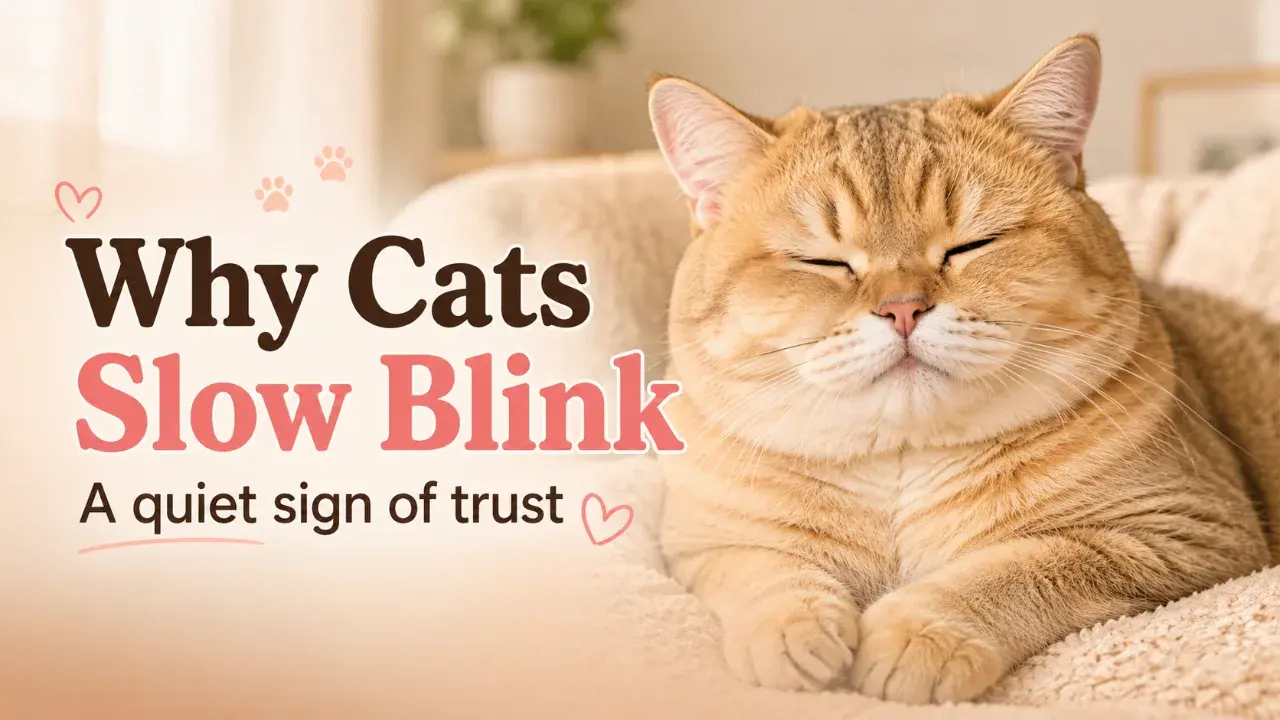
A slow blink can be a warm sign of trust, but it is not a magic translation of a cat’s feelings. The real meaning depends on the cat’s body language, mood, and the moment.
A cat’s slow blink can feel like a tiny private message. One moment your cat is watching you from the couch, and the next their eyelids soften, close halfway, and open again like they are answering you without a sound.
For many owners, that look feels affectionate — and research suggests they are not imagining it. Slow blinking appears to be one way cats and humans can share a calm, friendly signal. But it is also easy to overread. A slow blink is best understood as a sign of relaxed communication, not a simple one-word translation.
The “cat smile” is quieter than a dog’s wagging tail
Cats do not communicate like dogs, and that is part of why people often miss what they are saying. A dog may run to the door, wag its tail, and make its excitement obvious. A cat’s signals can be much smaller: ear position, tail height, whisker tension, posture, pupil size, and eye movement.
That is where the slow blink comes in.
A 2020 study published in Scientific Reports examined what researchers called “cat eye narrowing movements” in cat-human communication. The study described slow blink sequences as a mix of half-blinks, prolonged eye narrowing, or eye closure. In two experiments, cats were more likely to respond with eye narrowing after people slow blinked at them, and they were also more likely to approach an unfamiliar experimenter after that person slow blinked rather than held a neutral expression.
That does not mean every slow blink is a dramatic declaration of love. It does suggest that this small facial movement can work as a positive social signal between cats and people.
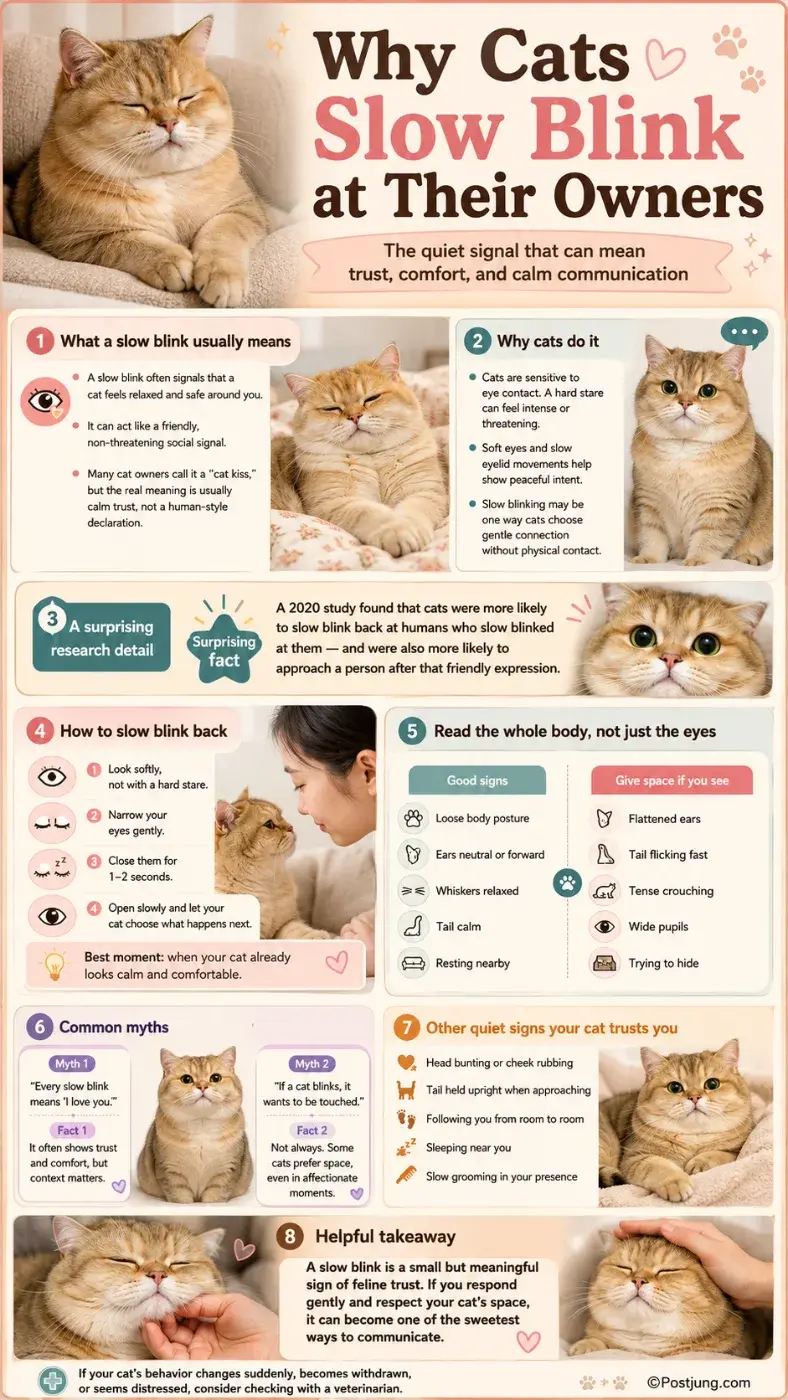
Why closing the eyes can signal trust
For an animal that pays close attention to movement, distance, and safety, the eyes matter. A direct, unblinking stare can feel intense to a cat. By contrast, soft eyes and slow eyelid movement can look less threatening.
That may be why a slow blink often appears in calm moments: your cat is resting nearby, sitting with a loose body, or watching you without tension. In that setting, the slow blink can feel like a quiet way of saying, “I’m comfortable here.”
Researchers at the University of Sussex, whose work focused on mammal communication and cognition, describe slow blinking as a form of positive emotional communication between cats and humans. Their summary of the research notes that cats not only slow blinked back at humans, but were also more likely to approach a person who had slow blinked at them.
That is the part many cat owners recognize. The slow blink is not loud. It is not needy. It is very cat-like: subtle, controlled, and easy to miss unless you are paying attention.
How to slow blink back
If your cat slow blinks at you while looking relaxed, you can try returning the gesture.
Do not stare hard. Soften your face, narrow your eyes gently, close them for a second or two, then open them slowly. Think of it less like winking and more like smiling with your eyes.
The key is not to force interaction afterward. If your cat blinks back, looks comfortable, or comes closer, that is a good sign. If they look away, leave, flick their tail, flatten their ears, or seem tense, give them space.
Cats Protection, a major UK cat welfare charity, advises owners not to stare at cats because they may see it as threatening. If a cat already seems comfortable and relaxed, slow blinking and slightly turning the head can be a friendlier way to communicate.
In other words, the slow blink works best when it respects the cat’s choice. The goal is invitation, not pressure.
Context matters more than the blink alone
The sweetest mistake cat owners make is treating one behavior as a full sentence. A slow blink can be affectionate, but body language changes the meaning.
A relaxed cat may have soft eyes, loose muscles, ears forward or gently relaxed, whiskers resting naturally, and a comfortable posture. Cats Protection lists slow blinking among signs associated with a happy cat, but also emphasizes that cats communicate through many small body signals.
A stressed cat can look very different. They may hide, crouch, overgroom, avoid people, change feeding or toileting habits, or show tense body posture. The RSPCA advises owners to watch for behavior changes because they can indicate that a cat is upset, bored, sick, injured, stressed, or frightened.
This is why the whole body tells the story. A slow blink from a cat stretched out on your bed is not the same as a blink from a cat cornered by a child, a dog, or another cat.
Cats Protection also notes that the evidence around slow blinking is not completely simple: it may be a positive sign, but it can also appear in stressful situations, so context is important.
What owners often get wrong
The biggest misunderstanding is thinking a slow blink always means “I love you.” That phrase is charming, and it may fit the feeling of the moment, but cats are not using human language in miniature.
A better interpretation is this: your cat may be showing comfort, trust, or a willingness to share a peaceful interaction. That is still meaningful. In some ways, it may be more meaningful because it is not automatic.
Cats are careful with social signals. They often prefer control over closeness, choice over pressure, and quiet routines over sudden attention. When a cat offers a slow blink from across the room, it may be choosing connection in a way that feels safe.
That is why owners should respond gently. Slow blink back. Let the cat decide whether to approach. Avoid grabbing, picking up, or rushing in for affection just because the moment feels sweet.
A small habit that can improve the bond
The slow blink is useful because it gives humans a more cat-friendly way to communicate. Instead of calling, reaching, or staring, you can soften your face and let the cat answer.
It is also a reminder that cats are not cold or unreadable. They are simply quieter than many people expect. Their affection may arrive as a head bump, a tail held upright, a relaxed nap nearby, a cheek rub against furniture, or a slow blink from the other side of the room.
The best cat owners learn to notice those small signals.
A slow blink will not solve every behavior problem, and it should not replace veterinary care if your cat’s behavior changes suddenly. But in an ordinary calm moment, it can be one of the simplest ways to meet your cat halfway.
Sometimes the message is not dramatic at all. Your cat may just be saying, in the softest possible way, I feel safe with you.
Scientific Reports, University of Sussex, RSPCA, Cats Protection
REFERENCES:
https://www.nature.com/articles/s41598-020-73426-0
https://www.sussex.ac.uk/research/labs/mammal-communication-and-cognition/research/cats-and-dogs-communication
https://www.rspca.org.uk/adviceandwelfare/pets/cats/behaviour
https://www.cats.org.uk/cats-blog/why-do-cats-slow-blink

เขียนโดย Postjung Insights
 5 คณะที่เรียนจบมาแล้ว มีอาชีพรองรับมากกว่าที่คิด
 อำเภอที่มีชื่ออำเภอสั้นที่สุด 3 อำเภอเท่านั้นในประเทศไทย
 เปิดรายชื่อโรงเรียนในไทยที่ “ว่ายน้ำ” อยู่ในหลักสูตร เรียนจริงตั้งแต่อนุบาลถึงมัธยม
 รู้หรือไม่? เปิดรายได้พนักงานส่งพัสดุของแต่ละแอป วันหนึ่งได้เท่าไร
 โรงเรียนที่มีนักเรียนมากที่สุดในไทย
 Google ยอมรับแล้ว! Gemini AI เข้าถึงระบบบริษัทจริง 3 แห่ง ระหว่างการทดสอบความปลอดภัย
 เลขเด็ดปฏิทิน "หลวงปู่โต๊ะ" งวดวันที่ 1 ตุลาคม 69..ส่องเลย เลขไหนให้โชค!
 เปิด 5 โรงเรียนหญิงล้วนเก่าแก่ของไทย ที่มีประวัติยาวนานกว่าศตวรรษ
 แปลปกสลาก งวด 1 ต.ค. 69 ส่องตัวเลขจากภาพปกสลากกินแบ่งรัฐบาล
 ทำไมของพลาสติกเก่าบางชิ้นถึง “เหนียว” ขึ้นมาเอง ทั้งที่ไม่ได้เปื้อนอะไร?
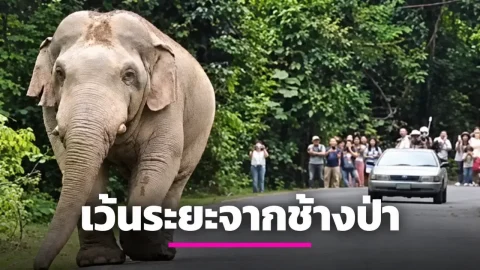 อุทยานเขาใหญ่เรียกตัว “ตีนผี” หลังขับจี้ช้างป่าพ่อลูก ลั่นระยะ 50 เมตรต้องจำให้ขึ้นใจ
 จุฬาฯ มหาวิทยาลัยแห่งแรกของไทย มีจุดเริ่มต้นในสมัยรัชกาลที่ 55 คณะที่เรียนจบมาแล้ว มีอาชีพรองรับมากกว่าที่คิดเปิดรายชื่อโรงเรียนในไทยที่ “ว่ายน้ำ” อยู่ในหลักสูตร เรียนจริงตั้งแต่อนุบาลถึงมัธยมGoogle ยอมรับแล้ว! Gemini AI เข้าถึงระบบบริษัทจริง 3 แห่ง ระหว่างการทดสอบความปลอดภัยเลขเด็ดปฏิทิน "หลวงปู่โต๊ะ" งวดวันที่ 1 ตุลาคม 69..ส่องเลย เลขไหนให้โชค!ทำไมของพลาสติกเก่าบางชิ้นถึง “เหนียว” ขึ้นมาเอง ทั้งที่ไม่ได้เปื้อนอะไร?อุทยานเขาใหญ่เรียกตัว “ตีนผี” หลังขับจี้ช้างป่าพ่อลูก ลั่นระยะ 50 เมตรต้องจำให้ขึ้นใจ
 English Edition