Before You Board Your Pet, Ask These Questions First
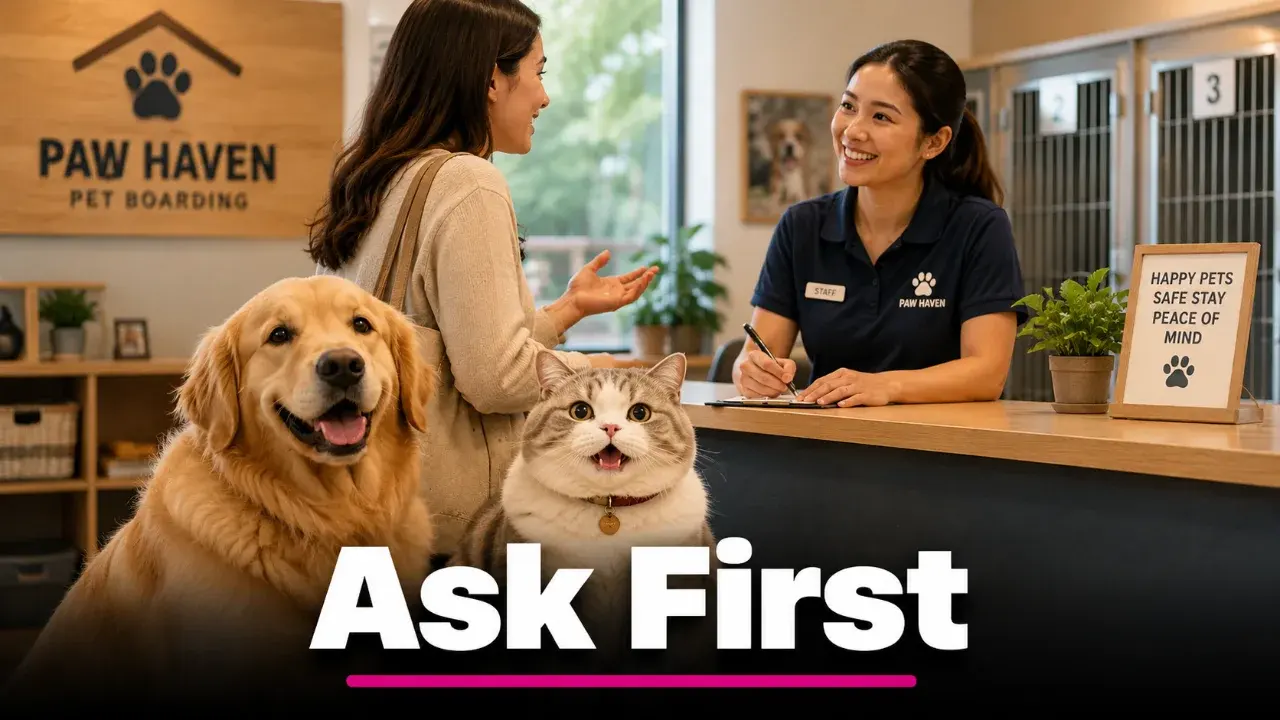
A clean lobby and friendly staff are only the beginning. The right questions can reveal how a boarding facility handles vaccines, supervision, feeding, medications, stress, and emergencies before you leave your pet there.
Pet boarding can look reassuring from the front desk. There may be smiling staff, tidy photos, and cheerful language about “home away from home” care.
But the real test is what happens after drop-off.
A good boarding facility should be able to explain, clearly and calmly, how animals are kept safe, monitored, fed, exercised, separated when needed, and cared for if something goes wrong. That matters whether you are boarding a dog for one night, a cat for a long trip, or an older pet that needs medication.
The best question is not simply, “How much does it cost?” It is: Would I trust this place when I am unreachable?
Ask what vaccines are required
Vaccination rules are one of the first signs that a facility takes health seriously. VCA Animal Hospitals advises pet owners to ask what vaccines are required before booking, noting that boarding facilities commonly ask about rabies, distemper, Bordetella for dogs, and other requirements depending on local risk.
For dogs, AAHA guidance separates vaccines into core and noncore categories, with risk-based vaccines depending on lifestyle and exposure. AAHA specifically notes that Bordetella is recommended for dogs that frequent kennels, grooming facilities, daycares, or similar high-density settings.
For cats, the AAHA/AAFP feline vaccination guidelines stress that vaccine planning should consider life stage, lifestyle, environment, and exposure risk. That means cat owners should not assume one facility’s rules apply everywhere.
Before booking, ask:
“What vaccines do you require, and how far in advance must they be completed?”
“Do you require proof from a veterinarian?”
“Do you accept pets with medical vaccine exemptions?”
“What happens if another animal shows signs of illness?”
A facility that does not ask for health records may seem convenient. It may also be taking unnecessary risks.
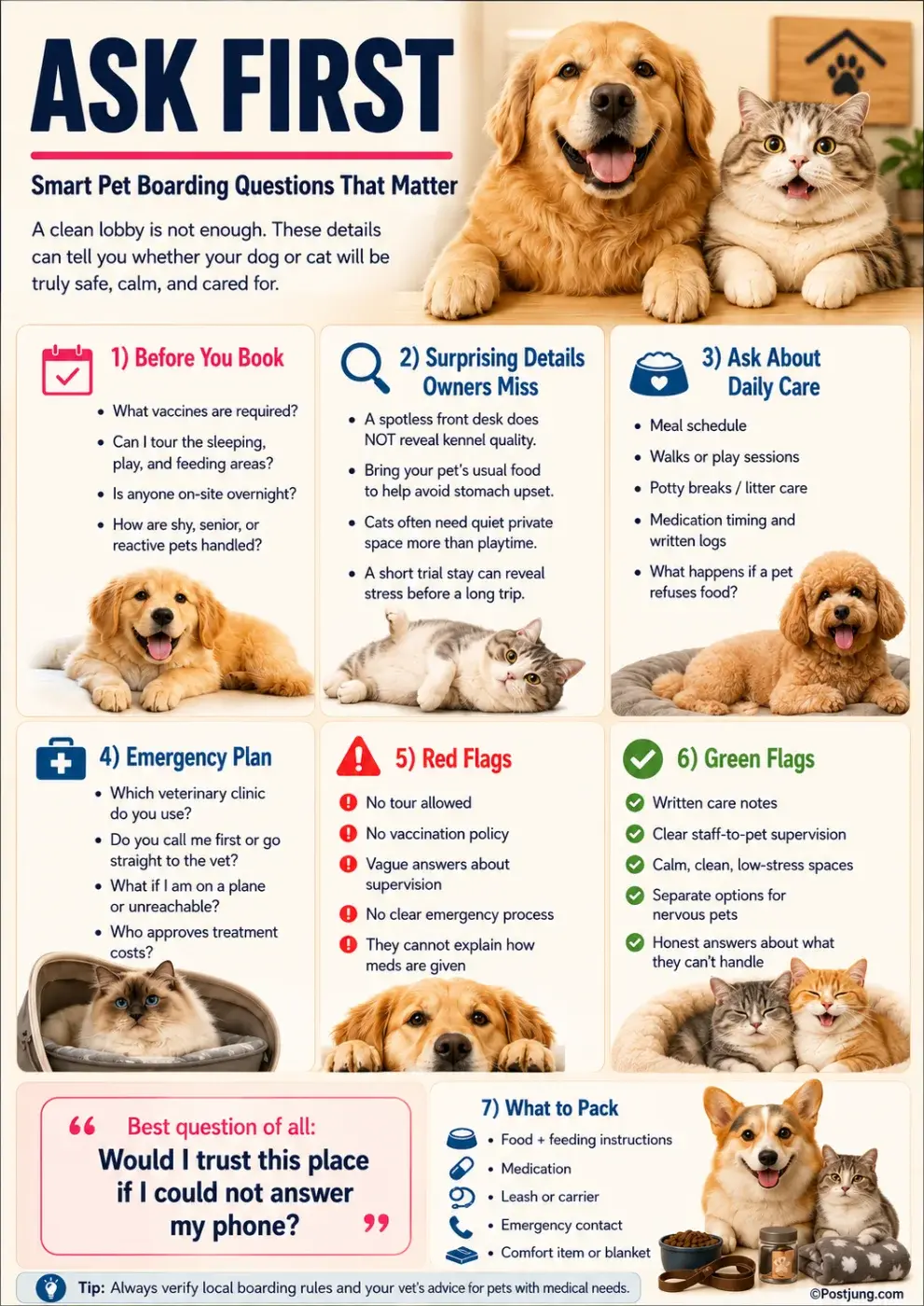
Ask to see where your pet will actually stay
Photos can be selective. A tour tells you more.
The American Kennel Club advises pet owners to organize tours in advance and says a reputable boarding organization should allow visitors to see dog runs, play spaces, meal preparation areas, and staff interaction. It also warns that a facility refusing access to key areas can be a red flag.
During a visit, look beyond the cute details. Ask yourself whether the space feels secure, calm, and manageable.
For dogs, ask whether each dog has a separate resting area, how group play is managed, and how dogs are separated if they become stressed. The RSPCA says dogs in boarding should have a suitable and safe environment, their own kennel unit unless sharing is specifically permitted, enough space to move naturally, daily exercise, behavioral monitoring, and a record of their stay.
For cats, the priority is different. Many cats do not want “fun group play.” They often need quiet, clean, escape-proof spaces, separate litter areas, and minimal stress from unfamiliar animals.
A beautiful facility is not automatically a safe one. The better sign is calm, specific answers.
Ask who is watching the animals
Staffing is one of the most important parts of boarding, and one of the easiest to overlook.
Ask:
“How many staff are on duty during the day?”
“Is anyone present overnight?”
“What training do staff receive?”
“How do you handle fights, fear, barking, hiding, or refusal to eat?”
“Who gives medication?”
The RSPCA’s boarding guidance highlights trained staff, behavior monitoring, health and wellbeing, suitable diet, and emergency procedures as part of animal welfare standards for licensed animal businesses in England. While rules differ by country, those categories are useful for pet owners anywhere.
For pets with medication needs, this question becomes essential. VCA recommends asking whether employees are trained to give medications, especially if a pet needs something more complex, such as an injection.
Do not settle for “we can handle it” if your pet has diabetes, seizures, arthritis, anxiety, blindness, deafness, allergies, or a strict medical schedule. Ask for the process.
A good facility should be comfortable explaining who gives the medicine, when, and how it is recorded.
Ask what a normal day looks like
A boarding stay should not be a mystery.
Ask for the daily routine: feeding times, potty breaks, walks, play sessions, rest periods, cleaning times, and quiet hours. VCA recommends asking what a pet’s itinerary will look like, including playtime, exercise, cuddling, group size, and supervision if dogs play together.
The right routine depends on the animal.
A young social dog may enjoy supervised play with carefully matched dogs. A senior dog may need shorter walks and more rest. A reactive dog may be safer with one-on-one care. A cat may prefer predictable feeding, quiet handling, and no unnecessary stimulation.
This is where owners should be honest. Boarding staff cannot protect a pet from needs they do not know about.
Tell them if your dog guards food, panics in crates, jumps fences, dislikes certain dogs, chases cats, or becomes anxious during storms. Tell them if your cat hides, stops eating when stressed, or needs a specific litter setup.
The question is not whether your pet is “good.” The question is whether the facility understands your pet’s actual temperament.
Ask about food, treats, and stomach trouble
Travel, separation, and new surroundings can upset a pet’s routine. Food changes can make it worse.
Ask whether you can bring your pet’s regular food from home. VCA notes that bringing familiar food is often easiest on a pet’s stomach and recommends checking whether the facility can follow a special diet.
You should also ask:
“Can you follow exact feeding instructions?”
“Are treats given?”
“Do you separate pets during meals?”
“What do you do if my pet refuses food?”
“Will you contact me if eating or bathroom habits change?”
Food is not just comfort. It is also a daily health signal.
A facility that tracks appetite, stool, vomiting, water intake, and unusual behavior is more likely to notice problems early.
Ask what happens in an emergency
This may be the most important question of all.
Ask:
“What veterinary clinic do you use?”
“How fast can my pet get care?”
“Do you contact me first, or go straight to the vet?”
“What happens if I am on a plane or out of cell service?”
“Do you require an emergency authorization form?”
“What costs am I responsible for?”
VCA advises that every boarding facility should have a close relationship with a nearby veterinary hospital for emergency situations.
Ask for the answer before you need it.
A good facility should have a medical plan in writing, not a vague promise that “we’ll call someone.”
Ask whether a trial stay makes sense
For first-time boarding, anxious pets, puppies, senior animals, or dogs that will join group play, a short trial can reveal a lot.
The American Kennel Club notes that some kennels offer or require test runs to assess temperament, play compatibility, separation anxiety, and whether a dog is likely to thrive in that setting.
A trial stay can show how your pet responds before a longer trip. After pickup, look for signs: Does your pet seem healthy, clean, relaxed, and normally tired? Or do they seem unusually distressed, dirty, injured, hoarse from barking, or desperate to leave?
Some stress can happen in any new environment. But you should not ignore your instincts.
The best boarding choice is the one that fits your pet
There is no single perfect boarding facility for every animal.
Some pets do well in a lively dog resort. Some need a quieter kennel. Some cats are better with a cat-only boarding space. Some pets may be safer with an in-home sitter, especially if they are elderly, medically fragile, highly anxious, or easily overwhelmed.
A trustworthy facility will not pressure you to book before answering basic questions. It will ask about your pet’s health, habits, fears, routines, and records. It will have rules. It will have limits. It will tell you what it can and cannot safely handle.
That honesty is a green flag.
Before choosing a pet boarding facility, ask enough questions to picture your pet’s whole day — where they sleep, who watches them, what they eat, how they move, how stress is handled, and what happens if something goes wrong.
The goal is not a place that looks perfect online.
The goal is a place where your pet can be safe, understood, and cared for when you are not there.
VCA Animal Hospitals, RSPCA, American Kennel Club, AAHA, American Association of Feline Practitioners
REFERENCES:
https://vcahospitals.com/resources/lifestyle-dog/boarding-facility-faq
https://www.rspca.org.uk/adviceandwelfare/pets/dogs/environment/kennels
https://www.akc.org/expert-advice/travel/dog-boarding-tips/
https://www.aaha.org/trends-magazine/publications/from-the-guidelines-summer-travel-vaccinations-for-dogs/

เขียนโดย Postjung Insights
 เปิดรายชื่อ 5 โรงเรียนเอกชนขนาดใหญ่ นักเรียนกว่า 5,000 คนทุกแห่ง
 รู้หรือไม่? เปิดรายได้พนักงานส่งพัสดุของแต่ละแอป วันหนึ่งได้เท่าไร
 อำเภอที่มีชื่ออำเภอสั้นที่สุด 3 อำเภอเท่านั้นในประเทศไทย
 ราคาทองวันนี้ 21 ก.ย. 69 อัปเดตตลาดทองคำ ทองรูปพรรณแตะ 69,750 บาท
 โรงเรียนที่มีนักเรียนมากที่สุดในไทย
 เปิด 5 โรงเรียนหญิงล้วนเก่าแก่ของไทย ที่มีประวัติยาวนานกว่าศตวรรษ
 'สควีชชี่'ของเล่นที่กำลังเป็นไวรัลอาจถูกเจ้าหน้าที่ของสนามบินยึดได้ ตรวจสอบให้ดีก่อนนำขึ้นเครื่อง
 แปลปกสลาก งวด 1 ต.ค. 69 ส่องตัวเลขจากภาพปกสลากกินแบ่งรัฐบาล
 เปิดรายชื่อ 5 โรงเรียนเป้าหมาย เด็กสอบเข้าต้องเตรียมตัวให้พร้อม
 ตาราง “เด่นเหนือเด่นใต้” งวด 1 ต.ค. 69 เปิดข้อมูลตามโพย เลขไหนอยู่ตรงไหน
 ซาบีดา” เรียกถกด่วน ปมภาพ “ชุดไทย” ถูกนำไปอ้างเป็นชุดกัมพูชา
 ส่องเลข 3 สำนักพิมพ์ งวด 1 ต.ค. 69 ตัวไหนมีข้อมูลตรงกัน
 เปิด 5 สินค้าส่งออกของลาวที่คนไทยอาจคาดไม่ถึง หนึ่งในนั้นทำเงินเกือบ 1 พันล้านดอลลาร์ราคาทองวันนี้ 21 ก.ย. 69 อัปเดตตลาดทองคำ ทองรูปพรรณแตะ 69,750 บาทเปิดรายชื่อ 5 โรงเรียนเอกชนขนาดใหญ่ นักเรียนกว่า 5,000 คนทุกแห่งซาบีดา” เรียกถกด่วน ปมภาพ “ชุดไทย” ถูกนำไปอ้างเป็นชุดกัมพูชาเปิดรายชื่อ 5 โรงเรียนเป้าหมาย เด็กสอบเข้าต้องเตรียมตัวให้พร้อม
 หนุ่มขับ Porsche ใจหล่อสุดๆ ติดประกาศเด็กหายไว้รอบคัน..หวังช่วยเผยแพร่ข้อมูลให้ตามหาได้เร็วขึ้น
 English Edition