Why Wand Toys Tap Into a Cat’s Hunting Brain
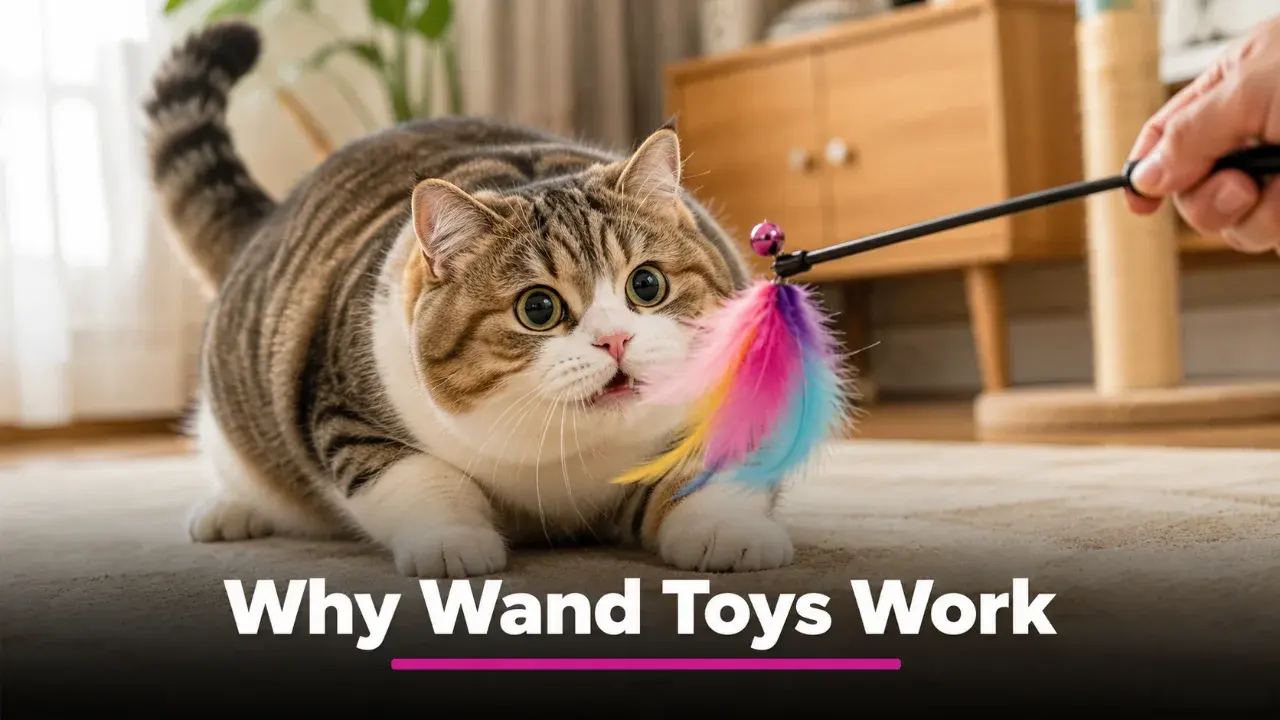
A wand toy works because it turns play into a tiny hunt: watching, stalking, chasing, and catching. Used safely, it can give indoor cats exercise, confidence, and a better way to spend their energy.
A wand toy looks simple: a stick, a string, and something fluttery at the end. To a cat, it can feel like a whole hunt packed into the living room.
That is why some cats ignore expensive gadgets but suddenly light up when a feather moves across the floor. The magic is not really the feather. It is the movement.
A wand toy behaves like prey
Cats are not just reacting to color or noise. They are responding to a pattern that feels familiar: something small appears, moves away, hides, pauses, darts, and becomes catchable.
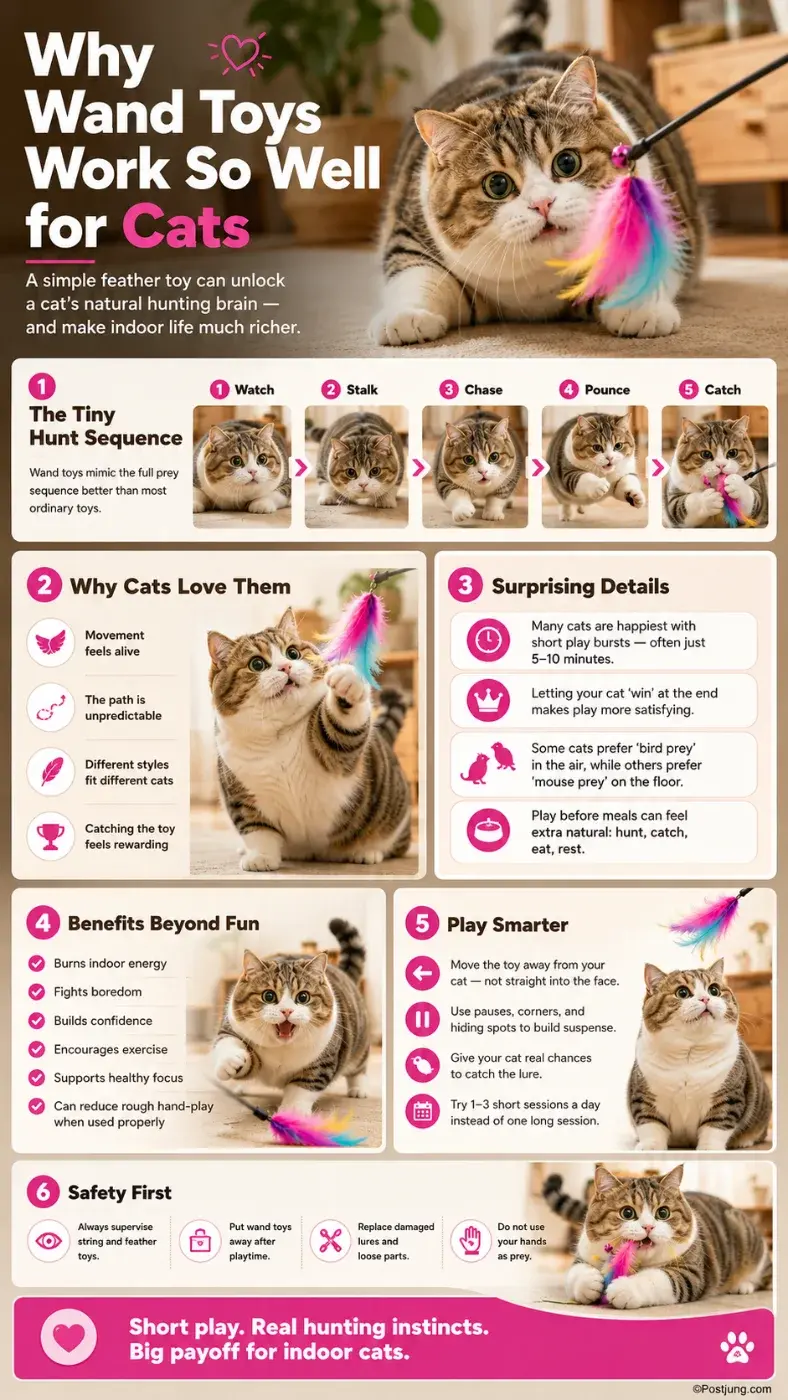
Veterinary behavior guidance describes cat play as closely tied to hunting behaviors such as stalking, chasing, pouncing, grabbing, clawing, and biting. Wand toys work so well because they let cats practice the full little hunting sequence in a safe, indoor way.
A ball on the floor can be fun, but it often becomes predictable. A wand toy, because a person controls it, can move like something with a mind of its own. It can tremble behind a chair leg, skim under a blanket, disappear around a corner, or suddenly stop just long enough for the cat to plan a pounce.
For many cats, movement matters more than the toy itself.
The human makes the toy interesting
One reason wand toys beat many solo toys is that they are interactive. The cat is not just batting at an object. The cat is reading timing, distance, speed, and direction.
That interaction matters. Texas A&M veterinary guidance notes that enrichment gives cats ways to act on natural instincts such as running, hunting, climbing, and playing, while also helping keep them mentally and physically engaged.
A good wand session also gives the cat choices. A confident cat may leap high for a “bird” style toy. A shy cat may prefer a lure that creeps slowly along the floor like a mouse. A senior cat may enjoy a gentler version with less jumping and more stalking.
The best toy is not always the flashiest one. It is the one that matches how that cat likes to hunt.
The catch is part of the reward
One common mistake is waving the wand too wildly or keeping it always out of reach. That may look exciting to humans, but it can frustrate a cat.
A satisfying play session usually needs a finish. The cat should get chances to catch, hold, kick, or bite the toy. AAHA guidance recommends thinking through the natural hunting sequence and allowing the cat to catch the “prey” near the end of play.
That moment matters because the catch is part of the reward. Without it, the game can feel like chasing something impossible.
A simple pattern works well: start slow, build interest, let the cat chase, allow a few successful catches, then slow the toy down before ending. Some cats also settle better if play is followed by a small meal or treat, because it completes the “hunt, catch, eat, rest” rhythm.
Indoor cats need real outlets
Many indoor cats live safe, comfortable lives, but comfort does not remove their need for stimulation. A cat can have food, a sofa, and a clean litter box and still need something to chase.
Cornell’s Feline Health Center notes that boredom can contribute to destructive behavior and that dedicated play time and acceptable toys are important for cats. Cornell also notes, in the context of reducing stress for some urinary problems, that cats benefit from opportunities to express natural predatory behavior, including toys that can be chased and caught.
This is where wand toys are useful. They create movement, exercise, anticipation, and shared attention without needing much space. Even in a small apartment, a cat can stalk from behind a chair, dash across a rug, or pounce from a cardboard box.
For indoor cats, play is not just entertainment. It can be part of a healthier daily rhythm.
How to use a wand toy better
The easiest upgrade is to stop dangling the toy directly in front of the cat’s face. Real prey usually does not run toward a predator and hover there.
Try moving the toy away from the cat, across the cat’s field of vision, or partly out of sight. Let it pause. Let the cat watch. Many cats enjoy the suspense before the chase.
Short sessions often work better than one long session. AAHA suggests that many cats may do well with a few short interactive play sessions per day, while also noting that age, personality, activity level, and health all matter.
That is especially important for kittens, high-energy cats, shy cats, and older cats. Some want fast bursts. Some need a slow invitation. Some cats prefer “air prey,” like a bird fluttering above them. Others prefer “ground prey,” like something skittering under a towel.
The goal is not to exhaust the cat. The goal is to help the cat feel successful.
Safety still matters
Wand toys are safest when they are used with supervision. Texas A&M veterinary guidance advises that string or ribbon-based toys should be used only under supervision and put away when not in use, because swallowed string or ribbon can be dangerous.
It is also smart to check attachments regularly. Feathers, bells, clips, and elastic cords can wear down. If a toy starts falling apart, replace the lure instead of letting the cat chew loose pieces.
Another benefit of wand toys is distance. Veterinary Partner notes that toys such as wands, fuzzy balls, and small mice can encourage chasing without directly involving a person’s hands. That makes play more fun while reducing the chance that fingers become the target.
The simple reason cats keep coming back
Wand toys work because they speak cat.
They move like prey, invite focus, reward patience, and give indoor cats a safe place to use behaviors that are already built into them. They also turn the owner into part of the game, which can make the experience more interesting than a toy left on the floor all day.
A wand toy does not need to be expensive. It just needs to move well, end safely, and give the cat a real chance to win.
That is the small brilliance of it: a few minutes, a moving feather, and a cat gets to feel like a hunter again.
American Animal Hospital Association, Texas A&M School of Veterinary Medicine & Biomedical Sciences, Veterinary Partner/VIN, Cornell University College of Veterinary Medicine
REFERENCES:
https://www.aaha.org/resources/how-often-should-you-play-with-your-cat/
https://vetmed.tamu.edu/news/pet-talk/feline-enrichment/
https://veterinarypartner.vin.com/doc/?id=11273009&pid=19239
https://www.vet.cornell.edu/departments-centers-and-institutes/cornell-feline-health-center/health-information/feline-health-topics/feline-behavior-problems-destructive-behavior

เขียนโดย Postjung Insights
 อำเภอที่มีชื่ออำเภอสั้นที่สุด 3 อำเภอเท่านั้นในประเทศไทย
 รู้หรือไม่? เปิดรายได้พนักงานส่งพัสดุของแต่ละแอป วันหนึ่งได้เท่าไร
 เลขเด็ดปฏิทิน "หลวงปู่โต๊ะ" งวดวันที่ 1 ตุลาคม 69..ส่องเลย เลขไหนให้โชค!
 โรงเรียนที่มีนักเรียนมากที่สุดในไทย
 5 คณะที่เรียนจบมาแล้ว มีอาชีพรองรับมากกว่าที่คิด
 Google ยอมรับแล้ว! Gemini AI เข้าถึงระบบบริษัทจริง 3 แห่ง ระหว่างการทดสอบความปลอดภัย
 เปิดรายชื่อโรงเรียนในไทยที่ “ว่ายน้ำ” อยู่ในหลักสูตร เรียนจริงตั้งแต่อนุบาลถึงมัธยม
 เปิด 5 โรงเรียนหญิงล้วนเก่าแก่ของไทย ที่มีประวัติยาวนานกว่าศตวรรษ
 จุฬาฯ มหาวิทยาลัยแห่งแรกของไทย มีจุดเริ่มต้นในสมัยรัชกาลที่ 5
 สถิติย้อนหลัง 10 ปี ออกเลขไหนบ้างมาดูกัน
 ตาราง “เด่นเหนือเด่นใต้” งวด 1 ต.ค. 69 เปิดข้อมูลตามโพย เลขไหนอยู่ตรงไหน
 โรงเรียนเพียงแห่งเดียวของประเทศไทย ที่อยู่มาตั้งแต่ยุครัชกาลที่ 45 คณะที่เรียนจบมาแล้ว มีอาชีพรองรับมากกว่าที่คิดเปิดรายชื่อโรงเรียนในไทยที่ “ว่ายน้ำ” อยู่ในหลักสูตร เรียนจริงตั้งแต่อนุบาลถึงมัธยมGoogle ยอมรับแล้ว! Gemini AI เข้าถึงระบบบริษัทจริง 3 แห่ง ระหว่างการทดสอบความปลอดภัยเลขเด็ดปฏิทิน "หลวงปู่โต๊ะ" งวดวันที่ 1 ตุลาคม 69..ส่องเลย เลขไหนให้โชค!
 ทำไมของพลาสติกเก่าบางชิ้นถึง “เหนียว” ขึ้นมาเอง ทั้งที่ไม่ได้เปื้อนอะไร?
 อุทยานเขาใหญ่เรียกตัว “ตีนผี” หลังขับจี้ช้างป่าพ่อลูก ลั่นระยะ 50 เมตรต้องจำให้ขึ้นใจ
 English Edition