Why a Limp Can Signal More Than a Minor Injury

A limp often starts with something simple, like a sprain or sore foot. But when it lasts, worsens, or appears with other symptoms, it can be an important clue about what is happening deeper in the body.
A limp is easy to explain away. Maybe you twisted an ankle, walked too far, wore the wrong shoes, or bumped your knee and expected it to fade by morning.
Often, that is exactly what happens. Minor strains, bruises, blisters, and overuse can all change the way someone walks for a short time. But a limp is still a signal, not a diagnosis. It is the body’s way of shifting weight away from pain, weakness, stiffness, instability, or another problem that may not be obvious at first.
Medical sources describe gait disorders as abnormal walking patterns that can come from many causes, including injury, joint pain, foot sores, balance problems, nerve damage, vision problems, arthritis, spinal conditions, stroke, and other movement-related conditions. Cleveland Clinic also notes that gait problems become more common with age and may raise the risk of falls or loss of independence.
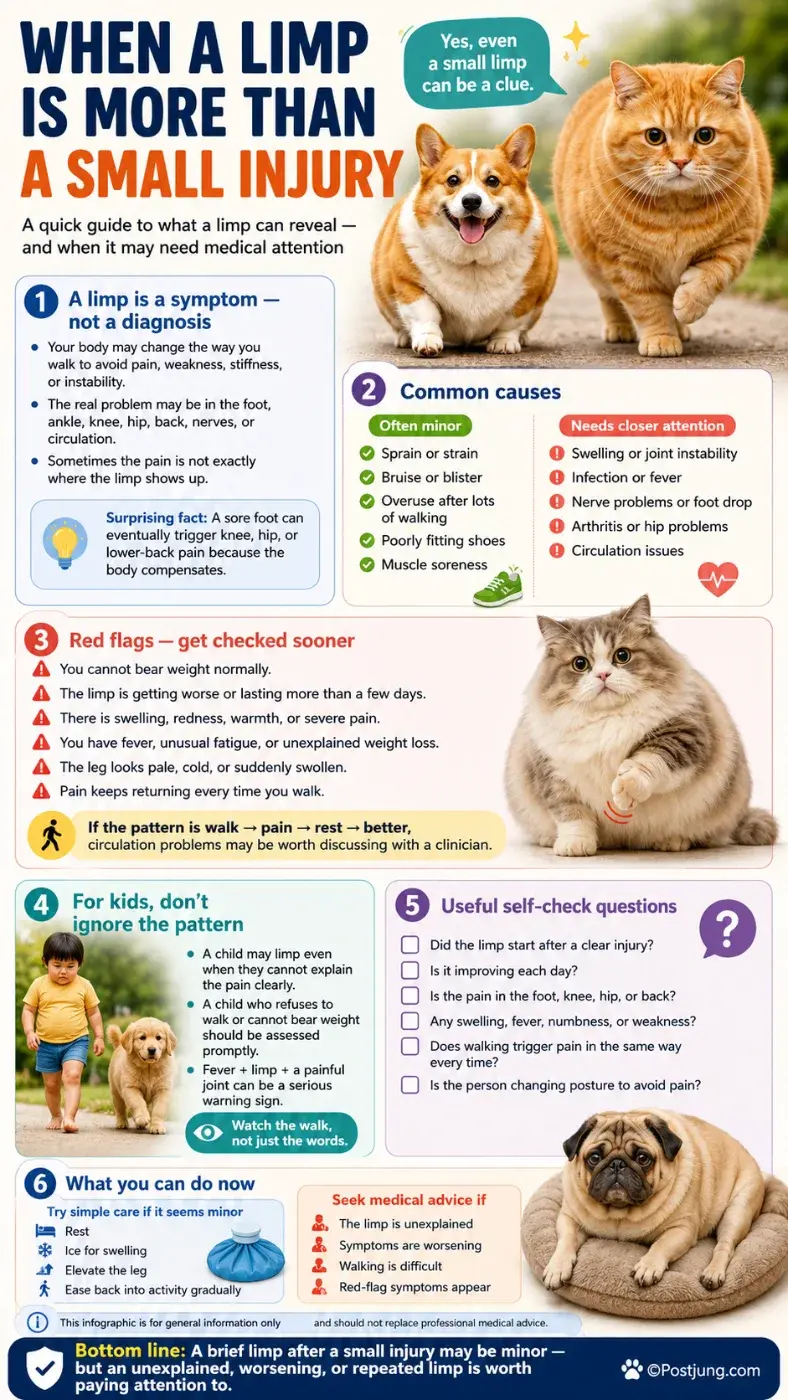
Why the body starts limping
Most limps happen because the body is trying to protect something.
If your ankle hurts, you spend less time standing on that side. If your hip is stiff, your stride may shorten. If a nerve problem makes the foot drag, the leg may swing differently. If balance is affected, walking can become slower, wider, or more cautious.
That means the visible limp is often only the surface clue. The real issue may be in the foot, ankle, knee, hip, back, nerves, muscles, bones, or even circulation.
This is why doctors usually care about the pattern. Did the limp begin suddenly after a fall? Does it come with swelling? Is there fever? Can the person bear weight? Is the pain in the calf during walking and better with rest? Did it appear in a child with no clear injury?
Those details matter because the cause changes the level of concern.
When a limp may be harmless
A limp after a clear, mild injury is often less alarming when the person can still walk, the pain is improving, there is no major swelling or deformity, and symptoms settle over a few days.
Common short-term causes include a sprain, muscle strain, bruise, blister, callus, uncomfortable footwear, or soreness after unusual activity. A person may naturally walk differently while the irritated area heals.
Even then, the limp should move in the right direction. If it keeps returning, gets worse, or causes pain in other areas, it deserves a closer look. Mayo Clinic advises making an appointment for leg pain that happens during or after walking, gets worse, or does not improve after a few days of home care.
Red flags adults should not ignore
Some limps should be treated as more urgent.
Mayo Clinic recommends immediate medical help or emergency care for leg injuries involving deep cuts, visible bone or tendon, inability to walk or bear weight, lower-leg pain with swelling, redness or warmth, or a popping or grinding sound at the time of injury. It also advises prompt care for signs of infection, a leg that is pale, cold, or swollen, calf pain after long sitting, swelling in both legs with breathing problems, or serious symptoms that start without a clear reason.
A limp can also be related to circulation. Peripheral artery disease, or PAD, happens when narrowed arteries reduce blood flow, usually to the legs. Mayo Clinic describes a classic pattern: leg muscle pain or cramping that begins with activity, such as walking or climbing stairs, and improves with rest.
That does not mean every walking-related calf pain is PAD. But pain that follows a repeated pattern — walk, hurt, rest, improve — is worth discussing with a healthcare professional, especially for people with risk factors such as smoking, diabetes, high cholesterol, high blood pressure, or older age.
Children are a special case
A limping child can worry parents because the cause is not always easy to see.
The NHS says limping in children is not usually serious and may come from something minor like a sprain or strain. But it also says a limp with no obvious cause should be checked by a GP because it could sometimes point to something serious.
The Royal Children’s Hospital Melbourne notes that most children with a limp do not need investigations, but an acute inability to walk or bear weight is a red flag. It also warns that septic arthritis is an orthopedic emergency when a child has a limp with swelling, reduced range of motion, and especially fever.
For parents, the practical message is simple: do not rely only on the child’s words. Watch the walking pattern, check whether the child can stand and bear weight, look for swelling or warmth, and pay attention to fever, unusual tiredness, night pain, rash, or symptoms that worsen.
Mayo Clinic advises consulting a child’s doctor when joint or muscle pain is persistent or comes with limping, impaired activity, swelling, stiffness, unexplained fever, rash, abdominal pain, fatigue, swollen glands, or unexplained weight loss.
Why waiting can make things harder
One reason a limp should not be ignored is that the body compensates.
A sore foot can change knee mechanics. A stiff hip can affect the lower back. Avoiding weight on one side may overload the other side. Over time, a small problem can create a chain of discomfort.
That does not mean every limp is dangerous. It means the timeline matters. A limp that improves quickly after a clear minor cause is different from one that persists, spreads, appears without explanation, or comes with systemic symptoms like fever, weakness, weight loss, redness, warmth, or unusual fatigue.
What to do before assuming the worst
For a mild, clear injury, simple self-care may help: rest the area, avoid activities that worsen pain, use ice for swelling, elevate the limb, and return to movement gradually as symptoms improve. People should be cautious with medications and follow product labels or medical advice, especially if they have allergies, stomach problems, kidney disease, blood thinner use, pregnancy, or other health conditions.
The key is not panic. The key is pattern recognition.
A limp that is brief, improving, and clearly linked to a minor cause is often less concerning. A limp that is unexplained, worsening, painful with walking, associated with fever or swelling, or makes weight-bearing difficult should be checked.
A strong rule of thumb is this: if walking changes and does not normalize, the body is asking for attention.
Cleveland Clinic, Mayo Clinic, NHS, Royal Children’s Hospital Melbourne
REFERENCES:
https://my.clevelandclinic.org/health/diseases/21092-gait-disorders
https://www.mayoclinic.org/symptoms/leg-pain/basics/when-to-see-doctor/sym-20050784
https://www.mayoclinic.org/symptom-checker/joint-pain-or-muscle-pain-in-children-child/related-factors/itt-20009075
https://www.nhs.uk/symptoms/limp-in-children/

เขียนโดย Postjung Insights
 รู้หรือไม่? เปิดรายได้พนักงานส่งพัสดุของแต่ละแอป วันหนึ่งได้เท่าไร
 อำเภอที่มีชื่ออำเภอสั้นที่สุด 3 อำเภอเท่านั้นในประเทศไทย
 โรงเรียนที่มีนักเรียนมากที่สุดในไทย
 งูมัลกา (Mulga Snake): นักล่าแห่งผืนดินแห้งแล้ง ของทวีปออสเตรเลีย กับฉายา King Brown กัดคนได้ถึงตาย
 ดูหนัง–ซีรีส์ฟรีอาจไม่ฟรีอย่างที่คิด! เปิดโทษละเมิดลิขสิทธิ์ เตือนคนปล่อยคอนเทนต์เถื่อน เสี่ยงทั้งคุกทั้งปรับ
 รมว.วัฒนธรรมเอาจริง! จ่อส่งหนังสือทักท้วง Miss Universe Cambodia ปมใช้ภาพหญิงกำแพงเพชร หากไม่แก้ เตรียมใช้กฎหมาย
 แมงป่อง: แมลงนักล่าสายพันธุ์โบราณของโลก ที่ยังคงอยู่มาจนถึงปัจจุบัน
 แมคาเดเมีย (Macadamia): ราชินีแห่งถั่ว กับขุมทรัพย์โภชนาการจากออสเตรเลีย
 สถิติย้อนหลัง 10 ปี ออกเลขไหนบ้างมาดูกัน
 5 คณะที่เรียนจบมาแล้ว มีอาชีพรองรับมากกว่าที่คิด
 ตาราง “เด่นเหนือเด่นใต้” งวด 1 ต.ค. 69 เปิดข้อมูลตามโพย เลขไหนอยู่ตรงไหน
 มัดรวมจับเลขชน สัตว์นำโชค 1 ตุลาคม 2569
 English Edition