What to Know Before Buying an Automatic Litter Box
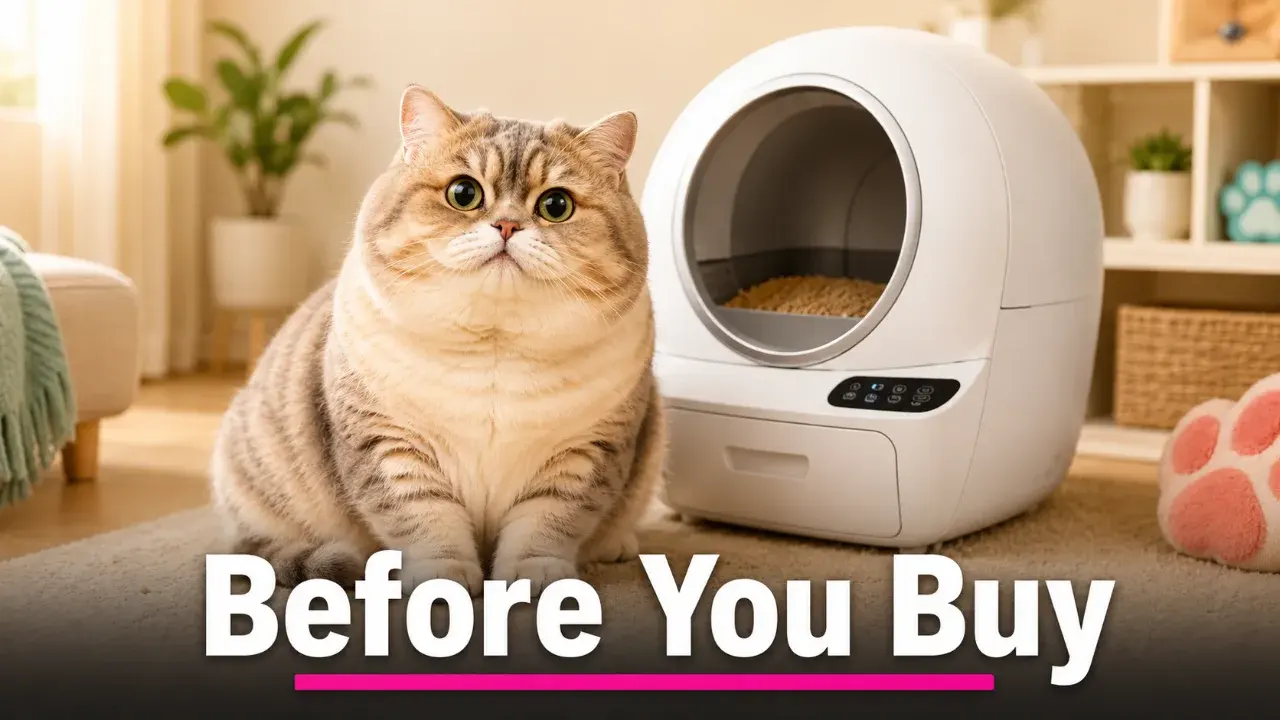
An automatic litter box can sound like the perfect upgrade: less scooping, better odor control, and maybe even app alerts about your cat’s bathroom habits. But it is still a machine sitting in one of the most sensitive places in your cat’s daily routine.
The best choice is not simply the smartest model or the most expensive one. The right automatic litter box is the one your cat will actually use safely, calmly, and consistently.
Automatic boxes are designed to separate clean litter from waste, usually by rotating, raking, or sifting after a cat leaves the box. Some models also track weight, visit frequency, or waste patterns through an app. That can be useful, especially for busy households or people who have trouble scooping every day.
But “automatic” does not mean effortless. It also does not mean every cat will accept it.
Convenience should not come before safety
The first thing to check is not the app. It is the safety design.
A good automatic litter box should not move while a cat is inside, touching the unit, or trying to enter. Look for more than one type of safety system, such as weight sensors, motion or infrared sensors, and a mechanical stop or reverse function if something goes wrong. Cats.com, which has tested multiple automatic litter boxes, notes that moving parts can be hazardous if a product is not engineered with cat safety in mind, and recommends checking for weight, motion, infrared, and pinch-related protections.
This matters because cats do not behave like predictable test objects. A kitten may climb in halfway. A senior cat may move slowly. A nervous cat may freeze when a motor starts. A curious cat may investigate the box during a cleaning cycle.
For that reason, safety features are not optional extras. They are the point.
Buyers should also check the brand’s return policy, warranty, replacement parts, and customer reviews outside the manufacturer’s own website. A cheap lookalike model may be tempting, but a litter box with weak sensors, unclear testing, or poor support can become an expensive mistake.
For U.S. shoppers, it is also sensible to search the Consumer Product Safety Commission recall database or report an unsafe product if there is a serious concern. The CPSC maintains consumer safety education and unsafe product reporting resources for U.S. households.
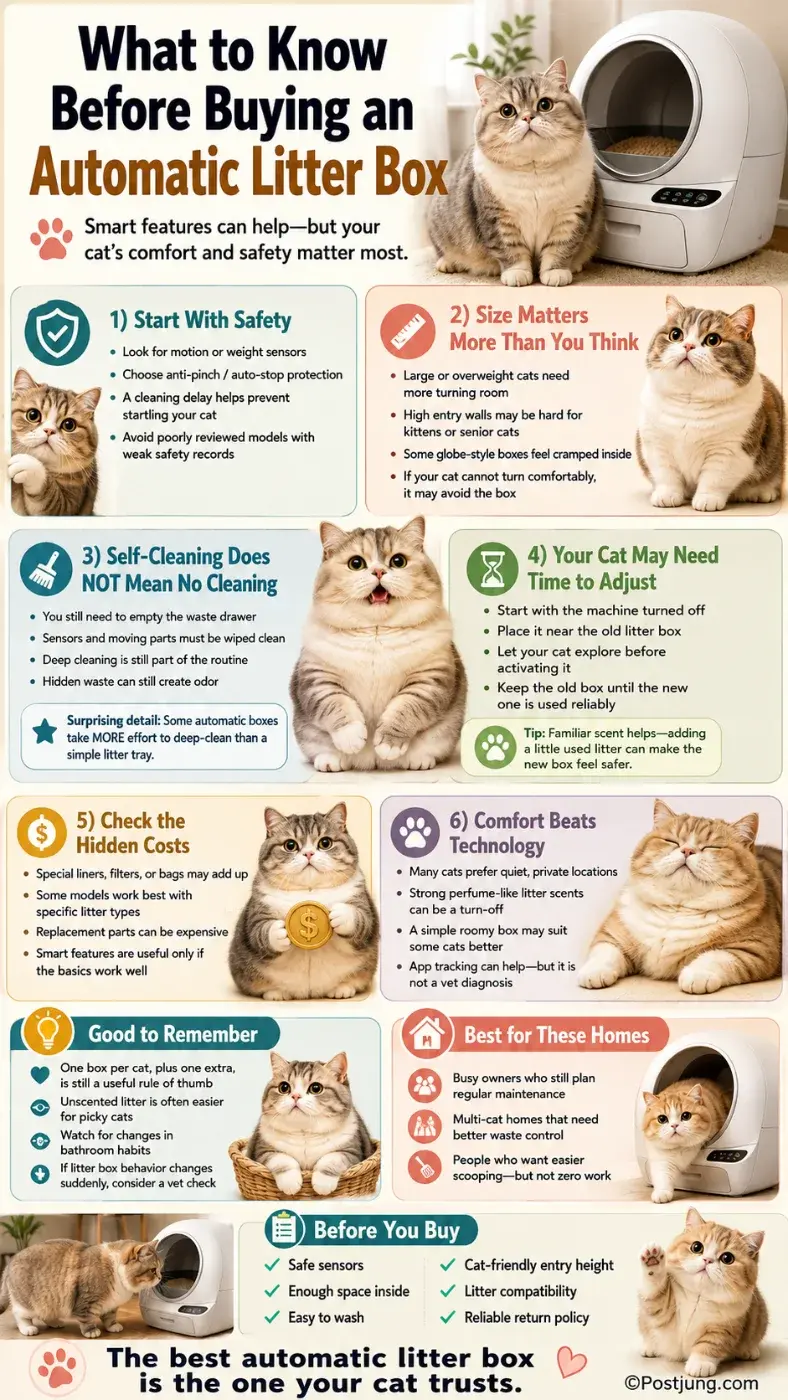
Your cat’s body matters more than the machine’s footprint
Automatic litter boxes can look huge in a room but still feel too small inside.
That is especially true for enclosed globe-style models. A cat needs enough space to turn, dig, squat, and leave without brushing awkwardly against the walls. Large cats, overweight cats, kittens, and senior cats may have very different needs.
Cornell Feline Health Center says overweight and large cats need bigger boxes, while kittens, elderly cats, and cats with joint pain need boxes with low sides. Cornell also notes that many cats prefer uncovered boxes because they allow odors to escape and give the cat a full view of the surroundings.
That does not mean every covered automatic box is bad. Some cats use them happily. But the inside dimensions, entry height, headroom, and escape route matter more than how sleek the device looks in product photos.
A simple test: imagine your cat stepping in at 3 a.m., half-awake, with the motor noise still unfamiliar. If the box feels narrow, loud, steep, or trapped, your cat may avoid it.
“Self-cleaning” still means cleaning
This is the surprise many buyers miss: an automatic litter box still needs human maintenance.
The machine may scoop or sift, but someone still has to empty the waste drawer, wipe sensors, replace liners or bags, clean the litter bed, and deep-clean parts that collect dust, urine residue, or odor. Cats.com notes that automatic models still require regular waste removal, and some need more involved deep-cleaning than a simple litter pan because of electrical parts and moving components.
Cornell’s general litter guidance remains useful here: if clumping litter is used, feces and clumps should be removed daily, and boxes should be cleaned with a gentle detergent and kept dry and fresh.
With an automatic box, the danger is psychological. Because the waste is hidden in a drawer, owners may forget how much is inside. Odor can build up. Sensors can get dusty. A drawer can fill faster than expected in a multi-cat home.
Hidden waste is still waste.
Do not throw away the old box too fast
Cats are creatures of habit. A sudden bathroom change can be stressful, even when the new box is cleaner or more expensive.
A smart transition is slow. Place the automatic box near the old one. Leave it turned off at first so your cat can explore without noise or motion. Add a small amount of used litter from the old box so the new one smells familiar. Reward curiosity, but do not force the cat inside.
Cats.com recommends gradual acclimation, including starting with the unit off and using familiar scent from the old box.
The old litter box should stay available until your cat is using the new one reliably. Some households may still need both.
AAHA and AAFP guidance recommends one litter box per cat plus one additional box, or one box per social group plus one extra when social groups are known. The boxes should be in different accessible locations, especially in multi-cat homes.
That rule does not disappear just because one box has Wi-Fi.
Watch the litter, noise, and placement
Many automatic litter boxes require clumping litter to work properly. Some use crystal litter. Others need specific liners, bags, filters, or branded parts. Before buying, check whether your current litter is compatible.
This matters because cats can be picky about texture and scent. Cornell says most cats prefer unscented, finer-textured litter about one to two inches deep. If a machine forces you to switch to a litter your cat dislikes, the device may solve your scooping problem while creating a house-soiling problem.
Noise is another issue. Some cats ignore motors. Others are startled by them, especially if the cleaning cycle begins too soon after they leave. Look for adjustable delay settings so the box does not start immediately.
Placement also matters. Cornell recommends quiet, private, easily accessible locations away from feeding areas, with special care for cats that have trouble using stairs. A laundry room with a loud washer or a tight closet with no escape route may look convenient to humans but feel unsafe to a cat.
Smart tracking can help, but it is not a vet
Some automatic boxes can track weight, number of visits, and usage patterns. That can be genuinely useful. A sudden change in bathroom behavior may be an early clue that something is wrong.
But app data is not a diagnosis. It can tell you that your cat is visiting more often, urinating differently, or losing weight. It cannot tell you why.
Cornell warns that medical conditions can interfere with normal urination and defecation, and cats with litter box problems should be checked by a veterinarian. AAHA also advises prompt veterinary help when house-soiling appears, especially because some urinary problems can be serious.
So the best use of smart tracking is simple: notice patterns sooner, then call a veterinarian when something seems off.
The bottom line
An automatic litter box can be a good purchase for the right cat and the right household. It may reduce daily scooping, control odor, and make litter care easier for people with busy schedules or physical limitations.
But it is not a magic appliance. It is a bathroom your cat must trust.
Before buying, check the safety system, interior size, cleaning process, litter compatibility, noise level, return policy, and whether your cat has the temperament or mobility to use it comfortably.
The smartest litter box is not the one with the longest feature list. It is the one that keeps the routine simple, clean, and safe — for the human, yes, but especially for the cat.
Cornell Feline Health Center, AAHA, AAFP, Cats.com, U.S. Consumer Product Safety Commission
REFERENCES:
https://www.vet.cornell.edu/departments-centers-and-institutes/cornell-feline-health-center/health-information/feline-health-topics/feline-behavior-problems-house-soiling
https://www.aaha.org/resources/2021-aaha-aafp-feline-life-stage-guidelines/general-litter-box-considerations/
https://cats.com/10-things-to-know-before-buying-automatic-litter-box
https://www.cpsc.gov/

เขียนโดย Postjung Insights
 ดูหนัง–ซีรีส์ฟรีอาจไม่ฟรีอย่างที่คิด! เปิดโทษละเมิดลิขสิทธิ์ เตือนคนปล่อยคอนเทนต์เถื่อน เสี่ยงทั้งคุกทั้งปรับ
 รมว.วัฒนธรรมเอาจริง! จ่อส่งหนังสือทักท้วง Miss Universe Cambodia ปมใช้ภาพหญิงกำแพงเพชร หากไม่แก้ เตรียมใช้กฎหมาย
 โรงเรียนที่มีนักเรียนมากที่สุดในไทย
 MRT เตาปูนกลับมาเปิดปกติแล้ว รมช.คมนาคมเผยปมไฟไหม้ พบประกายไฟจากชุดสายไฟ 750 โวลต์
 รู้หรือไม่? เปิดรายได้พนักงานส่งพัสดุของแต่ละแอป วันหนึ่งได้เท่าไร
 5 คณะที่เรียนจบมาแล้ว มีอาชีพรองรับมากกว่าที่คิด
 อำเภอที่มีชื่ออำเภอสั้นที่สุด 3 อำเภอเท่านั้นในประเทศไทย
 แมคาเดเมีย (Macadamia): ราชินีแห่งถั่ว กับขุมทรัพย์โภชนาการจากออสเตรเลีย
 ตาราง “เด่นเหนือเด่นใต้” งวด 1 ต.ค. 69 เปิดข้อมูลตามโพย เลขไหนอยู่ตรงไหน
 งูมัลกา (Mulga Snake): นักล่าแห่งผืนดินแห้งแล้ง ของทวีปออสเตรเลีย กับฉายา King Brown กัดคนได้ถึงตาย
 มัดรวมจับเลขชน สัตว์นำโชค 1 ตุลาคม 2569
 เปิด 5 โรงเรียนหญิงล้วนเก่าแก่ของไทย ที่มีประวัติยาวนานกว่าศตวรรษ
 English Edition