Why Dogs Bark at Delivery Drivers — and What It Really Means

A delivery driver may be at your door for less than a minute. To your dog, that short visit can feel like a major event: a stranger approaches the home, makes noise, drops something near the entrance, and disappears.
That last part matters. Many dogs bark because, from their point of view, the barking appears to work. The stranger comes close, the dog sounds the alarm, and the stranger leaves.
That does not mean your dog understands mail routes, online shopping, or the fact that the same driver may be delivering packages to the whole neighborhood. Dogs respond to patterns, and the delivery routine is almost perfectly designed to create a barking habit.
The front door is not neutral to a dog
For many dogs, the front door is one of the most emotionally loaded places in the home. It is where guests arrive, family members return, food may be delivered, and strange sounds happen without warning.
A delivery driver adds several triggers at once: footsteps, a vehicle stopping outside, a gate opening, a knock, a doorbell, a box hitting the porch, or a person moving quickly near the house. Dogs may bark territorially when unknown people approach familiar spaces such as the home, yard, car, or other areas they perceive as theirs. Cornell’s canine health guidance describes territorial barking as behavior motivated by a perceived need to protect space, while fear or anxiety barking may function as a “go away” signal.
That is why the same dog may ignore a stranger at the park but explode when someone steps onto the porch. The location changes the meaning.
At home, the dog may think: this is our place.
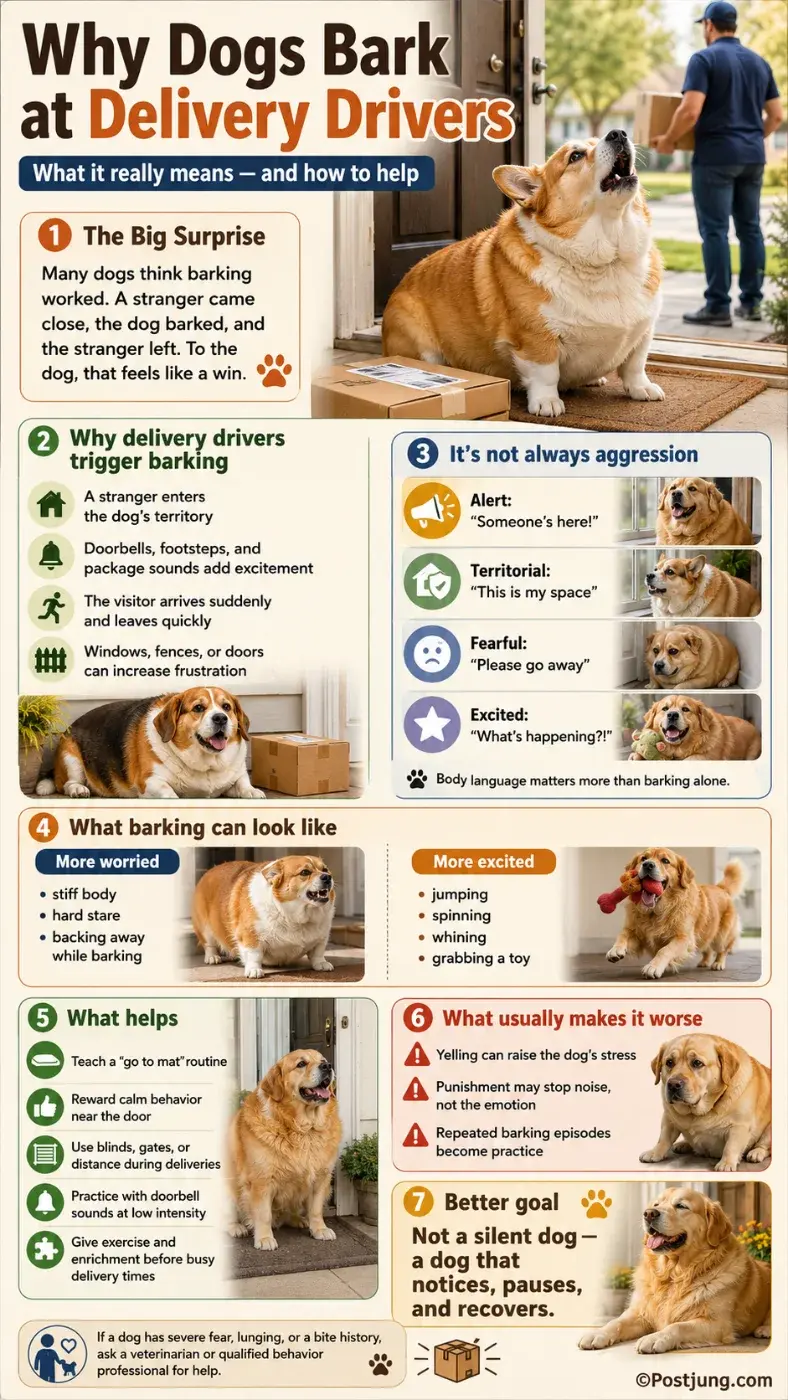
Delivery drivers accidentally reward the barking
The most interesting part is not simply that dogs bark at strangers. It is that delivery drivers usually leave right after the barking starts.
From a human perspective, the driver is just doing the job: drop off the package and move on. From the dog’s perspective, the sequence can look very different.
Stranger approaches. Dog barks. Stranger leaves.
The ASPCA’s pet behavior guidance notes that mail and package delivery can create a pattern where a dog believes barking drove the person away. Because the visitor approaches the property and then quickly exits, the behavior may be reinforced again and again.
That is why the barking can become louder over time. The dog is not necessarily becoming “mean.” The dog may be becoming more confident that the routine is successful.
It is not always aggression
A barking dog can sound intimidating, but barking does not always mean aggression. It can come from alertness, fear, frustration, excitement, or a mix of all four.
Some dogs bark because they are guarding. Some bark because the sudden sound startled them. Some bark because they desperately want to investigate the person on the other side of the door. Others bark because they are behind a window, fence, crate, or door and cannot reach what they are focused on.
The ASPCA separates territorial barking from alarm barking, noting that territorial barking is often connected to familiar places, while alarm barking may happen when sights or sounds startle or upset the dog even outside its home territory.
The body language matters. A dog with a stiff posture, hard stare, raised hackles, or growling may be feeling threatened. A dog spinning, jumping, whining, and grabbing toys may be overexcited. A dog backing away while barking may be scared.
The sound is only one clue. The whole dog tells the story.
Why yelling usually makes it worse
When a dog is barking at the door, yelling “Quiet!” may feel natural. But to a dog already in alarm mode, a raised human voice can add more intensity to the moment.
Humane World for Animals advises that yelling at a dog to be quiet will not reduce barking and that the better goal is to identify why the dog is barking, remove or reduce the trigger when possible, and teach an alternative behavior.
There is another reason punishment can backfire. If the dog is barking because of fear or territorial concern, punishment may suppress the sound without changing the feeling underneath. The ASPCA warns that territorial motivation can remain strong even if barking is punished, and a dog may try to control the situation in another way.
In plain terms: silence is not always calm.
Give the dog a better job
One of the most useful shifts is to stop treating the door as a battle and start treating it as a training routine.
Instead of letting the dog decide what to do when a delivery arrives, teach a simple replacement behavior: go to a mat, go to a bed, pick up a toy, move behind a baby gate, or settle in another room with a food puzzle.
This works because the dog is not just being told what not to do. The dog is being shown what to do instead.
Dogs Trust recommends gradually training dogs to respond calmly to knocks or doorbell sounds, starting quietly, rewarding calm behavior, and eventually teaching the dog to go to a bed when the sound happens.
For many homes, the first step is management, not training perfection. Close the blinds. Use window film. Add white noise. Move the dog away from the front window during busy delivery hours. Tufts veterinary guidance suggests reducing exposure to triggers such as people passing by, covering lower windows, using gates or doors, and giving the dog appropriate exercise and enrichment.
That may sound too simple, but it matters. Every barking episode is practice. Reducing practice helps weaken the habit.
The goal is not a silent dog
A dog who gives one or two alert barks when someone approaches the house is not broken. Barking is normal communication. The problem is when the dog cannot recover, the household becomes stressed, or the behavior creates risk for guests, neighbors, drivers, or the dog.
A realistic goal is not “never bark again.” A better goal is notice, pause, and recover.
That might look like this: the dog hears a delivery, gives one bark, turns back to the owner, goes to a mat, and gets rewarded. Over time, the delivery sound becomes less of a crisis and more of a cue.
For dogs with intense fear, lunging, biting history, or severe reactivity, a veterinarian or certified behavior professional is the safer route. A good plan should protect the delivery worker, reduce the dog’s stress, and avoid turning the front door into a daily conflict.
The delivery driver is not the villain in your dog’s story. To your dog, they are a fast-moving mystery at the edge of the territory.
Once you understand that, the barking makes a lot more sense — and it becomes much easier to change.
ASPCA, Cornell University College of Veterinary Medicine, Cummings School of Veterinary Medicine at Tufts University, Dogs Trust, Humane World for Animals
REFERENCES:
https://www.aspcapetinsurance.com/resources/dogs-and-delivery-drivers/
https://www.aspca.org/pet-care/dog-care/common-dog-behavior-issues/barking
https://www.vet.cornell.edu/departments-centers-and-institutes/riney-canine-health-center/canine-health-topics/excessive-barking
https://vet.tufts.edu/news-events/news/how-stop-territorial-barking

เขียนโดย Postjung Insights
 อำเภอที่มีชื่ออำเภอสั้นที่สุด 3 อำเภอเท่านั้นในประเทศไทย
 โรงเรียนที่มีนักเรียนมากที่สุดในไทย
 รู้หรือไม่? เปิดรายได้พนักงานส่งพัสดุของแต่ละแอป วันหนึ่งได้เท่าไร
 เปิดรายชื่อ 5 โรงเรียนเป้าหมาย เด็กสอบเข้าต้องเตรียมตัวให้พร้อม
 เปิด 5 โรงเรียนหญิงล้วนเก่าแก่ของไทย ที่มีประวัติยาวนานกว่าศตวรรษ
 ราคาทองวันนี้ 21 ก.ย. 69 อัปเดตตลาดทองคำ ทองรูปพรรณแตะ 69,750 บาท
 เปิดรายชื่อ 5 โรงเรียนเอกชนขนาดใหญ่ นักเรียนกว่า 5,000 คนทุกแห่ง
 สถิติย้อนหลัง 10 ปี ออกเลขไหนบ้างมาดูกัน
 ตาราง “เด่นเหนือเด่นใต้” งวด 1 ต.ค. 69 เปิดข้อมูลตามโพย เลขไหนอยู่ตรงไหน
 หนุ่มขับ Porsche ใจหล่อสุดๆ ติดประกาศเด็กหายไว้รอบคัน..หวังช่วยเผยแพร่ข้อมูลให้ตามหาได้เร็วขึ้น
 'สควีชชี่'ของเล่นที่กำลังเป็นไวรัลอาจถูกเจ้าหน้าที่ของสนามบินยึดได้ ตรวจสอบให้ดีก่อนนำขึ้นเครื่อง
 ซาบีดา” เรียกถกด่วน ปมภาพ “ชุดไทย” ถูกนำไปอ้างเป็นชุดกัมพูชา
 เปิด 5 สินค้าส่งออกของลาวที่คนไทยอาจคาดไม่ถึง หนึ่งในนั้นทำเงินเกือบ 1 พันล้านดอลลาร์ราคาทองวันนี้ 21 ก.ย. 69 อัปเดตตลาดทองคำ ทองรูปพรรณแตะ 69,750 บาทเปิดรายชื่อ 5 โรงเรียนเอกชนขนาดใหญ่ นักเรียนกว่า 5,000 คนทุกแห่งซาบีดา” เรียกถกด่วน ปมภาพ “ชุดไทย” ถูกนำไปอ้างเป็นชุดกัมพูชาเปิดรายชื่อ 5 โรงเรียนเป้าหมาย เด็กสอบเข้าต้องเตรียมตัวให้พร้อมหนุ่มขับ Porsche ใจหล่อสุดๆ ติดประกาศเด็กหายไว้รอบคัน..หวังช่วยเผยแพร่ข้อมูลให้ตามหาได้เร็วขึ้น
 English Edition