Why Litter Box Height Matters More as Cats Get Older
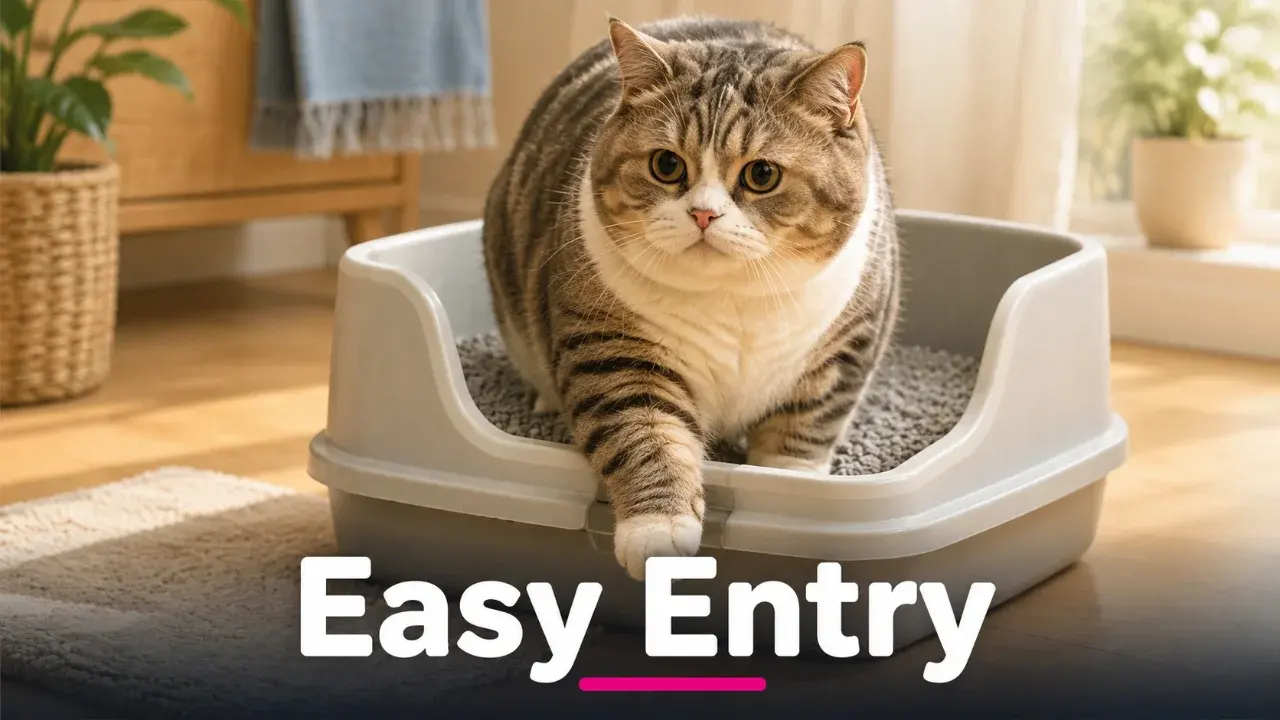
For aging cats, a litter box that once felt normal can become awkward, painful, or intimidating. A lower entry may help, but sudden litter box changes should also be treated as a possible health clue.
A litter box can look perfectly fine to a person and still feel like an obstacle course to an older cat. As cats age, stiff joints, weaker muscles, balance changes, and pain can turn a high-sided box into something they avoid, rush through, or struggle to enter. Cornell’s Feline Health Center notes that joint pain may make it difficult for older cats to get in and out of a litter box, and that a box with low sides or a cut-out may help with access.
That is why litter box height matters. It is not just a design detail. For some senior cats, the entrance is the problem.
A younger cat may hop over the side of a box without thinking. An older cat may have to lift sore hips, bend stiff ankles, or steady itself on litter that shifts under its paws. If the box has tall walls, a top-entry design, a lid, or a narrow opening, the cat may decide the effort is not worth it.
The result can look like “bad behavior.” In reality, it may be discomfort.
Why older cats may struggle with high-sided boxes
Many senior cats become less willing to jump, climb, or squeeze into tight spaces. The 2021 AAFP feline senior care guidance notes that degenerative joint disease and muscle weakness can show up as reduced jumping or climbing, and that senior cats may benefit from having resources placed so they do not need to travel as far to reach food, water, or the litter box.
That matters because cats are famously good at hiding pain. A cat may not limp dramatically. Instead, the signs can be small: sleeping lower to the ground, avoiding a favorite window seat, hesitating before jumping, grooming less, or choosing a rug instead of the litter box.
A high box can add one more hurdle. To use it, the cat must step over the wall, turn around, squat, balance, cover, and step out again. If any part hurts, the whole experience can become stressful.
The ASPCA also notes that geriatric cats or cats with physical limitations may have difficulty using certain litter boxes, including top-entry boxes or boxes with high sides. For older, arthritic, or special-needs cats, switching to a low-sided box may help.
The box should be easy, not just clean
Cleanliness still matters. Cats may avoid a dirty box, and the ASPCA recommends scooping at least once a day while keeping boxes accessible and comfortable. But for senior cats, a clean box in the wrong shape or location may still fail.
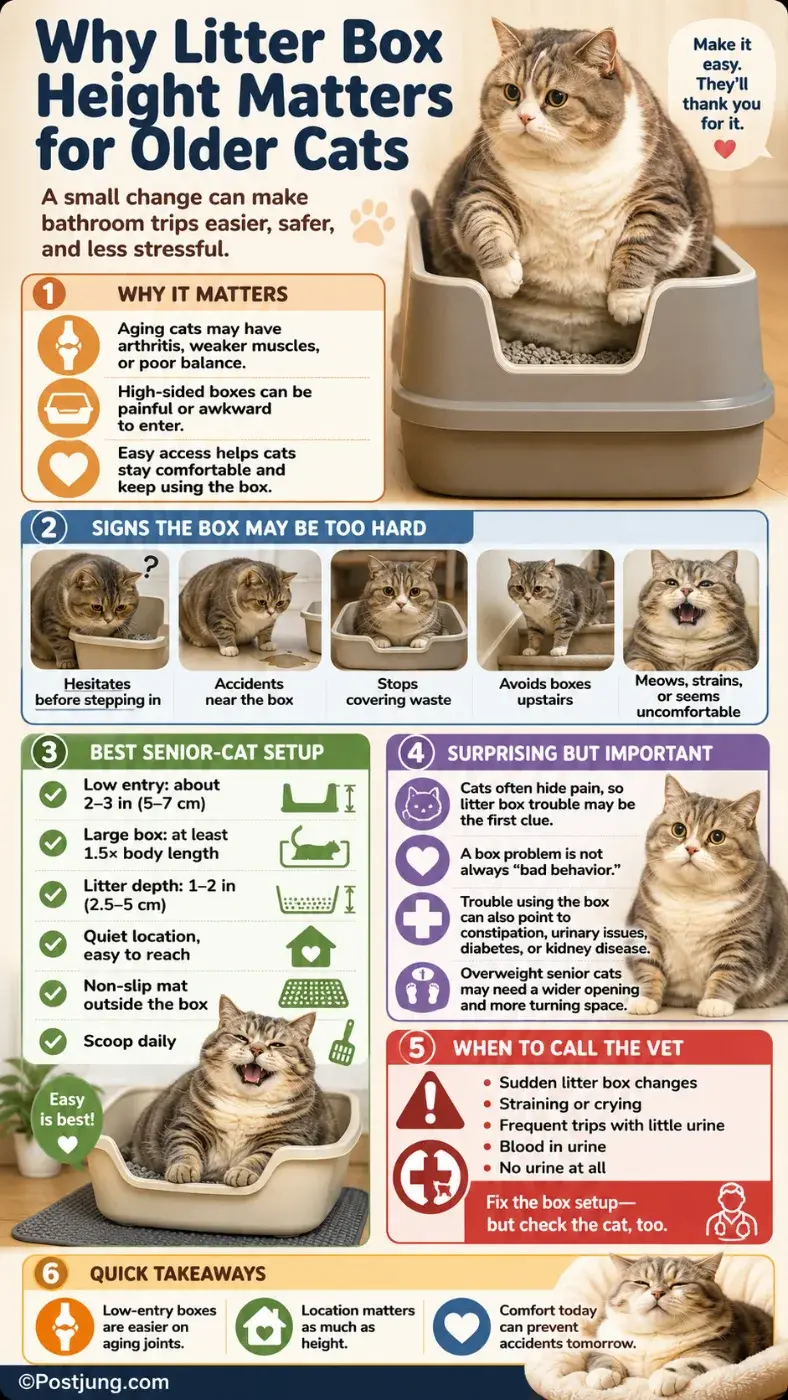
A better senior-cat setup usually starts with a low-entry opening. The cat should be able to walk in without lifting its legs high or jumping. Some owners use a box designed for senior cats; others modify a large storage container by cutting a smooth, low entrance.
Size matters too. A cat should have enough room to turn around comfortably. Cat Friendly Homes, a resource from the American Association of Feline Practitioners, suggests larger boxes and says the box should be at least 1.5 times the cat’s length from nose to the base of the tail, with soft clumping litter.
Litter depth can also affect comfort. The ASPCA says most cats prefer one to two inches of litter, rather than a deep layer. A shallow, stable surface may be easier for an older cat that feels unsteady while squatting.
Location can matter as much as height
Even a low box can be hard to use if it is in the basement, up a staircase, behind a noisy laundry machine, or near a busy hallway.
For senior cats, distance becomes part of access. A cat that has arthritis, kidney disease, diabetes, constipation, or reduced bladder control may not comfortably travel across the house every time. Cat Friendly Homes recommends placing low-entry litter boxes on every floor of the home, away from noisy and busy areas, and making sure cats do not have to use stairs to reach them.
This is especially helpful in multi-level homes. If an older cat spends most of the day in a bedroom, the nearest box should not be two rooms and one staircase away.
In multi-cat homes, location also affects stress. A senior cat may avoid a box if another cat can block the path or ambush the exit. Open, quiet locations with more than one escape route can make the box feel safer.
When a litter box problem is a health signal
A lower box can make life easier, but it should not replace medical attention when behavior changes suddenly.
The AAHA and AAFP life-stage guidance says new or unusual behavior in senior cats should be evaluated for medical conditions. Changes in litter box use may be related to urinary tract disease, constipation, diabetes, reduced strength, balance issues, or pain.
That means a cat peeing outside the box, straining, visiting the box often, crying, producing little urine, defecating less often, or suddenly avoiding the box deserves a veterinary check. The box may be too tall, but the cat may also be dealing with a medical problem.
The safest mindset is simple: fix the access, but check the cat.
A small change that respects an older cat’s body
Aging does not always announce itself loudly. Sometimes it shows up as a missed jump, a shorter grooming session, or a cat standing beside the litter box instead of stepping inside.
Lowering the entry point is a small adjustment, but it can change how safe and manageable the bathroom routine feels. It tells the cat’s body: you do not have to climb, jump, or strain for something you need every day.
For older cats, comfort is often built from small details. The right litter box height is one of them.
KEY TAKEAWAYS:
- Older cats may struggle with high-sided, covered, or top-entry litter boxes because of joint pain, weakness, or balance changes.
- A low-entry box or a smooth cut-out opening can make the litter box easier to access.
- Box size, litter depth, cleanliness, and location all affect whether a senior cat feels comfortable using it.
- Sudden litter box changes should not be dismissed as stubborn behavior; they may point to pain or illness.
- If an older cat starts avoiding the box, a veterinary check is the safest next step.
Cornell Feline Health Center, AAHA, American Association of Feline Practitioners, ASPCA
REFERENCES:
https://www.vet.cornell.edu/departments-centers-and-institutes/cornell-feline-health-center/health-information/feline-health-topics/special-needs-senior-cat
https://www.aaha.org/resources/2021-aaha-aafp-feline-life-stage-guidelines/behavior-and-environmental-needs-senior-cats/
https://catfriendly.com/keep-your-cat-healthy/home-modifications/
https://www.aspca.org/pet-care/cat-care/common-cat-behavior-issues/litter-box-problems

เขียนโดย Postjung Insights
 รู้หรือไม่? เปิดรายได้พนักงานส่งพัสดุของแต่ละแอป วันหนึ่งได้เท่าไร
 อำเภอที่มีชื่ออำเภอสั้นที่สุด 3 อำเภอเท่านั้นในประเทศไทย
 แมคาเดเมีย (Macadamia): ราชินีแห่งถั่ว กับขุมทรัพย์โภชนาการจากออสเตรเลีย
 รมว.วัฒนธรรมเอาจริง! จ่อส่งหนังสือทักท้วง Miss Universe Cambodia ปมใช้ภาพหญิงกำแพงเพชร หากไม่แก้ เตรียมใช้กฎหมาย
 ดูหนัง–ซีรีส์ฟรีอาจไม่ฟรีอย่างที่คิด! เปิดโทษละเมิดลิขสิทธิ์ เตือนคนปล่อยคอนเทนต์เถื่อน เสี่ยงทั้งคุกทั้งปรับ
 MRT เตาปูนกลับมาเปิดปกติแล้ว รมช.คมนาคมเผยปมไฟไหม้ พบประกายไฟจากชุดสายไฟ 750 โวลต์
 ส่องเลข 3 สำนักพิมพ์ งวด 1 ต.ค. 69 ตัวไหนมีข้อมูลตรงกัน
 โรงเรียนที่มีนักเรียนมากที่สุดในไทย
 ตาราง “เด่นเหนือเด่นใต้” งวด 1 ต.ค. 69 เปิดข้อมูลตามโพย เลขไหนอยู่ตรงไหน
 แมงป่อง: แมลงนักล่าสายพันธุ์โบราณของโลก ที่ยังคงอยู่มาจนถึงปัจจุบัน
 งูมัลกา (Mulga Snake): นักล่าแห่งผืนดินแห้งแล้ง ของทวีปออสเตรเลีย กับฉายา King Brown กัดคนได้ถึงตาย
 วงแหวนแฟร์รี่ (Fairy Circles): ปริศนาวงกลมกลางทะเลทราย ที่เรายังต้องหาคำตอบกันต่อไป...
 เปิด 5 สินค้าเกษตรจากลาวที่เข้าสู่ตลาดไทย สินค้าไหนมีบทบาทสำคัญที่สุดดูหนัง–ซีรีส์ฟรีอาจไม่ฟรีอย่างที่คิด! เปิดโทษละเมิดลิขสิทธิ์ เตือนคนปล่อยคอนเทนต์เถื่อน เสี่ยงทั้งคุกทั้งปรับรมว.วัฒนธรรมเอาจริง! จ่อส่งหนังสือทักท้วง Miss Universe Cambodia ปมใช้ภาพหญิงกำแพงเพชร หากไม่แก้ เตรียมใช้กฎหมายแมคาเดเมีย (Macadamia): ราชินีแห่งถั่ว กับขุมทรัพย์โภชนาการจากออสเตรเลียMRT เตาปูนกลับมาเปิดปกติแล้ว รมช.คมนาคมเผยปมไฟไหม้ พบประกายไฟจากชุดสายไฟ 750 โวลต์
 เปิด 5 สินค้าส่งออกของลาวที่คนไทยอาจคาดไม่ถึง หนึ่งในนั้นทำเงินเกือบ 1 พันล้านดอลลาร์
 English Edition