What “Complete and Balanced” Really Means on Pet Food

That small line on the back of a pet food bag can tell you whether the product is meant to be a full daily diet or just an occasional extra.
A pet food label can look crowded, glossy, and full of promises. But one of the most important phrases is usually not on the front of the bag. It is often printed in small type on the back or side: “complete and balanced.”
For dog and cat owners, that phrase matters because it helps answer a basic question: Can this food be used as a pet’s main daily diet, or is it only a treat, topper, or supplement?
In the United States, “complete and balanced” is tied to the nutritional adequacy statement on a pet food label. The U.S. Food and Drug Administration explains that when this phrase appears in that statement, the product is intended to be fed as a pet’s sole diet and should be nutritionally balanced.
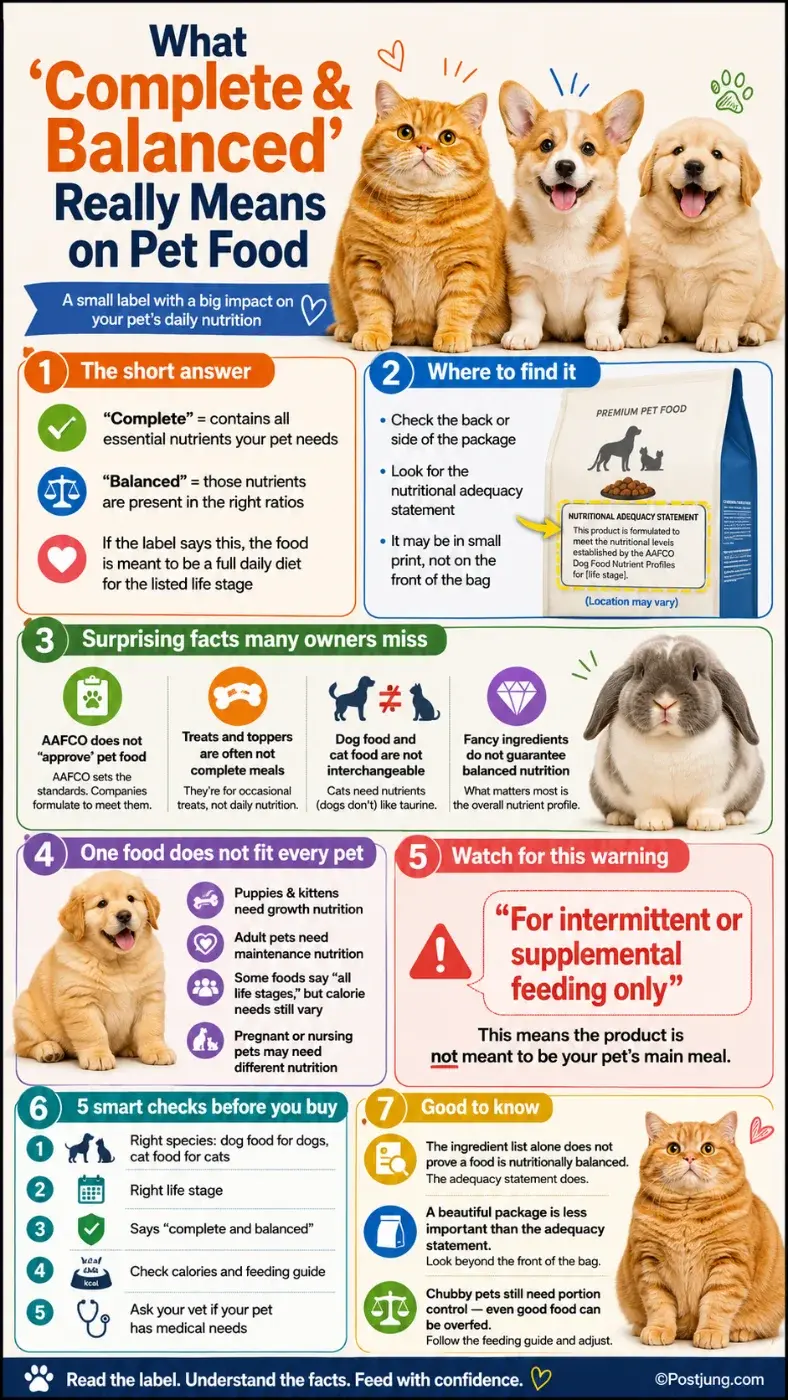
What the phrase actually means
The Association of American Feed Control Officials, better known as AAFCO, gives the simplest definition: “complete” means the food contains all required nutrients, while “balanced” means those nutrients are present in the correct ratios.
That second part is easy to overlook. A food can contain protein, fat, vitamins, and minerals, but nutrition is not just about having ingredients on a list. Dogs and cats need nutrients in the right amounts and relationships.
Calcium and phosphorus, for example, matter not only individually but also in proportion. Puppies, kittens, pregnant animals, nursing animals, and adult pets have different nutritional needs. A food that is appropriate for one life stage may not be ideal for another. The FDA notes that AAFCO nutrient profiles are organized around different life stages, including growth and reproduction and adult maintenance.
That is why owners should not stop at the front label. Words like “premium,” “natural,” “holistic,” or “real meat” may sound reassuring, but they do not replace the nutritional adequacy statement.
Where to find the important line
The nutritional adequacy statement is often easy to miss. AAFCO says it is usually found on the back or sides of the package and may appear in small print. It is considered a key part of matching a product with a pet’s nutritional needs.
A label may say the food is “formulated to meet” AAFCO dog or cat food nutrient profiles. That means the product is designed to contain the required nutrients for a stated life stage.
Another version may say animal feeding tests using AAFCO procedures show that the food provides complete and balanced nutrition. That means the food has gone through standardized feeding trial procedures for the life stage listed on the label.
Both types of statements can support a complete-and-balanced claim, but they are not identical. Tufts University’s Cummings School of Veterinary Medicine notes that, especially for growing puppies and kittens, it is ideal when products have passed AAFCO feeding trials rather than only being formulated to meet nutrient profiles.
Why “AAFCO-approved” is misleading
One common misunderstanding is the phrase “AAFCO-approved pet food.” AAFCO says plainly that it does not approve, certify, or endorse pet foods. There is no such thing as an AAFCO-approved pet food.
What AAFCO does is provide model standards, definitions, and nutrient profiles that regulators and manufacturers use. So the better question is not “Is this AAFCO approved?” It is: What does the nutritional adequacy statement actually say?
That distinction matters because a label can sound scientific without giving owners the information they need. A proper nutritional adequacy statement should tell you the species, the life stage, and whether the product is complete and balanced or intended only for limited feeding.
Treats are not the same as meals
Many pet treats, chews, toppers, and supplements are not designed to be a pet’s main food. AAFCO says products clearly identified as snacks or treats generally are not required to meet standard nutritional adequacy requirements.
If a product says “for intermittent or supplemental feeding only,” that is a warning that it is not meant to replace a complete daily diet. Tufts Petfoodology explains that foods with this type of statement do not have all the essential nutrients a healthy pet needs as a main food.
This does not mean treats are bad. It means they should stay in their lane. A training treat, dental chew, freeze-dried topper, or can of plain fish marketed for cats may be fine as an occasional extra, but it should not quietly become the bulk of a pet’s diet unless the label says it is complete and balanced for that pet’s life stage.
The ingredient list is not the whole story
Owners often start with the ingredient list, and that is understandable. It feels concrete. Chicken, salmon, rice, peas, liver, pumpkin, and blueberries are easier to understand than nutrient profiles.
But ingredients alone do not prove nutritional adequacy. A food made with appealing ingredients can still be poorly balanced, while a food with less fashionable ingredients may be nutritionally appropriate.
Tufts Petfoodology advises owners to look beyond label claims and ask manufacturers about quality control, nutrient analysis, feeding trials, research, calories, and whether the company can provide typical nutrient levels when needed.
That is especially important for pets with medical conditions, allergies, kidney disease, urinary issues, obesity, pregnancy, growth needs, or any special dietary concern. In those cases, a veterinarian or board-certified veterinary nutritionist can help interpret what a label does and does not tell you.
A simple way to shop smarter
For most owners, the practical label check can be simple.
Look for the nutritional adequacy statement. Confirm the food is for the correct species: dog food for dogs, cat food for cats. Then check the life stage. “Adult maintenance” is not the same as “growth,” and “all life stages” may not be the best fit for every pet, especially if calorie or mineral levels matter.
Then look at the feeding directions and calorie information. A food may be complete and balanced, but the amount still needs to fit the individual pet’s age, weight, activity level, body condition, and health status.
The phrase “complete and balanced” does not mean a food is perfect for every animal. It does not guarantee a pet will like it, digest it well, or thrive on it. But it does tell owners something valuable: the product is meant to provide full daily nutrition for the life stage listed on the label.
That small line of text may not be flashy. It may not be the part of the package designed to catch your eye. But for anyone trying to feed a dog or cat responsibly, it is one of the first places worth looking.
KEY TAKEAWAYS:
- “Complete” means the food contains required nutrients; “balanced” means they are in the correct ratios.
- The nutritional adequacy statement is usually more important than front-label marketing claims.
- “AAFCO-approved” is misleading because AAFCO does not approve or certify pet foods.
- Treats, toppers, and supplements may not be suitable as a pet’s main diet.
- Pets with medical needs should have diet choices reviewed by a veterinarian.
U.S. Food and Drug Administration, Association of American Feed Control Officials, Tufts University Cummings School of Veterinary Medicine, Tufts Petfoodology
REFERENCES:
https://www.fda.gov/animal-veterinary/animal-health-literacy/complete-and-balanced-pet-food
https://www.aafco.org/consumers/understanding-pet-food/reading-labels/
https://www.aafco.org/consumers/understanding-pet-food/frequently-asked-questions/
https://sites.tufts.edu/petfoodology/2017/05/31/top-five-nutrition-mistakes-pet-owners-make/

เขียนโดย Postjung Insights
 หัวลูกศรหินย้อนเวลา 80,000 ปี ในเอเชียกลาง… หลักฐานใหม่ชี้ โฮโม เซเปียนส์ อาจเคยบุกยุโรปเร็วขึ้นนับหมื่นปี!
 โรงเรียนที่มีนักเรียนมากที่สุดในไทย
 รู้หรือไม่? เปิดรายได้พนักงานส่งพัสดุของแต่ละแอป วันหนึ่งได้เท่าไร
 เปิด 5 โรงเรียนหญิงล้วนเก่าแก่ของไทย ที่มีประวัติยาวนานกว่าศตวรรษ
 ฝูงลิงญี่ปุ่นนับสิบรุมล้อมและโจมตีชายคนหนึ่งในคานากาวะ
 ตาราง “เด่นเหนือเด่นใต้” งวด 1 ต.ค. 69 เปิดข้อมูลตามโพย เลขไหนอยู่ตรงไหน
 อำเภอที่มีชื่ออำเภอสั้นที่สุด 3 อำเภอเท่านั้นในประเทศไทย
 ตึกยาวสวนกุหลาบฯ อายุเกิน 100 ปี ทำไมยังใช้เป็นห้องเรียนมาถึงวันนี้
 ถ้าไม่กลัวเหนื่อย 7 อาชีพที่ตลาดยังต้องการ และค่าทักษะไปถึง 800 บาท/วัน
 อินฟลูเอนเซอร์สาวผู้สร้างคอนเทนต์สำหรับผู้ใหญ่และมีรายได้ต่อปีกว่า 33 ล้านบาท ตัดสินใจเปลี่ยนอาชีพมาเป็นแพทย์แทน
 ส่องเลข 3 สำนักพิมพ์ งวด 1 ต.ค. 69 ตัวไหนมีข้อมูลตรงกัน
 สถิติย้อนหลัง 10 ปี ออกเลขไหนบ้างมาดูกันเปิด 5 โรงเรียนหญิงล้วนเก่าแก่ของไทย ที่มีประวัติยาวนานกว่าศตวรรษหัวลูกศรหินย้อนเวลา 80,000 ปี ในเอเชียกลาง… หลักฐานใหม่ชี้ โฮโม เซเปียนส์ อาจเคยบุกยุโรปเร็วขึ้นนับหมื่นปี!ถ้าไม่กลัวเหนื่อย 7 อาชีพที่ตลาดยังต้องการ และค่าทักษะไปถึง 800 บาท/วัน
 ทำไมแผนที่ส่วนใหญ่เอาทิศเหนือไว้ด้านบน ทั้งที่โลกไม่มี “ด้านบน” จริง ๆ?
 English Edition