Why Pet Food Labels Are So Easy to Misread

Pet food packages often look simple, but small wording changes can mean big differences in what is actually inside. Here’s how to read the label with more confidence.
Pet food labels can feel confusing because they are doing two jobs at once. They must meet labeling rules, but they are also designed to catch a shopper’s eye in a crowded aisle.
That is why two packages that both feature the word “chicken” may not contain chicken in the same way. The difference may come down to one small word on the front of the bag or can.
For pet owners, the label is not just packaging. It is one of the easiest ways to check whether a food matches a dog’s or cat’s species, life stage, and daily needs.
The front of the package can be the trickiest part
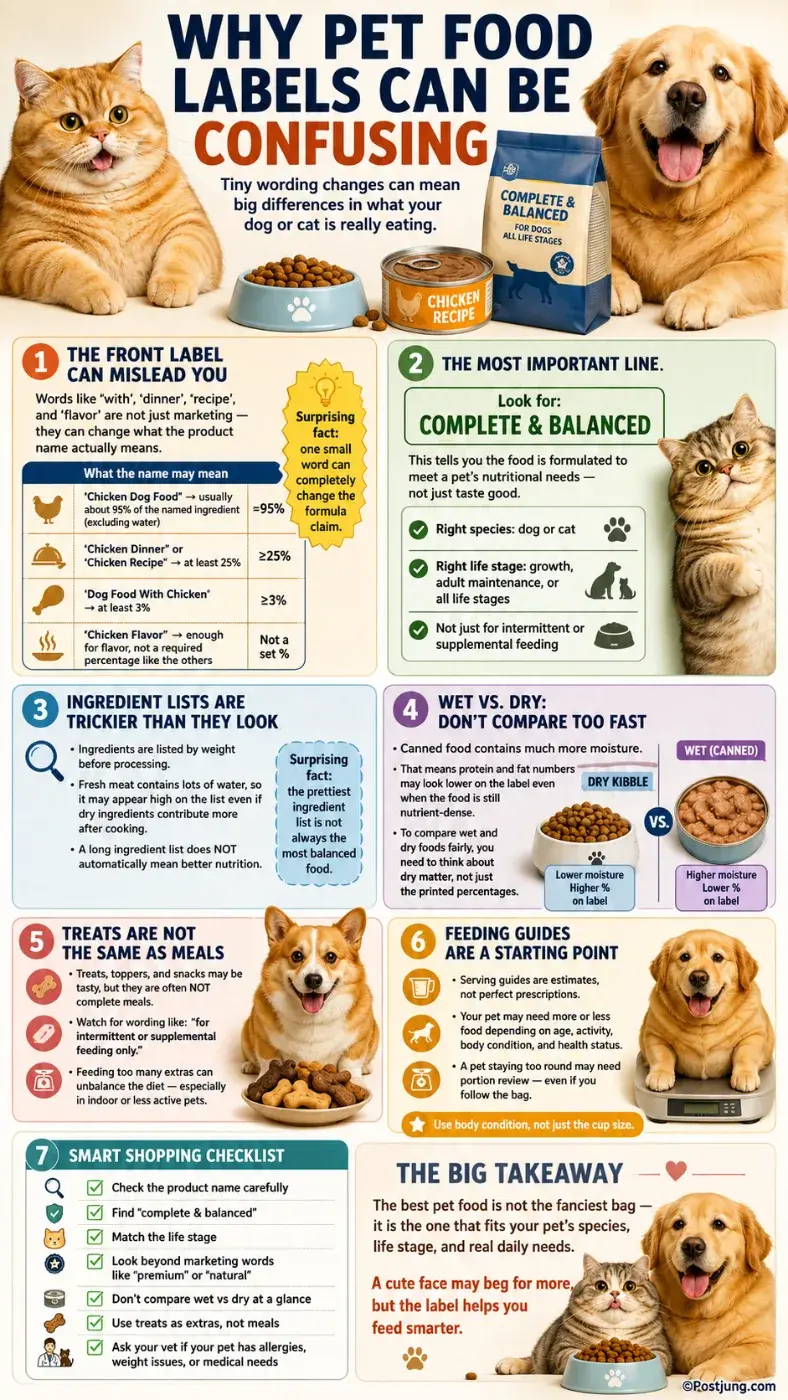
The most confusing part of a pet food label is often the product name. AAFCO, the Association of American Feed Control Officials, explains that product names follow rules that can affect how much of a named ingredient must be present. Its labeling guidance includes the 100%, 95%, 25%, “with,” and “flavor” rules.
That means “Chicken Dog Food,” “Chicken Dinner for Dogs,” “Dog Food with Chicken,” and “Chicken Flavor Dog Food” are not equal statements.
Under commonly cited AAFCO-style naming rules, a “with” claim may require only a small amount of the named ingredient, while a “flavor” claim does not promise a specific percentage of that ingredient. Virginia Cooperative Extension gives a useful example: “Cat Food With Tuna” may be easy to confuse with “Tuna Cat Food,” even though the naming rules behind those phrases are very different.
That is the first reason labels can mislead even careful shoppers: the smallest words may carry the biggest meaning.
“Complete and balanced” is more important than a pretty ingredient list
A long ingredient list can look impressive, but the nutritional adequacy statement is often more important.
AAFCO calls the nutritional adequacy statement “perhaps the most important part of a label” because it helps match a pet’s nutritional needs with the product. AAFCO also explains that “complete” means the product contains all required nutrients, while “balanced” means those nutrients are present in the right ratios.
The U.S. Food and Drug Administration says a dog or cat food can use a “complete and balanced” nutritional adequacy statement if it either meets an AAFCO nutrient profile or passes a feeding trial using AAFCO procedures. The FDA also notes that nutrient needs differ by life stage, such as growth and reproduction versus adult maintenance.
For shoppers, this matters more than many front-label phrases. A food that looks “premium” or “natural” still needs to be appropriate for the animal eating it.
A growing puppy, a nursing cat, and an older indoor dog do not all have the same nutritional needs. AAFCO lists recognized life stages including gestation/lactation, growth, maintenance, and all life stages.
Ingredients are listed by weight, but that has limits
Pet food ingredients are typically listed in descending order by weight. The FDA says federal regulations require ingredients on animal food labels to be listed by their common or usual name in descending order of predominance by weight.
That sounds simple, but it can still be hard to compare products.
Fresh meat contains moisture, so it may weigh more before processing than some dry ingredients. A meal ingredient can sound less appealing to a shopper, but it may be more concentrated after water has been removed. The ingredient list can tell you what went into the food, but it does not automatically tell you whether the final diet is nutritionally right for your pet.
That is why ingredient order is useful but not the whole story.
The guaranteed analysis is not always an easy comparison
The guaranteed analysis lists nutrient percentages such as crude protein, crude fat, crude fiber, and moisture. But comparing a wet food to a dry food by those numbers alone can be misleading.
The FDA explains that AAFCO nutrient profiles are expressed on a dry matter basis, while the guaranteed analysis on a pet food label is expressed on an “as-fed” basis, which includes moisture. Canned pet food is typically much higher in moisture than dry pet food, so meaningful comparisons between wet and dry foods require conversion to dry matter basis.
In plain English: a canned food may appear lower in protein on the label because it contains much more water. That does not automatically mean it provides less protein after adjusting for moisture.
This is one reason online arguments about “best” pet food can become messy. People may be comparing labels that are not written on the same basis.
Feeding directions are guidelines, not a perfect prescription
Most complete and balanced pet foods must include feeding directions. AAFCO says feeding directions for complete and balanced foods should specify how much food to give based on the animal’s weight and life stage, but it also notes that those directions are guidelines that may need adjustment for an individual pet.
That matters because two pets of the same weight may need different amounts of food. Activity level, age, body condition, health status, and whether a pet is spayed or neutered can all affect daily calorie needs.
A label can give a starting point. Your pet’s body condition tells you whether that starting point is working.
Treats and supplements are not always full meals
Another common source of confusion is the difference between food, treats, and supplements.
AAFCO explains that treats are usually not intended to provide a complete and balanced diet. Products labeled as treats, snacks, supplements, or “for intermittent or supplemental feeding only” should not be treated like daily complete meals unless they also carry the correct nutritional adequacy information.
This is especially important for picky eaters. A pet may love a topper, broth, treat, or single-ingredient product, but that does not mean it can replace a balanced diet.
The key phrase to watch for is “intermittent or supplemental feeding only.”
Labels may slowly become easier to read
There is some good news for U.S. shoppers. AAFCO approved new model pet food and specialty pet food labeling guidelines in 2023, describing them as the first major update in more than 40 years. The changes include standardized nutrition information, clearer ingredient statements, and storage and handling instructions.
AAFCO’s Pet Food Label Modernization project says the goal is to make labeling more transparent, easier to understand, and closer to a format consumers already recognize from human food labels. Because states have their own rulemaking processes, AAFCO recommends a six-year transition period for manufacturers to incorporate the changes.
So labels may not change everywhere overnight. But the direction is clear: pet owners want information that is easier to use.
The smartest way to read a pet food label
A good label check does not start with the biggest marketing words. It starts with a few practical questions.
Is the food made for the right species — dog or cat? Is it complete and balanced for the right life stage? Is it a full diet, a treat, or a supplement? Do the feeding directions make sense for your pet’s size and condition? Are you comparing wet and dry foods fairly?
For pets with allergies, chronic illness, weight problems, digestive issues, or special medical needs, the label is only a starting point. A veterinarian can help interpret whether a food is appropriate for that specific animal.
Pet food labels are confusing because they mix regulation, nutrition, and marketing in a very small space. But once you know where to look, the package becomes less like a sales pitch and more like a map.
The goal is not to find the fanciest bag. It is to find the food that fits the pet in front of you.
KEY TAKEAWAYS:
- Small words such as “with,” “dinner,” and “flavor” can change what a pet food name actually means.
- The nutritional adequacy statement is one of the most important parts of the label.
- Wet and dry foods cannot always be compared directly using the guaranteed analysis.
- Treats, toppers, and supplements are not necessarily complete meals.
- Feeding directions are useful starting points, but individual pets may need adjustments.
U.S. Food and Drug Administration, Association of American Feed Control Officials, Virginia Cooperative Extension
REFERENCES:
https://www.fda.gov/animal-veterinary/animal-health-literacy/complete-and-balanced-pet-food
https://www.fda.gov/animal-veterinary/animal-foods-feeds/animal-food-labeling-and-pet-food-claims
https://www.aafco.org/consumers/understanding-pet-food/reading-labels/
https://www.aafco.org/pflm/

เขียนโดย Postjung Insights
 อำเภอที่มีชื่ออำเภอสั้นที่สุด 3 อำเภอเท่านั้นในประเทศไทย
 MRT เตาปูนกลับมาเปิดปกติแล้ว รมช.คมนาคมเผยปมไฟไหม้ พบประกายไฟจากชุดสายไฟ 750 โวลต์
 รมว.วัฒนธรรมเอาจริง! จ่อส่งหนังสือทักท้วง Miss Universe Cambodia ปมใช้ภาพหญิงกำแพงเพชร หากไม่แก้ เตรียมใช้กฎหมาย
 โรงเรียนที่มีนักเรียนมากที่สุดในไทย
 รู้หรือไม่? เปิดรายได้พนักงานส่งพัสดุของแต่ละแอป วันหนึ่งได้เท่าไร
 ตาราง “เด่นเหนือเด่นใต้” งวด 1 ต.ค. 69 เปิดข้อมูลตามโพย เลขไหนอยู่ตรงไหน
 ดูหนัง–ซีรีส์ฟรีอาจไม่ฟรีอย่างที่คิด! เปิดโทษละเมิดลิขสิทธิ์ เตือนคนปล่อยคอนเทนต์เถื่อน เสี่ยงทั้งคุกทั้งปรับ
 แมคาเดเมีย (Macadamia): ราชินีแห่งถั่ว กับขุมทรัพย์โภชนาการจากออสเตรเลีย
 แมงป่อง: แมลงนักล่าสายพันธุ์โบราณของโลก ที่ยังคงอยู่มาจนถึงปัจจุบัน
 5 คณะที่เรียนจบมาแล้ว มีอาชีพรองรับมากกว่าที่คิด
 เปิด 5 โรงเรียนหญิงล้วนเก่าแก่ของไทย ที่มีประวัติยาวนานกว่าศตวรรษ
 สถิติย้อนหลัง 10 ปี ออกเลขไหนบ้างมาดูกัน
 English Edition