Why a Simple Ramp Can Make Life Easier for Senior Dogs

For many older dogs, the hardest movements are not long walks but everyday jumps onto beds, couches, and cars. A ramp can make those moments safer, calmer, and easier on aging joints.
Older dogs often do not announce pain loudly. They may simply hesitate before climbing into the car, stop jumping onto the couch, or look at the bed as if it has suddenly become too high.
That is where a simple ramp can help. It is not a cure for arthritis or aging, but it can reduce the daily strain that comes from jumping, slipping, and scrambling up surfaces that used to feel easy.
For senior dogs, comfort is often built through small changes. A ramp is one of the most practical.
The problem is not always the walk
Many owners notice when a senior dog slows down on a walk. Fewer people notice the small, repeated movements that may be harder on an aging body: jumping off a bed, climbing into an SUV, landing on slick floors, or twisting to get onto a couch.
Cornell University’s veterinary guidance lists difficulty navigating stairs or jumping onto couches among the signs that may appear with canine osteoarthritis, along with stiffness, lameness, lower activity, and trouble getting up from lying down.
That matters because a dog may still seem cheerful, hungry, and eager for attention while quietly changing how they move. A senior dog may hide discomfort by avoiding certain movements rather than crying out.
A ramp gives the dog another option. Instead of launching up or landing hard, the dog can walk at a controlled angle.
Why jumping down can be harder than it looks
Jumping up takes effort. Jumping down adds impact.
For a young, strong dog, that impact may not look dramatic. For an older dog with stiff joints, weaker muscles, arthritis, back problems, or reduced balance, the same movement can become stressful.
Canine Arthritis Resources and Education notes that jumping down from a bed or out of an SUV puts force on the front limbs and recommends ramps or stairs to help dogs, especially when getting down or out.
That is one of the most overlooked reasons ramps are useful. Owners often think about helping a dog get up, but the landing may be the bigger issue.
Beds, couches, and cars are the common trouble spots. A dog may still manage them, but managing is not the same as moving comfortably.
Ramps are part of a bigger mobility plan
A ramp works best when it is treated as one piece of senior-dog care, not the whole solution.
The American Animal Hospital Association lists lifestyle modifications such as pet ramps or stairs, non-slip floors, orthopedic bedding, and harnesses or slings as possible support for mobility-compromised older pets. It also notes that aging pets are more likely to experience pain from arthritis, dental issues, or chronic disease.
That broader view is important. If a dog is sliding across hardwood floors, a ramp alone may not be enough. If the dog is limping, falling, or suddenly refusing stairs, the next step should be a veterinary check, not just buying new equipment.
A ramp can make life easier, but it should not be used to ignore worsening pain.
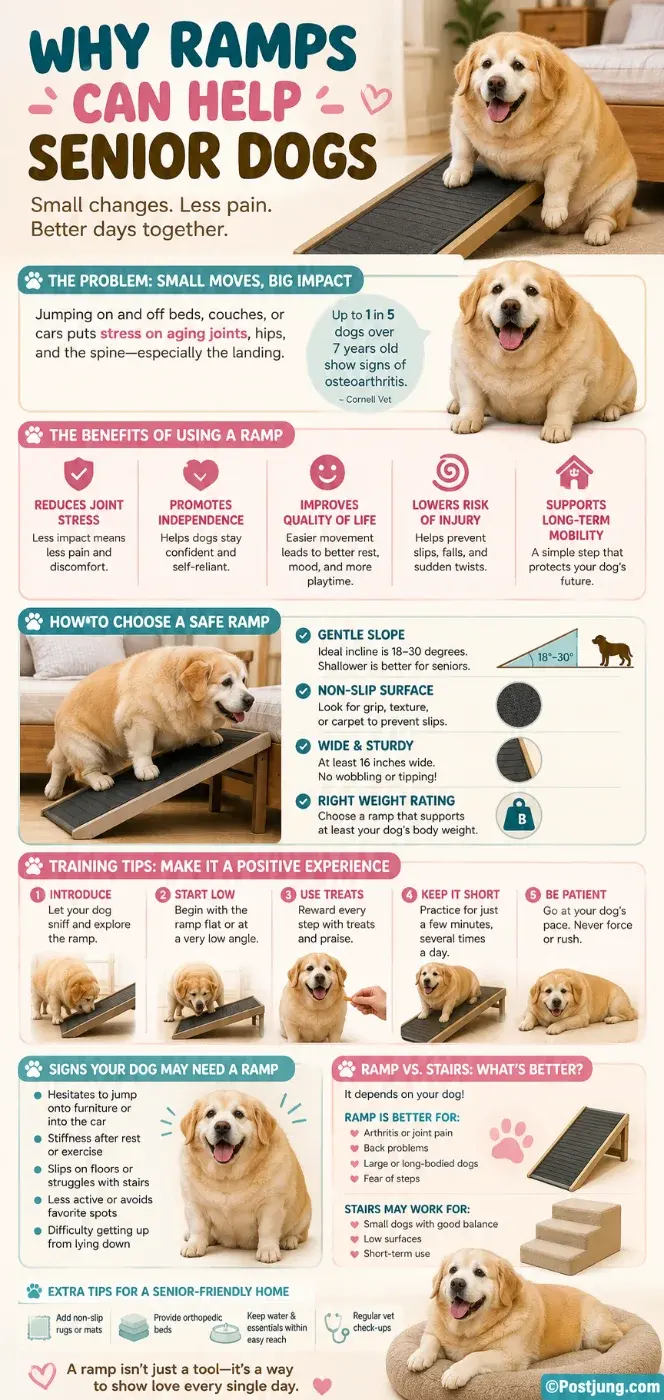
What makes a ramp safer
Not every ramp is equally helpful. A ramp that is too steep, too narrow, slippery, or wobbly may frighten a dog or create a new fall risk.
For senior dogs, the safest ramp usually has a gentle slope, a non-slip surface, enough width for the dog to feel secure, and a sturdy base. The American Kennel Club also advises checking that a ramp is rated for the dog’s weight and choosing a lightweight design if it needs to be moved for travel.
A good ramp should feel boring in the best way: stable, predictable, and easy to understand.
The surface matters more than many people expect. Carpet-like texture, rubber grip, or traction strips can help. A slick plastic ramp may look convenient but feel unsafe under a dog’s paws.
Width matters too. A small dog may accept a narrower ramp, while a large dog may need extra space to walk without feeling trapped.
Training matters more than forcing
Some dogs understand a ramp quickly. Others see it as a strange new object in their territory.
The best approach is calm and gradual. Let the dog sniff it. Place it flat or at a very low angle first if possible. Use treats, praise, and short practice sessions. Keep the experience positive.
Do not drag, push, or scold a dog into using it. That can create fear and make the ramp feel like a threat.
For many senior dogs, confidence is part of mobility. A ramp only helps if the dog trusts it.
Placing the ramp against a stable surface can also help. If there is a wall, couch side, or other boundary on one side, some dogs feel more secure because they are less likely to step off too early.
Ramps, stairs, or both?
Pet stairs can help some older dogs, especially smaller dogs that still have good balance and coordination. But ramps are often gentler for dogs with arthritis, back concerns, weakness, or fear of steps.
The choice depends on the dog’s size, diagnosis, confidence, home layout, and the height of the surface.
A ramp may be better for a dog that struggles with stairs, has a long back, has rear-limb weakness, or needs help getting into a car. Stairs may be enough for a small, agile dog that only needs help reaching a low couch.
The goal is not to make the house look pet-friendly. The goal is to reduce avoidable strain in the places where the dog moves every day.
The small change that protects routine
For many dogs, aging is not about one dramatic moment. It is a slow collection of small changes.
The couch becomes harder. The car becomes intimidating. The favorite sleeping spot feels out of reach. The dog starts waiting to be lifted or simply stops trying.
A ramp can protect those routines. It lets a senior dog stay close to family, keep familiar habits, and move with more independence.
That emotional piece matters. Dogs are creatures of routine. When movement becomes difficult, they may lose access not just to furniture, but to comfort, closeness, and confidence.
A ramp will not make an old dog young again. But it can make ordinary moments less painful, less risky, and less frustrating.
For a senior dog, that is a meaningful gift.
Owners should speak with a veterinarian if their dog shows limping, stiffness, sudden reluctance to jump, difficulty rising, slipping, or behavior changes. Mobility changes deserve attention, especially when they appear suddenly or worsen over time.
KEY TAKEAWAYS:
- Ramps can reduce the strain of jumping onto or down from beds, couches, and cars.
- Senior dogs may show discomfort by hesitating, avoiding movement, or changing habits rather than crying out.
- A safe ramp should be stable, wide enough, gently sloped, non-slip, and rated for the dog’s weight.
- Ramps work best alongside other support, such as non-slip flooring, orthopedic bedding, and veterinary care.
- A ramp is helpful only when the dog is trained calmly and trusts using it.
American Animal Hospital Association, Cornell University College of Veterinary Medicine, American Kennel Club, Canine Arthritis Resources and Education
REFERENCES:
https://www.aaha.org/resources/supporting-your-senior-pet-veterinary-care-recommendations/
https://www.vet.cornell.edu/departments-centers-and-institutes/riney-canine-health-center/canine-health-topics/osteoarthritis
https://www.akc.org/expert-advice/health/making-home-accessible-for-senior-dog/
https://caninearthritis.org/article/lifestyle-modifications/

เขียนโดย Postjung Insights
 รู้หรือไม่? เปิดรายได้พนักงานส่งพัสดุของแต่ละแอป วันหนึ่งได้เท่าไร
 ดูหนัง–ซีรีส์ฟรีอาจไม่ฟรีอย่างที่คิด! เปิดโทษละเมิดลิขสิทธิ์ เตือนคนปล่อยคอนเทนต์เถื่อน เสี่ยงทั้งคุกทั้งปรับ
 MRT เตาปูนกลับมาเปิดปกติแล้ว รมช.คมนาคมเผยปมไฟไหม้ พบประกายไฟจากชุดสายไฟ 750 โวลต์
 อำเภอที่มีชื่ออำเภอสั้นที่สุด 3 อำเภอเท่านั้นในประเทศไทย
 แมคาเดเมีย (Macadamia): ราชินีแห่งถั่ว กับขุมทรัพย์โภชนาการจากออสเตรเลีย
 รมว.วัฒนธรรมเอาจริง! จ่อส่งหนังสือทักท้วง Miss Universe Cambodia ปมใช้ภาพหญิงกำแพงเพชร หากไม่แก้ เตรียมใช้กฎหมาย
 แมงป่อง: แมลงนักล่าสายพันธุ์โบราณของโลก ที่ยังคงอยู่มาจนถึงปัจจุบัน
 5 คณะที่เรียนจบมาแล้ว มีอาชีพรองรับมากกว่าที่คิด
 เปิด 5 โรงเรียนหญิงล้วนเก่าแก่ของไทย ที่มีประวัติยาวนานกว่าศตวรรษ
 มัดรวมจับเลขชน สัตว์นำโชค 1 ตุลาคม 2569
 โรงเรียนที่มีนักเรียนมากที่สุดในไทย
 งูมัลกา (Mulga Snake): นักล่าแห่งผืนดินแห้งแล้ง ของทวีปออสเตรเลีย กับฉายา King Brown กัดคนได้ถึงตาย
 English Edition