Why Some Cats Are Better Off Staying Home
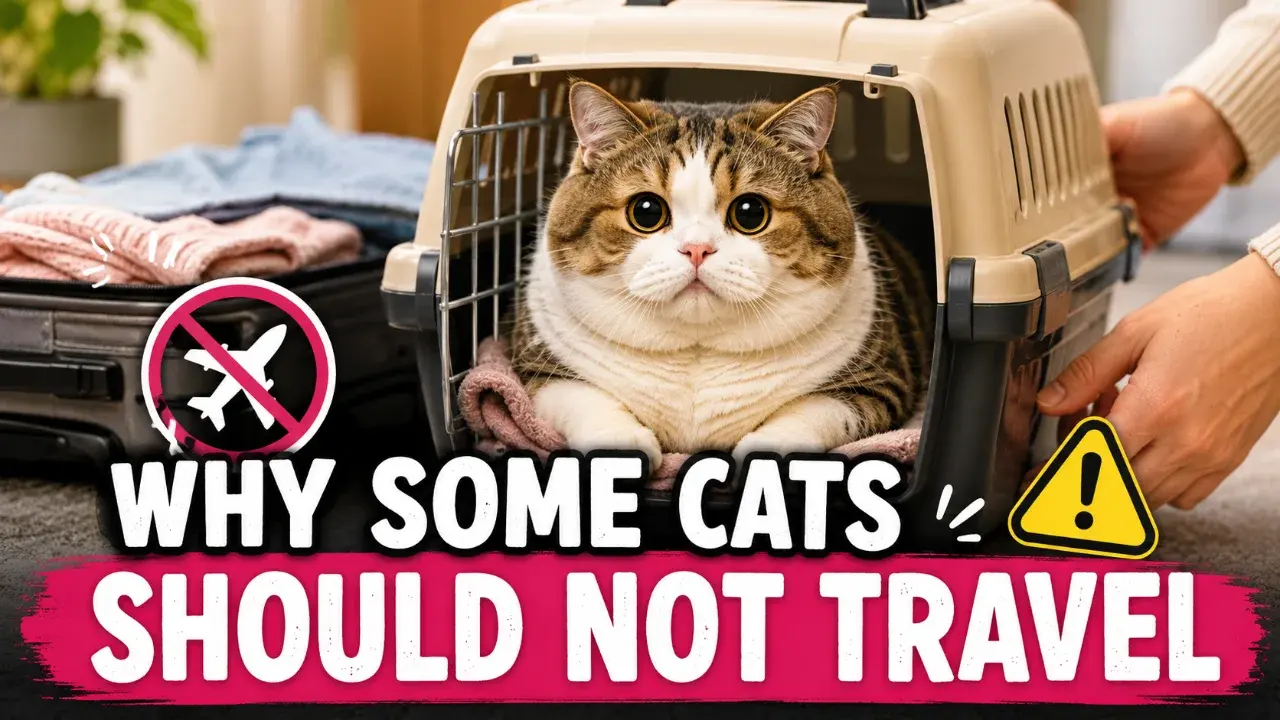
Travel can be stressful for almost any cat, but for some, it can create real health and safety concerns. Here is how to know when staying home may be the kinder choice.
For many cats, travel is not an adventure. It is a loud, unfamiliar, fast-moving disruption that can turn a calm pet into a frightened one within minutes.
That does not mean cats can never travel. Some cats handle car rides, moves, and even flights with careful preparation. But for others, especially cats with health problems or high stress responses, the safest trip may be no trip at all.
Veterinary and public health guidance repeatedly points to the same basic idea: pet travel should be planned around the animal’s health, temperament, destination rules, and transportation risks — not just the owner’s schedule. The CDC notes that travel conditions may contribute to medical complications in certain animals, especially older pets with chronic health conditions, very young animals, and short-nosed breeds such as Persian cats.
Some cats are not good travel candidates
A healthy, relaxed adult cat may be able to manage a short, well-planned trip. A fragile cat may not.
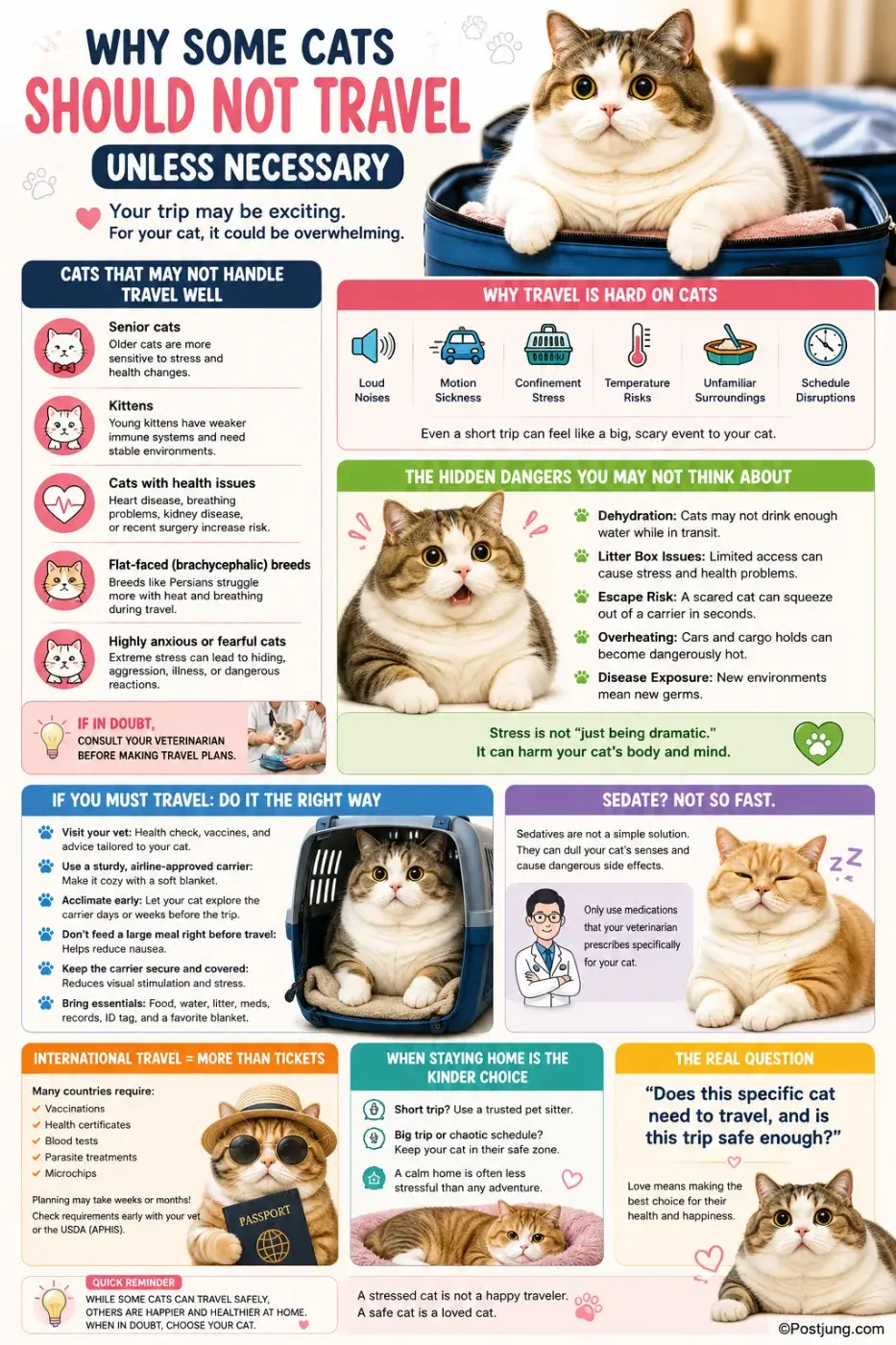
Cats that deserve extra caution include senior cats, kittens, cats recovering from illness or surgery, cats with heart or breathing problems, cats with severe anxiety, and flat-faced breeds such as Persians. These cats may be less able to cope with heat, confinement, motion, noise, schedule changes, or long periods without easy access to food, water, and a litter box.
This is especially important for air travel. Flying can be efficient for people, but pets face a very different experience: unfamiliar handling, security checks, airport noise, cabin or cargo restrictions, delays, temperature concerns, and limited owner control once the trip begins.
The FDA advises pet owners to check with a veterinarian before air travel to make sure a pet is fit to fly and to review airline policies, carrier rules, and how pets are handled from departure to arrival.
Stress is not “just being dramatic”
Cats are often creatures of territory and routine. A dog may associate a car ride with the park. A cat may associate the carrier with the veterinarian.
That difference matters.
Travel stress can show up as hiding, drooling, panting, vomiting, urinating in the carrier, refusing food, vocalizing, freezing, or trying to escape. A cat that looks “quiet” may not be calm; some frightened cats shut down rather than struggle.
This is why a quiet cat is not always a comfortable cat.
Carrier safety is also a real issue. Cat Friendly Homes, a cat-care education site connected with feline veterinary guidance, recommends transporting cats in carriers, covering the carrier during travel to reduce visual stimulation, and carrying the carrier securely so the cat feels safer.
The AAFP/ISFM feline handling guidelines also note that a carrier should be secured during travel, because a moving carrier can frighten the cat.
Sedation is not a shortcut
Many owners wonder whether a nervous cat can simply be sedated for travel. That question should always go through a veterinarian.
The FDA warns that sedatives can dull a pet’s senses and reduce the animal’s ability to react to its environment, which may be dangerous in an emergency. It advises owners to talk with a veterinarian before a trip if they believe a sedative is needed.
This does not mean medication is never used. Veterinarians may recommend anti-nausea or anti-anxiety support for certain cats. But the key point is that travel medication should be individualized, not guessed from online advice or borrowed from another pet.
A cat with breathing problems, heart disease, extreme fear, or previous bad reactions to medication needs special caution.
Paperwork can be harder than owners expect
For international trips, the question is not only “Can my cat handle this?” It is also “Will my cat be allowed to enter?”
USDA APHIS says pet owners traveling from the United States to another country should contact a USDA-accredited veterinarian as soon as they decide to travel, because destination requirements may include vaccinations, tests, treatments, and an endorsed health certificate.
The CDC also notes that some countries’ requirements can require months of planning, and that requirements may include updated vaccinations, parasite treatments, microchips, or blood testing depending on the destination.
For American readers, this is similar to the difference between packing for a weekend and preparing official travel documents. A pet is not just luggage. A cat may need its own timeline, records, medical review, and destination-specific approval.
When staying home is kinder
The hardest part is emotional. Owners often want to bring their cats because they love them. But love does not always mean bringing them along.
If the trip is short, optional, crowded, hot, chaotic, or full of moving between hotels, the better choice may be a trusted sitter, a quiet boarding facility, or care from a family member who understands the cat’s routine.
This is especially true for cats that panic in carriers, cats with unstable health, and cats that do poorly with changes in environment. A familiar home with food, water, litter, hiding spots, and a reliable caregiver can be far less stressful than a “fun” trip the cat never asked to take.
If travel is unavoidable, such as during a move, preparation should start early. Let the cat explore the carrier before travel day. Add a familiar blanket. Practice very short car exposure if your veterinarian agrees. Keep the carrier secure. Do not open it during roadside breaks. Bring medical records, medication, food, water, identification, and emergency vet contacts.
The FDA specifically advises keeping cats in carriers during travel stops to reduce the risk of escape.
The real question owners should ask
The question is not “Can cats travel?”
Many can.
The better question is: Does this specific cat need to travel, and is this specific trip safe enough?
For a confident, healthy cat, careful travel may be manageable. For a senior Persian with breathing issues, a kitten without completed veterinary planning, or a cat that panics in a carrier, the kindest decision may be to leave the suitcase for the humans.
A veterinarian can help owners judge the risks based on the cat’s health, age, temperament, destination, and method of travel. That conversation is worth having before tickets are booked, not after the carrier is already by the door.
KEY TAKEAWAYS:
- Some cats should avoid travel unless it is truly necessary, especially if they are older, very young, chronically ill, highly anxious, or short-nosed.
- Stress during travel can affect cats physically and behaviorally.
- Sedatives should only be discussed with and approved by a veterinarian.
- International and interstate travel may require health certificates, vaccines, microchips, tests, or other paperwork.
- For many cats, a trusted sitter or calm home care may be safer than a disruptive trip.
CDC, FDA, USDA APHIS, Cat Friendly Homes, AAFP/ISFM
REFERENCES:
https://www.cdc.gov/yellow-book/hcp/family-travel/traveling-with-pets-and-service-animals.html
https://www.fda.gov/animal-veterinary/animal-health-literacy/travel-training-you-and-your-pets
https://www.aphis.usda.gov/pet-travel
https://catfriendly.com/be-a-cat-friendly-caregiver/getting-cat-veterinarian/

เขียนโดย Postjung Insights
 อำเภอที่มีชื่ออำเภอสั้นที่สุด 3 อำเภอเท่านั้นในประเทศไทย
 ดูหนัง–ซีรีส์ฟรีอาจไม่ฟรีอย่างที่คิด! เปิดโทษละเมิดลิขสิทธิ์ เตือนคนปล่อยคอนเทนต์เถื่อน เสี่ยงทั้งคุกทั้งปรับ
 โรงเรียนที่มีนักเรียนมากที่สุดในไทย
 รมว.วัฒนธรรมเอาจริง! จ่อส่งหนังสือทักท้วง Miss Universe Cambodia ปมใช้ภาพหญิงกำแพงเพชร หากไม่แก้ เตรียมใช้กฎหมาย
 รู้หรือไม่? เปิดรายได้พนักงานส่งพัสดุของแต่ละแอป วันหนึ่งได้เท่าไร
 5 คณะที่เรียนจบมาแล้ว มีอาชีพรองรับมากกว่าที่คิด
 แมคาเดเมีย (Macadamia): ราชินีแห่งถั่ว กับขุมทรัพย์โภชนาการจากออสเตรเลีย
 สถิติย้อนหลัง 10 ปี ออกเลขไหนบ้างมาดูกัน
 เปิดหลักฐานเก่า 120 ปี ปมภาพหญิงเมืองกำแพงเพชร โผล่เวที Miss Universe Cambodia 2026
 MRT เตาปูนกลับมาเปิดปกติแล้ว รมช.คมนาคมเผยปมไฟไหม้ พบประกายไฟจากชุดสายไฟ 750 โวลต์
 มัดรวมจับเลขชน สัตว์นำโชค 1 ตุลาคม 2569
 วงแหวนแฟร์รี่ (Fairy Circles): ปริศนาวงกลมกลางทะเลทราย ที่เรายังต้องหาคำตอบกันต่อไป...
 English Edition