Why Balcony Safety Matters More Than Many Pet Owners Realize

A balcony can feel like the easiest way to give an indoor pet fresh air. But for cats, dogs, and small animals, a few overlooked details can turn that space into a serious safety risk.
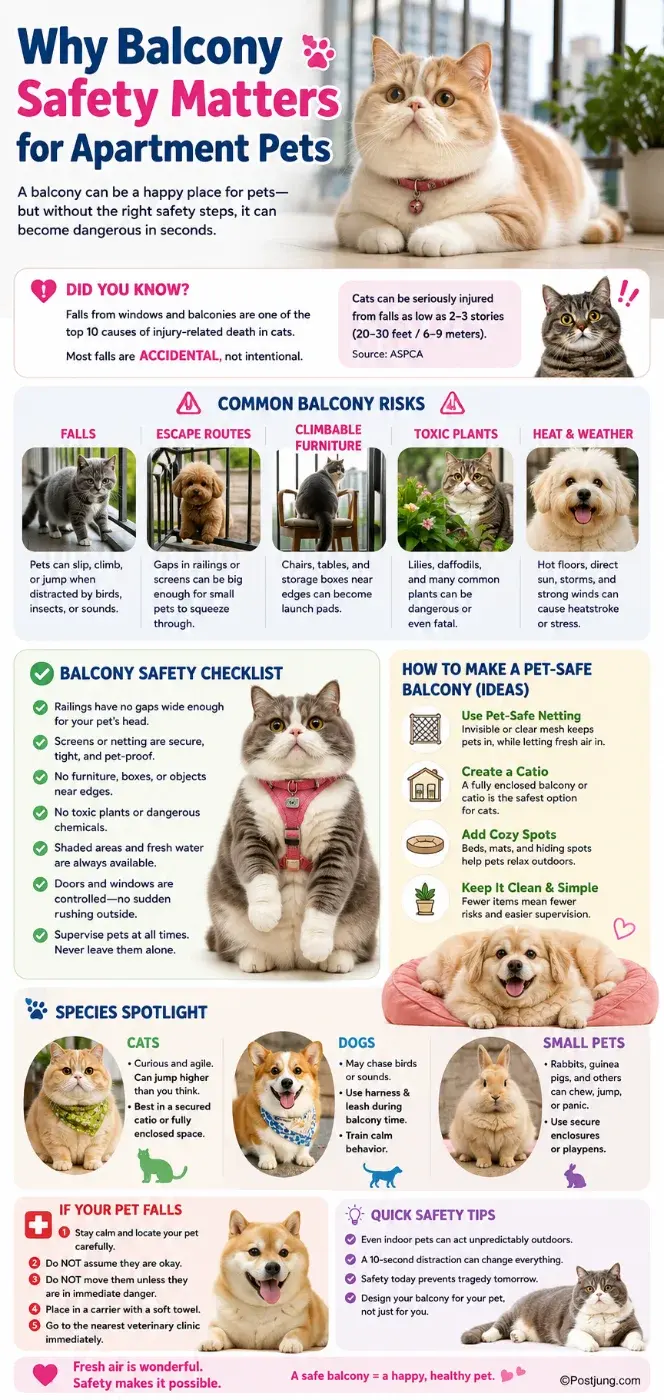
A balcony can feel like a small gift for an apartment pet: fresh air, sunlight, passing birds, street sounds, and a little change of scenery. But for cats, dogs, rabbits, and other companion animals, that same space can become dangerous in seconds if it is not secured properly.
The risk is not only dramatic falls from high-rise buildings. It can also be loose screens, climbable furniture, toxic plants, hot surfaces, narrow railings, or a pet suddenly chasing something before an owner can react. Animal welfare groups and veterinary sources repeatedly warn that open windows and balconies can lead to serious injuries, especially for cats.
For people living in apartments, condos, or high-rise buildings, balcony safety is not about being overprotective. It is about understanding that pets do not judge height like humans do.
The danger is often accidental, not reckless
One common misunderstanding is that pets “know better” than to fall. Cats, in particular, are often described as careful climbers with excellent balance. That reputation can make owners underestimate the risk.
The ASPCA notes that cats usually do not deliberately jump from dangerous heights. Many falls happen accidentally when a cat is distracted by a bird, insect, another animal, or movement outside. A narrow ledge, slippery surface, or poor grip can be enough to change the situation quickly.
This is why the term “high-rise syndrome” exists. It refers to injuries pets suffer after falling from windows, balconies, terraces, or similar elevated spaces. These injuries can include broken limbs, jaw trauma, lung injuries, pelvic fractures, and in some cases death.
Dogs are not immune either. Smaller dogs may squeeze through gaps, while larger dogs can jump, lean, or climb onto furniture near a railing. PetMD’s veterinary-reviewed guidance points out that both cats and dogs can fall from balconies, with cats more commonly associated with the risk.
A screen is not always a safety system
Many apartment residents feel safer if there is a window screen, balcony mesh, or childproof guard. That may help, but only if it is designed and installed for pet safety.
The ASPCA specifically warns that childproof window guards should not be treated as pet protection because cats and small dogs may still slip through them. It recommends snug, sturdy screens for windows and checking that adjustable screens are tightly fitted.
For balconies, Blue Cross advises that cats should only use a balcony if it is completely cat-proof, noting that cats can squeeze or climb through surprisingly small gaps. The group recommends professionally installed “catio” style protection for cats when possible.
The key point is simple: a barrier must match the animal, not just the building. A rail gap that looks narrow to a person may be wide enough for a kitten, a small dog, or a curious rabbit. A mesh panel that looks secure may still be weak if it can be pushed loose from the frame.
Balcony setup matters more than owners think
Even when the railing seems safe, the objects on the balcony can create new risks.
A chair, storage box, plant stand, or low table near the edge can become a launch point. A cat may jump onto it for a better view. A dog may climb up to follow a sound. A rabbit may hop higher than expected. Blue Cross and PetMD both advise moving furniture away from balcony edges so pets cannot use it to reach or clear a railing.
Plants are another overlooked issue. Balcony gardens often contain ornamental plants that may be unsafe for pets. Blue Cross specifically mentions lilies and daffodils as examples of plants that can be toxic to pets, while the ASPCA maintains toxic and non-toxic plant lists for cats and other animals.
For cat owners, lilies deserve extra caution. Many veterinary and animal welfare sources treat lilies as a serious risk for cats, including exposure through pollen. A balcony with fresh air and plants may look peaceful, but pet-safe plants should be checked before decorating.
Heat is another practical concern. A balcony floor can become much hotter than indoor tile or wood, especially in direct sun. Metal railings, artificial turf, and dark flooring can heat up quickly. Pets also need shade, fresh water, and a way back inside. Blue Cross recommends ensuring pets have shade and access to clean water when outside.
Supervision is not the same as prevention
Watching a pet on the balcony is important, but supervision alone is not enough. Accidents can happen faster than a person can stand up, open a door, or reach across a railing.
A safer approach starts before the pet goes outside:
Check every gap at railings, floor edges, and corners. Make sure screens or netting are secure and cannot be pushed loose. Move chairs, boxes, plant stands, and tables away from the railing. Remove toxic plants and chemicals. Avoid grills, hot surfaces, and dangling cords. Keep doors controlled so the pet cannot rush outside without you.
For dogs, a harness and leash may be useful during early balcony visits, especially if the dog is excitable or unfamiliar with the space. PetMD notes that keeping a pet in a harness or on a leash can help prevent sudden movement toward birds or squirrels.
For cats, a fully enclosed catio or professionally installed balcony protection is usually safer than relying on training or trust. Cats are agile, but agility does not make a ledge safe.
For rabbits, guinea pigs, and other small pets, an outdoor run or secure enclosure may be safer than free access to a balcony. Small animals can chew, squeeze, jump, panic, or overheat, so shade and containment matter.
What to do if a pet falls
If a pet falls from a balcony or window, do not assume the animal is fine just because it stands up or walks. Internal injuries, shock, lung trauma, and fractures may not be obvious immediately.
The ASPCA advises locating a fallen cat and taking the animal to an animal hospital or veterinarian promptly. Veterinary first-aid guidance also emphasizes careful handling because injured pets may be scared, painful, and unpredictable.
Use a carrier, towel, or blanket to limit movement if possible, and contact a veterinarian or emergency clinic right away. This is not a situation where an owner should wait to see whether symptoms develop.
The safest balcony is one designed around real pet behavior
Balcony safety matters because pets are curious, reactive, and sometimes unpredictable. A cat may chase a bird. A dog may lean through a gap. A rabbit may chew something unsafe. A calm indoor pet may behave differently outdoors when surrounded by sound, wind, smells, and movement.
That does not mean apartment pets can never enjoy balcony time. It means the balcony should be treated like a controlled pet area, not just an outdoor room.
The best setup is one where fresh air does not depend on luck: secure barriers, safe plants, no climbable furniture near edges, shade, water, supervision, and a clear path back indoors.
For apartment pet owners, balcony safety is a daily design choice. The goal is not to remove every small pleasure from a pet’s life. It is to make sure a few minutes of fresh air never becomes an emergency.
KEY TAKEAWAYS:
- Balconies can pose serious risks for cats, dogs, and small pets, especially in apartments and high-rise buildings.
- Many falls are accidental and happen when pets are distracted by birds, insects, movement, or sounds.
- Childproof guards, loose screens, and ordinary balcony railings may not be enough to protect pets.
- Furniture, toxic plants, heat, grills, chemicals, and rail gaps should all be checked before pets go outside.
- A fallen pet should be taken to a veterinarian or emergency animal hospital even if injuries are not immediately obvious.
ASPCA, Blue Cross, PetMD, AVMA
REFERENCES:
https://www.aspca.org/news/high-rise-syndrome-lifesaving-tips-cat-parents
https://www.bluecross.org.uk/advice/cat/health-and-injuries/how-to-keep-pets-safe-on-balconies
https://www.petmd.com/dog/general-health/balcony-safety-and-pets-how-avoid-high-rise-risks
https://www.avma.org/resources-tools/pet-owners/emergencycare/first-aid-tips-pet-owners

เขียนโดย Postjung Insights
 รู้หรือไม่? เปิดรายได้พนักงานส่งพัสดุของแต่ละแอป วันหนึ่งได้เท่าไร
 5 คณะที่เรียนจบมาแล้ว มีอาชีพรองรับมากกว่าที่คิด
 เปิดรายชื่อโรงเรียนในไทยที่ “ว่ายน้ำ” อยู่ในหลักสูตร เรียนจริงตั้งแต่อนุบาลถึงมัธยม
 โรงเรียนที่มีนักเรียนมากที่สุดในไทย
 อำเภอที่มีชื่ออำเภอสั้นที่สุด 3 อำเภอเท่านั้นในประเทศไทย
 จุฬาฯ มหาวิทยาลัยแห่งแรกของไทย มีจุดเริ่มต้นในสมัยรัชกาลที่ 5
 Google ยอมรับแล้ว! Gemini AI เข้าถึงระบบบริษัทจริง 3 แห่ง ระหว่างการทดสอบความปลอดภัย
 ตาราง “เด่นเหนือเด่นใต้” งวด 1 ต.ค. 69 เปิดข้อมูลตามโพย เลขไหนอยู่ตรงไหน
 สถิติย้อนหลัง 10 ปี ออกเลขไหนบ้างมาดูกัน
 ทำไมของพลาสติกเก่าบางชิ้นถึง “เหนียว” ขึ้นมาเอง ทั้งที่ไม่ได้เปื้อนอะไร?
 ส่องเลข 3 สำนักพิมพ์ งวด 1 ต.ค. 69 ตัวไหนมีข้อมูลตรงกัน
 เลขเด็ดปฏิทิน "หลวงปู่โต๊ะ" งวดวันที่ 1 ตุลาคม 69..ส่องเลย เลขไหนให้โชค!
 😃 ชวนเข้ามาดูกันอีกกับคนที่มีร่างกายพิเศษจนเหมือนมีกล่องสมบัติที่หายาก 😯5 คณะที่เรียนจบมาแล้ว มีอาชีพรองรับมากกว่าที่คิดเปิดรายชื่อโรงเรียนในไทยที่ “ว่ายน้ำ” อยู่ในหลักสูตร เรียนจริงตั้งแต่อนุบาลถึงมัธยมGoogle ยอมรับแล้ว! Gemini AI เข้าถึงระบบบริษัทจริง 3 แห่ง ระหว่างการทดสอบความปลอดภัยเลขเด็ดปฏิทิน "หลวงปู่โต๊ะ" งวดวันที่ 1 ตุลาคม 69..ส่องเลย เลขไหนให้โชค!ทำไมของพลาสติกเก่าบางชิ้นถึง “เหนียว” ขึ้นมาเอง ทั้งที่ไม่ได้เปื้อนอะไร?
 English Edition