Flying With a Dog: What Owners Should Check Before Booking
A dog-friendly trip can still go wrong if owners miss airline limits, health paperwork, carrier rules, or destination requirements. Here is what to check before booking a flight with your pet.
Flying with a dog can sound simple until the rules start stacking up. A pet-friendly airline does not automatically mean every dog can board, every route allows pets, or every destination will accept the same paperwork.
For owners, the safest approach is to plan the flight around the dog first, not the itinerary. That means checking the airline, the veterinarian, the airport process, and the destination rules before buying a ticket.
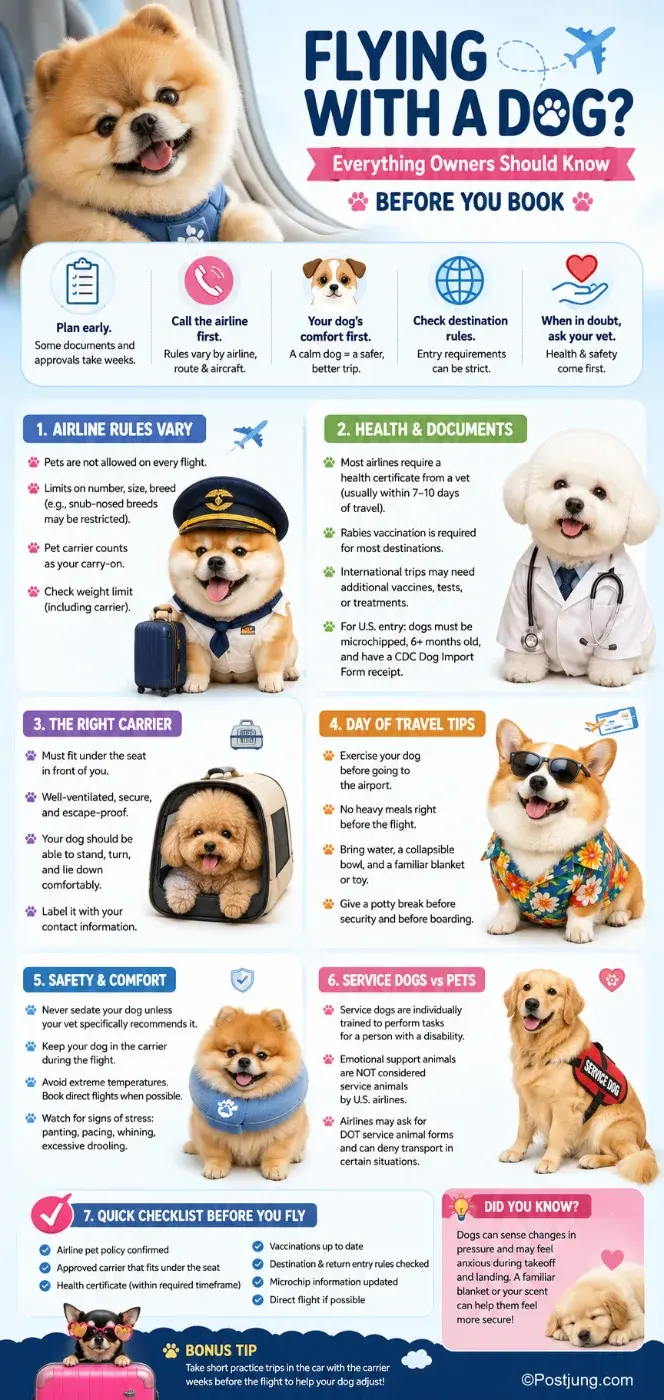
The FAA allows each airline to decide whether pets can travel in the passenger cabin. When pets are allowed in cabin, the pet carrier is treated as carry-on baggage and must fit under the seat without blocking access to the aisle. The carrier must also stay properly stowed during taxi, takeoff, and landing.
The airline rule comes first
The first call should be to the airline, not the airport.
Airlines set their own pet policies, including which animals are accepted, how many pets may be on a flight, whether the dog can travel in cabin, and what carrier size is allowed. Some airlines may also require a recent health certificate or limit pets on certain aircraft, routes, or seat types.
This matters because two flights that look similar to passengers may be very different for dogs. A nonstop domestic flight on one airline may allow a small dog under the seat, while a connecting international flight on another airline may require different paperwork, cargo handling, or may not accept pets at all.
For small dogs, cabin travel is often what owners hope for. But cabin travel usually means the dog must remain inside an approved carrier for the flight. If the dog cannot comfortably stay in the carrier, the trip may be stressful or unrealistic.
For larger dogs, owners may need to ask whether cargo or another pet transport option is available. That decision should be made carefully, especially if the dog is older, anxious, very young, short-nosed, medically fragile, or sensitive to heat.
Paperwork can take longer than expected
Dog travel is not just an airline issue. It can also involve veterinary documents, destination rules, and, for international travel, government requirements.
The USDA’s Animal and Plant Health Inspection Service says pet owners may need to complete paperwork or other tasks before travel, and that meeting requirements takes time. For U.S. travelers taking a pet abroad, USDA advises contacting a USDA-accredited veterinarian as soon as travel is being planned, because destination countries may require specific vaccines, tests, treatments, or endorsed health certificates.
The CDC also advises owners to check vaccinations, get a veterinary health certificate dated within 10 days of departure, and research both destination-country rules and U.S. return requirements for international trips.
That last part is easy to miss: returning home can have its own rules.
For dogs entering or returning to the United States, CDC rules depend partly on where the dog has been in the previous six months. CDC says all dogs must be at least 6 months old, be microchipped, appear healthy upon arrival, and have a CDC Dog Import Form receipt. Dogs with travel history in high-risk rabies countries may face additional requirements.
For American readers, the practical takeaway is simple: do not assume a rabies vaccine record alone is enough. Depending on the route, the dog’s travel history, and the destination, the required documents may be more specific.
The carrier is not just a bag
A dog carrier is part of the safety plan.
For in-cabin pets, the FAA says the container must be small enough to fit under the seat without blocking the aisle and must remain properly stowed during key parts of the flight. CDC also advises owners never to place a hand-carried pet in an overhead bin; pets should be secured in carriers below the seat according to airline policy.
That means owners should test the carrier before travel. The dog should be able to settle inside it, and the carrier should close securely without forcing the animal into an unnatural position.
A carrier that looks acceptable online may still fail in real life if it does not fit the aircraft seat space, leaks, collapses too much, or makes the dog panic. A few short practice sessions at home can reveal problems before the airport does.
Direct flights usually reduce stress
CDC recommends booking a direct flight when possible to reduce the chances of a pet being separated from the owner during extreme weather or layovers.
That advice is especially useful during hot or cold seasons. Delays, missed connections, long waits on the tarmac, and unfamiliar airport transfers can make pet travel harder than the flight itself.
Owners should also plan the dog’s bathroom break before securing it for travel. CDC recommends giving dogs a potty break before departure or after arrival before they are placed in the crate or carrier.
Small details matter here: a collapsible bowl, waste bags, a familiar blanket, extra medication, and clear ID can make a stressful travel day more manageable.
Do not assume sedation is safer
Some owners think a sedated dog will have an easier flight. That is not always true.
The FDA warns that sedatives can dull an animal’s senses and reduce its ability to react to the environment, which can be dangerous in an emergency. The agency advises avoiding sedatives for car or plane travel unless a veterinarian specifically recommends them.
The better first step is to talk to a veterinarian about whether the dog is fit to fly. The discussion should include the dog’s age, breed, breathing, heart health, anxiety, medication needs, and past travel behavior.
A dog that struggles with short car rides, confinement, loud noises, or separation may need more preparation than owners expect.
Service dogs are different from pets
One common source of confusion is the difference between pets, emotional support animals, and trained service dogs.
Under U.S. Department of Transportation rules, a service animal for air travel is a dog, regardless of breed or type, that is individually trained to do work or perform tasks for a qualified person with a disability. Emotional support animals, comfort animals, companionship animals, and service animals in training are not considered service animals under that rule.
Airlines may require DOT service animal forms, and service dogs must behave properly. Airlines may deny transport in certain situations, such as when a dog poses a direct threat, causes significant disruption, cannot be accommodated safely, or violates health requirements.
For pet owners, this means a regular dog cannot be treated as a service dog simply because travel feels emotionally easier with the animal nearby.
The best trip may be the one your dog can handle
The hardest question is not “Can my dog fly?” It is “Should my dog fly on this trip?”
Some dogs travel calmly. Others may be frightened by crowds, security lines, aircraft noise, confinement, turbulence, or unfamiliar smells. A short flight can still become a long day when parking, check-in, security, boarding, delays, and baggage claim are included.
Owners should consider alternatives when the trip is optional: a trusted pet sitter, a reputable boarding facility, a road trip, or choosing pet-friendly lodging closer to home.
Flying with a dog is possible, and many owners do it responsibly. But the smoothest trips usually happen when the boring details are handled early: airline approval, vet paperwork, carrier fit, destination rules, airport timing, and the dog’s comfort.
A plane ticket gets the owner on board. Careful preparation is what helps the dog get there safely.
KEY TAKEAWAYS:
- Check the airline’s pet policy before booking because each airline sets its own limits.
- Make sure the carrier fits under the seat and that the dog can stay inside it calmly.
- International travel and U.S. re-entry can require specific forms, vaccines, microchips, or health certificates.
- Do not sedate a dog for flying unless a veterinarian specifically recommends it.
- A trained service dog is not the same as a pet or emotional support animal.
CDC, USDA APHIS, Federal Aviation Administration, U.S. Department of Transportation, U.S. Food and Drug Administration
REFERENCES:
https://www.cdc.gov/healthy-pets/travel/index.html
https://www.cdc.gov/yellow-book/hcp/family-travel/traveling-with-pets-and-service-animals.html
https://www.aphis.usda.gov/pet-travel
https://www.faa.gov/travelers/fly_pets

เขียนโดย Postjung Insights
 รู้หรือไม่? เปิดรายได้พนักงานส่งพัสดุของแต่ละแอป วันหนึ่งได้เท่าไร
 5 คณะที่เรียนจบมาแล้ว มีอาชีพรองรับมากกว่าที่คิด
 เปิดรายชื่อโรงเรียนในไทยที่ “ว่ายน้ำ” อยู่ในหลักสูตร เรียนจริงตั้งแต่อนุบาลถึงมัธยม
 Google ยอมรับแล้ว! Gemini AI เข้าถึงระบบบริษัทจริง 3 แห่ง ระหว่างการทดสอบความปลอดภัย
 อำเภอที่มีชื่ออำเภอสั้นที่สุด 3 อำเภอเท่านั้นในประเทศไทย
 โรงเรียนที่มีนักเรียนมากที่สุดในไทย
 ดอลลาร์จะล่มสลายจริงไหม?
 ตาราง “เด่นเหนือเด่นใต้” งวด 1 ต.ค. 69 เปิดข้อมูลตามโพย เลขไหนอยู่ตรงไหน
 เลขเด็ดปฏิทิน "หลวงปู่โต๊ะ" งวดวันที่ 1 ตุลาคม 69..ส่องเลย เลขไหนให้โชค!
 สถิติย้อนหลัง 10 ปี ออกเลขไหนบ้างมาดูกัน
 ส่องเลข 3 สำนักพิมพ์ งวด 1 ต.ค. 69 ตัวไหนมีข้อมูลตรงกัน
 เปิด 5 โรงเรียนหญิงล้วนเก่าแก่ของไทย ที่มีประวัติยาวนานกว่าศตวรรษ5 คณะที่เรียนจบมาแล้ว มีอาชีพรองรับมากกว่าที่คิดเปิดรายชื่อโรงเรียนในไทยที่ “ว่ายน้ำ” อยู่ในหลักสูตร เรียนจริงตั้งแต่อนุบาลถึงมัธยมGoogle ยอมรับแล้ว! Gemini AI เข้าถึงระบบบริษัทจริง 3 แห่ง ระหว่างการทดสอบความปลอดภัยเลขเด็ดปฏิทิน "หลวงปู่โต๊ะ" งวดวันที่ 1 ตุลาคม 69..ส่องเลย เลขไหนให้โชค!
 ทำไมของพลาสติกเก่าบางชิ้นถึง “เหนียว” ขึ้นมาเอง ทั้งที่ไม่ได้เปื้อนอะไร?
 อุทยานเขาใหญ่เรียกตัว “ตีนผี” หลังขับจี้ช้างป่าพ่อลูก ลั่นระยะ 50 เมตรต้องจำให้ขึ้นใจ
 English Edition