Why Cats Get the Zoomies at Night — and What It Usually Means

Those late-night sprints are often less mysterious than they look. For many cats, nighttime zoomies are tied to natural activity rhythms, play needs, household routines, and sometimes health changes worth watching.
A cat tearing through the house at night can look chaotic, hilarious, and slightly alarming all at once. One moment the room is quiet; the next, your cat is sprinting down the hallway, bouncing off furniture, and acting as if an invisible intruder just entered the home.
Most of the time, this behavior is not a sign that anything is “wrong.” It is often a normal burst of energy shaped by a cat’s biology, daily routine, and need for play.
Veterinary behavior sources describe cats as crepuscular, meaning they are often more active around dusk and dawn. VCA Animal Hospitals notes that evening and early-morning activity is common because those are natural times for hunting and exploration, while the Merck Veterinary Manual says cats’ daily activity patterns are strongly influenced by the environment they live in.
The zoomies are often a mini hunting session
Domestic cats may live on couches, beds, and windowsills, but their behavior still carries the shape of a predator. Running, pouncing, stalking, grabbing, and sudden bursts of speed can all resemble pieces of a hunting sequence.
That is why the zoomies often show up after a quiet day indoors. If a cat spent hours sleeping while the household was at work or school, the evening may become the first exciting part of the day: people come home, food appears, lights change, rooms get active, and the cat finally has an audience.
FelineVMA explains that normal play in cats often mimics hunting, including chasing, pouncing, biting, and clawing at “prey.” The same guidance notes that hunting instincts persist even inside the home, and without appropriate outlets, normal feline behaviors can become frustrating for caregivers.
In plain language: your cat may not be acting weird. Your cat may be acting like a cat with unused energy.
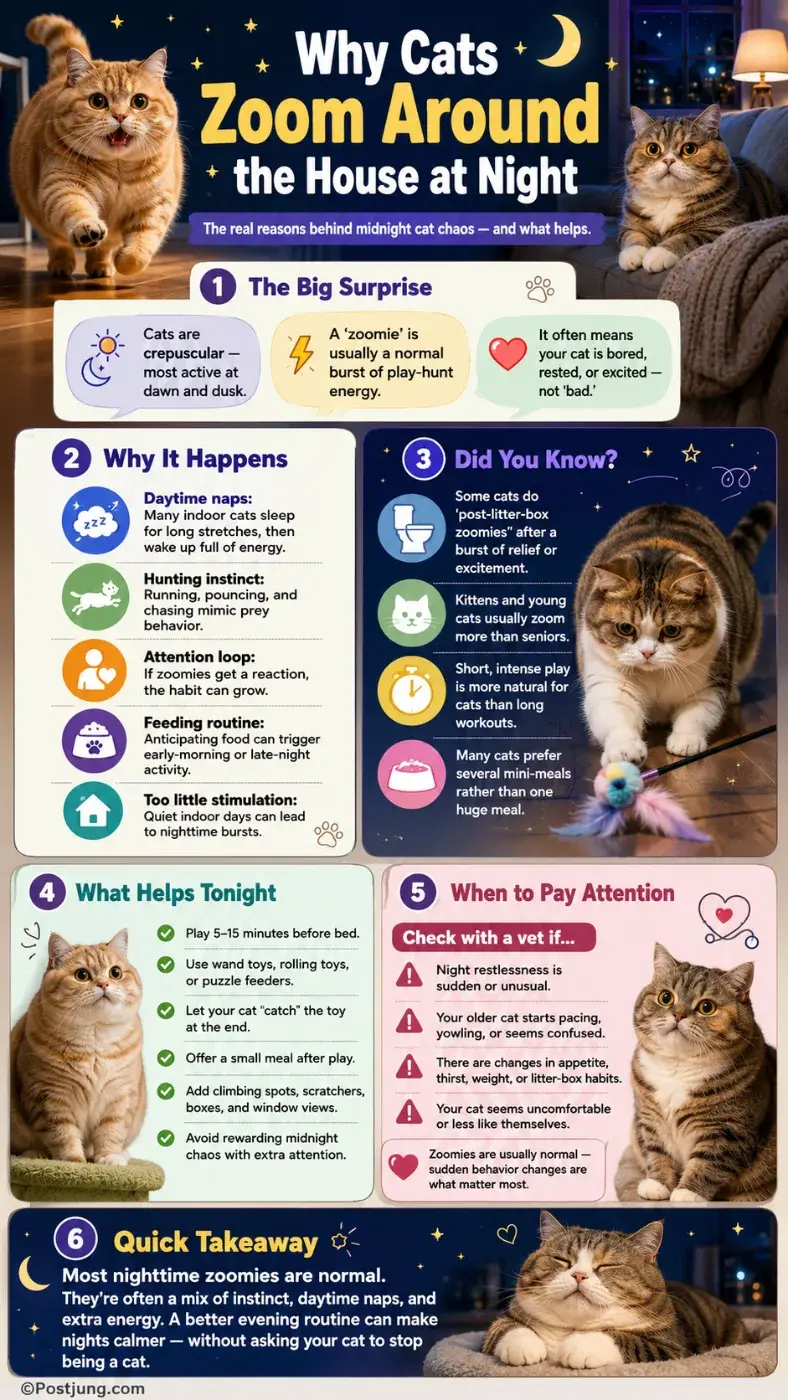
Why it happens at night
Nighttime zoomies often come from a few overlapping causes.
One is sleep timing. Cats can nap for long stretches during the day, especially indoor cats in quiet homes. By the time people are winding down, the cat may be warming up.
Another is attention. If a cat runs across the bed and gets a reaction — food, petting, play, talking, or even annoyed shouting — that reaction can become part of the reward. VCA notes that some owners accidentally reinforce nighttime activity by giving food, affection, or attention to calm the cat down.
Food can also play a role. A cat that expects breakfast at dawn may start waking the household earlier and earlier. A cat that eats one or two large meals may also become more restless around feeding times than a cat whose food routine better matches its natural tendency toward smaller eating moments.
Then there is simple boredom. Indoor cats are safe from cars, predators, and many outdoor risks, but indoor life can also be under-stimulating. A cat with no climbing space, no rotating toys, no window view, and no interactive play may save its energy for the most inconvenient hour.
The fix is usually routine, not punishment
The best response is not to scold, chase, spray, or scare the cat. Punishment can make a cat anxious and may damage the human-cat bond. Merck’s veterinary guidance specifically warns that positive punishment, such as scolding or spraying, can trigger fear, aggression, or other unwanted behaviors.
A better approach is to shift the energy earlier.
A focused play session in the evening can help. Use a wand toy, feather toy, rolling toy, or soft object your cat can chase and “catch.” Letting the cat capture the toy matters because play that never ends in a catch can be frustrating. Merck recommends offering opportunities to chase, pounce on, and bite toys, while FelineVMA says normal play behavior includes the same hunting-style actions.
After play, offer a small meal or snack if it fits your cat’s feeding plan. For some cats, that play-then-eat rhythm helps mimic the natural sequence of hunt, catch, eat, groom, and rest.
Environmental enrichment also helps. A cat tree, perch, cardboard box, tunnel, scratching post, puzzle feeder, or rotating toy basket can make the day less empty. Merck describes play areas, climbing options, scratching surfaces, boxes, small toys, and food puzzles as ways to meet cats’ behavioral needs indoors.
The goal is not to exhaust your cat into silence. The goal is to give the cat more appropriate ways to spend energy before bedtime.
When nighttime zoomies may deserve a closer look
Zoomies are usually normal, especially in kittens and younger cats. Still, a sudden change in behavior deserves attention.
If an older cat suddenly becomes restless at night, cries more, seems unusually hungry or thirsty, loses weight, stops using the litter box normally, or appears uncomfortable, it is safer to check with a veterinarian. VCA notes that cats often hide signs of illness and that sudden changes in energy, appetite, thirst, litter box use, breathing, or general behavior can be important warning signs. It also notes that hyperthyroidism may make some cats restless at night.
That does not mean every midnight sprint is a medical problem. It means owners should know their cat’s normal pattern. A familiar burst of play is different from a sudden personality change.
What cat owners can try tonight
Start with one simple change: schedule play before the time your cat usually gets wild.
Keep it short but intentional. Five to fifteen minutes may be enough for some cats; others need several brief sessions. Try different toy styles because cats have individual preferences. Some love feather wands. Some prefer small toys that skitter across the floor. Some want boxes, tunnels, or a toy partly hidden behind furniture.
Then make the late-night response boring. If the cat learns that running across the bed earns food or attention, the pattern may continue. If the cat’s needs have been met earlier and the nighttime performance gets no reward, many cats gradually adjust.
For multi-cat homes, watch whether one cat is chasing another in a playful way or whether the second cat is hiding, hissing, or trying to escape. What looks funny to people may feel stressful to the cat being chased. In that case, more individual play and separated resting spaces may help.
The sweetest truth about cat zoomies is that they are often a sign of life, instinct, and pent-up play. Your cat is not trying to ruin your sleep on purpose. It is moving through the world with a body built for quick bursts, sharp senses, and sudden decisions.
Give that energy a better outlet, and the house may get quieter after dark — without asking your cat to stop being a cat.
KEY TAKEAWAYS:
- Nighttime zoomies are often normal and linked to cats’ dusk-and-dawn activity patterns.
- Indoor cats may run wild at night when they have unused energy from a quiet day.
- Evening play, food puzzles, climbing spaces, and predictable routines can help.
- Avoid punishing zoomies; redirect the behavior instead.
- Sudden behavior changes, especially in older cats, should be discussed with a veterinarian.
Merck Veterinary Manual, VCA Animal Hospitals, Feline Veterinary Medical Association
REFERENCES:
https://www.merckvetmanual.com/behavior/behavior-of-cats/social-behavior-of-cats
https://vcahospitals.com/know-your-pet/cat-behavior-problems---nocturnal-activity
https://catvets.com/resource/setting-up-for-success/
https://vcahospitals.com/know-your-pet/recognizing-signs-of-illness-in-cats

เขียนโดย Postjung Insights
 รู้หรือไม่? เปิดรายได้พนักงานส่งพัสดุของแต่ละแอป วันหนึ่งได้เท่าไร
 เปิดรายชื่อโรงเรียนในไทยที่ “ว่ายน้ำ” อยู่ในหลักสูตร เรียนจริงตั้งแต่อนุบาลถึงมัธยม
 Google ยอมรับแล้ว! Gemini AI เข้าถึงระบบบริษัทจริง 3 แห่ง ระหว่างการทดสอบความปลอดภัย
 อำเภอที่มีชื่ออำเภอสั้นที่สุด 3 อำเภอเท่านั้นในประเทศไทย
 5 คณะที่เรียนจบมาแล้ว มีอาชีพรองรับมากกว่าที่คิด
 ตาราง “เด่นเหนือเด่นใต้” งวด 1 ต.ค. 69 เปิดข้อมูลตามโพย เลขไหนอยู่ตรงไหน
 เปิด 5 โรงเรียนหญิงล้วนเก่าแก่ของไทย ที่มีประวัติยาวนานกว่าศตวรรษ
 เลขเด็ดปฏิทิน "หลวงปู่โต๊ะ" งวดวันที่ 1 ตุลาคม 69..ส่องเลย เลขไหนให้โชค!
 จุฬาฯ มหาวิทยาลัยแห่งแรกของไทย มีจุดเริ่มต้นในสมัยรัชกาลที่ 5
 โรงเรียนที่มีนักเรียนมากที่สุดในไทย
 แปลปกสลาก งวด 1 ต.ค. 69 ส่องตัวเลขจากภาพปกสลากกินแบ่งรัฐบาล
 ทำไมของพลาสติกเก่าบางชิ้นถึง “เหนียว” ขึ้นมาเอง ทั้งที่ไม่ได้เปื้อนอะไร?5 คณะที่เรียนจบมาแล้ว มีอาชีพรองรับมากกว่าที่คิดเปิดรายชื่อโรงเรียนในไทยที่ “ว่ายน้ำ” อยู่ในหลักสูตร เรียนจริงตั้งแต่อนุบาลถึงมัธยมGoogle ยอมรับแล้ว! Gemini AI เข้าถึงระบบบริษัทจริง 3 แห่ง ระหว่างการทดสอบความปลอดภัยเลขเด็ดปฏิทิน "หลวงปู่โต๊ะ" งวดวันที่ 1 ตุลาคม 69..ส่องเลย เลขไหนให้โชค!ทำไมของพลาสติกเก่าบางชิ้นถึง “เหนียว” ขึ้นมาเอง ทั้งที่ไม่ได้เปื้อนอะไร?
 อุทยานเขาใหญ่เรียกตัว “ตีนผี” หลังขับจี้ช้างป่าพ่อลูก ลั่นระยะ 50 เมตรต้องจำให้ขึ้นใจ
 English Edition