How to Choose a Scratching Post Your Cat Will Actually Use

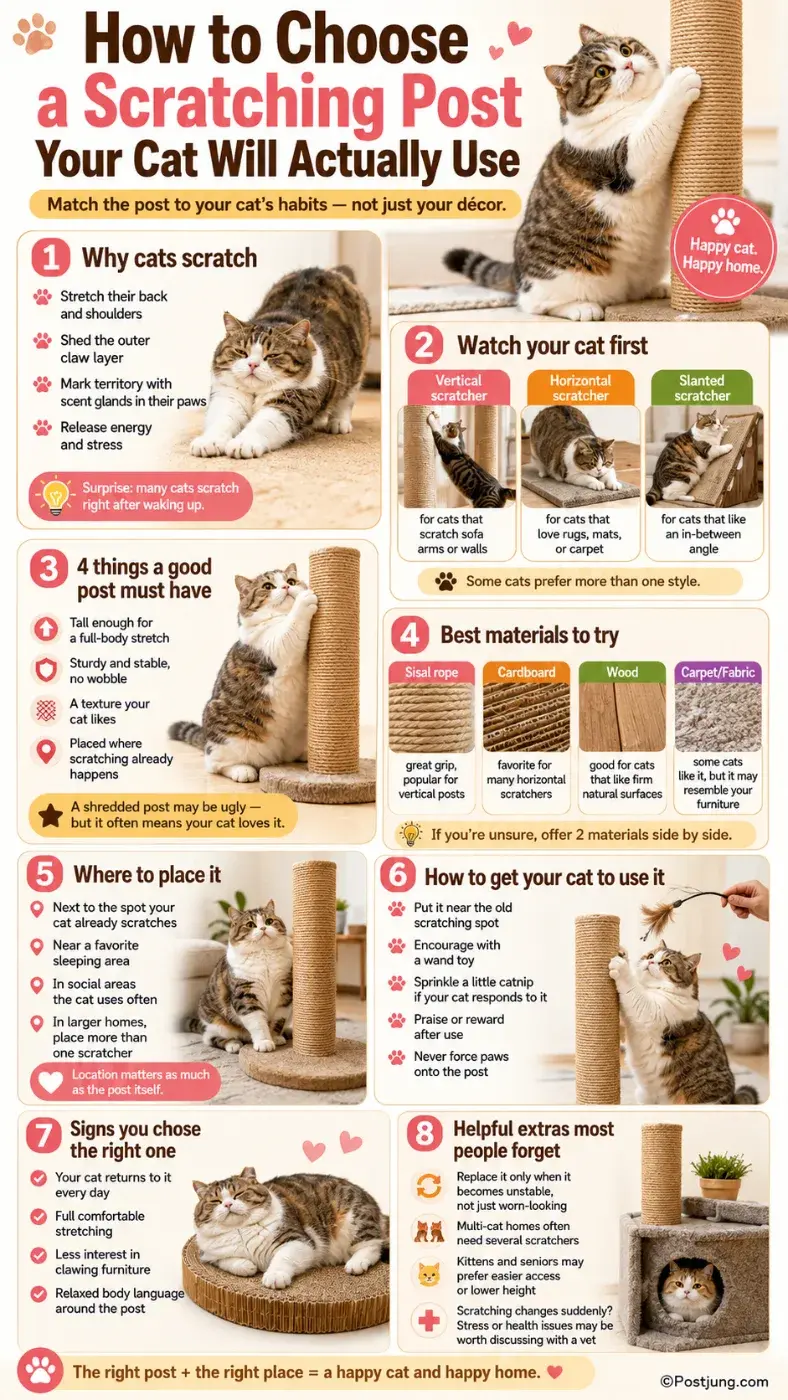
The best scratcher matches your cat’s preferred angle, texture, reach, and location. A sturdy post placed where your cat already scratches is far more appealing than a beautiful one hidden in the wrong corner.
A scratching post works only if it makes sense to the cat. The right choice matches four things your cat already shows you: direction, texture, reach, and location.
That means the best shopping guide may be the corner of your sofa—or the patch of carpet your cat keeps choosing.
Scratching is not revenge, disobedience, or bad manners. It is normal feline behavior that helps cats stretch, maintain their claws, and leave visual and scent marks. The realistic goal is not to stop scratching. It is to give the cat a surface that works better than the furniture.
Your furniture is already giving you the answer
Before buying anything, watch how and where your cat scratches.
A cat that stands on its hind legs and reaches up a sofa arm is showing a preference for a vertical surface. A cat that crouches and rakes the carpet may be asking for a horizontal pad. Some cats prefer a slanted board that sits between those two positions.
The existing target also offers clues about texture. Upholstery, carpet, wood, and woven surfaces feel different beneath a cat’s paws. Let your cat’s current target be the clue, rather than assuming the most popular material will automatically be the right one.
Observe the location, too. Does the scratching happen beside a sleeping spot, near an entrance, or on the same corner of the couch every day? Those details matter because scratching is partly a marking behavior, not simply a form of nail care.
A full stretch needs height and a steady base
For a vertical post, choose one tall enough for your cat to stand on its hind legs and extend its front paws without reaching the top. Body length is a more useful guide than relying on a single recommended height for every cat.
A horizontal scratcher should likewise be long enough for the cat to stretch across it rather than placing only its front paws on the surface.
Stability is just as important. Cats pull against a scratching surface with considerable leverage, so a lightweight post with a narrow base may shift or lean. Look for a broad, heavy base, a secure wall attachment, or a nonslip backing.
A simple test can reveal a weak design: press the upper part of the post gently from several directions. If it rocks easily under your hand, it may move even more when a full-grown cat uses it.
Full-body stretch without wobbling should be the minimum standard. A compact scratcher may save floor space, but it is not a bargain if the cat returns to the couch.
Texture is a preference, not a universal winner
Sisal is a common choice because many cats enjoy its rough, grippable surface. Corrugated cardboard is another popular option, especially for cats that scratch horizontally. Carpet and unfinished wood can also appeal to individual cats.
There is no material that every cat prefers. Texture is personal, not a product ranking. When the cat’s preference is unclear, offer two inexpensive options in the same area—for example, a vertical sisal post and a flat cardboard pad.
This small comparison is often more revealing than buying one elaborate cat tree and hoping for the best. Watch which surface receives repeated visits, then provide more scratchers with similar qualities.
Do not throw away a favorite post merely because it looks shredded. Torn fibers give claws something to grip, and the post carries familiar scent marks. Replace or repair it when it becomes unstable or exposes unsafe hardware—not simply because it no longer looks new.
A ragged post is often a successful post.
Put the scratcher where the behavior already happens
A perfectly designed post can still fail when it is placed in a room the cat rarely visits.
Start by positioning the new scratcher directly beside the object the cat currently uses. If the couch corner is the target, the post belongs beside that corner—not across the room and not hidden in a spare bedroom.
Cats also commonly scratch and stretch after waking, making the area near a favorite bed or resting place another useful location. Entryways, windows, and active family spaces may matter because scratching can communicate a cat’s presence within its territory.
Location is part of the product. A basic cardboard pad in the right place may receive more use than expensive furniture positioned where scratching has no meaning to the cat.
If your cat scratches in several areas, provide several acceptable surfaces. One post does not have to solve every situation, particularly in a larger home or a household with multiple cats.
Once the cat is using a new post consistently, it can be moved gradually if necessary. Large, sudden changes may send the cat back to the original target.
Make the first experience easy and positive
Introduce the scratcher without placing the cat’s paws on it.
Instead, play nearby with a wand-style toy so the cat naturally reaches toward the surface. A small amount of catnip may encourage investigation in cats that respond to it. When the cat uses the scratcher, offer a treat, petting, play, or another reward the cat enjoys.
Forcing a cat’s paws against the material can create fear or avoidance. Yelling, spraying water, or punishing the cat can also damage trust without teaching the cat which surface should be used instead.
The better approach is to invite, reward, and protect. Temporarily cover the scratched part of the furniture or use an appropriate surface deterrent while placing the approved scratcher directly beside it. The cat then receives a clear alternative rather than a prohibition it cannot understand.
When a new scratcher is ignored, reconsider one variable at a time. Move it closer to the existing target. Check for wobbling. Try a horizontal or slanted design. Change the material. A cat that rejects one post has not necessarily rejected scratching furniture made for cats.
A sudden or substantial change in scratching can sometimes be associated with stress, environmental conflict, or another concern. If the behavior changes abruptly, keeps escalating, or appears alongside other unusual behavior, discuss it with a veterinarian.
The best scratching post is not necessarily the biggest, most expensive, or most stylish. It is the one that tells your cat, through the right position, texture, size, and location: this surface is yours.
KEY TAKEAWAYS:
- Match the scratcher’s vertical, horizontal, or slanted position to the way your cat already scratches.
- Choose a surface large enough for a full stretch and stable enough to resist wobbling.
- Test materials such as sisal, cardboard, carpet, or wood instead of assuming every cat prefers the same texture.
- Place the scratcher beside an existing target or near a favorite sleeping area.
- Encourage use with play and rewards; never force the cat’s paws onto the surface.
Cat Friendly Homes, Cornell Feline Health Center, ASPCA, Humane World for Animals
REFERENCES:
https://catfriendly.com/be-a-cat-friendly-caregiver/living-clawed-cat/
https://www.vet.cornell.edu/departments-centers-and-institutes/cornell-feline-health-center/health-information/feline-health-topics/feline-behavior-problems-destructive-behavior
https://www.aspca.org/pet-care/cat-care/common-cat-behavior-issues/destructive-scratching
https://www.humaneworld.org/en/resources/how-stop-cats-destructive-scratching

เขียนโดย Postjung Insights
 อำเภอที่มีชื่ออำเภอสั้นที่สุด 3 อำเภอเท่านั้นในประเทศไทย
 Google ยอมรับแล้ว! Gemini AI เข้าถึงระบบบริษัทจริง 3 แห่ง ระหว่างการทดสอบความปลอดภัย
 รู้หรือไม่? เปิดรายได้พนักงานส่งพัสดุของแต่ละแอป วันหนึ่งได้เท่าไร
 เลขเด็ดปฏิทิน "หลวงปู่โต๊ะ" งวดวันที่ 1 ตุลาคม 69..ส่องเลย เลขไหนให้โชค!
 โรงเรียนที่มีนักเรียนมากที่สุดในไทย
 เปิด 5 โรงเรียนหญิงล้วนเก่าแก่ของไทย ที่มีประวัติยาวนานกว่าศตวรรษ
 5 คณะที่เรียนจบมาแล้ว มีอาชีพรองรับมากกว่าที่คิด
 เปิดรายชื่อโรงเรียนในไทยที่ “ว่ายน้ำ” อยู่ในหลักสูตร เรียนจริงตั้งแต่อนุบาลถึงมัธยม
 ตาราง “เด่นเหนือเด่นใต้” งวด 1 ต.ค. 69 เปิดข้อมูลตามโพย เลขไหนอยู่ตรงไหน
 ทำไมของพลาสติกเก่าบางชิ้นถึง “เหนียว” ขึ้นมาเอง ทั้งที่ไม่ได้เปื้อนอะไร?
 ส่องเลข 3 สำนักพิมพ์ งวด 1 ต.ค. 69 ตัวไหนมีข้อมูลตรงกัน
 ถ้าไม่กลัวเหนื่อย 7 อาชีพที่ตลาดยังต้องการ และค่าทักษะไปถึง 800 บาท/วัน5 คณะที่เรียนจบมาแล้ว มีอาชีพรองรับมากกว่าที่คิดเปิดรายชื่อโรงเรียนในไทยที่ “ว่ายน้ำ” อยู่ในหลักสูตร เรียนจริงตั้งแต่อนุบาลถึงมัธยมGoogle ยอมรับแล้ว! Gemini AI เข้าถึงระบบบริษัทจริง 3 แห่ง ระหว่างการทดสอบความปลอดภัยเลขเด็ดปฏิทิน "หลวงปู่โต๊ะ" งวดวันที่ 1 ตุลาคม 69..ส่องเลย เลขไหนให้โชค!ทำไมของพลาสติกเก่าบางชิ้นถึง “เหนียว” ขึ้นมาเอง ทั้งที่ไม่ได้เปื้อนอะไร?
 อุทยานเขาใหญ่เรียกตัว “ตีนผี” หลังขับจี้ช้างป่าพ่อลูก ลั่นระยะ 50 เมตรต้องจำให้ขึ้นใจ
 English Edition