Why Older Pets Need Softer, Safer Places to Land
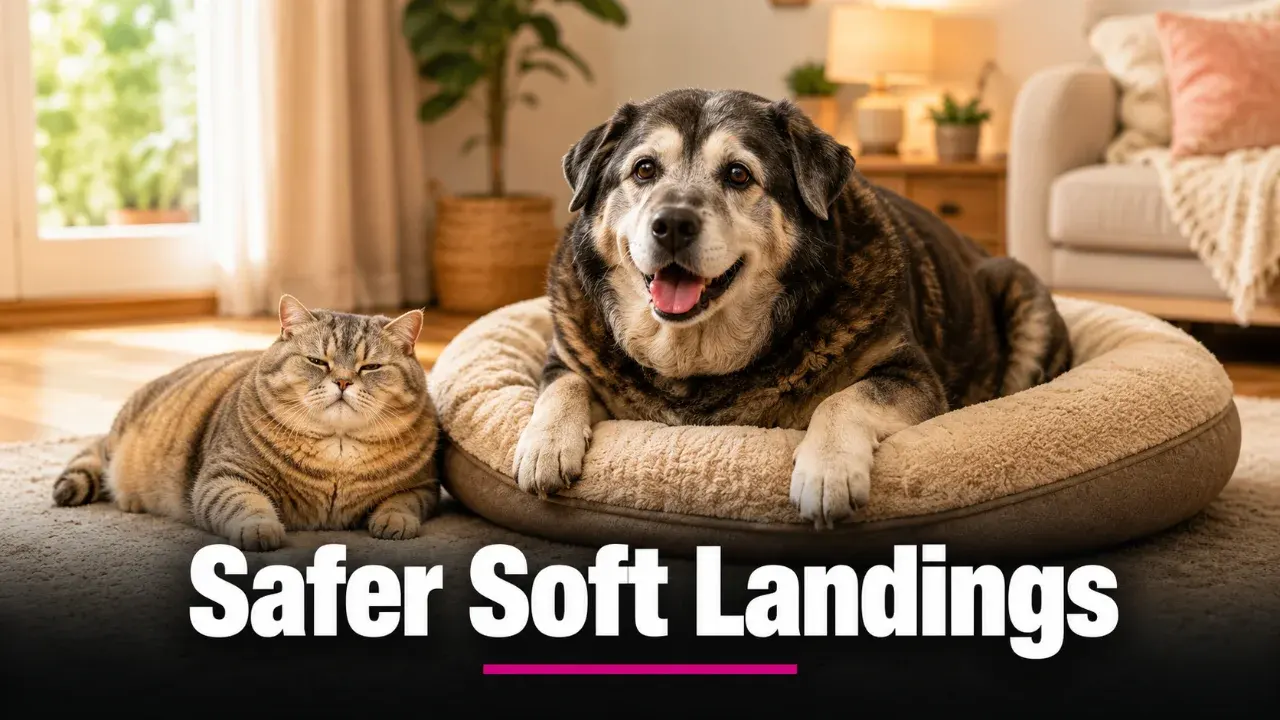
A familiar home can become harder to navigate as a pet ages. Supportive bedding helps, but safer flooring, lower access points, and well-placed resting areas can matter just as much.
The first sign of an aging pet is not always a gray muzzle. It may be a pause before jumping off the couch, a slip on tile, or a restless search for a position that feels comfortable.
A “soft landing spot” is more than a plush bed. It is a resting place an older dog or cat can reach, use, and leave without a difficult climb, a risky jump, or a scramble for footing.
Veterinary guidance treats the home environment as part of senior care. The American Animal Hospital Association says there is no single age at which every animal becomes senior because species, breed, size, and expected lifespan differ. A more useful question is whether everyday function is changing: walking, rising, turning, jumping, grooming, eating, or using the litter box.
The house stays the same, but the pet does not
A young animal may barely notice a polished floor, a high sofa, or one step down to the yard. Later, those same features can become repeated physical tests.
Stiffness when rising, reluctance to use stairs, avoiding jumps, and hesitation on slick floors can signal discomfort. Cats may be especially subtle: instead of an obvious limp, they may jump less, stop grooming part of the body, withdraw, or have trouble entering a litter box.
This is why a soft landing is a whole route. The path between a pet’s bed, water, food, toilet area, door, and favorite family space matters as much as the bed itself.
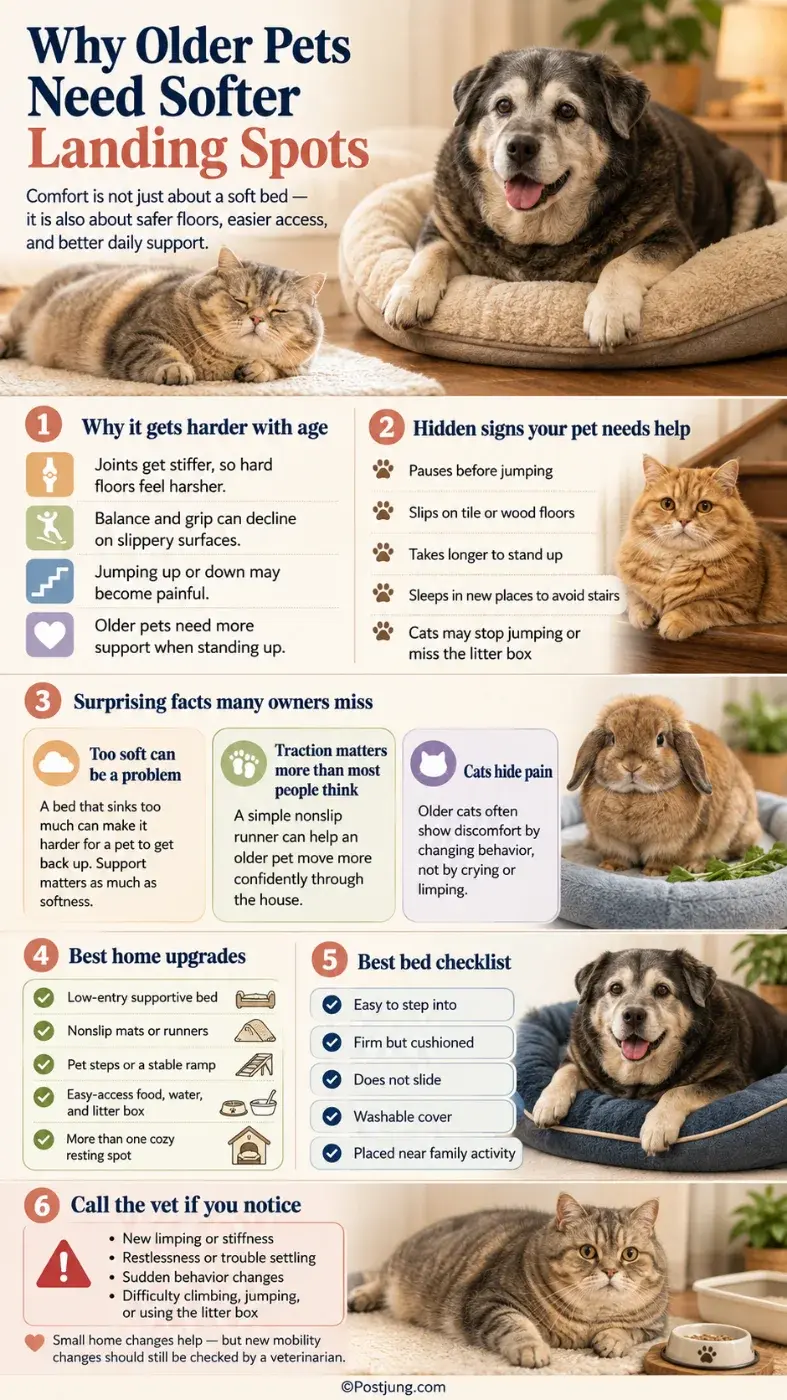
A bed should support rest—not create another obstacle
A padded bed can soften contact with a hard floor and offer a predictable place to settle. AAHA guidance includes added padding and bedding placed in accessible areas among practical changes for senior animals.
Still, “softer” should not automatically mean taller, deeper, or more luxurious. A bed that collapses heavily, slides during entry, or has a high rim may be difficult for a weak or painful pet to use. In practical terms, the best bed is one your pet can enter and leave without a leap or a struggle to stand.
Look for a low entrance, a stable nonslip base, enough cushioning to soften pressure, and enough structure to support getting up. A washable cover makes daily care easier.
Placement matters too. Put resting spots where the pet already wants to be: beside the couch, near a quiet window, in the bedroom, or close to normal family activity. Several simple rest points may serve an aging animal better than one expensive bed in an isolated corner.
In hot climates, keep a cool resting option and use breathable, easy-to-clean materials. Comfort should not require a pet to choose between support and overheating.
Traction can matter as much as cushioning
A comfortable bed is of limited use when the floor around it feels unsafe. Traction matters as much as cushioning.
Secure runners, rubber-backed mats, or yoga mats can create a clear route across tile, wood, or polished concrete. Stable ramps or low pet steps can reduce repeated jumps onto a couch, bed, or vehicle. AAHA recommends traction-friendly flooring, accessible bedding, ramps, carpet runners, barriers near hazards, and other home adjustments tailored to the pet.
Test every aid from the animal’s point of view. A rug that bunches, a ramp that flexes, or steps that are too narrow can introduce a different risk. Keep pathways clear, use gates around stairs or pools when balance is unreliable, and consider night-lights along routes used after dark. In warm homes where a pet enjoys cool tile, a grippy lane between key destinations may be enough.
These changes are not about making the home look medical. They are about preserving confidence and access to the people and routines the animal enjoys.
Dogs and cats often need different compromises
For an older dog, the hardest moments may be transitions: standing, lying down, stepping off a curb, entering a car, or crossing a slick room. A low bed near the door, a nonslip path, or a properly fitted mobility harness may help more than simply adding a thicker cushion.
For an older cat, access is often vertical. A favorite windowsill or bed may still matter even when one large jump is no longer comfortable. Intermediate steps or a stable ramp can preserve access.
The American Association of Feline Practitioners’ chronic-pain guidance recommends low-entry litter boxes in easy-to-reach locations, along with steps or ramps to favored resting places. Cornell notes that arthritic cats may struggle with stairs and high-sided boxes even when they do not appear overtly lame.
The goal is not to force exercise or remove every challenge. It is to offer smaller, safer choices so the animal can keep doing familiar things with less strain.
Do not dismiss a new habit as “just old age”
A pet that suddenly sleeps downstairs, stops using the sofa, misses the litter box, flops down instead of lowering slowly, or paces because it cannot settle may be adapting to pain or another health problem.
Environmental changes can make daily life easier, but they do not identify the cause. AAHA advises veterinary assessment when pets develop stiffness, movement avoidance, posture changes, restlessness, or other possible pain signs.
Record short videos of difficult moments—getting up, crossing the floor, using stairs, or entering the litter box—and show them to a veterinarian. Pets may move differently at home than they do in a clinic, and familiar video can make subtle changes visible.
Aging pets are not necessarily asking for a smaller life. Often, they are asking for the same life with fewer hard edges: a path that grips, a lower step, and a resting place that feels safe. Small changes can protect everyday independence, which may be the softest landing a family can offer.
KEY TAKEAWAYS:
- A soft resting place should be easy to reach, enter, and leave.
- Nonslip routes can be as important as additional cushioning.
- Low beds, stable ramps, runners, and accessible litter boxes can reduce daily obstacles.
- Older dogs and cats may show pain through behavioral changes rather than obvious crying or limping.
- New mobility or sleeping changes should be discussed with a veterinarian.
American Animal Hospital Association, American Association of Feline Practitioners, Cornell University College of Veterinary Medicine
REFERENCES:
https://www.aaha.org/wp-content/uploads/globalassets/02-guidelines/2023-aaha-senior-care-guidelines-for-dogs-and-cats/resources/2023-aaha-senior-care-guidelines-for-dogs-and-cats.pdf
https://www.aaha.org/resources/whats-wrong-common-pet-pain-signs/
https://catvets.com/wp-content/uploads/2024/04/AAFP_Chronic_Pain_Toolkit_Full.pdf
https://www.vet.cornell.edu/departments-centers-and-institutes/cornell-feline-health-center/health-information/feline-health-topics/special-needs-senior-cat

เขียนโดย Postjung Insights
 รู้หรือไม่? เปิดรายได้พนักงานส่งพัสดุของแต่ละแอป วันหนึ่งได้เท่าไร
 เปิดรายชื่อโรงเรียนในไทยที่ “ว่ายน้ำ” อยู่ในหลักสูตร เรียนจริงตั้งแต่อนุบาลถึงมัธยม
 โรงเรียนที่มีนักเรียนมากที่สุดในไทย
 5 คณะที่เรียนจบมาแล้ว มีอาชีพรองรับมากกว่าที่คิด
 จุฬาฯ มหาวิทยาลัยแห่งแรกของไทย มีจุดเริ่มต้นในสมัยรัชกาลที่ 5
 Google ยอมรับแล้ว! Gemini AI เข้าถึงระบบบริษัทจริง 3 แห่ง ระหว่างการทดสอบความปลอดภัย
 อำเภอที่มีชื่ออำเภอสั้นที่สุด 3 อำเภอเท่านั้นในประเทศไทย
 ตาราง “เด่นเหนือเด่นใต้” งวด 1 ต.ค. 69 เปิดข้อมูลตามโพย เลขไหนอยู่ตรงไหน
 เปิด 5 โรงเรียนหญิงล้วนเก่าแก่ของไทย ที่มีประวัติยาวนานกว่าศตวรรษ
 เลขเด็ดปฏิทิน "หลวงปู่โต๊ะ" งวดวันที่ 1 ตุลาคม 69..ส่องเลย เลขไหนให้โชค!
 สถิติย้อนหลัง 10 ปี ออกเลขไหนบ้างมาดูกัน
 ทำไมของพลาสติกเก่าบางชิ้นถึง “เหนียว” ขึ้นมาเอง ทั้งที่ไม่ได้เปื้อนอะไร?
 😃 ชวนเข้ามาดูกันอีกกับคนที่มีร่างกายพิเศษจนเหมือนมีกล่องสมบัติที่หายาก 😯5 คณะที่เรียนจบมาแล้ว มีอาชีพรองรับมากกว่าที่คิดเปิดรายชื่อโรงเรียนในไทยที่ “ว่ายน้ำ” อยู่ในหลักสูตร เรียนจริงตั้งแต่อนุบาลถึงมัธยมGoogle ยอมรับแล้ว! Gemini AI เข้าถึงระบบบริษัทจริง 3 แห่ง ระหว่างการทดสอบความปลอดภัยเลขเด็ดปฏิทิน "หลวงปู่โต๊ะ" งวดวันที่ 1 ตุลาคม 69..ส่องเลย เลขไหนให้โชค!ทำไมของพลาสติกเก่าบางชิ้นถึง “เหนียว” ขึ้นมาเอง ทั้งที่ไม่ได้เปื้อนอะไร?
 English Edition