Why Some Houseplants Are Risky for Dogs—and What to Do

Plant toxicity ranges from painful mouth irritation to life-threatening liver damage. Knowing a plant’s exact name—and what to do after a bite—can change the response.
A dog does not need to swallow an entire leaf for a houseplant to cause trouble. The risk depends on the species, the part of the plant, how much was chewed, and the dog’s size and health. Many exposures cause limited mouth or stomach irritation, while a smaller group can injure the liver, heart, or nervous system.
“Toxic” can mean irritation—or a true emergency
One of the biggest misunderstandings is treating every toxic plant as equally dangerous. The ASPCA notes that even plant material classified as non-toxic can cause vomiting or gastrointestinal upset, while plants in its toxic database may produce intense digestive irritation or effects elsewhere in the body. In other words, “toxic” is not one level of danger.
Plant names can make the problem harder. Unrelated species sometimes share the same common name, and varieties that look alike may carry different risks. For a veterinarian or poison specialist, the scientific name matters because it helps identify the toxin, likely symptoms, and appropriate response.
The part that was eaten matters, too. Sago palm seeds are especially toxic, cyclamen’s tuberous root is a particular concern, and the bulbs of tulips and daffodils can cause more serious effects than their above-ground parts. A chewed fallen leaf, a dug-up bulb, and a swallowed seed are not equivalent exposures.
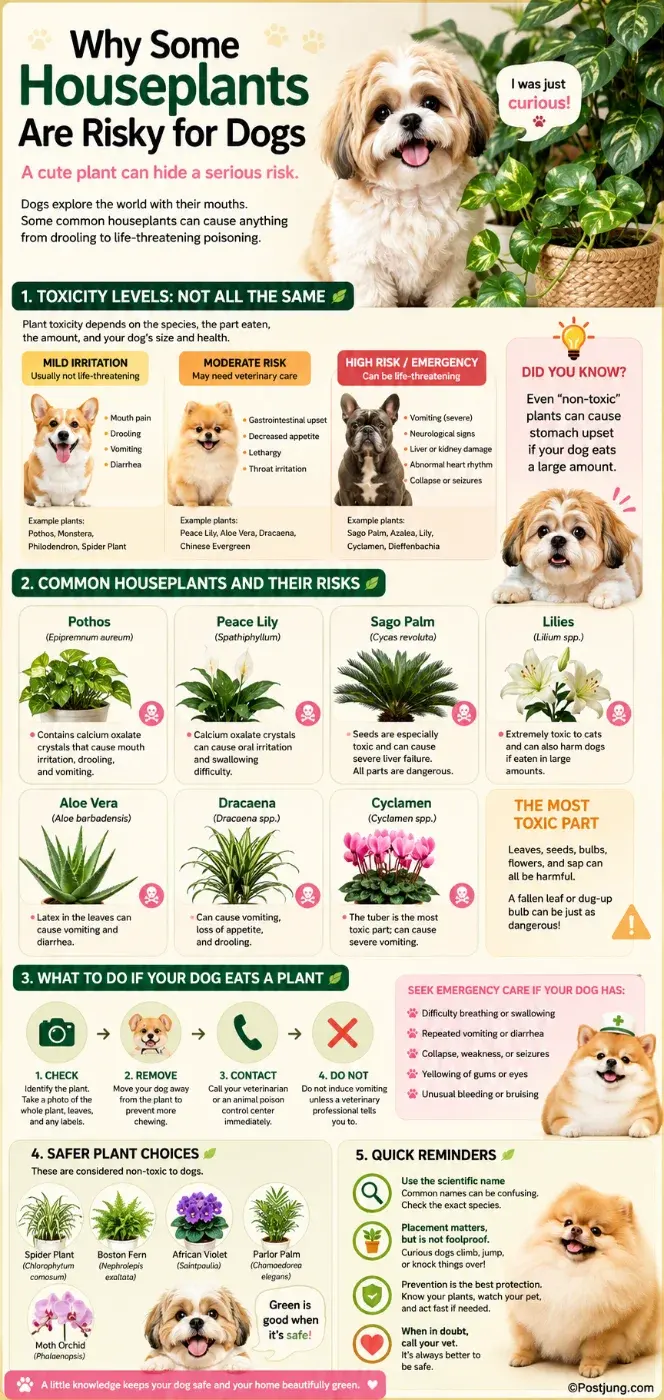
Why pothos and monstera can burn the mouth
Many familiar leafy plants—including pothos, philodendron, monstera, dieffenbachia, peace lily, alocasia, ZZ plant, and Chinese evergreen—contain insoluble calcium oxalate crystals. When a dog bites into the plant, tiny needle-like crystals are released into the mouth.
That means pain can start almost immediately. A dog may drool, paw at its mouth, shake its head, retch, refuse food, or vomit. Significant swelling at the back of the throat and breathing difficulty are uncommon, but they require urgent veterinary care.
These exposures are often less severe than poisonings that damage internal organs, and lasting effects are not generally expected after a typical small chew. Still, the plant should be identified and the dog’s condition discussed with a veterinarian rather than judged from a photo or online list alone.
Sago palm belongs in a different risk category
Cycads sold under names such as sago palm, cardboard palm, or coontie palm may look like compact ornamental palms, but they are particularly hazardous to dogs. All parts are considered toxic, the seeds are the most toxic, and dogs are highly sensitive.
Ingestion can cause vomiting, diarrhea, abdominal pain, weakness, neurologic signs, abnormal bleeding, and severe liver injury. Early digestive signs may appear within hours, while liver damage can progress later. Sago palm exposure is a veterinary emergency, even when a dog still appears normal.
In warm climates, the same ornamental may be kept inside, placed on a balcony, or planted outdoors. That is a useful reminder that “houseplant” describes where people put a plant—not how safe it is.
Other ornamentals work differently. Azaleas and rhododendrons contain compounds that can affect the digestive, cardiovascular, and nervous systems after a significant exposure. Aloe latex can cause marked vomiting or diarrhea, while plants such as dracaena and snake plant more commonly produce gastrointestinal signs. The plant’s identity is often more informative than the first symptom.
What to do after a bite
First, move the dog away from the plant and prevent further chewing. Record the time, the part involved, and the estimated amount. Photograph the whole plant, its leaves, pot label, and any packaging; when practical, take a plant sample to the clinic in a sealed bag.
Call a veterinarian or animal poison-control service promptly, especially when the plant is unknown, a sago palm may be involved, or symptoms have started. Do not wait for illness to become obvious after a potentially serious exposure.
Most importantly, do not induce vomiting unless a veterinary professional directs you. Salt, oil, gagging, and other home methods can create additional injuries, and vomiting is not appropriate in every poisoning case. Advice must be matched to the plant, the dose, the dog, and the time since exposure.
Difficulty breathing or swallowing, repeated vomiting, collapse, severe weakness, tremors, seizures, unusual bleeding, or yellowing of the eyes or gums warrants emergency care. In the United States, ASPCA Poison Control operates around the clock at 888-426-4435, and a consultation fee may apply. Readers elsewhere should contact a local emergency veterinarian or regional animal poison service.
This information is general and cannot replace advice for an individual dog. Toxicity varies with the exact plant, the amount eaten, and the animal’s condition.
Safer greenery starts before checkout
Before bringing a plant home, check its scientific name against a veterinary toxic-plant database. A “pet-friendly” shelf tag is helpful only when it identifies the correct species, and placing a toxic plant high up may not protect a puppy that jumps, knocks over pots, or finds fallen leaves.
The ASPCA lists options such as spider plant, African violet, Boston fern, moth orchid, and parlor palm as non-toxic to dogs and cats. Even these can cause stomach upset if enough plant material is eaten, so discouraging chewing still makes sense.
A green home and a dog can coexist. The most useful questions are simple: What exact plant is this? Which parts can the dog reach? Who will be called if it is chewed? Plant identification now can prevent frantic guessing later.
KEY TAKEAWAYS:
- Plant risk varies widely according to the exact species, plant part, amount eaten, and animal involved.
- Pothos, monstera, philodendron, and similar plants commonly cause immediate mouth pain, drooling, and digestive irritation.
- Every suspected sago palm ingestion should be treated as an urgent veterinary matter.
- Owners should not attempt to make a dog vomit without direct veterinary guidance.
- Checking a plant’s scientific name before purchase is more reliable than depending on appearance or a common name.
ASPCA Animal Poison Control Center, Merck Veterinary Manual, UC Davis School of Veterinary Medicine
REFERENCES:
https://www.aspca.org/pet-care/aspca-poison-control/toxic-and-non-toxic-plants
https://www.merckvetmanual.com/toxicology/poisonous-plants/houseplants-and-ornamentals-toxic-to-animals
https://magazine.vetmed.ucdavis.edu/news-article-spring-2025/when-plants-and-animals-dont-mix
https://www.aspca.org/news/it-ever-safe-induce-vomiting

เขียนโดย Postjung Insights
 รู้หรือไม่? เปิดรายได้พนักงานส่งพัสดุของแต่ละแอป วันหนึ่งได้เท่าไร
 ดูหนัง–ซีรีส์ฟรีอาจไม่ฟรีอย่างที่คิด! เปิดโทษละเมิดลิขสิทธิ์ เตือนคนปล่อยคอนเทนต์เถื่อน เสี่ยงทั้งคุกทั้งปรับ
 รมว.วัฒนธรรมเอาจริง! จ่อส่งหนังสือทักท้วง Miss Universe Cambodia ปมใช้ภาพหญิงกำแพงเพชร หากไม่แก้ เตรียมใช้กฎหมาย
 แมคาเดเมีย (Macadamia): ราชินีแห่งถั่ว กับขุมทรัพย์โภชนาการจากออสเตรเลีย
 MRT เตาปูนกลับมาเปิดปกติแล้ว รมช.คมนาคมเผยปมไฟไหม้ พบประกายไฟจากชุดสายไฟ 750 โวลต์
 อำเภอที่มีชื่ออำเภอสั้นที่สุด 3 อำเภอเท่านั้นในประเทศไทย
 แมงป่อง: แมลงนักล่าสายพันธุ์โบราณของโลก ที่ยังคงอยู่มาจนถึงปัจจุบัน
 5 คณะที่เรียนจบมาแล้ว มีอาชีพรองรับมากกว่าที่คิด
 ตาราง “เด่นเหนือเด่นใต้” งวด 1 ต.ค. 69 เปิดข้อมูลตามโพย เลขไหนอยู่ตรงไหน
 โรงเรียนที่มีนักเรียนมากที่สุดในไทย
 งูมัลกา (Mulga Snake): นักล่าแห่งผืนดินแห้งแล้ง ของทวีปออสเตรเลีย กับฉายา King Brown กัดคนได้ถึงตาย
 เปิด 5 โรงเรียนหญิงล้วนเก่าแก่ของไทย ที่มีประวัติยาวนานกว่าศตวรรษ
 English Edition