Why Bored Pets Often Act Out — and What They Really Need

Many common pet problems are not signs of spite or disobedience. They may be a pet’s way of asking for movement, attention, problem-solving, and a more interesting day.
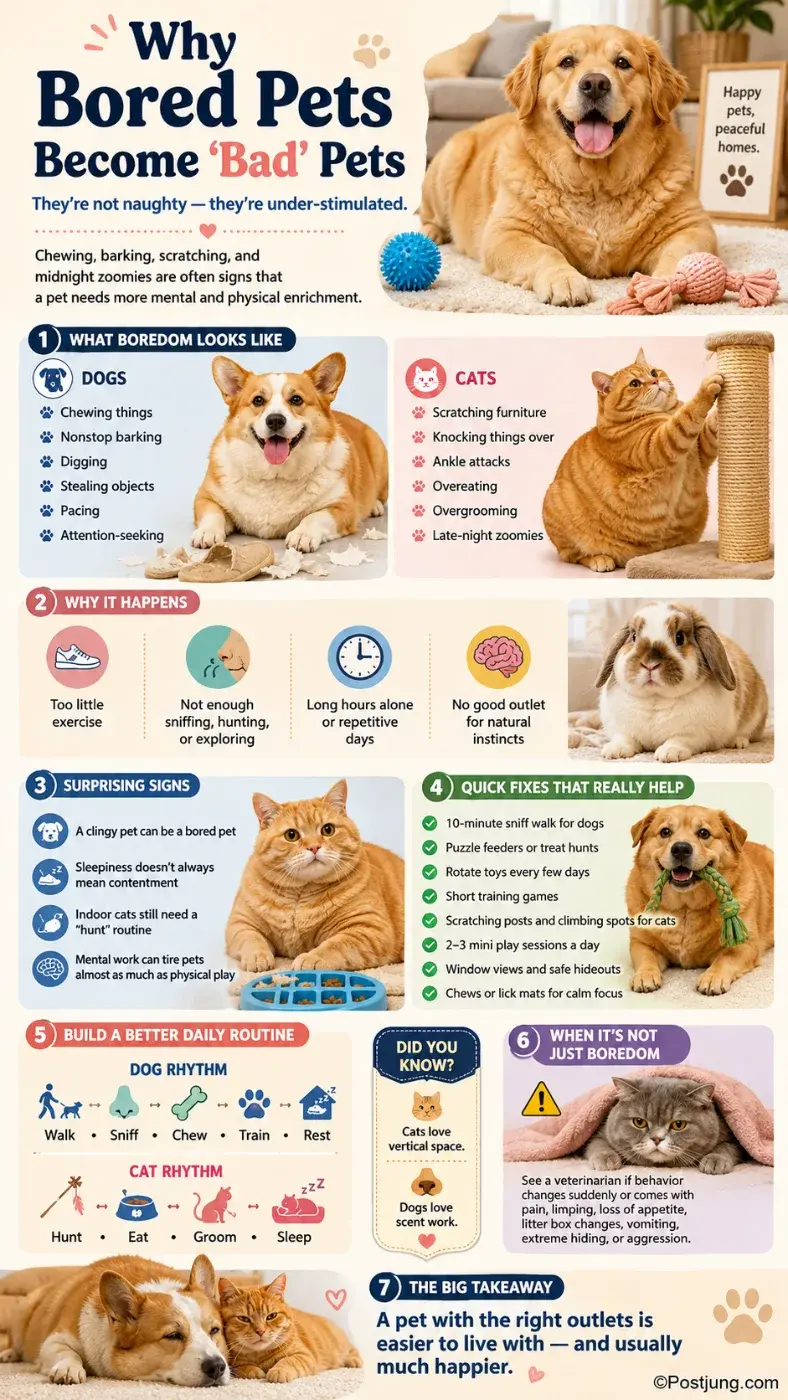
A bored pet rarely looks bored. More often, boredom shows up as chewed shoes, shredded furniture, nonstop barking, late-night zoomies, scratched couches, or a cat suddenly treating the living room like a hunting ground.
That is why many “bad” pets are not really bad at all. They are animals with instincts, energy, and curiosity living inside a human home that may not give them enough to do.
Veterinary and animal-welfare groups often use the word enrichment to describe activities that let pets use their bodies, brains, senses, and natural behaviors. The American Animal Hospital Association says a lack of appropriate outlets can appear as chewing, scratching, barking, or litter box issues, while regular enrichment can reduce boredom and frustrating behaviors.
Bad behavior is often normal behavior in the wrong place
Dogs chew. Cats scratch. Both investigate, chase, sniff, climb, pounce, and seek attention. The problem begins when a home gives them no acceptable way to do those things.
A dog that destroys a pillow may not be “getting revenge.” Chewing is a normal canine behavior, and the ASPCA notes that dogs may chew for fun, stimulation, anxiety relief, or because they lack enough physical and mental activity.
A cat that scratches furniture may not be trying to annoy anyone. Scratching is a normal feline behavior connected to stretching, marking, claw maintenance, and emotional release. The Feline Veterinary Medical Association’s environmental-needs guidance stresses that cats need chances to express natural behaviors, and unmet needs can increase stress and unwanted behavior.
The useful shift is this: stop asking what the pet ruined and start asking what need the behavior was trying to meet.
Boredom can look like trouble, noise, or clinginess
For dogs, boredom may appear as chewing, digging, barking, pacing, stealing objects, rough play, or constantly demanding attention. Some dogs become escape artists because the world beyond the door is simply more interesting than the one inside.
For cats, boredom may look quieter but can be just as disruptive. A bored cat may scratch more, knock things over, chase ankles, vocalize at odd hours, overeat, overgroom, or seek attention in ways humans find irritating.
Cornell’s Feline Health Center says toys can encourage exercise and cognitive enrichment by letting cats stalk, pounce, and problem-solve, and that lack of stimulation can contribute to issues such as destructive scratching and inappropriate elimination.
That does not mean every behavior problem is boredom. Pain, fear, separation-related distress, urinary problems, digestive issues, age-related changes, or conflicts with other animals can all change behavior. A sudden or severe change deserves a veterinarian’s attention, especially if it involves aggression, house-soiling, appetite changes, hiding, excessive licking, or signs of pain.
Enrichment does not have to be expensive
One of the most helpful myths to drop is that enrichment means buying a pile of complicated toys. Many pets are thrilled by simple changes.
A dog may benefit from a slow sniff walk instead of a rushed march around the block. A cat may love a cardboard box, paper bag with handles removed, window perch, wand toy, or a few minutes of chase-and-catch play.
The RSPCA Knowledgebase recommends low-cost enrichment such as puzzle feeders, treat hunts, snuffle-style activities, cardboard tubes, egg boxes, paper bags, and rotating activities to keep pets interested. It also warns that pets should be supervised with new enrichment items, especially toys that can be chewed, shredded, or swallowed.
The goal is not to keep a pet busy every second. The goal is to give the animal a few satisfying jobs during the day: sniff this, find that, chew this, climb here, chase this, rest safely there.
For many animals, ten focused minutes can matter. A short training game, a food puzzle, a scent hunt, or a wand-toy session can change the emotional tone of the day.
Dogs need more than a walk
A walk is useful, but not all walks are equally enriching. A dog dragged along at human speed may get exercise without much mental satisfaction. A slower “sniff walk,” where the dog is allowed to investigate safe smells, can be more mentally tiring.
Food enrichment can also help. Instead of serving every meal in a bowl, part of a dog’s food can go into a puzzle toy, snuffle mat, rolled towel, or scatter-feeding game. The ASPCA recommends puzzle toys, scavenger hunts, short positive training sessions, and activities that let dogs use their noses and brains.
Chewing matters too. The safe version depends on the dog’s size, chewing style, teeth, and health. Some dogs need durable toys; others need softer options. Cooked bones are risky because they can splinter, and very hard chews can damage teeth, so owners should ask a veterinarian when unsure.
A calmer dog is often not a “more obedient” dog. It is often a dog whose day finally made sense.
Cats need a home that respects the hunter inside
Indoor cats are safer from traffic, fights, and many outdoor dangers, but indoor life can become dull if it offers nothing to stalk, climb, hide, scratch, or watch.
Good feline enrichment often starts with the environment. Cats need safe resting spots, vertical space, scratching surfaces, separated food and water areas, clean litter boxes, and predictable places to retreat. AAHA/AAFP feline life-stage guidance notes that feline health and welfare are tied to behavior, and that understanding behavioral needs is essential to preventing problems.
Play should also feel like hunting. A wand toy that darts, hides, pauses, and lets the cat “catch” it is often more satisfying than waving a toy randomly in the air. Ending with a small treat or meal can complete the hunt-eat-groom-sleep rhythm many cats naturally follow.
For cats, boredom often hides behind independence. A cat that sleeps a lot may still need short bursts of meaningful activity.
Punishment usually misses the point
Scolding a pet after damage is done may make the human feel like something has been addressed, but it rarely teaches the animal what to do next. It can also increase fear or confusion.
The MSD Veterinary Manual advises that normal but undesirable dog behaviors should be managed by meeting behavioral needs, reinforcing desirable behavior, and avoiding punishment-based techniques that can contribute to fear, anxiety, and aggression.
The American Veterinary Society of Animal Behavior also recommends reward-based methods and says aversive approaches should not be used in dog training or behavior modification.
A better plan is usually simple: prevent access to the wrong target, provide the right outlet, reward the behavior you want, and repeat until the new routine becomes easy.
That might mean shoes go behind a closed door, the dog gets a chew before the usual destructive time of day, the cat gets a tall scratching post near the couch, or meals become little problem-solving games.
The real question is: what is missing?
When pets act out, the most useful question is not “Why are they being bad?” It is “What are they missing?”
Are they getting enough movement? Enough sniffing, scratching, chewing, climbing, or hunting-style play? Enough calm attention? Enough rest? Enough control over their space? Enough predictability?
Not every problem can be solved with a puzzle feeder or a longer walk. Some pets need medical care, behavior support, medication, or a safer home setup. But many everyday problems soften when humans stop treating boredom as a character flaw and start treating it as a welfare need.
A pet with something appropriate to do is easier to live with. More importantly, that pet is usually happier.
The best-behaved home is not the one where animals have no instincts. It is the one where their instincts have somewhere safe to go.
KEY TAKEAWAYS:
- “Bad” pet behavior is often a sign of unmet needs, not spite.
- Dogs and cats need mental stimulation as well as physical exercise.
- Cheap enrichment can work: boxes, food puzzles, sniff games, rotating toys, and short play sessions.
- Sudden, severe, or unusual behavior changes should be checked by a veterinarian.
- Reward-based training and environmental management are safer than punishment.
American Animal Hospital Association, ASPCA, Cornell Feline Health Center, Feline Veterinary Medical Association, RSPCA Knowledgebase, MSD Veterinary Manual, American Veterinary Society of Animal Behavior
REFERENCES:
https://www.aaha.org/resources/enrichment-supporting-your-pets-mental-and-emotional-wellbeing-at-home/
https://www.aspca.org/news/home-tips-keeping-your-pets-busy-and-engaged
https://www.vet.cornell.edu/departments-centers-and-institutes/cornell-feline-health-center/health-information/feline-health-topics/safe-toys-and-gifts
https://catvets.com/resource/aafp-isfm-environmental-needs-guidelines/

เขียนโดย Postjung Insights
 รมว.วัฒนธรรมเอาจริง! จ่อส่งหนังสือทักท้วง Miss Universe Cambodia ปมใช้ภาพหญิงกำแพงเพชร หากไม่แก้ เตรียมใช้กฎหมาย
 รู้หรือไม่? เปิดรายได้พนักงานส่งพัสดุของแต่ละแอป วันหนึ่งได้เท่าไร
 โรงเรียนที่มีนักเรียนมากที่สุดในไทย
 งูมัลกา (Mulga Snake): นักล่าแห่งผืนดินแห้งแล้ง ของทวีปออสเตรเลีย กับฉายา King Brown กัดคนได้ถึงตาย
 ตาราง “เด่นเหนือเด่นใต้” งวด 1 ต.ค. 69 เปิดข้อมูลตามโพย เลขไหนอยู่ตรงไหน
 อำเภอที่มีชื่ออำเภอสั้นที่สุด 3 อำเภอเท่านั้นในประเทศไทย
 ดูหนัง–ซีรีส์ฟรีอาจไม่ฟรีอย่างที่คิด! เปิดโทษละเมิดลิขสิทธิ์ เตือนคนปล่อยคอนเทนต์เถื่อน เสี่ยงทั้งคุกทั้งปรับ
 เปิด 5 โรงเรียนหญิงล้วนเก่าแก่ของไทย ที่มีประวัติยาวนานกว่าศตวรรษ
 สถิติย้อนหลัง 10 ปี ออกเลขไหนบ้างมาดูกัน
 แมคาเดเมีย (Macadamia): ราชินีแห่งถั่ว กับขุมทรัพย์โภชนาการจากออสเตรเลีย
 5 คณะที่เรียนจบมาแล้ว มีอาชีพรองรับมากกว่าที่คิด
 MRT เตาปูนกลับมาเปิดปกติแล้ว รมช.คมนาคมเผยปมไฟไหม้ พบประกายไฟจากชุดสายไฟ 750 โวลต์
 English Edition