Why Flying Can Be Stressful for Pets—and How to Prepare
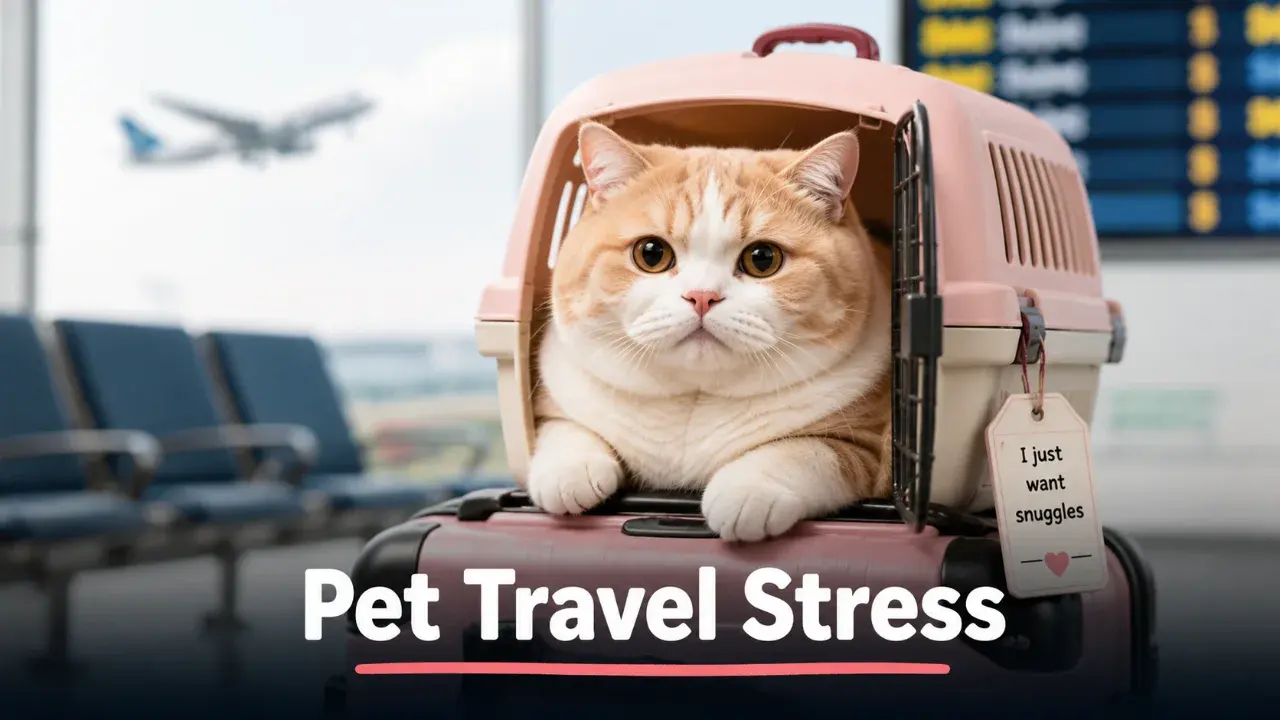
Airports, carriers, unfamiliar handling, and changing travel rules can make a trip difficult long before takeoff. Careful preparation can reduce the pressure, but the right plan depends on the animal, route, and airline.
A pet’s hardest moment may come before the aircraft ever leaves the gate. The stress often starts before takeoff, when familiar surroundings are replaced by a carrier, airport activity, strange sounds, disrupted routines, and—on some trips—separation from the owner.
The International Air Transport Association, or IATA, describes travel as potentially unsettling for animals and recommends minimizing disturbance. Owners face their own pressure: airline restrictions, carrier measurements, health documents, and deadlines that may differ by destination.
Air travel is not automatically harmful to every pet. A 2023 owner-reported study found that most dogs in its sample coped with and recovered from flying reasonably well, while a smaller group experienced physical, mental, or emotional difficulties during or after the trip. The study involved dogs rather than cats, and its authors noted that research on the welfare effects of pet air travel remains limited.
The flight is only one part of the experience
For an animal, an airline trip is a chain of unfamiliar events rather than a single flight. The day may involve a car ride, a busy terminal, waiting in a carrier, security procedures, new handlers, temperature changes, and a long period without the freedom to move normally.
Pets traveling in the passenger cabin generally remain inside a carrier placed under the seat or in another location specified by the airline. IATA guidance says the animal should be able to stand, sit, turn around, and lie naturally inside the container. Dogs and cats should not be removed from it during the flight.
That restriction can be difficult for an animal that has not been introduced gradually to confinement. A carrier that appears roomy in a living room may also feel very different once it is placed under an aircraft seat.
Cargo is not automatically the worst option. IATA notes that the aircraft hold used for animals can offer a quieter, darker environment than the passenger cabin. That does not guarantee comfort or safety for an individual pet, and owners still need to consider the animal’s health, size, temperament, route, and the airline’s procedures.
A carrier is part of the preparation, not just the equipment
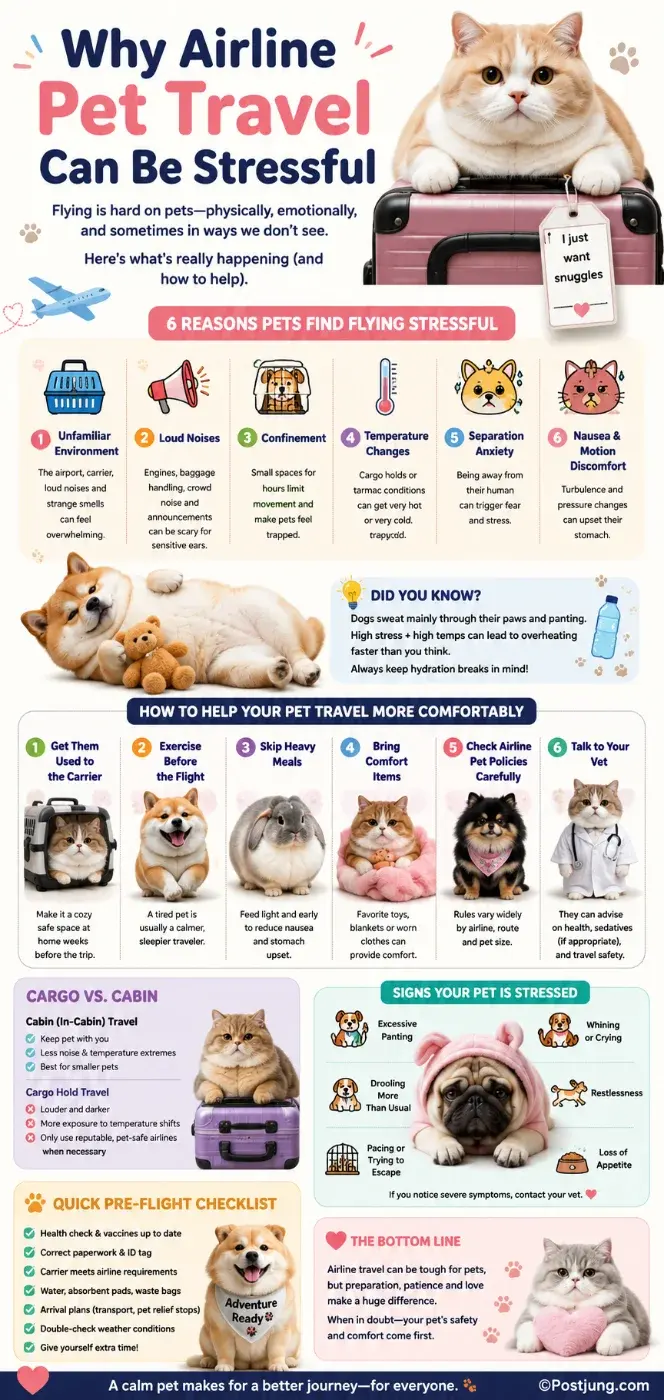
IATA recommends introducing dogs and cats to their travel container well before departure so that confinement itself causes less stress. Short, calm sessions at home can also reveal whether the carrier is too small, poorly ventilated, unstable, or frightening to the animal.
Carrier fit is a safety issue. IATA warns that a soft-sided carrier can compress when pushed under a seat, potentially blocking ventilation openings and allowing heat to build up. It also does not certify or endorse commercial products as “IATA approved,” despite labels that travelers may see in stores or online. The airline ultimately decides whether a particular container meets its requirements.
Owners should confirm the airline’s exact measurements instead of relying only on a product description. The pet should be able to rest naturally without the bag folding inward around its body.
Paperwork can turn a simple trip into a timed process
International pet travel often requires more than a reservation. USDA guidance says destination countries may require microchips, particular vaccinations, laboratory tests, treatments, import permits, or endorsed health certificates. Some documents are valid only within a specific window, and airlines may impose additional conditions of their own.
Rules can change between booking and departure. Travelers need to check the requirements for the destination, any transit country, the return journey, and the airline itself. A valid document for entering one country may not satisfy the rules of an airport used during a connection.
A trip from the United States to Thailand shows how quickly those obligations can accumulate. Current USDA guidance says dogs and cats traveling with a person must be at least four months old and require an import permit, an APHIS-endorsed health certificate, and a copy of the owner’s passport. The same page warns that entry requirements can change without notice.
This administrative pressure affects the travel day. A missed veterinary deadline, incorrect certificate, or carrier rejected at check-in can create a rushed and confusing environment for both the owner and the animal.
Preparation should begin with suitability, not a sedative
Before booking, owners should discuss the trip with a veterinarian who knows the pet’s medical history. IATA guidance says sick, injured, or debilitated animals may not be suitable for air travel, and some airlines place restrictions on particular breeds or categories of animals.
Sedation is not a do-it-yourself solution. IATA advises against routinely sedating or tranquilizing dogs and cats for air travel because the drugs can reduce an animal’s ability to respond to physical stress. An airline may also refuse to transport a sedated animal. When medication is being considered, it should be directed by a veterinarian, and the airline should be informed.
Practical preparation includes acclimating the pet to the carrier, confirming where the animal will travel, checking every airline involved in the itinerary, allowing extra time for health documents, and keeping copies readily available. Food, water, exercise, and medication plans should follow veterinary and airline instructions rather than last-minute internet advice.
A pet that panics during a brief carrier session at home may need additional preparation—or a different travel plan—before attempting a long international flight.
Sometimes the least stressful flight is no flight
For a short vacation, remaining at home with a trusted caregiver may be less disruptive for some pets. A permanent move, family relocation, or other unavoidable situation may make air travel the most practical option.
The decision should not be reduced to whether flying with pets is simply “safe” or “unsafe.” The better question is whether this particular animal, carrier, route, season, and travel plan are suitable.
The goal is a predictable trip, not a perfect one. Familiarizing the pet with its carrier, checking medical suitability, completing documents early, and understanding the airline’s process can remove much of the avoidable stress. The uncertainty that remains should be treated honestly—without dismissing it and without turning every pet flight into a disaster story.
KEY TAKEAWAYS:
- Pet travel stress often begins with confinement, unfamiliar surroundings, and disrupted routines rather than the time spent in the air alone.
- Most dogs in one owner-reported study coped and recovered well, but some experienced meaningful physical or emotional difficulties.
- Introduce the carrier well before travel and confirm its measurements directly with the airline.
- Do not sedate a pet for flying without veterinary direction and confirmation that the airline will accept the animal.
- International entry, transit, health-certificate, and airline requirements should be checked again shortly before departure.
International Air Transport Association, U.S. Department of Agriculture Animal and Plant Health Inspection Service, Animals
REFERENCES:
https://www.iata.org/en/youandiata/travelers/traveling-with-pets/
https://www.aphis.usda.gov/pet-travel/pet-travel-process-overview
https://www.aphis.usda.gov/pet-travel/us-to-another-country-export/pet-travel-us-thailand
https://doi.org/10.3390/ani13193093

เขียนโดย Postjung Insights
 รู้หรือไม่? เปิดรายได้พนักงานส่งพัสดุของแต่ละแอป วันหนึ่งได้เท่าไร
 5 คณะที่เรียนจบมาแล้ว มีอาชีพรองรับมากกว่าที่คิด
 เปิดรายชื่อโรงเรียนในไทยที่ “ว่ายน้ำ” อยู่ในหลักสูตร เรียนจริงตั้งแต่อนุบาลถึงมัธยม
 อำเภอที่มีชื่ออำเภอสั้นที่สุด 3 อำเภอเท่านั้นในประเทศไทย
 ตาราง “เด่นเหนือเด่นใต้” งวด 1 ต.ค. 69 เปิดข้อมูลตามโพย เลขไหนอยู่ตรงไหน
 เลขเด็ดปฏิทิน "หลวงปู่โต๊ะ" งวดวันที่ 1 ตุลาคม 69..ส่องเลย เลขไหนให้โชค!
 โรงเรียนที่มีนักเรียนมากที่สุดในไทย
 Google ยอมรับแล้ว! Gemini AI เข้าถึงระบบบริษัทจริง 3 แห่ง ระหว่างการทดสอบความปลอดภัย
 อุทยานเขาใหญ่เรียกตัว “ตีนผี” หลังขับจี้ช้างป่าพ่อลูก ลั่นระยะ 50 เมตรต้องจำให้ขึ้นใจ
 เปิด 5 โรงเรียนหญิงล้วนเก่าแก่ของไทย ที่มีประวัติยาวนานกว่าศตวรรษ
 สถิติย้อนหลัง 10 ปี ออกเลขไหนบ้างมาดูกัน
 ทำไมของพลาสติกเก่าบางชิ้นถึง “เหนียว” ขึ้นมาเอง ทั้งที่ไม่ได้เปื้อนอะไร?
 😃 ชวนเข้ามาดูกันอีกกับคนที่มีร่างกายพิเศษจนเหมือนมีกล่องสมบัติที่หายาก 😯5 คณะที่เรียนจบมาแล้ว มีอาชีพรองรับมากกว่าที่คิดเปิดรายชื่อโรงเรียนในไทยที่ “ว่ายน้ำ” อยู่ในหลักสูตร เรียนจริงตั้งแต่อนุบาลถึงมัธยมGoogle ยอมรับแล้ว! Gemini AI เข้าถึงระบบบริษัทจริง 3 แห่ง ระหว่างการทดสอบความปลอดภัยเลขเด็ดปฏิทิน "หลวงปู่โต๊ะ" งวดวันที่ 1 ตุลาคม 69..ส่องเลย เลขไหนให้โชค!ทำไมของพลาสติกเก่าบางชิ้นถึง “เหนียว” ขึ้นมาเอง ทั้งที่ไม่ได้เปื้อนอะไร?
 English Edition