Why Cats Shed More in Spring and Fall

Cats shed year-round, but daylight, temperature, coat type, and indoor living can make the fur seem endless during certain months. Here is what is normal — and what may deserve a vet check.
Cats do not shed more just to test your patience. Their coats follow a natural cycle, and seasonal changes can push more dead hair out at once.
For many cats, the biggest shedding periods happen around spring and fall. That is when changing light and temperature help signal the body to adjust the coat for warmer or cooler weather.
Shedding is part of a healthy coat cycle
Every cat loses hair. Even the sleekest short-haired cat is constantly replacing old hairs with new ones.
Veterinary sources describe shedding as part of the hair-growth cycle. Hair grows, rests, and eventually falls out so new hair can take its place. The American Animal Hospital Association describes this cycle through growth, transition, and resting phases before hair is shed.
That means normal shedding is not the same as hair loss. Loose fur on your sofa, clothes, or brush can be annoying, but it is often just your cat’s coat renewing itself.
Seasonal shedding becomes more noticeable when a large amount of undercoat loosens at once. VCA Animal Hospitals notes that cats in cooler climates, especially those that spend time outdoors, may have two heavier seasonal shedding cycles each year, often in late spring and late fall.
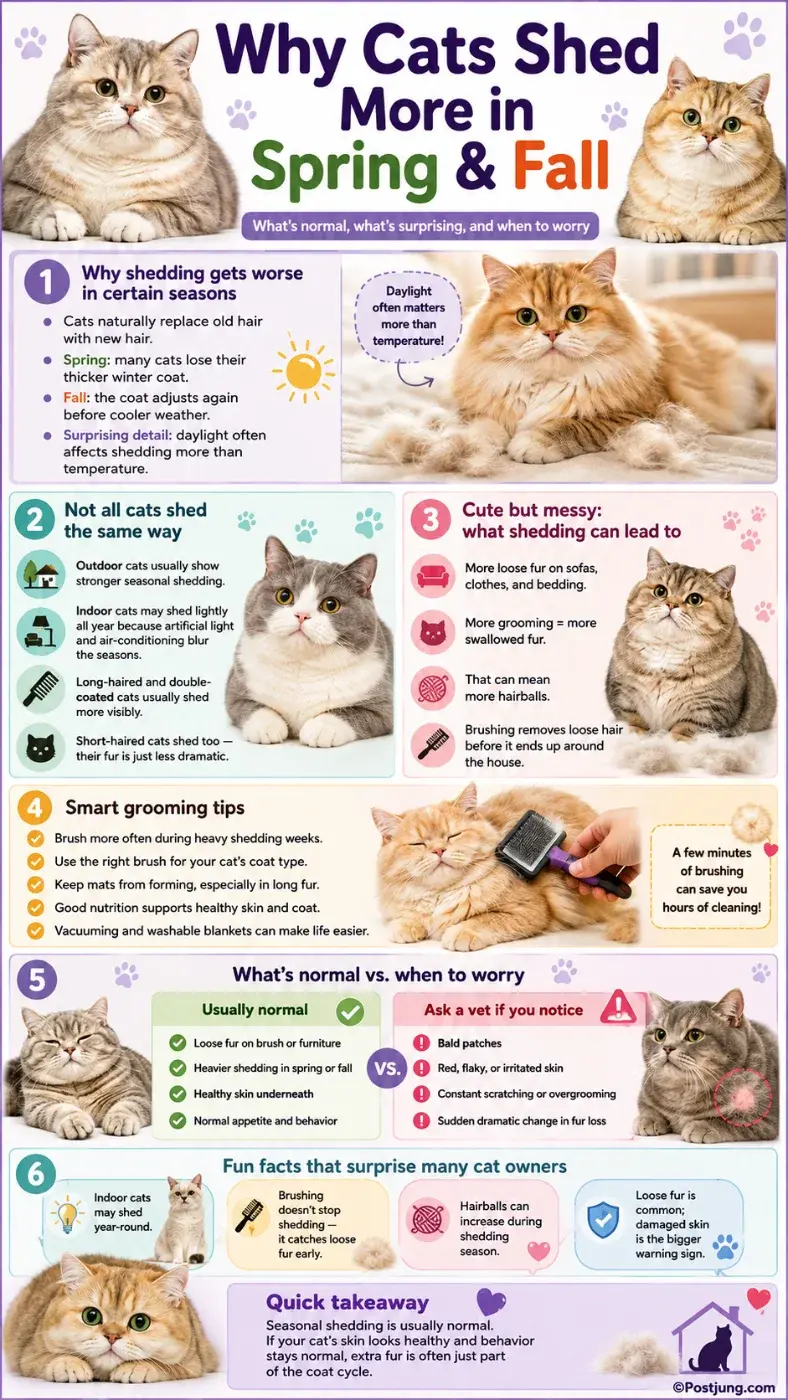
Why spring can feel like the worst season
Spring shedding often seems dramatic because many cats are letting go of a heavier cold-weather coat.
The winter coat helps trap air and conserve warmth. As the weather shifts, cats may shed that thicker layer and grow a lighter coat better suited to warmer months. The MSD Veterinary Manual notes that the cold-weather coat is often longer and finer, while the warm-weather coat has shorter, thicker hairs and fewer secondary hairs.
This is why a cat that looked only mildly fluffy in January may suddenly cover your blanket in fur by April.
Fall can bring another round of shedding as the coat changes again. The pattern is not identical for every cat, but the general idea is simple: the coat is adjusting before the season fully changes.
Indoor cats can shed on a different schedule
If your cat lives indoors, the calendar may not explain everything.
Indoor cats are exposed to artificial lighting, air conditioning, heating, and steady room temperatures. That can soften the seasonal signal that outdoor animals experience. Cats Protection notes that indoor cats may shed more consistently year-round because they are less exposed to natural light cycles and seasonal temperature changes.
VCA Animal Hospitals makes a similar point: cats that share our homes often shed their undercoat and guard hairs at low levels throughout the year.
So if your indoor cat seems to shed in every month, that does not automatically mean something is wrong. It may simply mean your home has created a permanent mild-weather environment.
For cat owners in tropical or warm climates, the seasonal pattern may also feel less obvious than it does in places with cold winters. The trigger is not only heat. Light exposure, breed, coat density, health, and grooming all matter.
Coat type makes a big difference
Some cats are simply built to shed more visibly.
Long-haired and thick-coated cats can leave behind large clumps of fur, especially when the undercoat loosens. VCA notes that breeds and coat types vary widely, from low-shedding cats to heavy shedders such as Maine Coons.
Short-haired cats shed too. Their fur may just be harder to see until it sticks to dark clothing, bedding, or the corner of the couch.
A cat’s grooming habits can also change what you notice. Cats remove loose hair when they lick their coats, and some of that hair is swallowed. Cats Protection notes that grooming can speed the shedding process by helping remove old hairs that are still clinging to the coat.
That is one reason brushing helps. You are not stopping shedding. You are catching loose fur before it spreads around the house or becomes part of a hairball problem.
What owners can do at home
The simplest tool is regular brushing.
VCA recommends regular brushing to remove loose hairs and dead skin cells, distribute natural skin oils, and help keep the coat free of debris and parasites. Long-haired, silky, or curly coats may need daily brushing, while short-haired cats may need less frequent brushing.
During heavy shedding weeks, brushing more often can make a big difference. Use a brush or comb that matches your cat’s coat type, and avoid forcing through mats. A tight mat can pull painfully on the skin.
Nutrition matters too. The MSD Veterinary Manual notes that hair growth and coat health are affected by nutrition, hormones, disease, drugs, and environment.
A dull, brittle, greasy, or patchy coat should not be dismissed as “just shedding,” especially if it appears suddenly.
When shedding may not be normal
Most shedding is harmless. The warning signs are about pattern, skin, and behavior.
The MSD Veterinary Manual says shedding may be abnormal if it leads to obvious coat loss or bald spots, while shedding without bald patches or symmetric hair loss is more likely part of natural coat replacement.
AAHA advises owners to contact a veterinarian if they notice bald spots, patchy hair loss, red or crusted skin, or a sudden dramatic increase in shedding. Possible causes can include stress, poor nutrition, skin infections, parasites, allergies, hormonal disorders, systemic disease, immune conditions, or cancer.
Cats Protection also flags bald patches, thinning fur, red or flaky skin, excessive grooming, and scratching as reasons to speak with a vet.
The helpful rule is this: loose fur is usually normal, damaged skin is not.
A cat that sheds heavily but has a shiny coat, normal skin, normal appetite, and normal behavior may simply be going through a seasonal coat change. A cat that is itchy, overgrooming, losing fur in patches, or developing irritated skin needs closer attention.
The takeaway for cat owners
Seasonal shedding is messy, but it is not a mystery.
Cats shed because their coats are alive, responsive, and constantly renewing. Spring and fall can make that process more visible, especially in cats with thick coats or outdoor exposure. Indoor cats may spread the same process across the whole year.
The best response is calm and practical: brush more during heavy shedding periods, watch the skin underneath the fur, and learn what is normal for your own cat.
A little extra fur on the sofa may be seasonal. A sudden change in the coat, skin, or behavior is worth a veterinary conversation.
KEY TAKEAWAYS:
- Cats shed year-round, but spring and fall can bring heavier shedding.
- Daylight, temperature, coat type, and indoor living all influence shedding patterns.
- Indoor cats may shed more consistently because artificial light and stable temperatures blur seasonal signals.
- Regular brushing helps manage loose fur, dander, mats, and hairballs.
- Bald patches, irritated skin, excessive scratching, or sudden dramatic shedding should be checked by a veterinarian.
MSD Veterinary Manual, VCA Animal Hospitals, American Animal Hospital Association, Cats Protection
REFERENCES:
https://www.msdvetmanual.com/cat-owners/skin-disorders-of-cats/structure-of-the-skin-in-cats
https://vcahospitals.com/know-your-pet/grooming-and-coat-care-for-your-cat
https://www.aaha.org/resources/pets-and-shedding/
https://www.cats.org.uk/cats-blog/why-do-cats-shed-their-fur

เขียนโดย Postjung Insights
 รู้หรือไม่? เปิดรายได้พนักงานส่งพัสดุของแต่ละแอป วันหนึ่งได้เท่าไร
 5 คณะที่เรียนจบมาแล้ว มีอาชีพรองรับมากกว่าที่คิด
 Google ยอมรับแล้ว! Gemini AI เข้าถึงระบบบริษัทจริง 3 แห่ง ระหว่างการทดสอบความปลอดภัย
 โรงเรียนที่มีนักเรียนมากที่สุดในไทย
 เปิดรายชื่อโรงเรียนในไทยที่ “ว่ายน้ำ” อยู่ในหลักสูตร เรียนจริงตั้งแต่อนุบาลถึงมัธยม
 อำเภอที่มีชื่ออำเภอสั้นที่สุด 3 อำเภอเท่านั้นในประเทศไทย
 สถิติย้อนหลัง 10 ปี ออกเลขไหนบ้างมาดูกัน
 ตาราง “เด่นเหนือเด่นใต้” งวด 1 ต.ค. 69 เปิดข้อมูลตามโพย เลขไหนอยู่ตรงไหน
 จุฬาฯ มหาวิทยาลัยแห่งแรกของไทย มีจุดเริ่มต้นในสมัยรัชกาลที่ 5
 เลขเด็ดปฏิทิน "หลวงปู่โต๊ะ" งวดวันที่ 1 ตุลาคม 69..ส่องเลย เลขไหนให้โชค!
 แปลปกสลาก งวด 1 ต.ค. 69 ส่องตัวเลขจากภาพปกสลากกินแบ่งรัฐบาล
 ทำไมของพลาสติกเก่าบางชิ้นถึง “เหนียว” ขึ้นมาเอง ทั้งที่ไม่ได้เปื้อนอะไร?5 คณะที่เรียนจบมาแล้ว มีอาชีพรองรับมากกว่าที่คิดเปิดรายชื่อโรงเรียนในไทยที่ “ว่ายน้ำ” อยู่ในหลักสูตร เรียนจริงตั้งแต่อนุบาลถึงมัธยมGoogle ยอมรับแล้ว! Gemini AI เข้าถึงระบบบริษัทจริง 3 แห่ง ระหว่างการทดสอบความปลอดภัยเลขเด็ดปฏิทิน "หลวงปู่โต๊ะ" งวดวันที่ 1 ตุลาคม 69..ส่องเลย เลขไหนให้โชค!ทำไมของพลาสติกเก่าบางชิ้นถึง “เหนียว” ขึ้นมาเอง ทั้งที่ไม่ได้เปื้อนอะไร?
 อุทยานเขาใหญ่เรียกตัว “ตีนผี” หลังขับจี้ช้างป่าพ่อลูก ลั่นระยะ 50 เมตรต้องจำให้ขึ้นใจ
 English Edition