Why Dogs Sleep Belly Up—and What It Really Means
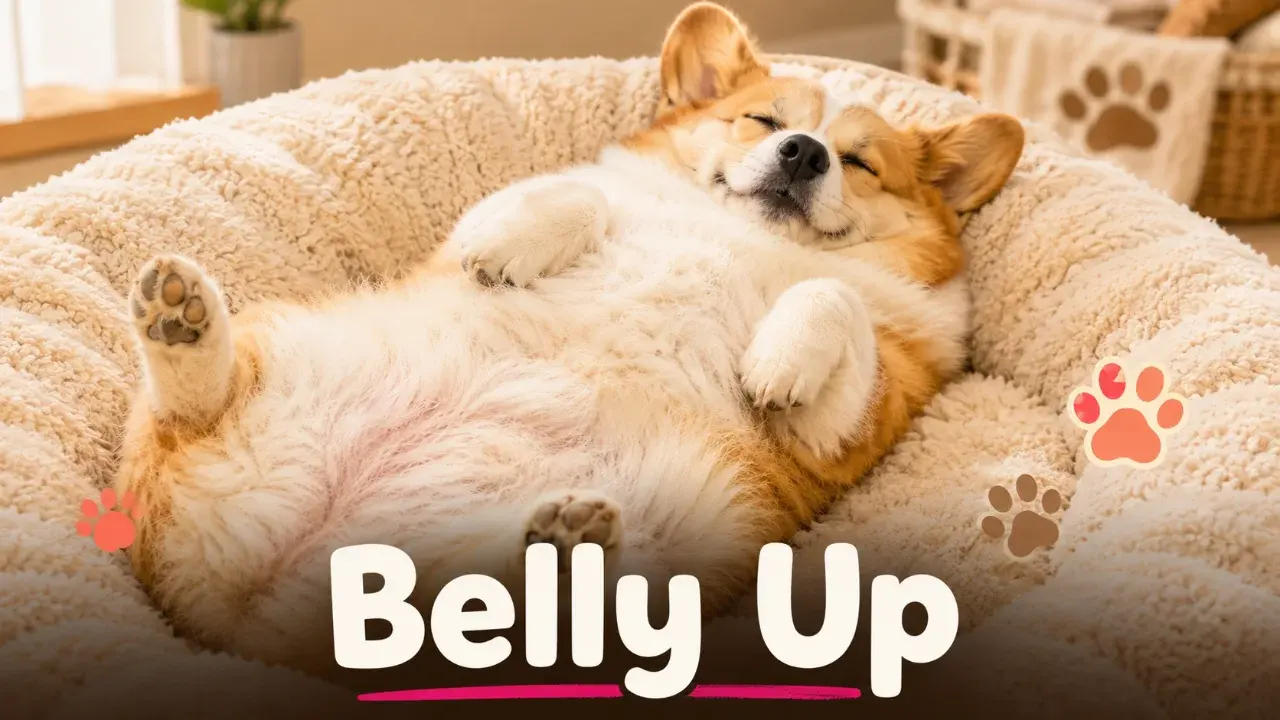
A dog sleeping on their back may look silly, but the position can say something about comfort, body temperature, and how safe they feel at home.
A dog sleeping belly up can look ridiculous in the best possible way: paws loose, belly exposed, sometimes with a face that suggests they have never known stress in their life.
For many dogs, that upside-down pose is exactly what it appears to be: a sign of comfort and relaxation. But it can also help them cool down, stretch out, or simply sleep in the position that feels best in the moment.
Veterinary and pet health sources generally agree on one important point: a single sleep position should not be treated like a full emotional report. It can offer clues, but your dog’s overall behavior matters more.
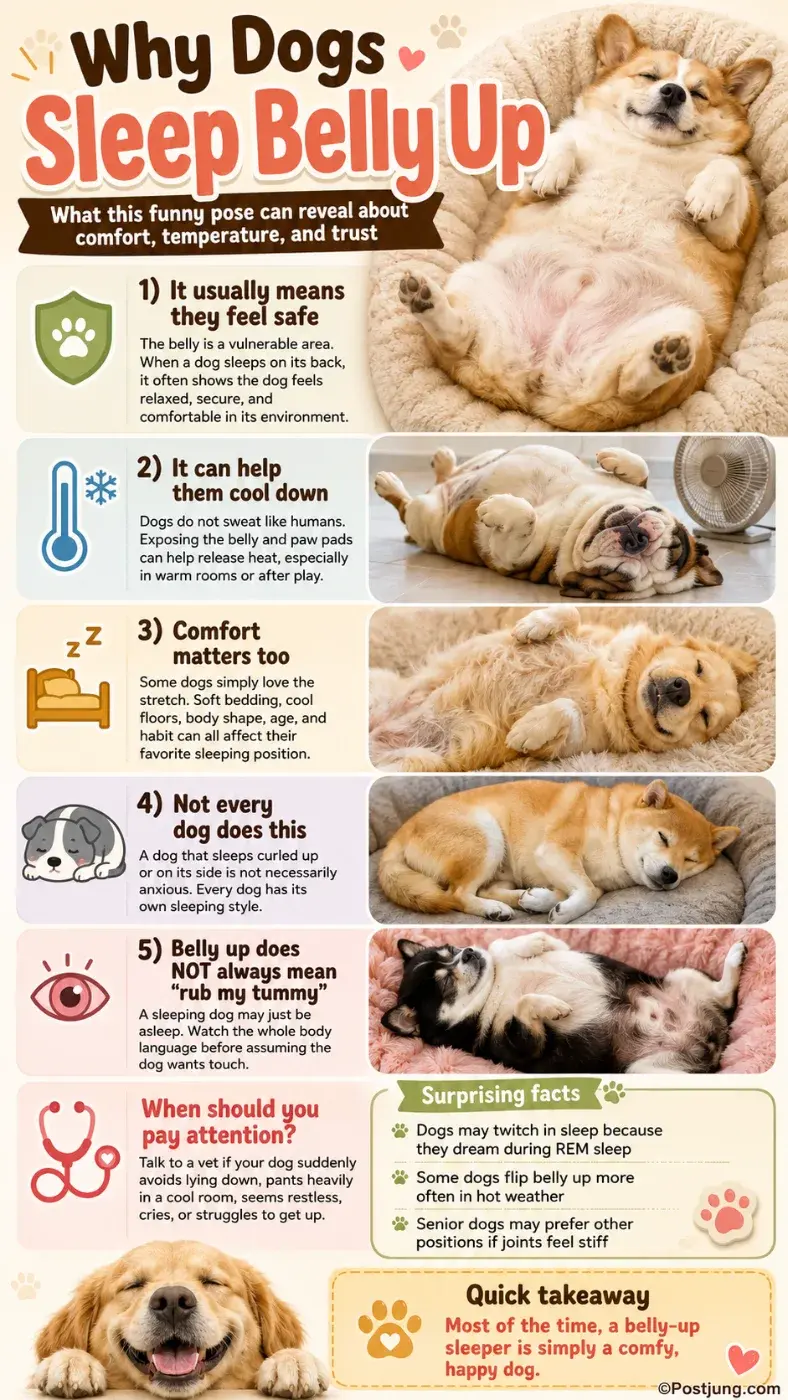
The belly is a vulnerable place
When a dog sleeps on their back, they expose the soft underside of the body. That includes the belly and chest—areas animals often protect when they feel uncertain or unsafe.
That is why many people read belly-up sleeping as a sign of trust. A dog in that position is not ready to jump up quickly or defend themselves. They are letting their guard down, at least for that nap.
The American Kennel Club notes that dogs lying on their backs can signal that they feel relaxed and mentally comfortable in the household. VCA Animal Hospitals also describes “feet in the air” sleeping as a position linked to cooling down and letting off steam.
Still, it is better to think of this as one clue, not a guarantee. Some very trusting dogs never sleep belly up. Others may do it only on certain beds, during warm weather, or when they are deeply tired.
It can also help dogs cool off
The belly-up pose is not only emotional. It can be practical.
Dogs do not cool themselves the same way humans do. The Merck Veterinary Manual explains that dogs and cats primarily regulate body temperature through panting, while limited sweating may occur and plays only a minor role. Sweat glands are found on the footpads, not spread across the body like in humans.
That matters because a dog lying on their back exposes areas with less fur, including the belly, while lifting the paws into the air. In warm indoor conditions, that may help air move around the body more easily.
A 2025 review in Frontiers in Animal Science also describes panting as the dominant cooling mechanism as temperature rises, with some heat loss through areas such as paw pads, armpit regions, and the groin.
So when your dog flips over on a hot afternoon, they may not be making a grand statement about love. They may simply be saying, in dog language, “this feels cooler.”
Comfort is still the simplest answer
Dogs, like people, have sleep preferences.
Some curl into a tight donut. Some sprawl on their side. Some wedge themselves into the most inconvenient part of the couch. Some sleep belly up because it feels good.
PetMD notes that dogs usually do not choose uncomfortable sleeping positions, though older dogs may shift away from belly-up sleeping if it puts pressure on the spine or joints.
That is a useful reminder for owners. If your dog has always slept upside down, there is usually no reason to worry. If your dog never sleeps that way, that also does not mean they are unhappy, anxious, or emotionally distant.
Breed, body shape, temperature, age, flooring, bedding, and habit can all affect how a dog sleeps.
Flat-faced breeds, senior dogs, dogs with joint pain, and dogs recovering from injury may prefer other positions. A dog may also choose cool tile over a soft bed when the room is warm.
Do not assume belly-up means “rub my stomach”
This is where many humans get it wrong.
A dog exposing their belly while awake can sometimes invite touch, but not always. In some situations, rolling over can also be a submissive or appeasing gesture. A sleeping dog belly up is even simpler: they may just be asleep.
The safest approach is to look at the whole dog. Loose body, soft face, relaxed mouth, and slow breathing usually suggest comfort. Stiffness, tucked tail, whale eye, lip licking, or sudden freezing can suggest the dog is not enjoying the interaction.
If your dog is asleep belly up, let them rest. If they wake up and lean into a gentle scratch, that is different. But the pose itself is not automatic permission.
When a sleep position may be worth watching
Most belly-up sleeping is normal. In fact, it is often one of the cutest signs that a dog feels at home.
But changes in sleep behavior can matter.
If a dog suddenly avoids a favorite position, seems restless at night, pants heavily in a cool room, whines when lying down, struggles to get up, or changes appetite or energy level, it may be worth checking with a veterinarian.
The concern is not the belly-up pose itself. The concern is a pattern that looks different for your dog.
Owners should also take heat seriously. If a dog is panting hard, drooling heavily, weak, confused, vomiting, or unable to settle after heat exposure, that can be urgent. Cooling behavior should not be mistaken for safety if the dog is actually overheating.
The sweetest meaning is usually the simplest one
A belly-up dog is not always sending a deep message. Sometimes they are warm. Sometimes they are stretching. Sometimes they are deeply relaxed. Sometimes they are just strange in the very specific way dogs are allowed to be strange.
But in many homes, that upside-down nap does say something lovely.
A dog who sleeps with their belly exposed is often comfortable enough to be unguarded. They have found a place where they can rest without staying ready for trouble.
That may not need overthinking. It may simply mean your dog feels safe enough to sleep like a goofball.
KEY TAKEAWAYS:
- Belly-up sleeping often suggests a dog feels relaxed, safe, and comfortable.
- Dogs may also sleep this way to cool down because the belly and paws can release heat.
- Not every dog sleeps belly up, and that does not automatically signal a problem.
- A sudden change in sleep habits, discomfort, heavy panting, or restlessness may be worth discussing with a veterinarian.
- A sleeping dog exposing their belly is not always asking for a belly rub.
American Kennel Club, VCA Animal Hospitals, Merck Veterinary Manual, Frontiers in Animal Science, PetMD
REFERENCES:
https://www.akc.org/expert-advice/health/why-does-my-dog-sleep-on-his-back/
https://vcahospitals.com/resources/behavior-dog/decode-your-pet-s-sleeping-positions
https://www.merckvetmanual.com/integumentary-system/integumentary-system-introduction/the-integumentary-system-in-animals
https://www.frontiersin.org/journals/animal-science/articles/10.3389/fanim.2025.1679377/full

เขียนโดย Postjung Insights
 รู้หรือไม่? เปิดรายได้พนักงานส่งพัสดุของแต่ละแอป วันหนึ่งได้เท่าไร
 ถ้าไม่กลัวเหนื่อย 7 อาชีพที่ตลาดยังต้องการ และค่าทักษะไปถึง 800 บาท/วัน
 เปิด 5 โรงเรียนหญิงล้วนเก่าแก่ของไทย ที่มีประวัติยาวนานกว่าศตวรรษ
 อำเภอที่มีชื่ออำเภอสั้นที่สุด 3 อำเภอเท่านั้นในประเทศไทย
 โรงเรียนที่มีนักเรียนมากที่สุดในไทย
 ตาราง “เด่นเหนือเด่นใต้” งวด 1 ต.ค. 69 เปิดข้อมูลตามโพย เลขไหนอยู่ตรงไหน
 ฝูงลิงญี่ปุ่นนับสิบรุมล้อมและโจมตีชายคนหนึ่งในคานากาวะ
 หัวลูกศรหินย้อนเวลา 80,000 ปี ในเอเชียกลาง… หลักฐานใหม่ชี้ โฮโม เซเปียนส์ อาจเคยบุกยุโรปเร็วขึ้นนับหมื่นปี!
 อินฟลูเอนเซอร์สาวผู้สร้างคอนเทนต์สำหรับผู้ใหญ่และมีรายได้ต่อปีกว่า 33 ล้านบาท ตัดสินใจเปลี่ยนอาชีพมาเป็นแพทย์แทน
 ยูเครนขอจัดการประชุมสุดยอดกับญี่ปุ่น
 ส่องเลข 3 สำนักพิมพ์ งวด 1 ต.ค. 69 ตัวไหนมีข้อมูลตรงกัน
 แปลปกสลาก งวด 1 ต.ค. 69 ส่องตัวเลขจากภาพปกสลากกินแบ่งรัฐบาลเปิด 5 โรงเรียนหญิงล้วนเก่าแก่ของไทย ที่มีประวัติยาวนานกว่าศตวรรษหัวลูกศรหินย้อนเวลา 80,000 ปี ในเอเชียกลาง… หลักฐานใหม่ชี้ โฮโม เซเปียนส์ อาจเคยบุกยุโรปเร็วขึ้นนับหมื่นปี!ถ้าไม่กลัวเหนื่อย 7 อาชีพที่ตลาดยังต้องการ และค่าทักษะไปถึง 800 บาท/วัน
 ทำไมแผนที่ส่วนใหญ่เอาทิศเหนือไว้ด้านบน ทั้งที่โลกไม่มี “ด้านบน” จริง ๆ?
 English Edition