Why Cats Knock Things Off Tables, Explained Without the Drama
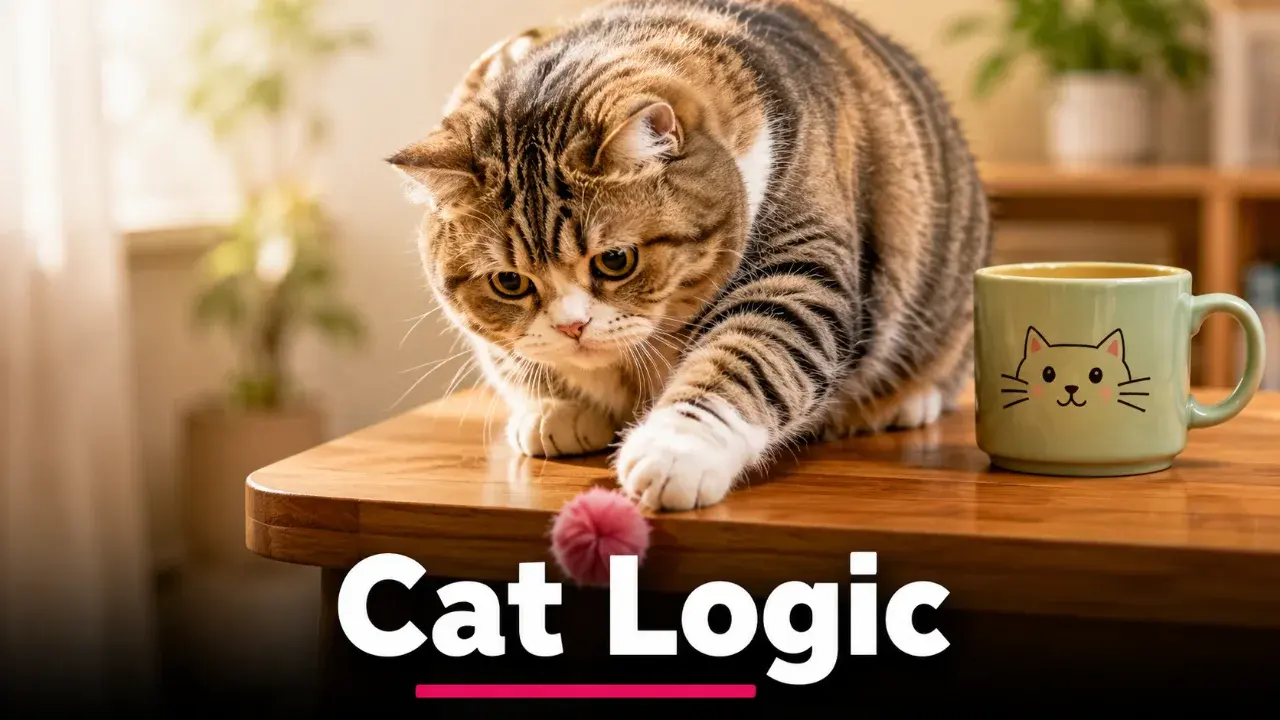
That dramatic paw swipe is usually not revenge. It is more often a mix of hunting instinct, curiosity, boredom, and one very simple lesson: humans react.
A cat staring at a glass before slowly pushing it off the table can look almost theatrical. But the behavior is usually less about mischief and more about how cats explore the world, use their paws, and learn what gets a reaction.
Veterinary behavior sources commonly point to three big reasons cats knock things over: instinct, boredom, and learned attention-seeking. PetMD summarizes the pattern this way: cats may bat objects because of predatory instinct, because they are under-stimulated, or because people have accidentally rewarded the behavior by reacting every time something hits the floor.
Your Cat Is Testing the World With Its Paws
Cats are natural hunters. Even indoor cats that have never had to catch dinner still carry the same basic play sequence: notice, stalk, paw, chase, pounce, capture.
That is why a pen, lip balm, keychain, or small bottle cap can become strangely interesting. It moves. It rolls. It makes a sound. It disappears over an edge.
To a cat, that object may not be “trash on a table.” It may be a tiny physics experiment with paws.
VCA Animal Hospitals notes that cats naturally stalk, chase, pounce on, and capture things that move, and that many cats enjoy toys they can hunt, attack, and carry. A tabletop object is not a proper toy, but it can accidentally behave like one.
Sometimes the Floor Drop Is the Reward
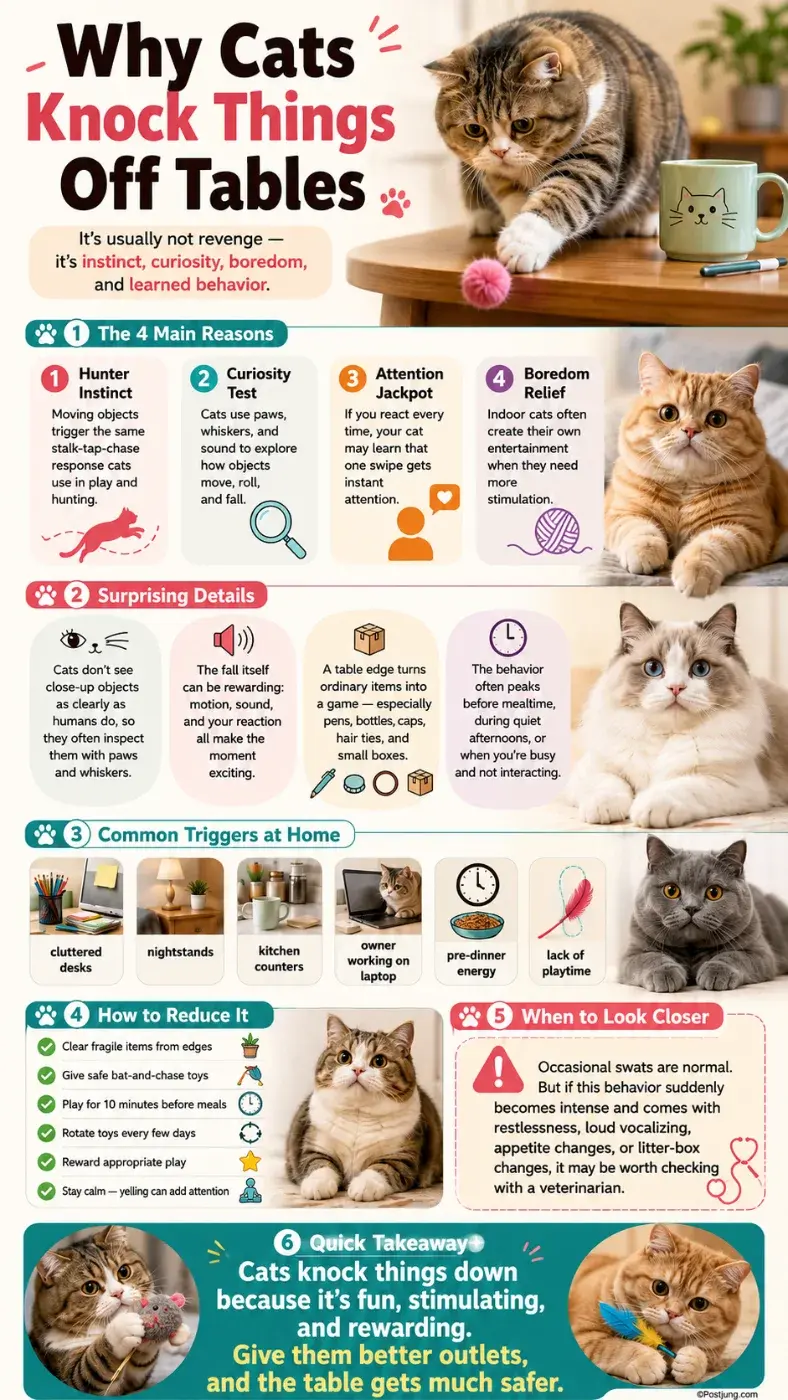
The second reason is simple: cats learn fast.
A cat bats a water glass. You jump up, say its name, rush over, pick up the glass, clean the mess, and maybe even scoop the cat away. From your point of view, you are stopping the behavior. From the cat’s point of view, the room just became much more interesting.
That does not mean your cat is plotting revenge. It means your cat may have learned that one little push makes people move.
PetMD notes that owners may unintentionally reinforce the behavior by talking to, picking up, or otherwise responding to the cat when it starts pushing objects toward the edge. Even a frustrated reaction can still be attention.
Boredom Makes Tables More Interesting
For indoor cats, a table can become an activity center if the rest of the home is too predictable. A cat with too little stimulation may create its own entertainment, and your desk supplies may become the day’s main event.
This is especially common when a cat is awake during a quiet part of the day, hungry before mealtime, or trying to start interaction with a human who is busy.
Cornell Feline Health Center says toys can encourage exercise and cognitive enrichment by letting cats stalk, pounce, and problem-solve, and that rotating toys can help prevent boredom. That matters because a bored cat is not trying to be “bad.” It is trying to do something.
The Best Fix Is Not Yelling
Scolding often gives the behavior more drama, and drama can become part of the reward. Physical punishment is also a bad idea because it can create fear, avoidance, or aggression.
A better approach is to change the setup.
Put fragile, dangerous, or spillable items away. Give the cat legal things to bat, chase, and knock around. Then make those things more rewarding than your coffee mug.
Cat Friendly Homes, created by the feline veterinary community, recommends toys that mimic prey, routine toy rotation, food puzzles, cat trees, perches, and other enrichment items that let cats play and explore when people are not home.
In practical terms, try this:
Move breakables off edges.
Offer a few small rolling toys.
Use wand play before the cat’s usual trouble time.
Rotate toys so they feel new.
Reward the cat when it plays with appropriate objects.
Stay calm when something harmless gets pushed.
The goal is not to remove the cat’s instinct. The goal is redirecting the instinct somewhere safer.
Give the Hunt a Better Ending
One detail many owners miss: cats often enjoy play more when they get to “catch” the toy. Endless laser-pointer sessions or toys that never let the cat win can leave some cats frustrated.
VCA recommends predatory games with toys a cat can eventually catch, such as toy mice or balls of paper, and notes that adult cats still benefit from regular play.
A short play session before dinner can work especially well because it fits the natural rhythm: hunt, catch, eat, groom, rest.
That rhythm may sound small, but for an indoor cat, it can make the home feel more complete.
When Knocking Things Over May Signal a Bigger Issue
Most table-sweeping is normal cat behavior. But sudden changes deserve attention.
If a cat that never did this before suddenly becomes destructive, restless, unusually vocal, aggressive, or withdrawn, it may be worth checking for stress, environmental changes, pain, hunger patterns, or medical issues.
The behavior itself is usually not an emergency. The pattern around it is what matters.
A cat knocking over one pen while watching you cook is probably being a cat. A cat suddenly knocking things down all night, acting distressed, or changing appetite or litter box habits should be observed more carefully and discussed with a veterinarian if it continues.
The Real Answer Is More Charming Than Revenge
Cats knock things off tables because objects move, people react, and indoor life can get boring. It is partly instinct, partly curiosity, partly learned behavior, and sometimes partly a request for more stimulation.
That slow paw swipe may feel personal when your favorite mug is involved. But to the cat, it is usually not a message of chaos.
It is a small hunt, a small experiment, and sometimes a very successful way to say: “Pay attention to me.”
KEY TAKEAWAYS:
- Cats usually knock things off tables because of instinct, curiosity, boredom, or learned attention-seeking.
- The behavior is rarely “revenge” or true spite.
- Reacting dramatically can accidentally reward the habit.
- More play, toy rotation, puzzle feeding, and safer surfaces can reduce the problem.
- Sudden or extreme behavior changes should be watched and discussed with a veterinarian if they continue.
PetMD, Cornell Feline Health Center, VCA Animal Hospitals, Cat Friendly Homes
REFERENCES:
https://www.petmd.com/cat/behavior/why-do-cats-knock-things-over
https://www.vet.cornell.edu/departments-centers-and-institutes/cornell-feline-health-center/health-information/feline-health-topics/safe-toys-and-gifts
https://vcahospitals.com/know-your-pet/cat-behavior-and-training---play-and-play-toys
https://catfriendly.com/be-a-cat-friendly-caregiver/playing-with-your-cat/

เขียนโดย Postjung Insights
 รู้หรือไม่? เปิดรายได้พนักงานส่งพัสดุของแต่ละแอป วันหนึ่งได้เท่าไร
 เปิดรายชื่อโรงเรียนในไทยที่ “ว่ายน้ำ” อยู่ในหลักสูตร เรียนจริงตั้งแต่อนุบาลถึงมัธยม
 เลขเด็ดปฏิทิน "หลวงปู่โต๊ะ" งวดวันที่ 1 ตุลาคม 69..ส่องเลย เลขไหนให้โชค!
 Google ยอมรับแล้ว! Gemini AI เข้าถึงระบบบริษัทจริง 3 แห่ง ระหว่างการทดสอบความปลอดภัย
 อำเภอที่มีชื่ออำเภอสั้นที่สุด 3 อำเภอเท่านั้นในประเทศไทย
 เปิด 5 โรงเรียนหญิงล้วนเก่าแก่ของไทย ที่มีประวัติยาวนานกว่าศตวรรษ
 5 คณะที่เรียนจบมาแล้ว มีอาชีพรองรับมากกว่าที่คิด
 ส่องเลข 3 สำนักพิมพ์ งวด 1 ต.ค. 69 ตัวไหนมีข้อมูลตรงกัน
 โรงเรียนที่มีนักเรียนมากที่สุดในไทย
 จุฬาฯ มหาวิทยาลัยแห่งแรกของไทย มีจุดเริ่มต้นในสมัยรัชกาลที่ 5
 สถิติย้อนหลัง 10 ปี ออกเลขไหนบ้างมาดูกัน
 ตาราง “เด่นเหนือเด่นใต้” งวด 1 ต.ค. 69 เปิดข้อมูลตามโพย เลขไหนอยู่ตรงไหน
 😃 ชวนเข้ามาดูกันอีกกับคนที่มีร่างกายพิเศษจนเหมือนมีกล่องสมบัติที่หายาก 😯5 คณะที่เรียนจบมาแล้ว มีอาชีพรองรับมากกว่าที่คิดเปิดรายชื่อโรงเรียนในไทยที่ “ว่ายน้ำ” อยู่ในหลักสูตร เรียนจริงตั้งแต่อนุบาลถึงมัธยมGoogle ยอมรับแล้ว! Gemini AI เข้าถึงระบบบริษัทจริง 3 แห่ง ระหว่างการทดสอบความปลอดภัยเลขเด็ดปฏิทิน "หลวงปู่โต๊ะ" งวดวันที่ 1 ตุลาคม 69..ส่องเลย เลขไหนให้โชค!
 ทำไมของพลาสติกเก่าบางชิ้นถึง “เหนียว” ขึ้นมาเอง ทั้งที่ไม่ได้เปื้อนอะไร?
 English Edition